Distributors are operating in an increasingly unforgiving environment. Since 2022, average distributor EBITDA margins have declined from 8.7 percent to about 8.0 percent1—a drop representing almost a tenth of industry profits. Persistent margin headwinds have been created by geopolitical events, including changing tariffs, conflicts, supply shocks, and logistical interruptions. And heightened private equity activity and large-scale strategic acquisitions have seen consolidation accelerate dramatically: Annual M&A deal value has increased from a 2021–24 average of approximately $55 billion to around $100 billion in 2025.2
Together, these forces of margin compression and consolidation are reshaping the competitive landscape. With scale alone no longer enough to protect profitability, distributors are looking inward for durable sources of advantage, from operating models to commercial discipline and cost structure. But one lever stands out for its ability to deliver outsize impact: category management.
Research across the industrial, food service, and specialty distribution sectors shows distributors consistently outperform their peers when they move beyond traditional buying and vendor management toward a more strategic, analytics-led category management approach. Indeed, leading players are achieving average gross margin improvements of three to five percentage points—while simultaneously building capabilities that sustain performance over time.
The financial implications are likely to be significant. Distribution is a fixed-cost business: Once infrastructure, labor, and logistics are in place, incremental margin flows largely to the bottom line. As a result, a single percentage-point increase in gross margin can translate into a roughly 12 percent uplift in profit margin,3 which helps distributors offset the margin erosion seen across the industry in recent years.
While category management has long been one of the most reliable and scalable sources of value creation, what’s new is how category management is executed. AI is fundamentally reshaping the discipline—compressing analysis cycles, improving decision quality, and enabling a level of precision that was previously impractical at scale. For distributors with established category management capabilities, AI represents the next frontier of performance. For those earlier in their journey facing an environment in which organic growth is increasingly difficult, it offers an opportunity to leapfrog traditional limitations altogether.
Realizing AI’s promise: Five ways to rewire the category management domain
AI is emerging as a powerful enabler of productivity and insight in distribution, with the potential to transform tasks traditionally done manually. Now and in the near future, tasks may be done with AI assistance. Later, agents might execute tasks independently with occasional human checks. Eventually, there is the potential for agentic category management operating systems to take shape. All may not only reduce manual effort but accelerate the pace of analysis and open new ways to manage portfolio spend across thousands or even millions of SKUs. Analyses that once took weeks can be completed in days or even hours, enabling category teams to act more quickly and with greater precision. These technologies can be deployed across the full category management life cycle, with distribution leaders consistently identifying five use cases that deliver particularly high impact.
Faster speed to insight and real-time visibility
For years, distributors have tried to keep pace with supplier pricing through periodic reviews, spreadsheets, and point-in-time analyses, often weeks or months after cost changes have already flowed through. AI-enabled analytics could change that equation. These tools can provide category teams with near-real-time visibility into supplier behavior, pricing actions, and underlying cost drivers, allowing them to respond as markets move rather than after the fact.
Advanced models can connect directly to commodity and input-cost indexes, continuously monitoring cost movements and automatically flagging supplier price increases that are not supported by fundamentals. This means that instead of chasing data across systems, category managers can see cost performance at any level by category, supplier, or individual SKU. With the right training, the same models may also surface missed rebates, incentives, and other lapses in contract compliance that could otherwise remain buried (opportunities agents may eventually automatically act on).
During diligence on a potential acquisition, for example, one distributor deployed an AI-based indexing tool to stress-test the target’s pricing discipline. Within days, the tool isolated several commodity-exposed categories, mapped the target’s highest-volume SKUs to thousands of relevant indexes, and identified price increases that had not been reversed after temporary commodity spikes subsided. The analysis, which once would have required weeks of manual analysis, revealed millions of dollars in potential procurement synergies, exposed gaps in the target’s category management maturity, and produced a prioritized list of renegotiation opportunities if the transaction moved forward.
The same capabilities extend beyond M&A. AI-enabled index tracking now supports modern parametric clean-sheeting, even for complex SKUs, giving category managers a credible, data-backed view of “should cost” as a basis for improving the quality and outcomes of supplier discussions.
Data cleansing, enrichment, and faster synergy identification
Poor data availability has long been a major barrier to effective category management. Fragmented systems, inconsistent naming conventions, and incomplete product attributes often make it difficult to understand true spend, performance, and opportunity. AI-powered data cleansing, scraping, and enrichment tools have the potential to remove that constraint, helping distributors standardize supplier and product data, reconcile inconsistencies, and create a single, usable view of spend and performance at scale.
One distributor struggling to document its full product catalog—a top priority for customers shopping online (exhibit)—used generative AI to consolidate data from multiple internal systems and to scrape external websites for references to its SKUs. Within weeks, it had created enriched product descriptions and attributes that previously would have taken months to assemble. The improved online catalog increased search visibility, boosted conversion rates, and unlocked a new wave of cross-selling opportunities.
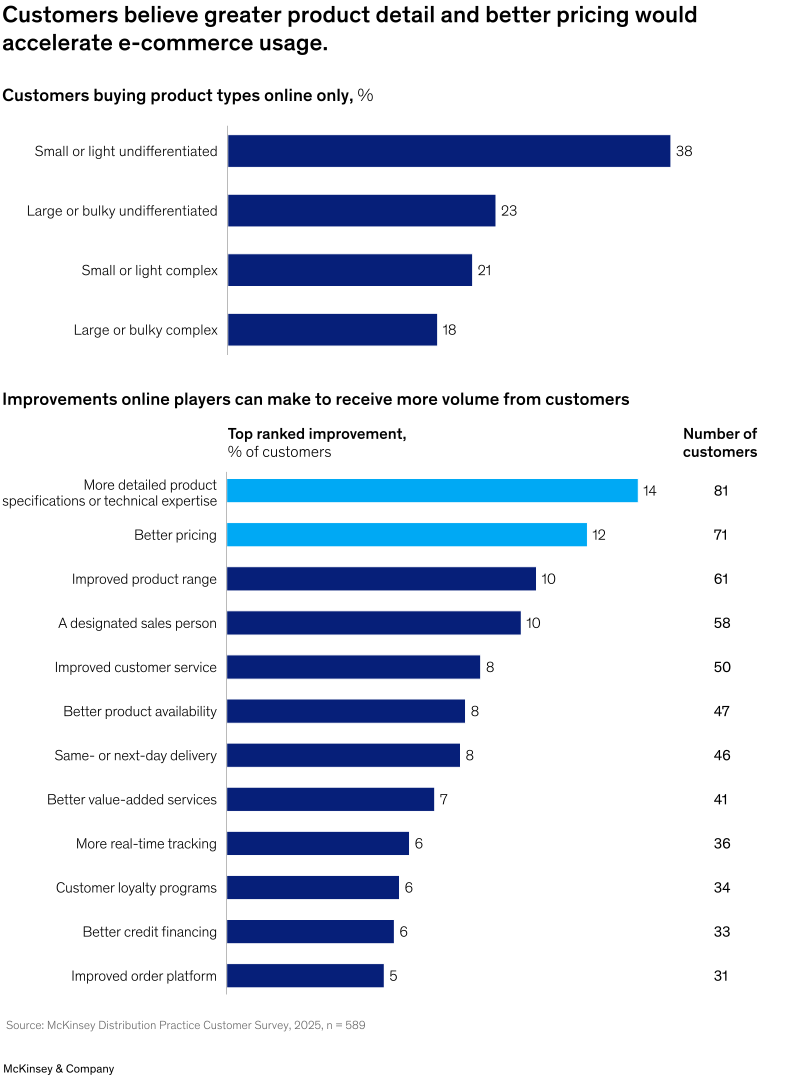
AI’s ability to clean and enrich data at scale is particularly important as e-commerce becomes increasingly central to distribution. Customers expect clear product availability, accurate specifications, reliable order tracking, and transparent pricing. Effective use of AI can help category managers build the data foundations required to deliver on these expectations while enabling better-informed assortment, pricing, and sourcing decisions.
A sounding board for supplier engagement and negotiations
When properly prompted, AI tools can serve as powerful negotiating assistants for distributors. They can synthesize historical pricing, share-of-wallet data, performance trends, and external benchmarks to generate structured negotiation insights and fact-based scenarios. This allows category managers to rehearse negotiations repeatedly, testing different approaches and receiving targeted feedback before ever sitting down with a supplier. While suppliers will also have access to AI tools, distributors can retain an information edge through their own proprietary data, and the eventual deployment of agents may drive even greater competitive advantage.
One large distributor deployed AI-supported negotiation preparation tools to help category managers build a stronger fact base ahead of supplier discussions. The tools reduced preparation time, improved confidence at the negotiating table, and helped teams focus on the highest-value levers. Across priority categories, the distributor achieved improved outcomes, including approximately 10 percent cost savings on one of its largest growth categories. One category manager noted that before running the simulations, he had not planned to push for that level of improvement.
Identifying and sourcing alternative vendors
As many procurement leaders learned during the COVID-19 pandemic—and are relearning amid rising tariffs and geopolitical uncertainty—having credible alternatives for core categories supports resilience. AI-enabled sourcing tools can automate much of the vendor discovery process by scanning internal and external data to identify alternative suppliers, assess risk exposure, and evaluate trade-offs across cost, quality, and service levels.
Implementing an AI-enabled sourcing tool helped another distributor identify alternative suppliers in categories heavily affected by tariffs. The tool rapidly surfaced more than ten viable suppliers in geographies less exposed to tariff risk. After validating potential partners, category managers onboarded new suppliers, shifted a portion of spend, and reengaged incumbents with a credible alternative in hand. As a result, the distributor achieved savings of more than 10 percent across targeted categories, which drove both improved financial results and higher customer stickiness.
Improving assortment and accelerating private-label growth
AI can enable distributors to manage assortments and private-label strategies with a level of precision that was previously impractical. By combining customer demand signals, margin analytics, and substitution modeling, the technology empowers category teams and, eventually, agents to make more-disciplined decisions about which products to carry, promote, or replace. With better data and analytics, private-label offerings are increasingly able to outperform national brands on both value and profitability.
A food service distributor applied AI-driven assortment analytics to identify categories in which private-label products could deliver superior customer value while improving margins. The result was a more-focused assortment strategy and accelerated private-label penetration in targeted segments. Another distributor reintegrated digital data originally developed for its online portal back into its category management ecosystem using AI-enabled web scraping. The enriched data revealed extensive SKU duplication—nearly 30 percent in one category—and highlighted new opportunities for private-label expansion. These insights enabled cost improvement on over $500 million in previously unaddressable spend, including newly consolidated and private-label SKUs.
Winning with AI: Making it happen
Capturing value from AI-enabled category management requires more than deploying new technology. Across industries, companies find that gains do not materialize automatically: While 89 percent of companies are engaged in digital and AI transformations, just 30 percent of organizations are realizing expected revenue increases, and 25 percent expect to see cost reductions.4 Capturing value with AI requires a coordinated approach spanning strategy, organization, technology, talent, and the operating model.
- Set the ambition and leadership mandate. Successful transformations are empowered by clear mandates from the top. CEOs and executive teams should define how AI-enabled category management supports enterprise value creation, with explicit targets tied to margin improvement, working capital, supplier performance, and productivity. Clear ownership is critical, with accountable leaders, often category managers, responsible for delivering results. This alignment across procurement, category teams, IT, and analytics helps move initiatives beyond isolated pilots and into sustained impact.
- Within procurement, prioritize high-impact use linked to ROI. Leading organizations develop domain-level road maps of focused AI use cases mapped directly to business outcomes. Starting by focusing on a single domain allows for the benefits of scope and scale—for instance, data that is cleaned for one procurement use case can quickly be used for another. Within a domain, each use case is assessed based on potential value, feasibility, and organizational readiness. This discipline concentrates resources on initiatives with measurable impact rather than spreading efforts too thin. In distribution, high-value use cases often include spend transparency, rebate compliance, assortment optimization, negotiation support, and supplier risk management. Each initiative is tied to a quantified benefit and a clear timeline, creating accountability and momentum.
- Invest in scalable technology and data foundations. AI-enabled category management works best with a strong data and technology foundation, because AI inputs for AI tools derived from integrated platforms that connect source-to-pay systems, supplier data, contract repositories, and market intelligence tend to result in stronger outputs. But such a foundation is not a prerequisite to get started. Notably, advances in AI are shifting the calculus on building strong foundations, enabling lean teams to build more, faster, and with messier data than was feasible even a few years ago. Robust data governance and cybersecurity are critical, particularly given the sensitivity of pricing and supplier information. Organizations also need to make deliberate build-versus-buy decisions. While commercial tools can accelerate deployment, custom solutions may better fit specific workflows. Regardless of approach, architectures should be scalable and designed for continuous improvement.
- Build capabilities and upskill the workforce. AI changes how category managers work, but it does not replace them. Leading distributors invest in upskilling programs that build data literacy, analytical judgment, and confidence in AI-driven insights. Many establish centers of excellence to support category teams, codify best practices, and drive adoption at scale. Talent strategies typically include both upskilling existing teams and selective external hiring in analytics, data science, and change management. The goal is to embed AI into everyday decision-making rather than treating it as a stand-alone capability.
- Define human–agent teaming and decision rights. AI demands a different operating model. Over time, getting this right may matter as much as the technology itself. Distributors need to explicitly define per workflow what agents recommend, what they execute, and what continues to require human sign-off. This should span three working modes: work that is human-led but enabled by agents, work that is agent-led with a human in the loop, and work that is fully agentic but audited.
The case for AI in category management is rapidly coming into focus. Distributors that embed AI into how categories are managed are likely to gain speed, precision, and discipline in decisions that directly shape margin and cash flow. Over time, these advantages can compound, enabling leaders to reinvest, scale more effectively, and respond faster as market conditions change. And as agents are deployed at scale, the consumption cost of running them will become its own fast-growing category of spending, with category management the natural owner of governing it.
In a business where small shifts in gross margin drive outsize changes in profitability, category management can be a critical differentiator. With AI raising the bar on what “good” looks like, distributors that move early and execute well have an opportunity to set a higher performance standard for the industry, maximizing the odds of turning AI capability into durable competitive advantage.