Procurement is entering a new age—one defined not just by cost containment, but by its ability to shape broader enterprise outcomes: resilience, sustainability, speed to market, and innovation. Yet today’s procurement teams are struggling to keep pace. Rapid shifts in the geopolitical environment, market dynamics, supply shocks, inflationary pressure, and an overwhelming volume of data are all converging to expose the limits of traditional operating models.
Procurement leaders tell us that they must become more agile than ever, tracking, preempting, and responding to external and internal volatility while also working to strengthen the deep and collaborative supplier partnerships their businesses depend on. Yet even high-performing procurement organizations are facing a growing gap between ambition and execution. Category teams are often buried under administrative workloads, sourcing cycles are too slow, and insight generation is fragmented across siloed systems.
At the same time, supplier organizations are rapidly advancing their own adoption of AI in commercial functions. This shift is changing the dynamics of negotiation, sourcing, and market intelligence—creating a widening performance gap between digital leaders and laggards.
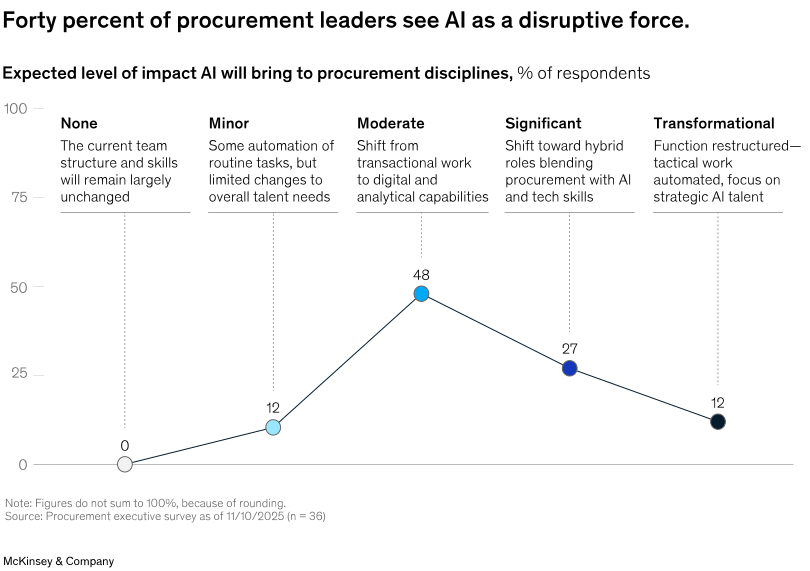
This is not a technology problem; it’s a leadership one. The strategic relevance of procurement in this environment hinges on the function’s ability to evolve how it works. And AI—particularly the emerging class of agentic AI—offers a path not just to improve processes, but to reimagine them entirely. In this context, AI is no longer optional (Exhibit 1). It is the engine powering the next frontier of savings, resilience, and innovation.
From automation to intelligence
Historically, technology in procurement has focused on transactional automation—from purchase orders (POs) and invoices to catalogs and sourcing events. While these systems delivered efficiencies, they often left strategy untouched. Decision-making remained manual, slow, and reliant on backward-looking data.
The new wave of AI changes that. We are now witnessing the shift from analytical AI (“Show me the data”) to agentic AI (“Do it for me”). AI agents emulate human judgment, carry out multistep tasks, and continuously improve through learning loops. Rather than creating static dashboards or reports, they ingest complex datasets, reason through trade-offs, and autonomously generate options and recommendations.
Think of agentic AI as a digital colleague—one that analyzes supplier bids overnight, tracks market indices in real time, flags cost deviations, and prepares negotiation playbooks while your team sleeps. It operates across time zones, scales with data volume, and doesn’t get distracted or fatigued.
What’s powerful about this model is not just the automation of steps, but the orchestration of outcomes. AI agents can operate end to end: from identifying a strategic opportunity to sourcing suppliers, to preparing commercial strategies, to tracking performance post-award. This creates a truly hybrid workforce—where humans focus on creative problem solving, relationship building, and complex judgment, while agents handle scale, speed, and synthesis.
Measurable impact, delivered fast
While the vision is bold, the impact is real—and it’s happening now. Leading companies that have embraced AI in procurement are already seeing outsized results.
A tech company employed a linked set of AI agents to rebuild its strategy for sourcing external services. One agent integrated spend and market data to generate real-time insights into price trends and savings opportunities, for example. Another simulated the evolution of demand under various market scenarios, allowing the company to hedge against volatility. The approach helped the company identify savings opportunities of 12 to 20 percent in its contact center operations, and 20 to 29 percent in business process outsourcing (BPO) and financial services spend.
A chemicals company is piloting the use of AI agents to conduct autonomous sourcing in the consumables category. Its agents automate the preparation of tenders, the identification and prequalification of suppliers, and the analysis of competing bids. Another agent routes, tracks, and synthesizes queries and clarifications from suppliers during the sourcing exercises. This new system has increased the efficiency of procurement staff by 20 to 30 percent, while also boosting value capture by 1 to 3 percent.
Elsewhere, a telco player is using AI agents to support price negotiations across its long-tail spend on specialized software products. Its agents help negotiating teams by preparing a comprehensive prenegotiation fact base; making real-time suggestions during negotiations; evaluating trade-offs between cost, service levels, and risk; and automatically generating counteroffers to supplier proposals. In use, the AI system cut the time negotiating teams needed to spend on analysis and emails by up to 90 percent. The AI-guided negotiations led to 10 to 15 percent savings across vendors.
Agentic AI is delivering results during routine purchasing activities, too. One pharmaceutical company has deployed AI agents to enforce invoice-to-contract compliance, for example. Its agents track supplier delivery performance and automatically check invoices and POs against contract terms. The new approach has cut the value lost through “leakage” by 4 percent. An aircraft OEM is using agents to automate order execution and inventory levels based on production planning data. The approach has helped the company cut active inventory by 30 percent, boosting EBIT by around $700 million.
What’s striking is how quickly these results can be achieved. With the right foundation—typically a few key datasets and defined use cases—organizations can go from prototype to pilot in weeks, and from pilot to scale in under a year. This isn’t about massive ERP replacements or multiyear IT programs. It’s about targeted, high-ROI interventions that show results in months, not years.
The rewired procurement model
For AI to move from pilot to performance, it must be embedded in a new operating system—one that integrates data, decisions, and delivery. This is what we refer to as a “rewired procurement model” (Exhibit 2).
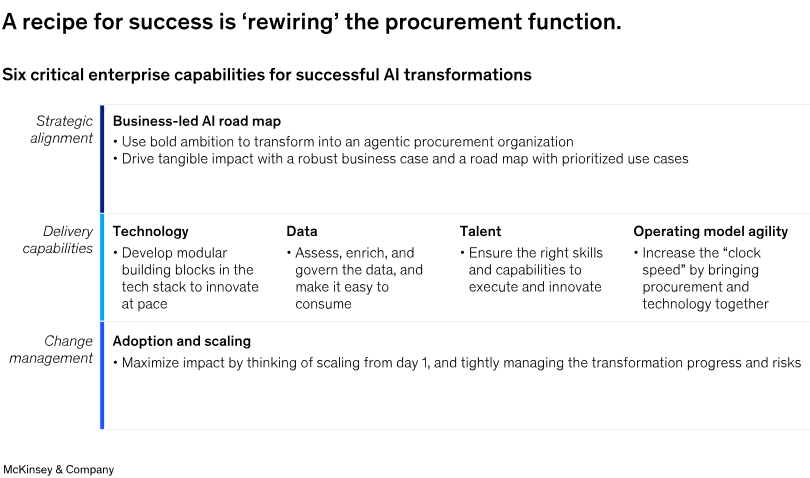
At its core, this model involves four key shifts:
- Data as a strategic asset. Procurement can no longer afford to operate with fragmented, outdated, or incomplete data. We estimate that today’s procurement functions use less than 20 percent of the data available to them to support decision-making. AI agents will help them use more of that data, provided it is accessible to them. That will require a systematic effort to break down data siloes, first with digital links between existing tools and data, and ultimately with the creation of a common “data spine” that provides a single source of truth across spend, suppliers, contracts, and market benchmarks.
- Agents as operating infrastructure. Early AI use cases have been narrow in scope, perhaps providing an improved interface to existing tools. A rewired procurement model will break those hardwired links. Instead, organizations will run “factories” of agents as operating infrastructure. These agents will be designed to achieve specific tasks: importing data from unstructured sources, analyzing that data, or conversing in natural language, for example. Procurement tasks will involve teams of such agents, assembled to meet the requirements of each workflow and drawing on a diverse range of data sources.
- Human-agent teaming. In a rewired procurement function, humans and AI agents will work side by side. Procurement staff will guide and coach their digital counterparts, while agents will take over most repetitive transactional work, freeing up people to focus on strategic decision-making, orchestration, and oversight. This will demand new capabilities for procurement personnel, including prompt engineering, scenario evaluation, and change management.
- End-to-end integration. AI’s true power is unlocked when applied across the full source-to-pay life cycle. From early demand signals to supplier performance tracking, an integrated system allows for compound benefits—faster decisions, lower costs, and reduced risk.
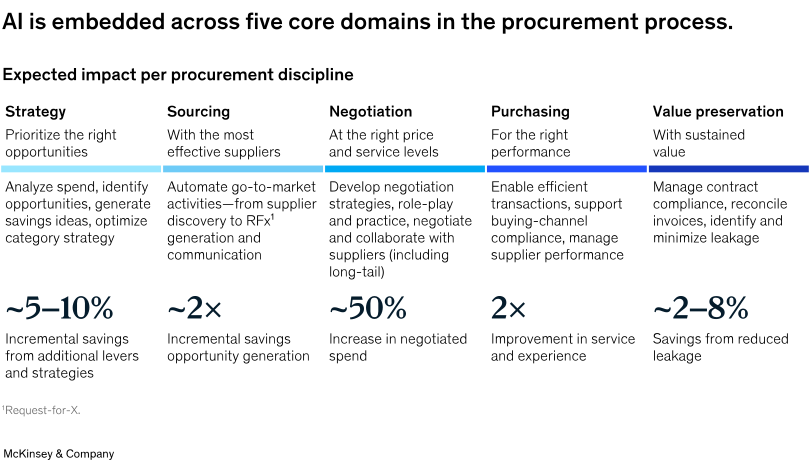
Together these shifts don’t just improve the function—they fundamentally reposition procurement as a competitive advantage for the enterprise (Exhibit 3).
Implications for the C-suite
For executives, this shift presents both an opportunity and a challenge. The opportunity lies in making procurement a strategic lever—not just for cost, but for growth, resilience, and environmental, social, and governance (ESG). AI can enable smarter design-to-value decisions, more agile supplier networks, and better capital allocation.
But capturing this value requires leadership. Specifically, executives should consider the following:
- Rethinking organizational roles. As agents take on execution, teams must be reskilled for strategy, exception management, and insight interpretation.
- Investing in data readiness. Clean, connected data is the fuel of AI. Organizations must make bold moves to build and maintain their procurement data spine. In a world of ubiquitous large language models (LLMs), competitive edge comes from specific context and domain signals.
- Embedding change, not just tools. Successful transformations pair technology with operating model redesign, new KPIs, and strong change leadership. AI must be integrated into the rhythms and rituals of how work gets done.
- Elevating the procurement agenda. With AI, procurement becomes a board-level lever. Executives must align procurement’s ambitions with enterprise goals—sustainability, innovation, supply-chain resilience—and ensure cross-functional integration.
From measured savings to procurement ROI
A rewired procurement function will require companies to rethink the way they measure impact. Procurement ROI is a single metric that makes sense. It is defined as the total value created divided by the total cost to achieve that impact. Value includes realized savings, leakage avoided, working-capital and risk benefits, and revenue enablement. AI lifts value by expanding category management coverage beyond today’s bandwidth, improving outcomes in every negotiation, and opening new pools of value such as automated tail-spend repricing and tighter compliance. Cost reflects the full run rate of people (internal and external), technology, data, and change management. AI shifts that mix—more platform and data investment, a leaner team with different skills. With the right sequencing, uplift is visible within months as agents move from pilot to production and the operating model evolves.
A practical road map
While the technology is ready, each organization’s path to transformation will be different. That said, successful efforts often follow a consistent approach:
- Activate no-regret agents now. There are already agentic AI solutions that companies can apply off the shelf. Examples include category copilots, RFx generation and analytics, contract optimization, invoice-to-contract compliance, or tail repricing systems.
- Define the long-term vision and value case. Focus on business outcomes—not just use cases or tools.
- Start focused, scale fast. Pick two or three high-impact categories or domains to reimagine. Use success to build momentum.
- Build the right team. Combine procurement, data, AI, and change expertise to create a cross-functional taskforce.
- Invest in capability building. Don’t wait for AI to arrive—start upskilling teams today.
- Establish feedback and learning loops. AI systems improve with use. Treat every cycle as a learning opportunity.
AI in procurement is not a feature—it is a new foundation. Anchor decisions in procurement ROI: total value created. AI rewiring of procurement redefines what is possible in cost management, supplier collaboration, and business agility.
The path is a recipe, not a pilot: Build the data spine; activate no-regret agents across sourcing, negotiation, and value preservation; and rewire roles and processes for human and agent ways of working. This is leadership work—challenging legacy systems, setting clear guardrails, and investing in capabilities that compound.
For chief procurement officers (CPOs) and their C-suite peers, this is a once-in-a-generation opportunity to elevate procurement from a support function to a source of strategic advantage. Those who seize it will define the next frontier of enterprise value. Those who delay risk being left behind—not just by competitors, but by their own suppliers.