On May 8, 2026, Germany’s Bundesrat, the upper house of parliament, approved the Altersvorsorgereformgesetz [Pension Reform Act], a complete replacement of the Riester pension system,1 effective January 1, 2027.2 The legislation does not merely cap fees; it redesigns the architecture of Germany’s subsidized private pension system. Today, a subsidized pension is typically a savings contract in an insurance wrapper: funds inside, a guarantee, an annuity option, and an agent on top for an all-in cost of about 1.85 percent of assets a year.3 The mandatory 100 percent capital guarantee that made that wrapper necessary is gone.4 In its place sits the Altersvorsorgedepot [retirement savings account]—a certified securities account open to banks, neobrokers, and asset managers, with the law also authorizing a future public standard product provider. For the first time the subsidy attaches to the purpose—saving for retirement—rather than to an insurance contract. Lifelong annuitization is no longer required, front-loaded acquisition costs are prohibited by the Zillmerungsverbot [ban on front-loaded acquisition costs], and on the Standarddepot—the standard low-cost product that any provider seeking certification for subsidized products must offer either directly or through a partner—a cap of 1 percent a year on all costs borne by the saver sets a price anchor for the entire market.
That anchor is the point. Insurers remain free to sell higher-cost products alongside it, but once a visible, subsidized benchmark exists at 1 percent, the burden of proof shifts. An insurer charging the market average of roughly 1.85 percent will have to explain what the additional 85 basis points buy.5 The customer benefit tests of BaFin, Germany’s financial supervisor, were built to ask exactly that question; a subsidized 1 percent product gives them a public reference point. The Standarddepot is not an autoenrollment default since savers must choose it, so its force is competitive, not automatic.6 Cheap exchange-traded fund (ETF) savings plans already existed in Germany, but a tax-privileged standard product, the costs of which every provider must disclose on the same basis, makes 1 percent the number savers and supervisors compare against. New entrants have already announced products at a fraction of that cost. How fast the market moves is less certain than its direction: Capital relief under the Solvency II review, possible backlash over the advice gap, and the slow migration of millions of existing Riester contracts could all slow the shift.
Germany is the most explicit instance of a pattern building across continental Europe, in which the structural advantages that supported pricing of 1.5 to 2.5 percent are eroding. Compliance is the easy part. The harder question is what kind of company a life insurer wants to be. There are two potential answers to this question: The first is an integrated capital-light platform that either administers savings products for a flat asset-based fee at low unit cost, which is a model heavily reliant on scale, or that differentiates through advice clients pay for. The second is a capital-heavy specialist or consolidator approach, with capital deployed against risks noninsurers cannot manufacture. The window for choosing a model from a position of strength is closing faster than most board agendas reflect.
The moat around fee-based accumulation is disappearing
Demand for retirement savings is growing: Europe’s old-age dependency ratio is expected to rise by about 15 percentage points by 2050,7 and state pensions will replace a smaller share of preretirement income, widening the gap private retirement savings have to fill.8 The question is, who will provide the products to close this gap and on what margin? This is particularly pressing because three structural advantages that have supported insurers’ economics are disappearing.
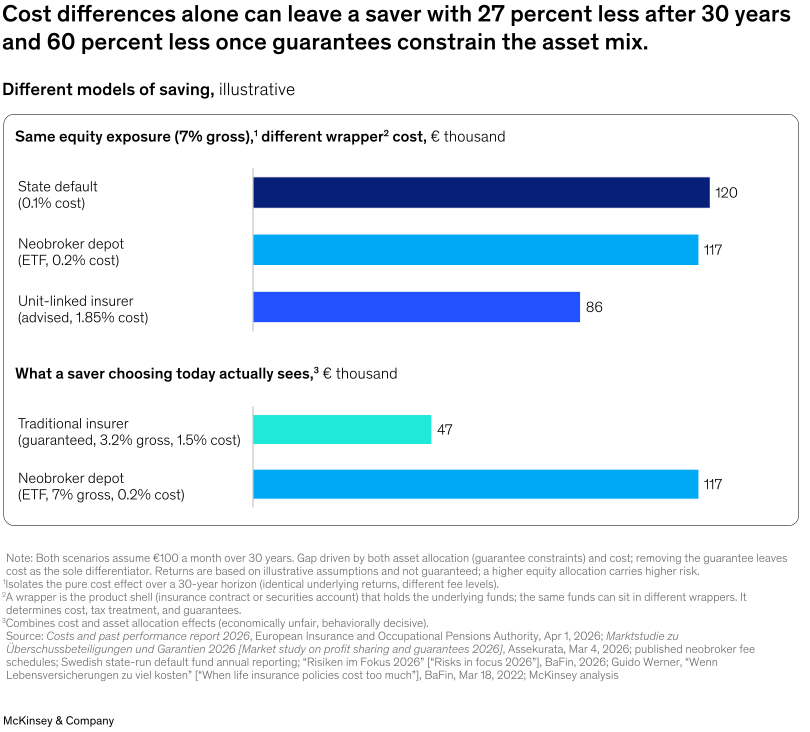
The product is becoming a commodity. Nonguaranteed unit-linked contracts, the fastest-growing product outside the subsidized system, are economically close to mutual funds, made up of the same underlying funds, the same market risk borne by the customer, and the same net-asset-value-based pricing. They account for around 39 percent of French life premiums,9 about a third of new life business in Italy,10 and more than a quarter of new regular premium business in Germany.11 Where the tax advantage migrates from the wrapper to the savings purpose, as it does with the Altersvorsorgedepot, the category distinction disappears—and the difference in returns becomes visible. Constrained by Solvency II and contractual guarantees, European life insurers hold 55 to 65 percent bonds,12 and German insurers credited savers roughly 2.5 to 3.0 percent in 2025.13 Competitors unconstrained by guarantees will likely run equity-heavy portfolios and show visibly higher net returns for the same saver. Over a 30-year contract, a higher cost load compounding against a more conservative asset mix could produce a gap in final savings that savers will see side by side in the standardized product information, which is exactly the comparison the new standard product is meant to surface (Exhibit 1).
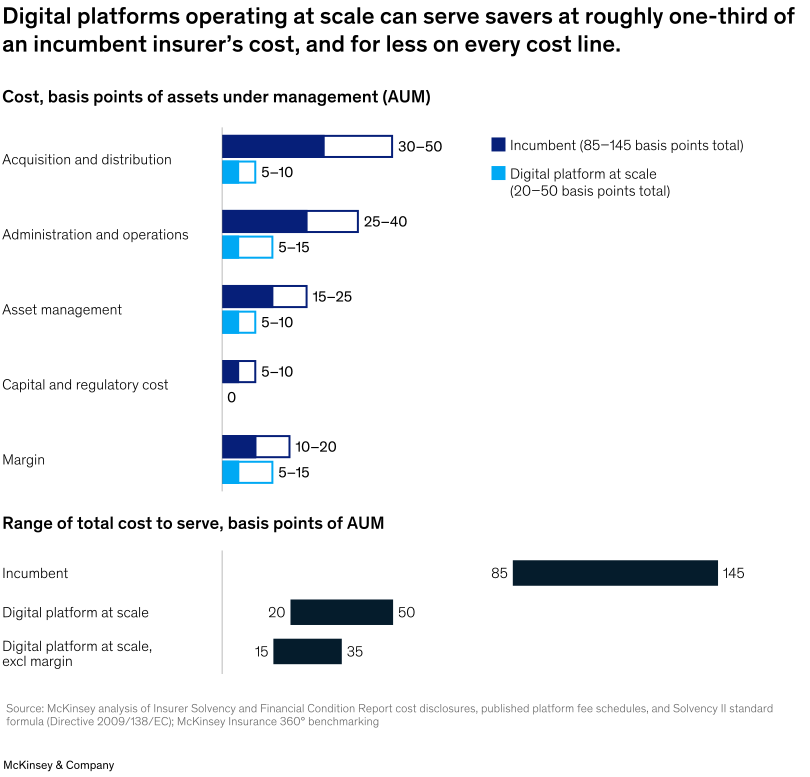
Distribution is being unbundled. Tied agents, sales forces that sell one insurer’s products on commission, are the single-largest cost component for life insurers at 30 to 50 basis points of the saver’s assets a year, roughly a third of everything the saver pays. The model depends on customers buying what an agent recommends rather than shopping on price, and it is under pressure: The Netherlands banned commissions on investment-linked insurance outright in 2013, Germany’s Zillmerungsverbot stops providers from charging acquisition costs up front on the new subsidized products,14 EU inducement rules are tightening, and digital channels serve the customers willing to act without a push. Advised distribution will not disappear, but it will need to justify its margin through measurable outcomes rather than inherit it by default.
Competitors without the incumbent cost base are emerging. Digital platforms and neobrokers can run a Standarddepot-compliant product for well under a fifth of the 1 percent cap. Several online brokers have announced Altersvorsorgedepots for 2027 that charge nothing for the account, the savings plan, or transactions, and some also waive the fund costs on selected ETFs. The platforms earn their margin elsewhere in the client relationship.15 Prices are therefore likely to be set by competition, well below the cap. These platforms carry no tied agents and no legacy IT, and no Solvency II capital is required behind the savings flow (Exhibit 2). Collectively, noninsurance retail platforms have added millions of customers over the past two years, with aggregate assets under management (AUM) already in the low hundreds of billions of euros.16 Their weaknesses are equally tangible, such as no track record in decumulation or subsidy administration and no 30-year relationship. The threat is less about full-stack disintermediation than competition for new accumulation flows: New savers will open their depot in a platform’s app. When they want a guarantee or a lifelong income, the platform will buy it from an insurer and embed it. For incumbents, the risk is being relegated to manufacturing commoditized products behind someone else’s interface, on someone else’s margin.
Any one of these shifts would likely be manageable. Arriving together, they remove much of what made 1.5 to 2.5 percent pricing defensible. The gap between the 1.85 percent average and the 1.00 percent cap exceeds the profit margin on most products. At the rate of cost improvement for 2024 of roughly eight basis points a year,17 closing this gap would take more than a decade. In Germany today, only a quarter of insurance-based investment products cost less than 1 percent a year, and on the standardized projection every product must publish, nearly three-fifths are not expected to return more than 2 percent a year after costs—no better than inflation.18 This is not a compliance problem with an operational fix. It is a viability test.
A continental one-way street
Germany’s reform is among the most prescriptive, but every major continental market is moving the same way through different instruments (Exhibit 3). France challenges fees on a rolling basis through value-for-money benchmarks and a continuous duty of advice, without a formal cap.19 The Netherlands is converting some €1.7 trillion of occupational pensions from guaranteed benefits to individual accounts,20 the same move away from guarantees but at a far larger scale. Italy uses mandatory cost transparency to expose insurance-based plans as the high-cost tier. Switzerland shows the same compression without a regulatory trigger: Pillar 3a, the country’s tax-advantaged private retirement savings plan, was already open to bank foundations, and digital entrants used that access to undercut incumbents at around 0.4 percent.21 And Sweden’s state-run default fund operates around 0.05 percent,22 anchoring what European regulators treat as the cost of retirement saving.
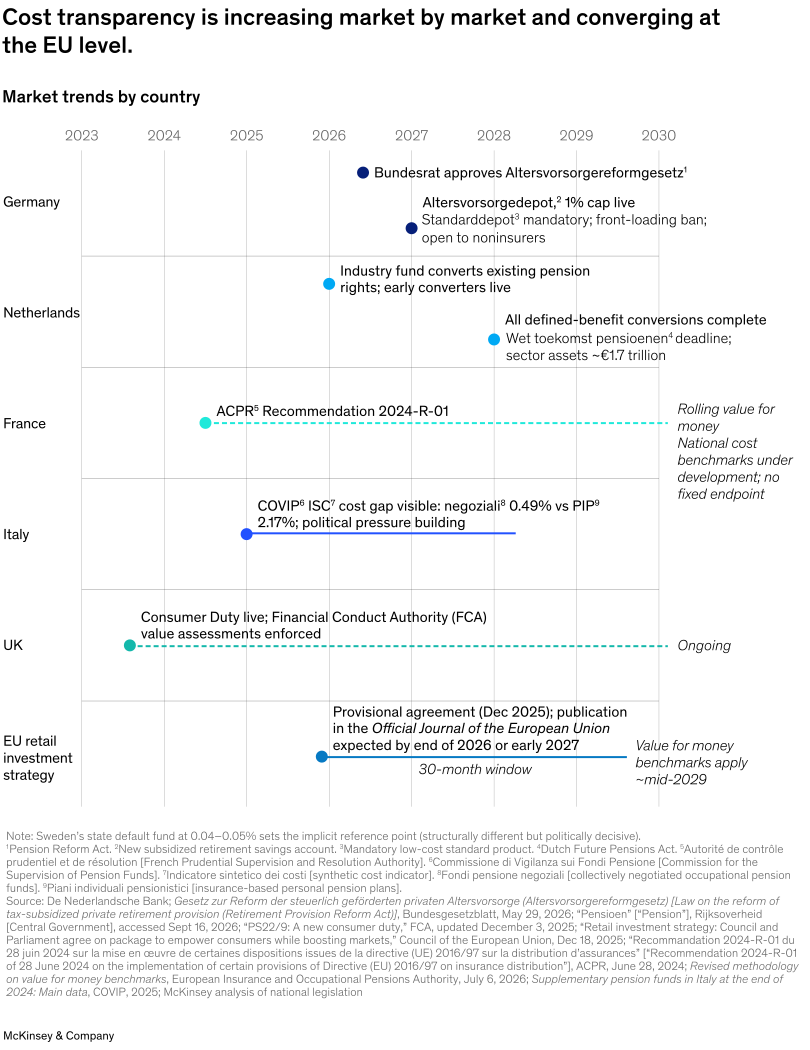
The national measures came first. What turns them into a continental standard is the EU Retail Investment Strategy. The provisional agreement reached by the European Parliament and the Council of the European Union in December 2025 is expected to apply from around 2029 onward and makes value-for-money assessments mandatory for all insurance-based investment products.23 Manufacturers must show in their product governance that costs are justified against performance, and outliers against European Insurance and Occupational Pensions Authority and European Securities and Markets Authority benchmarks have to be justified to supervisors. The result is not a single European cap; it is an EU-wide benchmarking regime that makes every national cost outlier visible to its own supervisor at once. For a CEO, the details of the implementing regulation matter less than whether a model priced for the old moat can survive a decade in which every continental supervisor holds the same benchmark. These developments suggest insurers should plan for sustained pressure on pricing power in intermediated savings.
We have seen this before
Today, life insurer profitability argues against urgency, but it may offer a false sense of security. Higher rates have restored life insurance economics, but the strength is cyclical, while the threats are structural. Rates lifted every insurer at once, flattering the laggards and disguising how much of today’s results are borrowed from the cycle rather than earned from the model. When rates normalize, the gap between an insurer that used good years to reset its cost base and one that did not will likely be visible in the accounts. In three prior episodes comparable cost pressure permanently reset the economics of an entire market (Exhibit 4).
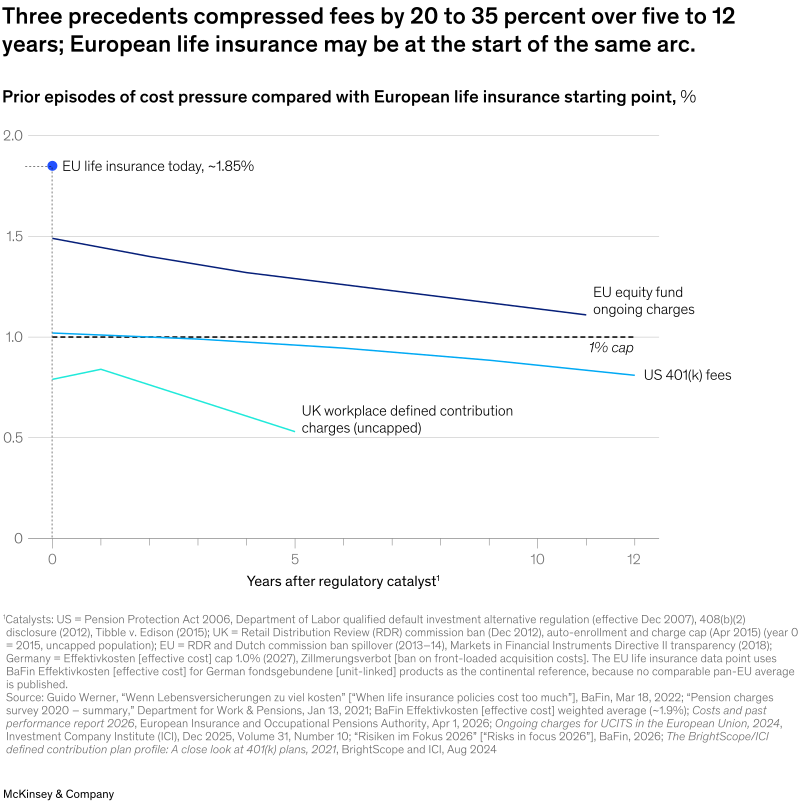
The US 401(k) moved retirement savings from employer-guaranteed pensions to individual accounts and low-cost default menus, compressing average plan fees by roughly a fifth in the 12 years to 2021 alone24 and squeezing the undifferentiated middle out entirely. In the United Kingdom, the Retail Distribution Review (RDR) banned commission on advice in 2013, cutting adviser numbers by close to a quarter at the low point and leaving the channel around a fifth smaller a year later,25 and the 2015 pension freedoms completed the end of compulsory annuitization, which began in 2011.26 In parallel, though driven primarily by Solvency II capital pressure and low rates rather than the distribution reforms themselves, capital-intensive life books migrated to specialist consolidators—firms that buy closed books of policies and run them for value, several backed by private capital—and a number of large UK life insurers ceased to exist as independent firms. The EU’s Markets in Financial Instruments Directive II reinforced the same pattern in European asset management, though the decisive driver there was the rise of passive and ETF shares rather than transparency alone. In all three, the sequence was broadly the same: transparency, a lower-cost alternative, and a visible benchmark.
The outcome was also similar: The industry bifurcated toward two extremes (scale and low cost at one end and specialist capital strength at the other) while the middle compressed. There is little reason to expect continental life insurance to resolve differently.
Transform or be transformed
Insurers face two tasks. The first applies regardless of destination: In the next 12 to 18 months, life insurance cost and distribution economics will need to be restructured—fund costs renegotiated, legacy administration retired, straight-through processing raised toward the levels digital entrants already run, and acquisition rebased onto ongoing rather than up-front commission. Leaders will make these changes while margins are still healthy enough to fund the investment. This could buy time, but it leaves the second, harder task of deciding what kind of life insurer to be once the savings product is a commodity, distribution is unbundled, and the guarantee that justified the wrapper is optional.
For those that want to stay in the game, the likely answer is a choice of which end of the life insurer business model barbell to occupy (Exhibit 5). The middle—a little bit of a platform, a little advice, and a little risk carrying all inside one market and one balance sheet—is the space that shrank fastest in all three precedents. In the United Kingdom, life insurers that straddled multiple models within a single market were acquired. Diversified groups can hold more than one position, but only across geographies or through genuinely separate entities. Within a single market, straddling is not a strategy.
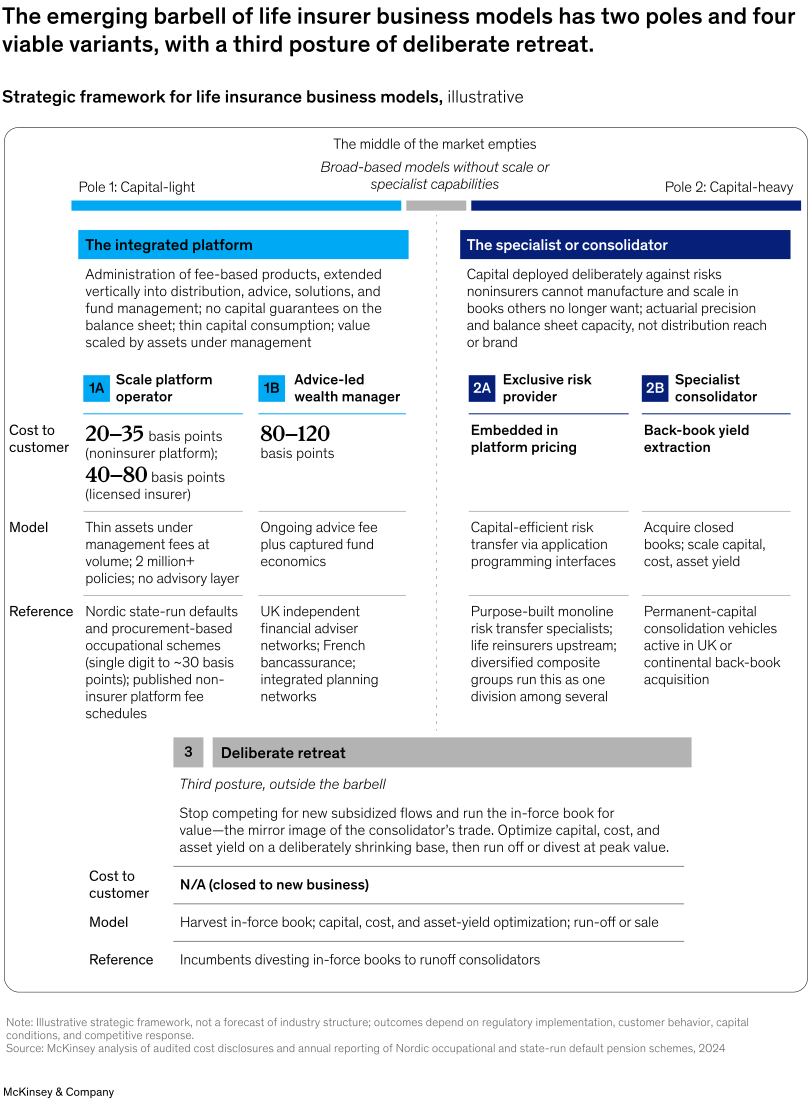
One end of the barbell is the capital-light integrated platform. Insurers here administer fee-based savings at low unit cost and extend into advice and fund manufacturing, capturing the full stack rather than paying it away. But this is only viable at scale. Unit costs fall toward zero only once fixed platform and technology investment is spread across millions of policies, so we expect room for only a few credible scale platform operators per market. A scale platform operator delivers savings at 20 to 35 basis points as a noninsurer, or roughly 40 to 80 as a licensed insurer, across those millions of policies and earns the insurer premium through what a platform cannot offer: subsidy administration, the occupational channel, and an integrated route into guaranteed income at age 85. Also on the capital-light end of the barbell, an advice-led wealth manager justifies 0.80 to 1.20 percent through outcomes clients cannot replicate alone, such as tax optimization, estate coordination, and behavioral coaching that keeps savers invested through drawdowns. For a German insurer with 20,000 tied agents, this would likely mean a change of identity.
The other end of the barbell is the capital-heavy specialist or consolidator. Insurers here deploy capital against risks noninsurers cannot manufacture without an insurance license (for example, biometric underwriting, longevity pooling, and guarantee construction) or acquire closed books at scale and extract value through capital efficiency and higher asset yield. It is the highest-return use of insurance capital remaining, though it comes at the price of being nearly invisible to the end saver.
A third posture, deliberate retreat, rejects both premises. An incumbent that concludes new subsidized accumulation no longer justifies the investment to win can stop competing for new flows and run its in-force book for value. This is the mirror image of the consolidator’s trade—and, for some balance sheets, the value-maximizing one. What unites all three positions is that each is a clear decision that insurers commit to with capital and governance. The real risk lies in not making a choice and defending the current model a quarter at a time until the options are chosen by others.
The window is gradually closing
The new industry structure will not emerge overnight. In the base case, customer inertia and tied-agent defense stretch the transition over years, and the industry reaches 2030 looking like it does today but with new-business margins 40 to 60 basis points thinner. Precedent says evolution can happen faster. The countervailing forces are real, but each of them could change the pace, not the direction, of travel.
Across scenarios, the insurers best placed for what comes next will do three things by the end of 2027. They will choose which end of the barbell to occupy or make the deliberate choice to retreat and run the in-force book for value. They will close the technology and cost gap. And they will rebuild a customer model that the new, thinner economics can actually fund.
Continental European life insurers today have strong capital, healthy profitability, and the resources to shape their own trajectory, things their UK peers had on the eve of the RDR in 2013 and their US peers had before the 401(k) compression began. But they have something those peers did not: the benefit of knowing how three similar chapters ended. The incumbents that moved early retained the widest set of options; those that waited had their options narrowed for them, and some became consolidation targets, acquired at book value by competitors who had already built what the market required. The 1 percent cap is a wake-up call. The question is whether that call is answered now from a position of strength or later with a narrower set of options.