As the global payments industry evolves into an increasingly diverse network of competing systems, instant payments are becoming a bigger part of the landscape. Instant payments value flows reached nearly $22 trillion in 2024 across the 15 largest economies that have adopted these payment rails,1 representing 1 percent of the $2 quadrillion in value flows worldwide.2 They are expected to grow at 15 to 18 percent annually over the next five years.
Instant payments started gaining momentum in the late 2000s and early 2010s in mature electronic-payment markets such as the United Kingdom and the Nordics and Benelux regions, and in historically cash-dominant emerging markets such as India, Nigeria, and Thailand. Since then, many other markets—from the United States and Europe to developing markets across Latin America and Asia—have introduced instant payments with varying results. Many more instant payments markets are expected to gain traction in the coming years.
In this article, we look at how instant payments have developed in markets such as Brazil, India, Mexico, and the United States. These markets provide insights and a glimpse into the future for commercial players across the payments value chain. As demand for instant payments grows, banks, acquirers, and payment schemes may see revenue from traditional sources pressured and will need to adapt their services, products, and business models to remain competitive.
India and Mexico: Early adopters with opposite outcomes
Two early adopters of instant payments offer contrasting cases on how these rails have developed.
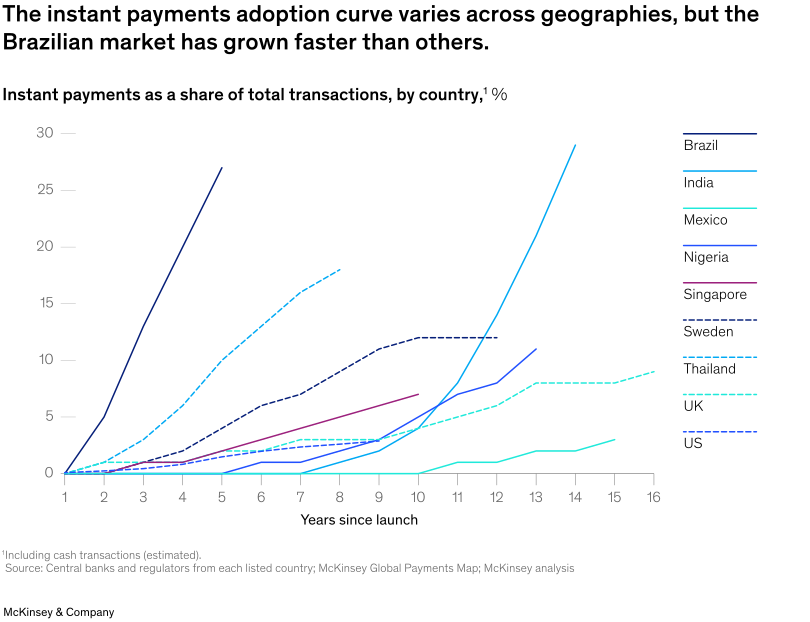
India launched its Immediate Payment Service in 2010, followed by its Unified Payments Interface (UPI) in 2016. UPI has since grown into the largest instant payments system in the world, processing more than 19 billion transactions per month, or nearly a third of India’s total transaction volume.3 UPI was introduced by the National Payments Corporation of India (NPCI) and supported by the government, which established zero fees for merchants and customers using the system and provided subsidies to financial institutions for low-value transactions. The UPI rollout was supported by several major banks and third-party application providers. A key advantage was that consumers could link accounts from any participating bank to multiple UPI-enabled apps. UPI also benefited from India’s broader digital public infrastructure, which simplified identity verification, onboarding, and document storage and reduced friction for consumers and merchants. UPI established features to support person-to-person (P2P), person-to-business (P2B), and recurring transactions, link credit cards to instant payment systems, and enable cashless transactions on simpler feature phones that are more widely used by consumers in rural and remote areas. UPI’s growth was accelerated by India’s 2016 demonetization policy, which withdrew 86 percent of the country’s cash by value, and by the COVID-19 pandemic, hastening cash’s decline as the primary retail payment method. This transition was supported by banks and app providers such as PhonePe and GPay. UPI is now expanding beyond India’s borders, supporting instant payments in the Middle East and Southeast Asia.
Conversely, Mexico has struggled to translate its SPEI (Interbank Electronic Payment System) infrastructure into broad retail instant payment adoption. Instant payments represent less than 5 percent of Mexico’s total transaction volume, compared with roughly 30 percent in India. In McKinsey’s 2025 Latin American Payments Survey, 33 percent of Mexican respondents reported making more than 50 percent of their in-store payments in cash, while 40 percent cited convenience, speed, control of spending, or merchant acceptance as key reasons for using cash.
Repeated attempts by the Mexican central bank to spur adoption of instant payments have not gained real traction. In 2019, Mexico’s central bank launched CoDi, an instant payments platform built on top of SPEI. But CoDi’s incentives to promote retail usage were not embraced among Mexico’s largest banks. In 2023, the central bank launched a new instant payments system called DiMo, built on SPEI, to boost peer-to-peer transactions and overcome CoDi’s adoption challenges. DiMo is still in its early-adoption phase. Neither system was accompanied by the coordinated push that supported adoption in India and Brazil, where central banks and scheme operators paired mandated bank participation with near-zero pricing for consumers and merchants to boost reach and adoption. In Mexico, participation remained largely voluntary and pricing was left to individual banks. Both CoDi and DiMo offer limited consumer incentives compared with cards and digital wallets. In the 2025 Latin American Payments Survey, 22 percent of Mexican respondents said cashback, discounts, loyalty points, or rewards would influence them to adopt or switch payment methods. In addition, QR code–based payments, which CoDi uses, have not become a mainstream habit. Only 40 percent of Mexican respondents have used a mobile device to pay in stores via tap to pay or QR codes, and only 18 percent use these solutions frequently.
Brazil’s swift adoption journey
Brazil, one of the newer adopters, has rapidly scaled its instant payments market (Exhibit 1). Since Brazil’s central bank launched its Pix system in 2020, instant payments have grown to account for nearly 30 percent of the country’s total transaction volume.
Brazil introduced Pix at a time when conditions were favorable to disrupt the payments market. The country had strong internet penetration, with 83 percent of households online and more consumers shifting from cash to electronic payment methods. At the same time, high banking transaction fees were a hindrance for some lower-income consumers.
Like the introduction of instant payments in India, Brazil’s rollout was aided by incentives such as zero fees for consumers; mandates requiring certain banks to participate in the system; a broad range of P2P, P2B, and B2B use cases; and strong user experience through banks’ mobile apps and websites.
Pix has evolved in waves (Exhibit 2). Its initial adoption was centered on P2P transactions, driven by convenience, a user-friendly interface, and the absence of fees for consumers. In a 2024 McKinsey survey on consumer payments in Brazil, 55 percent of Pix users cited speed and ease of use as the primary reasons for adoption, particularly among lower-income populations and younger consumers.
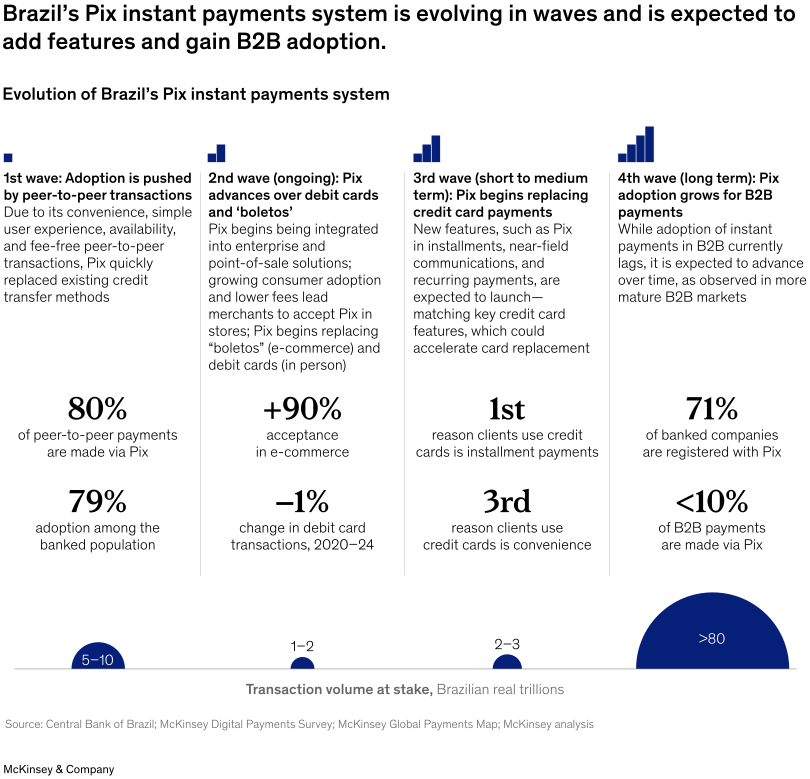
As consumer demand and familiarity grew, a second wave emerged as merchants began to accept instant payments and enterprise software providers and acquirers integrated Pix into their solutions, accelerating its use in P2B transactions. Insights from a 2025 McKinsey survey of small and medium-size Brazilian enterprises indicate that almost all micro, small, and medium-size enterprises use instant payments, with Pix representing approximately 40 percent of their sales mix. This early expansion in P2B transactions initially disrupted established payment instruments such as bank slips (boletos) and debit cards, which became less attractive to consumers.
Pix is currently in its third wave of adoption, driven by new functionalities and solutions that have helped instant payments make inroads against credit cards. For example, banks have launched options through Pix to allow consumers to pay in installments. However, credit cards remain the primary option for higher-income populations, accounting for roughly 60 percent of transactions among these customers, due to their benefits and rewards programs.
Looking ahead, a fourth wave of Pix evolution is likely to further expand into the B2B segment. In a 2025 McKinsey survey of large corporate and investment banks in Brazil, 95 percent of companies reported plans to increase their use of Pix. While the adoption of instant payments in B2B transactions naturally lags other segments, this transition is likely to accelerate in the coming years.
The United States: Adoption remains in an early stage
The United States represents one of the most closely watched instant payments markets globally. Unlike many countries that launched a single national scheme, the United States operates two real-time payment networks: the Clearing House banking association’s RTP network, launched in 2017, and the Federal Reserve’s FedNow Service, launched in 2023. Together, these networks provide nationwide infrastructure supporting instant, irrevocable payments 24/7.
Despite significant investment and growing participation, adoption has progressed much slower than many market observers initially anticipated. RTP processed approximately 447 million transactions in 2025, while FedNow processed about eight million transactions, representing only a small fraction of the roughly 345 billion annual US payments transactions.4 Although transaction growth remains strong, the market has not yet experienced the rapid acceleration observed in countries such as Brazil or India. Reach is part of the explanation. Out of some 9,000 US depository institutions, roughly 1,800 participate in FedNow and about 1,200 in RTP, and many participants are enabled only to receive payments rather than originate them. Merchant acceptance at the point of sale remains negligible. Zelle, by comparison, processed 4.2 billion transactions in 2025, roughly nine times the combined volume of RTP and FedNow, suggesting that US consumers already have an instant option that meets their day-to-day needs.
Several structural factors help explain the difference. Unlike markets where instant payments addressed clear gaps in existing payment infrastructure, the United States already had a highly developed payments ecosystem. Consumers and businesses have long relied on cards, automated clearinghouse (ACH), wire transfers, digital wallets, and person-to-person networks such as Zelle. As a result, instant payments often compete against solutions that are already viewed as sufficiently convenient for many use cases. The United States also lacked the combination of incentives that accelerated adoption elsewhere. Neither RTP nor FedNow was paired with mandated participation or near-zero pricing, so banks chose whether and how quickly to enable the rails, and end users were given no clear financial reason to switch.
At the same time, adoption patterns suggest that consumers and businesses care more about outcomes than the specific payment network used. Businesses, for instance, rarely request RTP or FedNow explicitly; instead, they seek faster payments, quicker access to funds, and better visibility into their cash position. Many financial institutions use multiple payment networks and choose the option that best fits each transaction.
Adoption today is concentrated in a relatively narrow set of use cases where the immediate availability of funds creates clear value. These include wage payments, merchant settlements, digital-wallet funding, gaming and sportsbook payouts, and account-to-account transfers. Other use cases, including bill pay, B2B payments, real estate transactions, and international payments, remain in the early stages of development, and their trajectory is uncertain. Growth will depend on how quickly businesses adopt instant payments and embrace data standards such as ISO 20022. Deeper integration into accounting systems, cash management, and billing could help accelerate adoption. Emerging capabilities, such as embedded finance services and programmable payments, could also increase demand by making instant settlement a built-in feature of business software. Stablecoin-based settlement, by contrast, may compete with instant payment rails for some of the same use cases, particularly cross-border B2B transactions. The RTP network amended its rules this year to allow certain cross-border payments involving the U.S. leg of the transaction. It plans to launch a pilot in September, with cross-border payment flows to follow in early 2027. The Federal Reserve has also begun laying the groundwork for cross-border instant payments. In April 2026, it proposed allowing FedNow participants to use intermediary institutions for the international leg of a payment, while FedNow processes the US domestic portion. Although the proposal remains under review, it signals growing interest in extending real-time payment infrastructure beyond domestic use cases.
Another factor influencing adoption is that instant payments can be harder to monetize. While card payments generate revenue for many financial institutions, the benefits of instant payments come from lower costs, better customer relationships, and new service offerings rather than transaction fees. This could give financial institutions less incentive to promote instant payments over cards.
This dynamic is particularly pronounced in the United States, where the profitability of credit cards can create a stronger economic incentive to maintain card usage. India and Brazil differed in two respects. Their central banks and scheme operators actively drove adoption through mandated participation and near-zero pricing rather than leaving it to commercial discretion.
The US experience highlights an important lesson for markets introducing instant payments: Infrastructure availability alone does not guarantee adoption. Sustainable growth depends on customer demand, industry support, and compelling use cases that deliver measurable value over existing alternatives.
Why instant payments adoption differs across markets
The experiences of India, Brazil, Mexico, and the United States demonstrate that instant payments adoption depends less on the availability of real-time payment infrastructure than on the structure of the broader payments ecosystem. Across markets, three distinct archetypes have emerged:
- Archetype 1: Instant payments become the primary payment rail. India and Brazil illustrate how instant payments can fundamentally reshape a payments ecosystem. In both markets, instant payments addressed significant pain points, including high cash usage, high payment acceptance costs, and gaps in digital payment infrastructure. Adoption quickly expanded beyond person-to-person transfers to merchant, government, and business payments. As new functionality was introduced, instant payments displaced cash, reduced debit card usage, and began competing with credit cards in selected use cases.
- Archetype 2: Instant payments complement established payment ecosystems. The United Kingdom and other European markets have also seen reasonable growth in instant payments (which account for about 10 percent of retail payments) but only within mature electronic payments ecosystems. In these markets, instant payments primarily enhance account-to-account transfers for consumers and businesses, while cards remain the preferred payment method at the point of sale. As adoption has matured, attention has increasingly shifted toward making national instant payment systems work together. The rollout of the Single Euro Payments Area Instant Credit Transfer system is expected to accelerate account-based payments across Europe, although the impact is likely to complement rather than disrupt established card ecosystems.
- Archetype 3: Instant payments compete with established payment habits. The United States and Mexico demonstrate that introducing an instant payments rail does not automatically translate into broad adoption. In the United States, instant payments compete with an ecosystem that already offers consumers and businesses a wide range of convenient payment options, including cards, ACH, digital wallets, and real-time person-to-person networks. In Mexico, the challenge has been different. Continued reliance on cash, limited financial inclusion, and weaker merchant adoption have constrained demand despite the availability of instant payments infrastructure. In both markets, the infrastructure has advanced faster than customer adoption.
Potential impact on the payments value chain
These differences in adoption have also shaped how value shifts across the payments ecosystem. In markets where instant payments have become the primary payment rail, banks, acquirers, and payment schemes have each responded differently as traditional revenue pools came under pressure and new opportunities emerged:
- Banks have used instant payments to strengthen customer relationships while developing new revenue streams. In Brazil, Pix displaced debit cards for many everyday purchases, prompting banks to reposition credit cards around rewards, premium customer benefits, and installment financing rather than payment convenience alone. Several banks have also introduced Pix Parcelado, which allows consumers to pay merchants instantly while repaying the purchase in installments, preserving an important source of lending revenue. In India, banks have embraced UPI for everyday payments while differentiating themselves through lending, merchant solutions, and premium card offerings. Fintechs have similarly used their large payment user bases to expand into adjacent businesses, including lending and insurance distribution, merchant advertising, and other value-added services. The Reserve Bank of India’s decision to enable RuPay credit cards on UPI further demonstrates how incumbent players have adapted existing products rather than treating instant payments as a substitute. The resulting transaction data has also enabled new use cases across lending, insurance, merchant marketing, and customer analytics, creating additional revenue opportunities.
- Acquirers have expanded beyond payment acceptance to become broader merchant technology providers. As instant payments reduced the role of traditional revenues for acquirers in markets such as Brazil, players have integrated Pix into point-of-sale terminals, e-commerce platforms, QR code acceptance, reconciliation, and cash management tools. Competition increasingly shifted away from payment processing toward software, analytics, financing, and other value-added services that help merchants manage and grow their businesses. Similar opportunities are emerging in other markets as merchants seek integrated payment, treasury, and business management solutions rather than stand-alone payment acceptance. The opportunity is also expanding beyond retail purchases into recurring payments, bill payments, and other account-to-account use cases, reinforcing demand for broader payment and treasury capabilities. Much of this shift has come through acquisition, with acquirers and schemes buying dozens of software, risk, and infrastructure businesses over the past five years. Worldpay’s purchase of Ravelin, for instance, added merchant fraud capability to its payment acceptance platform.
- Payment schemes have extended their role beyond the traditional card network. In markets where instant payments have gained scale, card schemes have reinforced the value proposition of cards through premium products, tokenization, fraud prevention, and digital-identity capabilities while expanding into adjacent parts of the payments ecosystem through acquisitions and partnerships. For example, Visa’s acquisition of Pismo strengthened its cloud-native banking infrastructure capabilities. At the ecosystem level, India’s NPCI has continuously expanded UPI through new capabilities centered around international connectivity, helping sustain adoption beyond the initial launch.
The experiences across these markets point to a common lesson: Infrastructure is necessary, but it is not sufficient. Markets that have scaled instant payments combine three factors. First, they have ensured broad participation across the payments ecosystem, such as Brazil’s central bank requiring large banks to join Pix. Second, they have offered a compelling value proposition for consumers and merchants alike, such as India’s zero-fee model and NPCI subsidies for low-value transactions. Third, they have delivered continuous innovation with new features, including Pix Parcelado in Brazil and RuPay card support on UPI in India. Where any one of the three was missing, as in Mexico and the United States, infrastructure alone has not been enough to spur widespread adoption. The institutions that have captured the greatest value have not simply processed instant payments; they have strengthened customer relationships, expanded value-added services, and repositioned themselves at the center of an increasingly interconnected payments ecosystem.
Commercial players in markets that are introducing or expanding their instant payments systems can learn from the journeys of early adopters—both the standouts and the underperformers. As instant payments become an increasingly important component of the global payments market, they could represent significant opportunities and challenges for players across the value chain. For instance, in mature payments markets such as the United States, instant payments are unlikely to replace existing methods. Instead, banks are more likely to compete by building instant payments into services such as treasury management, liquidity management, embedded finance, and other value-added offerings, rather than by competing on the payment network itself. Institutions that make strategic choices about how to protect their core businesses while adapting to change will most likely be the ones that thrive in the future of payments.