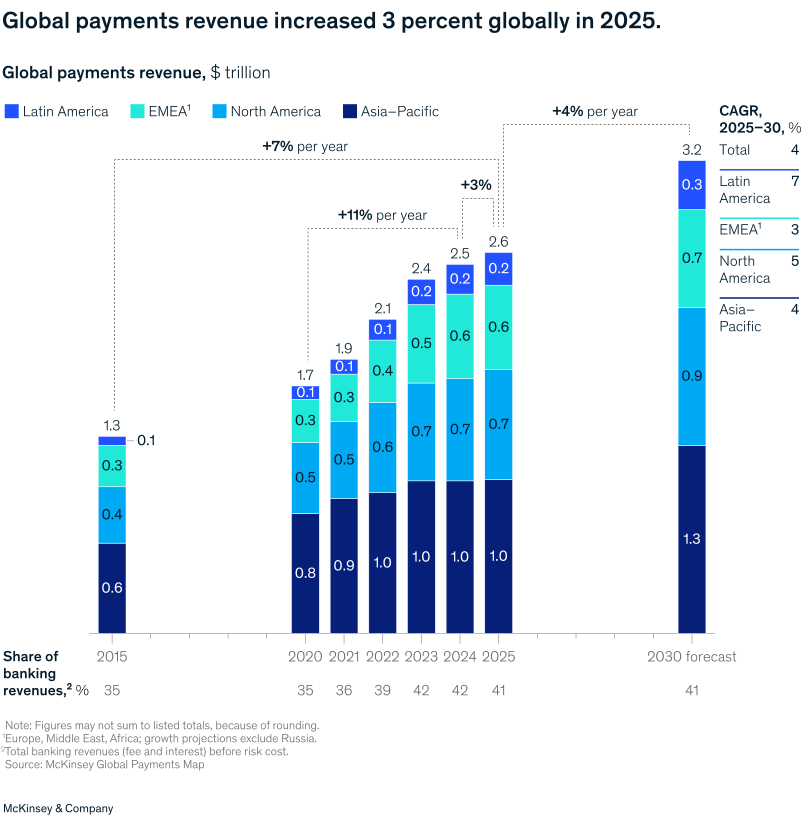
Global payments represents banking’s largest revenue pool, generating approximately $2.6 trillion in revenue from 3.8 trillion transactions and $2.1 quadrillion in annual value flows. Accounting for roughly 41 percent of total banking revenues, the sector has been a core pillar of global banking economics.
Between 2020 and 2025, industry revenues grew at an average annual rate of 9 percent. Four factors powered this expansion: cash-to-digital conversion, rapid payment flow velocity relative to global gross domestic product, elevated net interest margins, and value-added software services.
That trajectory is now shifting. From 2025 to 2030, revenue growth is projected to moderate to about 4 percent annually. The global revenue pool will still expand by roughly $600 billion, reaching $3.2 trillion by 2030. Growth will stem less from broad volume momentum and more from operational discipline, pricing sophistication, balance sheet management, and technological capabilities.
At the same time, the payments architecture is evolving. For decades, payments economics have centered on the visible customer interface, including card swipes, contactless taps, and checkout screens. As software embeds transaction flows, value relocates to the underlying control layer: machine identity credentials, consent frameworks, dynamic routing, and policy guardrails. One clear result is that institutions relying primarily on transaction-clearing volume face increasing margin pressure.
In this excerpt from The 2026 McKinsey Global Payments Report, we offer three snapshots of our key findings shaping the next era of payments:
- shifting sources of revenue—how providers are navigating the transition from broad volume expansion to operational discipline and fee resilience as top-line growth moderates
- navigating multi-rail complexities—why payments infrastructure is fragmenting into contested regional networks rather than consolidating into a global standard
- the implications of agentic commerce—how autonomous software agents are moving transactions from front-end screens to background protocols, putting legacy fee pools (as much as $75 billion in revenues) at risk while unlocking a substantial productivity opportunity of about $110 billion from agentic AI, which could offset the loss.
Shifting sources of revenue
The global payments industry is transitioning from an era of rapid expansion to a cycle defined by execution. Between 2020 and 2025, global payments revenue grew from $1.7 trillion to $2.6 trillion. Revenue grew at 11 percent annually through 2024, then slowed to 3 percent in 2025. Over the next five years, annual revenue growth is projected to average 4 percent, below the ten-year historical average of 7 percent (Exhibit 1). Even with this moderation, the expansion will add about $600 billion in annual revenue, reaching $3.2 trillion by 2030.
Fading drivers and revenue mix realities
Four historical forces lifted the sector over the past decade: cash displacement (declining 4 percent annually), flow velocity outpacing gross domestic product (by 1.2 times), elevated interest rates boosting net interest income, and software-led value-added services. These drivers are now leveling off, and low-cost alternative payment networks are compressing transaction margins.
Consequently, the global revenue mix is expected to rebalance. In 2025, net interest income accounted for 46 percent of payments revenue, while fee income contributed 54 percent. By 2030, fee income is projected to reach 56 percent of the pool, while net interest income settles at 44 percent.
Interest rates will remain an important revenue lever. Our analysis suggests that a sustained 25-basis-point increase in global interest rates from 2026 onward would add about $100 billion to industry revenues by 2030.
Divergent regional paths
The revenue transition will unfold unevenly among major geographies:
- North America. Revenue remains consumer led, with consumer transactions generating 65 percent of payments revenue. Fees account for 58 percent of the revenue pool, supported by credit card interchange and merchant acquiring. Annual growth is expected to slow from 9 percent during 2020–25 to 5 percent during 2025–30.
- Asia–Pacific. Reaching $1.3 trillion by 2030, the region remains heavily commercial, with corporate flows generating 56 percent of revenues. Reliance on deposit balances and transaction banking net interest income will cause annual growth to moderate from 5 percent to 4 percent.
- Europe, the Middle East, and Africa. Commercial transactions account for 54 percent of revenue. Lower benchmark rates are compressing treasury margins, accelerating the transition to fee-based revenue. Growth is expected to slow to 3 percent annually, down from 14 percent between 2020 and 2025.
- Latin America. Latin America is projected to be the fastest-growing region, expanding at 7 percent annually through 2030. Although interest rate benefits are easing and domestic instant-payment networks such as Pix and Bre-B are compressing card margins, growth remains supported by ongoing financial inclusion and e-commerce expansion.
This revenue rebalancing does not occur in a vacuum. As providers seek to defend margins in a slower-growth environment, they must navigate an underlying payment infrastructure that is fracturing into distinct regional markets.
Navigating multi-rail complexities
Rather than converging toward a unified global network, payment rails are fragmenting into competitive regional arenas. In early 2026, interviews with more than 20 senior payments executives across major markets found that domestic policy goals, legacy habits, and regulatory mandates are driving structural divergence among regional payment systems.
Three regional archetypes define payment rails today (see Exhibit 2 for details):
- Card-resilient markets. In North America, the United Kingdom, and Western Europe, card networks remain deeply entrenched. High consumer rewards and universal merchant acceptance protect existing card rails. Autonomous software agents operating in these markets will likely route transactions through existing card rails to preserve buyer protections and liability coverage.
- Instant-dominant markets. In countries such as India and Brazil, state-orchestrated account-to-account networks have achieved scale. Platforms such as India’s Unified Payments Interface and Brazil’s Pix have absorbed cash flows, operating with minimal transaction fees. These open networks bypass traditional card interchange and provide an environment well suited for direct software integration.
- Leapfrog markets. In parts of East and West Africa, economies bypassed telecommunications landlines and traditional card networks. These markets transitioned from cash to mobile-money clearing systems. Mobile network operators serve as regional clearinghouses, and banks build payment products directly on telecommunications infrastructure.
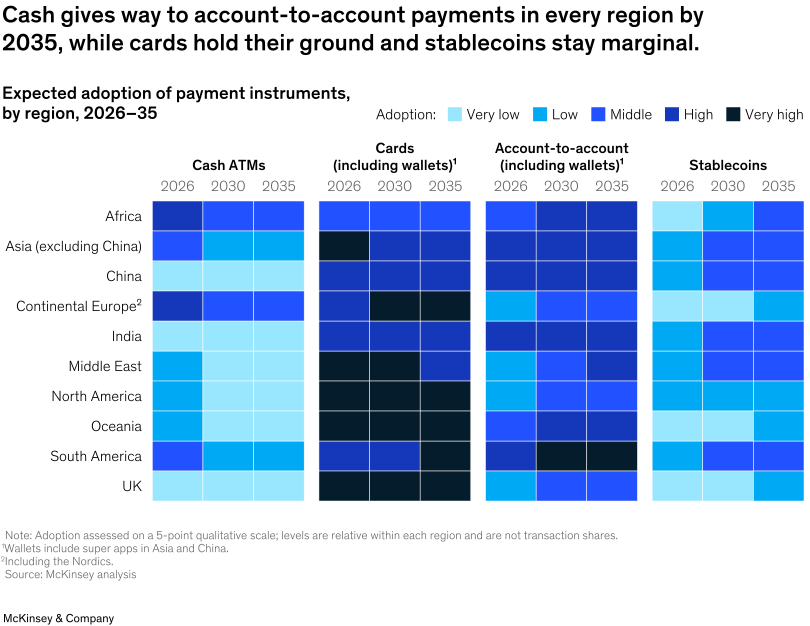
Beyond the increased complexity across traditional fiat payment rails, we also are seeing the rise of digital assets. Discussions with payments leaders indicate that stablecoins and tokenized commercial bank deposits primarily serve as wholesale corporate settlement tools, rather than supporting retail point-of-sale commerce.
In thin or currency-constrained corporate corridors, correspondent interbank transfers often take three to five business days to clear. Multinational enterprises and liquidity providers are turning to stablecoins and tokenized deposits to bridge these illiquid corridors. These assets work alongside real-time payment networks to accelerate intercompany settlement, avoiding foreign-exchange spreads and clearing markups.
Managing this fragmented environment creates cost pressures. Payments IT spending is projected to grow by roughly 9 percent annually through 2030, more than double the sector’s 4 percent revenue growth. Building proprietary connections to every regional network leads to unsustainable margin compression. As a result, organizations are increasingly turning to dynamic routing software and strategic partnerships with domestic market leaders to navigate local clearing rules.
But navigating regional rails is only the first hurdle. A deeper transformation is underway: The transaction itself is becoming invisible, orchestrated not by consumers interacting with checkout screens, but by autonomous software agents that make dynamic routing and execution decisions at machine speed.
The implications of agentic commerce
For more than six decades, payments economics have centered on an observable human checkpoint: handing over a physical card or clicking a checkout button. Today, that physical interaction is receding into the software.
Monetization evolves accordingly. As payments dissolve into background code, value shifts away from branded checkout interfaces to the infrastructure that governs transactions: verifiable machine credentials, consent management, dynamic routing, and automated policy enforcement.
The delegation spectrum: Four states of a payment
Payments do not disappear in a single leap. Two questions define their evolution: Is a human present when the transaction occurs? And was the execution decision fixed in advance or made at runtime?
These criteria underlie four operating states:
- Visible: Human decides and authorizes. The user manually initiates and authenticates the transaction at the point of sale, such as tapping a card or entering numbers during checkout. Commercial maturity is universal, and value resides at the interface.
- Reduced friction: Human decides; execution streamlined. Credentials remain on file, and the user authorizes charges within the application workflow, such as biometric authentication or one-click ride-hailing checkouts. Friction is reduced, but the decision is not delegated.
- Invisible: Human absent; decision fixed in advance. Transactions execute under predetermined instructions using credentials on file, such as recurring subscriptions, direct debits, and balance sweeps. The decision is made once, in advance, based on deterministic rules.
- Agentic: Agent chooses material parameters at execution. The user defines boundary policies, but a software agent dynamically selects the counterparty, amount, timing, or clearing rail at runtime, as in autonomous procurement agents and liquidity routing based on intraday money market yields.
Automation versus runtime discretion
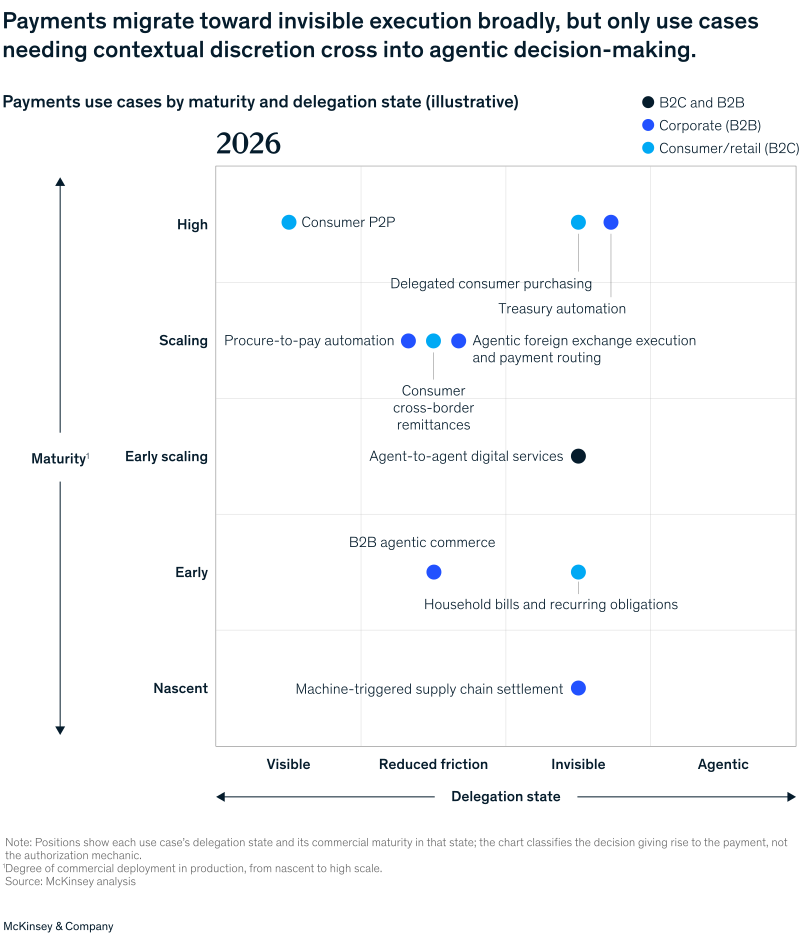
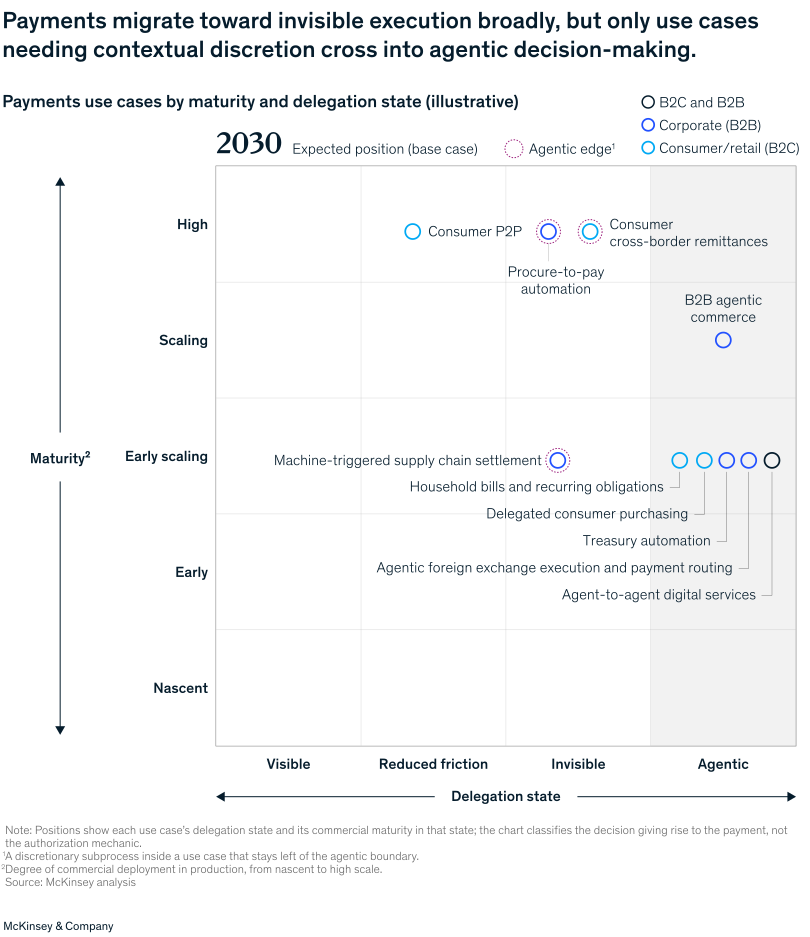
The critical boundary lies between state 3 (invisible) and state 4 (agentic). Financial institutions have automated execution for decades through recurring debits and balance sweeps. But those flows operate on parameters set in advance. True agentic execution occurs only when the decision is made dynamically at runtime, with the agent selecting from options unknown to the principal at the time the mandate was written.
This distinction provides an objective test for investment cases: When variables are known in advance, deterministic automation remains the most reliable and cost-effective option. When variables remain fluid, static rules fail, necessitating delegated authority, runtime policy enforcement, and auditable decision logs.
Progression along this delegation spectrum depends primarily on trust infrastructure, not raw computing power. Evaluating ten primary payment use cases through 2030 highlights how this boundary operates in commercial and retail workflows (Exhibit 3).
The economics of agentic commerce: Disruption versus productivity
Autonomous software alters payments economics through two distinct mechanisms: revenue exposure in legacy fee pools and an immediate operational productivity dividend.
Under our baseline adoption scenario, agentic artificial intelligence could put roughly $75 billion in global payments revenue at risk by 2030.This represents about 4 percent of the $1.9 trillion pool of demand deposits and consumer credit card revenues. In an aggressive scenario with rapid regulatory clarity and consumer delegation, that exposure could reach $160 billion, or 8 percent of the pool.
Two main mechanisms account for this baseline revenue exposure:
- Deposit net interest income compression ($65 billion at risk). Autonomous treasury and personal finance agents could automatically sweep idle cash into higher-yielding accounts or alternative investments, thereby reducing low-cost deposit balances that institutions rely on to maintain interest margins.
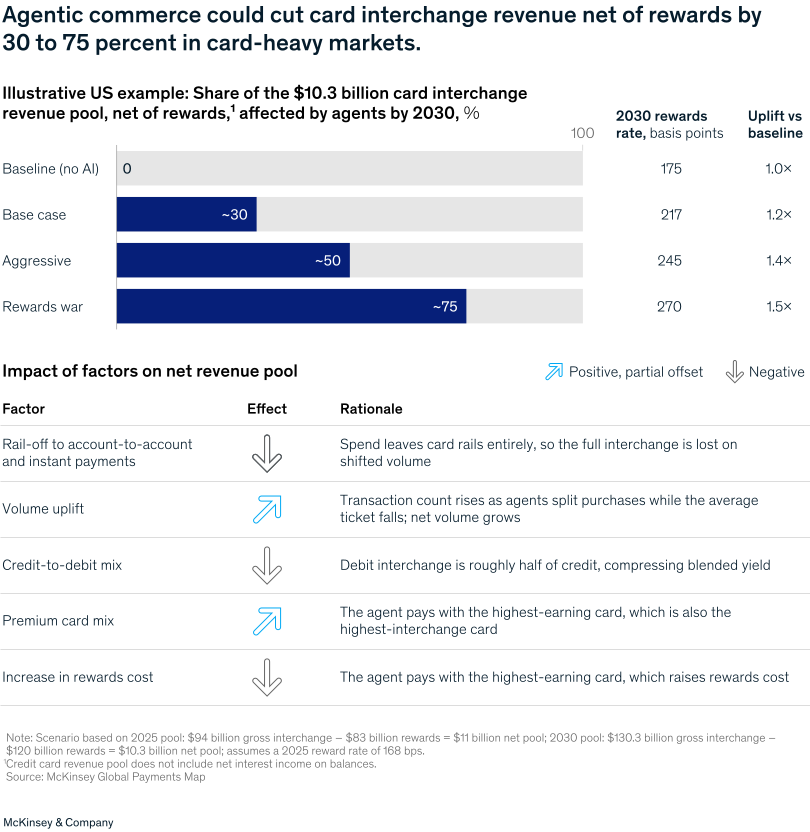
- Consumer card revenue erosion ($10 billion at risk). Agents programmed to optimize merchant processing costs or consumer rewards could dynamically switch payment rails, bypass interchange fees, and automate card payoff schedules to avoid interest charges. In the United States, agentic optimization could disrupt roughly 30 percent of the $10.3 billion net card interchange pool by 2030 by routing transactions away from high-fee rails (Exhibit 4).
Counterbalancing this revenue exposure is an immediate operational productivity dividend. Roughly half of a typical payment service provider's cost base is in technology and customer operations.
Our analysis indicates that generative and agentic artificial intelligence offer an annual operational productivity opportunity of up to $110 billion across four functional domains:
- Customer operations ($50 billion). Payments providers could achieve 15 to 20 percent higher contact efficiency and up to 40 percent reductions in post-contact administrative work.
- Software engineering and IT ($30 billion). Productivity gains of 20 to 25 percent could be achieved through automated code generation, regression testing, and legacy modernization.
- Support functions ($20 billion). Corporate function efficiency could be improved by 15 to 20 percent, and checkout conversion could increase 2 to 3 percent.
- Product development ($10 billion). Payments providers could accelerate time to market and feature design by 15 to 20 percent.
While gross operational task reductions can exceed 60 percent, rising expenditure on computing and specialized talent mean that net cost base reductions typically range from 15 to 20 percent. Organizations that capture these efficiencies early could increase return on tangible equity by up to four percentage points, generating self-funded capital to invest in the next layer of payment infrastructure.
The emerging control layer and protocol standards
As basic authorization and transaction clearing become increasingly commoditized, five product capabilities capture emerging infrastructure value:
- agent credentials—cryptographic identities that bind software agents to human or corporate principals, defining clear authority boundaries and enabling instant revocation
- mandate and consent engines—standardized protocols that specify what an agent is permitted to execute, including spending caps, approved counterparties, and active expiration windows
- runtime policy guardrails—granular spending rules enforced at runtime, such as velocity throttles and category restrictions
- agent wallets—programmatic liquidity containers that enable autonomous agents to hold operating balances and execute micropayments within defined parameters.
- transaction dispute frameworks—recourse mechanisms and clear liability allocations when an agent executes a transaction that technically complies with its mandate yet conflicts with user intent
These infrastructure components generate recurring per-mandate fees, API call pricing, and risk underwriting premiums rather than transaction volume basis points.
Market participants are establishing complementary protocols in different layers of the transaction stack. Card network initiatives such as Visa’s Trusted Agent Protocol and Mastercard Agent Pay focus on machine identity and network dispute rules. At the same time, application standards such as Google’s Agent Payment Protocol and the Stripe and OpenAI Agentic Commerce Protocol govern runtime checkout interactions.
Strategic priorities for financial institutions and operators
To navigate this transition, leaders may want to evaluate focused strategic priorities tailored to their institution’s role.
Priorities for banking institutions
- Anchor trust and machine identity. Issue verifiable machine credentials and manage dynamic consent registries, using established regulatory compliance capabilities.
- Monetize intelligence via APIs. Offer automated cash forecasting, yield optimization, and liquidity management as premium API services to capture active deposit flows.
- Deploy agentic advisory services for commercial clients. Embed autonomous cash management tools directly into corporate workflows to prevent independent software platforms from disintermediating primary corporate banking relationships.
- Capture operational productivity early. Prioritize internal efficiency gains in software engineering, dispute management, and file review to self-fund necessary infrastructure investments.
Priorities for payments operators and networks
- Develop multi-rail orchestration capabilities. Integrate machine identity, consent verification, and dynamic rail routing into a unified offering, rather than competing on single-rail transaction fees.
- Deepen workflow integration. Embed payment software directly within enterprise resource planning and procurement systems to protect customer relationships from commoditization.
- Productize compliance services. Package know-your-customer, anti–money laundering, and dispute resolution into productized compliance services for smaller network participants.
- Build natively for algorithmic agents. Support high-frequency micropayments, sub-millisecond execution, and programmatic API pricing tailored to autonomous software.
The future of global payments will not be decided on visible checkout screens. When transactions are embedded in background code, and software agents make discretionary purchasing decisions, value shifts to the systems that establish machine trust.
Institutions that rely solely on processing volume face steady margin compression. Sustainable value creation will likely favor organizations that achieve operational discipline, capture the artificial intelligence productivity dividend, and secure a defining role in verifying identity, consent, and dynamic routing in an invisible payments world.