Imagine Sandra, who has purchased a subscription to a nonbanking gen AI agent to manage her finances. The AI agent has regular dialogue with Sandra, autonomously scanning for the best banking products on her behalf and seamlessly executing transactions. Sandra might never again need to open her bank-branded app, contact a call center, or visit a branch.
This scenario—in which AI agents disintermediate retail banks’ engagement with customers—may sound far-fetched. But all signs point to the emergence of financial-services AI agents, given the spread of agentic AI applications and increasing user adoption of gen AI more generally. These applications feature systems that can plan, remember, orchestrate, and execute multistep workflows; handle unstructured data; and collaborate across tasks.
Technology may open the door to a future in which an AI agent makes suggestions—for example, “I found a way to pay down your credit card balances with excess cash and save $2,000”—and then acts on the customer’s behalf, even if the “last click” sits with the customer for regulatory reasons. In three to five years, an AI agent could become the channel of choice for all banking interactions, acting as the primary interface between customers and their financial institutions. In other words, retail banks could lose their preeminence in customer relationships.
In this article, we explore how incumbent retail banks can respond to this challenge. We describe a no-regrets move for all banks, followed by a discussion of three strategic postures that they could adopt: Wait and see how the market develops; accept the new AI agent interface layer and adapt by becoming a supplier of financial products; or compete to retain the direct customer relationship. Gen and agentic AI technology is moving fast, so it’s urgent for executives to begin considering their options now.
The threat of disintermediation
Some industries, including entertainment, media, and travel, were subject to disintermediation during the digital revolution. Retail banks faced similar threats from comparison websites, fintechs, and, in many countries, mortgage brokers. Banks mostly succeeded in reinventing distribution to retain a direct connection with their customers, but the coming wave of AI disruption may present a different challenge.
Let’s look at what is already happening. Some financial-infrastructure developments predict the possibility of a banking world of AI agents. Payment networks are enabling agentic commerce. For example, Visa introduced Trusted Agent Protocol, a framework designed to facilitate secure agent-driven checkout where AI can search, compare, and pay on behalf of consumers. Microsoft and PayPal have launched Copilot Checkout, which permits shoppers to discover, decide, and pay without leaving Copilot, an AI-powered chatbot. BBVA has embedded its app into OpenAI’s ChatGPT in Germany and Italy to enable its customers to engage with its products there.
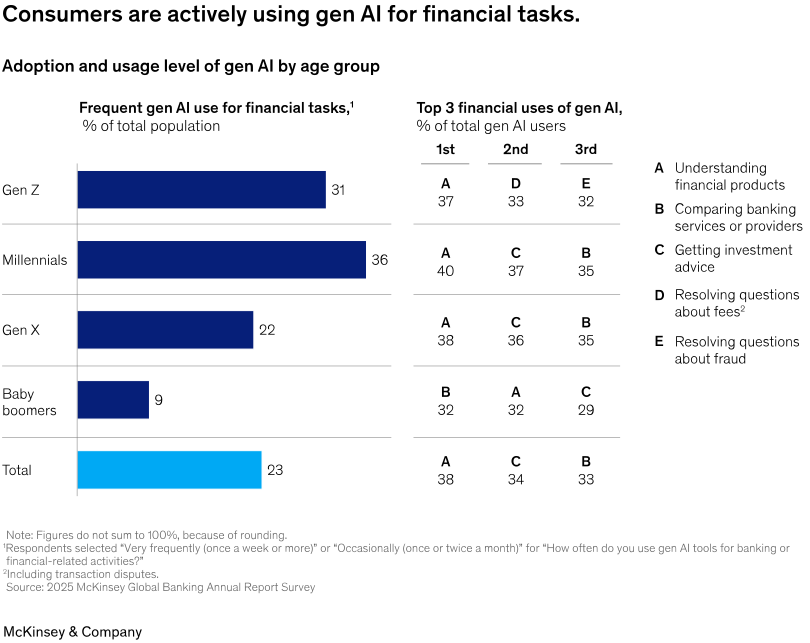
Consumers are already employing gen AI in financial services (Exhibit 1): 23 percent of consumers who responded to a survey for McKinsey’s Global Banking Annual Review 2025 said they use gen AI for financial tasks at least monthly.1 Top-cited tasks included understanding products (38 percent), getting investment advice (34 percent), and providing comparisons (33 percent).
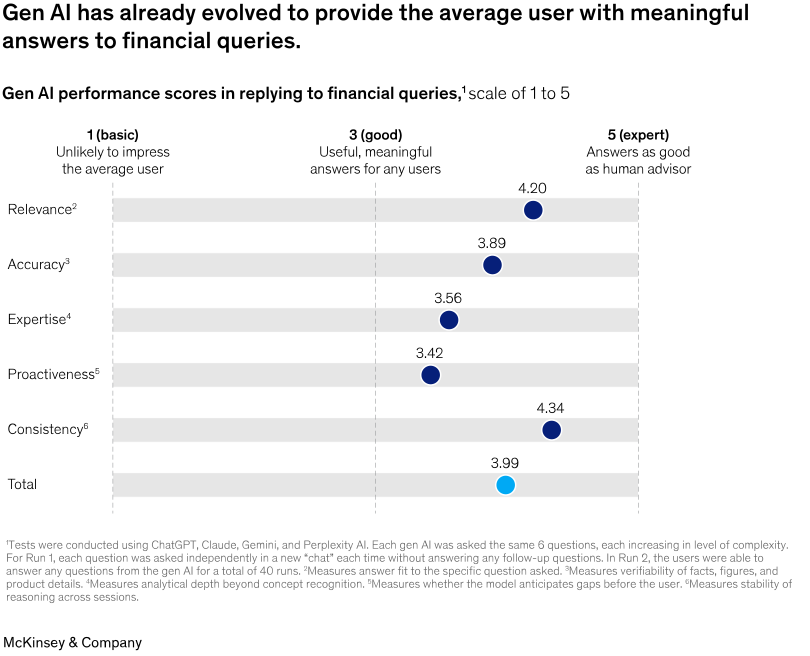
Our research suggests that gen AI is increasingly able to answer users’ financial questions (Exhibit 2). We also found that large language models (LLMs) are much more likely than traditional web searches to suggest financial institutions such as digital-native lenders, fintechs, and credit unions to queries such as “best savings account.” This raises the possibility of intensified competition for retail banks, potentially affecting bank profitability (see sidebar “How gen AI could affect bank profitability”).
Pursuing no-regrets moves
Bank customers’ behavior is shifting from just searching the internet for financial information to asking gen AI for more definitive information about what to do with their money.2 Banks should consider building on classic SEO by developing robust generative engine optimization (GEO) capabilities. Unlike SEO—which focuses on driving traffic—GEO is designed to ensure inclusion and correct framing inside the model’s answer. In our gen AI survey, 49 percent of consumers reported using AI-based search; 53 percent of those said they used it specifically to guide brand discovery and purchase decisions. One financial institution that introduced GEO optimization saw sixfold growth in monthly organic (unpaid) website traffic, according to McKinsey research.
Navigating this shift is about ensuring your content is the most usable, transparent, and credible input to an LLM. Banks have several practical questions to consider:
- Presence and prominence. Are you included in the model’s answer? If so, are you visible and positioned as a legitimate option?
- Sentiment. Is the tone of the content confident and positive, or hedged and skeptical?
- Accuracy and relevance. Are your products described correctly in the answer, and are they matched to the right customer context (not miscategorized or generalized)?
- Depth and usefulness. Does the response help the customer decide (trade-offs, suitability, caveats), or does it stay superficial?
Regardless of which long-term strategy banks eventually adopt, focusing on three areas could improve their chances of appearing at the top of a gen AI response:
Content. Publish clear, structured, and trustworthy material designed for decision-making (for example, financial legislation changes and how-to guides), not marketing. Offer plain-language product explanations and transparent pricing and eligibility information. Employ scenario-based guides that answer pertinent customer questions (for example, “If I travel a lot, how should I manage FX?”). In an AI-mediated world, quality beats volume.
Sourcing. Models infer trust from external validation. That means banks should seek out reputable third-party references—such as media coverage from credible sources; reviews (for example, on Reddit, social media, or LinkedIn); and research citations that are easy for models to find and repeat. In practice, banks should try to shape and influence the set of sources that the model treats as authoritative.
Technical optimization. Gen AI rewards what it can understand. Banks should ensure their website pages are easily searchable, fast, well structured, and unambiguous, with consistent product naming, clean page hierarchies, and machine-readable feature data where possible. Banks should think about how to scale this new capability across different LLMs to account for differences in the various models.
How retail banks could respond to AI agents
We see three paths that retail banks could consider in response to the arrival of AI agents (Exhibit 3).
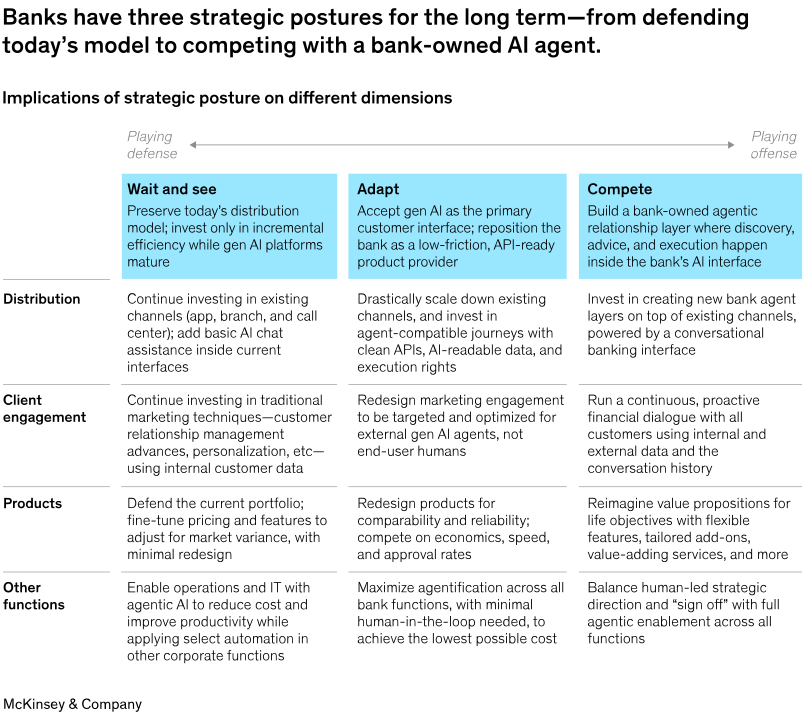
A table lists AI strategies for banks by function across a spectrum of playing defense on the left to playing offense on the right. On the left is the wait and see strategy, which is to preserve today’s distribution model and invest only in incremental efficiency while gen AI platforms mature. For distribution, this strategy involves continued investment in existing channels and adding basic AI chat assistance inside current interfaces. For client engagement, this strategy involves continued investment in traditional marketing techniques using customer data. For products, this strategy involves defending the current portfolio and fine-tuning pricing and features to adjust for market variance, with minimal redesign. For other functions, this strategy involves enabling operations and IT with agentic AI to reduce cost and improve productivity while applying select automation in other corporate functions.
In the middle of the strategy spectrum is the adapt strategy, which is to accept gen AI as the primary customer interface and reposition the bank as a low-friction API-ready product providers. For distribution, this strategy involves scaling down existing channels and investing in agent-compatible journeys with clean APIs, AI-readable data, and execution rights. For client engagement, this strategy involves redesigning marketing engagement to be targeted and optimized for external gen AI agents, not end-user humans, to trigger. For products, this strategy involves redesigning products for comparability and reliability, competing on economics, speed, and approval rates. For other functions, this strategy involves maximizing agentification across all bank functions, with minimal human-in-the-loop needed, to achieve the lowest possible cost.
The playing offense strategy is the compete strategy, which is to build a bank-owned agentic relationship layer where discovery, advice, and execution happen inside the bank’s AI interface. For distribution, this strategy involves investing in creating new bank agent layers on top of existing channels, powered by a conversational banking interface. For client engagement, this strategy involves running a continuous, proactive financial dialogue with all customers using internal, external, and conversation history. For products, this strategy involves reimagining value propositions for life objectives with flexible features, tailored add-ons, value-adding services, and more. For other functions, this strategy involves balancing human-led strategic direction and “sign off” with full agentic enablement across all functions.
Wait and see: Carry on with the status quo but prepare to be a fast follower
In this option, retail banks acknowledge that AI agent banking is coming but assume its impact doesn’t justify a material change in investment or strategy. Banks pursuing the wait-and-see approach believe that various friction points will slow or disrupt the potential disintermediation, including regulation, consumer inertia, affordability, and lack of trust (we discuss these issues in greater depth below). In this reading of the marketplace, banks conclude that they have faced multiple threats over the past ten years but have mostly overcome them and can do so again.
Their operating posture can remain the same: Continue investment in the current distribution model, fine-tune core banking products, improve marketing capabilities, and treat AI primarily as an internal productivity tool rather than as a customer relationship disintermediation threat.
That said, the speed of development of AI technology is so fast that a wait-and-see approach could lead to a “too little, too late” outcome. Banks should regularly review this stance and consider building the right capabilities to position themselves as fast followers, allowing them to move quickly if disintermediation becomes a real threat.
Adapt: Embrace disintermediation
In this strategy, retail banks fully embrace gen AI agents as the new distribution model and see opportunities in disintermediation, especially if they act early. They optimize their operating model by committing to work within the gen AI environment, tailoring their marketing to this new channel, increasing product commoditization, and becoming more efficient to better compete on price.
Fully exposed service and sales journeys. Banks will operate inside the AI agent environment, allowing customers to complete all financial needs there. The AI agent will evaluate and transact products regularly to optimize outcomes for the user. This requires machine-readable product information, clean API integration, simplified agent-friendly workflows, and seamless onboarding to reduce switching friction.
Tailor marketing for gen AI. Banks will still need to engage in proactive marketing to win share of wallet. But instead of marketing directly to customers, they will market offers directly to customers’ AI agents. The aim is to encourage the AI agent to consider moving some of the customer’s money to the bank sending the prompt.
Redesigned product lines. As more banks integrate with the AI environment, the agent will be able to evaluate banks on rates, fees, and reliability. In response, banks will increasingly commoditize some products while in parallel exploring the potential of a few specialized products that can stand out in the marketplace.
Attain the lowest possible cost to serve. AI agents will increasingly handle discovery, acquisition, cross-selling, and service, potentially lowering banks’ direct distribution costs. This could mean fewer frontline staff such as tellers, bankers, and call-center agents. Instead, small groups of specialized experts might remain (for example, mortgage advisers) for niche and high-value situations. However, this evolution could strip banks of control over experience, leaving pricing as a primary sales lever.
Success in adapting to this new world could come down to using the new technology to fundamentally reduce overall operational costs and the cost of risk, providing a margin buffer to more aggressively compete on pricing (for example, more favorable interest rates for the customer).
Compete: Fight to retain customer relationships
Banks could treat the interface shift not as destiny but as a competitive arena. This approach means striving to remain the place where decisions get made and customer actions are executed. Banks should further double down on their strengths—trustworthiness, access to unparalleled data, and financial expertise—to create personalized, contextualized, and “always on” dialogue with customers across both mass and affluent segments about their needs (see sidebar “What the new model could look like in practice”). Some 62 percent of surveyed consumers said they most trust their primary bank to offer gen AI financial services (compared with only 19 percent who most trust a major tech company).3
Banks taking the “compete” approach will sometimes be unable to fulfill a customer need (for example, not offering a loan because of risk). The bank should still support the customer by offering guidance on product selection, even if it is not the end provider of the product.
Competing is a realistic option for banks that can transition into this new kind of interaction model before gen AI becomes the default interface. To achieve this, banks should use the latest AI technology to pursue four important actions:
Embrace conversational banking for distribution. Banks can create their own conversational interface layer—an agent—atop existing banking channels. The objective is straightforward: Maintain a continuous financial dialogue with the customer and defend against third parties becoming the default coordinators of financial life. Some 57 percent of customers already say they would consider using a third-party gen AI financial agent if their banks don’t offer one.4
For a retail bank, this approach demands significant change. A bank’s mobile app must shift from a primarily point-and-click-based interface to a typing-to-action, chat-style interface that mirrors gen AI. The call center will be powered by a voice bot; human support can be provided for more complex situations through a small agent team or rerouted to branch staff. As for in-branch or remote human advisers, they could partner with an AI agent that listens in and actively contributes to meetings, provides coaching and feedback, optimizes daily tasks, and suggests strategies for customer engagement.
Banks could create a master “conversation” log containing every customer interaction, leading to a new unstructured data source that can be tapped by other agentic teams, such as analytics.
Success will require a clear scale-up road map that starts with a well-defined pilot in a target channel. The pilot would form the foundation of the future conversational layer.
Build an always-on customer interaction core. AI will be critical in processing, generating, and orchestrating how banks engage with customers. For example, if a bank’s systems detect a change in a customer’s life circumstances, they could suggest a relevant option before the customer turns to gen AI for recommendations.
To do this at scale, banks will use gen and agentic AI to combine existing customer data with external signals (such as the best time of day to contact a customer) and with prompts extracted from the conversation log referenced above to anticipate customer needs and adjust engagement strategies in real time. Currently, most engagement involves either servicing or sales; in the future, the range and scope of contact with customers could expand significantly, adding outreach to areas such as financial education or the implications of external market events (for example, changes in interest rates). AI will then create truly personalized communication approaches, including tailored text, tone, visuals, and pricing.
Banks that have started this journey are already seeing strong results, from a 65 percent increase in cross sales to a 30 percent net annual growth in primary customers, according to McKinsey research.
Reimagine the value proposition. Each product line will have to offer more than just the core financial component. Product lines should support life events and objectives such as improving health and facilitating hobbies. For example, daily banking (checking accounts and credit cards) could have selectable add-ons based on customer interests. Movie fans could get a discounted bundle to streaming platforms, while fitness buffs could select monthly class passes.
Other products could focus on providing adjacent services. Looking to organize a wedding? Here is a list of professional photographers. Need to renovate? Here are some local builders. These types of service providers might include small-business clients that opt into the bank’s marketplace. In parallel, banks should embed thoughtful loyalty strategies across all interactions to create meaningful stickiness by rewarding positive financial health actions and behaviors.
Rewire the bank to a human-led, agentic-powered productivity powerhouse. To deliver the changes outlined above, manage growing complexity, and maintain healthy profit margins, banks will need to greatly improve productivity. Banks that have already applied existing digitization and automation techniques have reduced their cost-to-income ratios by nearly 10 percent, according to Finalta analysis.
Agentic AI should enable banks to further improve their productivity. Agentic AI teams can be deployed for tasks ranging from quality control of mundane, repeatable tasks to complex orchestration of real-time customer engagement strategies and even strategic workforce planning, all with human-in-the-loop supervision. For example, they could handle end-to-end mortgage origination, including know-your-customer authentication, document verification, and risk assessment. Agentic AI could also take on software development for faster time to market. Recent advances in technology make it faster and cheaper to build, deploy, and manage such agentic teams.
Proper governance and protocols must be put in place to manage AI at this scale to address risk issues and duplicative efforts while keeping humans at the steering wheel, setting the direction and supervising critical decisions.
Slowing the rise of AI agent banking disintermediation
The possibility of gen AI agent disintermediation is real, but at least four kinds of friction could slow it down.
Regulation
The moment an AI agent can move money, open accounts, refinance debt, or route payments, regulatory requirements could come into play. The introduction of an AI agent raises three main issues: intent (did the customer truly want to execute the suggested transaction?), identity (is the agent acting for the right customer, with valid authority?), and liability (who pays when something goes wrong—the platform, bank, or customer?). Any AI company that wants to pursue traditional banking activities must earn the right to operate within local regulatory frameworks.
Natural friction
Deposit mobility isn’t just a function of rate awareness. Switching requires a customer to untangle entrenched banking arrangements—their paycheck, bills, cards, and savings may all be tied to one banking hub. Even if AI agents reduce friction, they can’t eliminate household complexity.
Affordability
A high-functioning, always-on AI agent experience can be costly for consumers if a premium subscription is required. Only roughly 5.0 percent of gen AI users today pay for premium subscriptions to OpenAI models, with an increase to just 8.5 percent expected by 2030.5 The customer would need large-enough balances for the few hundred extra basis points of yield that an AI agent could facilitate to translate into the higher earnings that would offset the customer’s subscription costs for the AI agent.
Trust may lag behind utility
Even customers who seek financial advice from agents may be reluctant to hand over control of their money. It’s one thing to ask an AI agent to compare rates; it’s another to let it manage the money deposited from a paycheck, touch savings, or tinker with debt. A few visible failures could undermine trust, lead to tighter controls, and push the market toward a model in which agents recommend, but banks (and customers) remain the execution gatekeepers.
The adoption of gen and agentic AI has broad financial and operational implications for retail banks. In the years to come, these banks could lose customer relationships to AI agents. Some may choose to wait and see how the market develops. Others may see gen AI disintermediation as an opportunity and adapt to it. Some will vigorously compete to keep the direct customer relationship. Whatever path bank executives ultimately choose, now is the time to begin evaluating the opportunity or threat that AI agents pose.