Modernizing the core technologies underpinning the insurance industry has long been viewed as essential. Yet excuses for failing to act persist, from complexity to cost to risk. No more. Agentic AI, drawing on experience from large-scale AI transformations, including work pioneered within QuantumBlack, McKinsey’s AI arm, presents the opportunity to fundamentally transform how modernization is done end to end by capturing legacy knowledge at scale, compressing rework loops, and improving predictability across testing, reconciliation, and cutover.1 It holds the promise of agents performing and coordinating discrete tasks with auditable outputs and human-in-the-loop controls—empowering leaders to rethink their modernization portfolio. And not only could it help insurers significantly improve financial viability by moving from one-off, bespoke programs toward a repeatable, scalable modernization factory,2 but early adopters of agentic AI may gain a competitive edge.
The problem: Insurance core modernization’s endless challenge
Insurers failing to modernize core systems often blame their inaction on specific structural costs and risks related to how technologies are built and operated.3 And there’s no denying these challenges are real: Executives know that legacy core modernization is hard because the “core” is a living socio‑technical system that may comprise several decades’ worth of sparsely documented embedded business rules, batch windows, custom interfaces, and data semantics.
In addition, in policy administration migrations, several common constraints may repeatedly create schedule slippage and re-baselining cycles,4 from underdocumented product logic and actuarial settings to semantic gaps that often surface late and drive rework as well as cutover and runbook risks that force conservative sequencing. These dynamics have direct economic consequences that also reduce the appeal of modernizing core systems, including causing costly “double-bubble” periods in which insurers pay to run the legacy stack while funding the change program and prolonging the need to run systems in parallel, extending the timeline for decommissioning legacy platforms.5
A final but critical nuance undermining insurers’ motivation is understanding where effort actually goes. In most insurance migrations, rewriting code or configuring the target platform is only a small portion of the work. A disproportionate share of time and investment often sits in understanding and configuring the rules, data conversion, quality control, reconciliation, operational readiness, and postmigration stabilization. That’s why platform migrations often disappoint when teams attempt to recreate legacy complexity on a modern core. The discipline is knowing not only what to build but also what not to rebuild.

The state of AI in 2026: On the road to ROI
Organizations are deploying agentic coding tools and coming to grips with the costs of AI while still seeking to capture more of the benefits that their workers are deriving from their individual use of AI.
The potential solution: Agentic AI reshapes the cost curve
While the challenges of core system modernization have proved insurmountable for many insurers, agentic AI may provide a solution, drawing on experience from large-scale AI transformations, including work pioneered within QuantumBlack, McKinsey’s AI arm. Autonomous or semiautonomous software agents can interpret legacy artifacts, produce structured documentation, generate and validate configuration or code, create and run tests, and coordinate workflows across the software delivery life cycle.6
This is different from a developer copilot: While copilots assist a user moment by moment, agents are designed to pursue a goal, break it into tasks, use tools and context, and iterate based on feedback and controls.7 In a policy administration migration, this matters because the biggest bottlenecks are rarely typing code but rather the loops of discovery, mapping, testing, reconciliation, and cutover. Exhibit 1 outlines where agents can create efficiency within each domain step with, in our experience, typical productivity improvements ranging from 10 to 90 percent, depending on the step and the degree of automation.
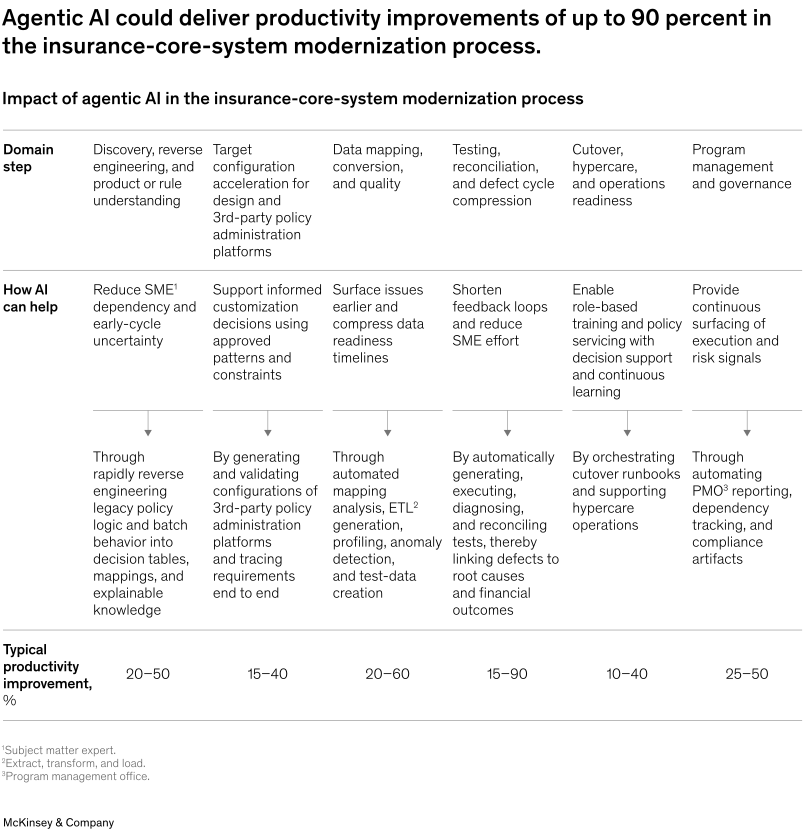
Most core technologies in the insurance industry use programming language, coding, and even systems created decades ago. In many cases, it’s difficult to find people fluent in these languages and systems—or even workers able to understand them. That’s why some of the most significant gains in enabling core modernization with agents come from decoding and translating outdated programming language, drafting rules, and mapping artifacts. Agents can read code written in archaic languages, reverse engineer the logic, and convert it into plain English. Likewise, agents can parse code and extract and document the business rules embedded within it. In many cases, an agent can accomplish within days what would take a trained subject matter expert months or even years to do.
Once these agent capabilities are established, the incremental cost of modernizing additional products and systems can fall quickly because the same agents, patterns, and context layers can be reused across waves and domains. In this way, agentic AI creates a portfolio option that insurance technology leaders have not had before. In addition to enabling the transition to a new core system (which is often a software-as-a-service platform), there is often a long tail of adjacent legacy applications, utilities, and interfaces that need to be migrated. Agentic approaches can make selective rewrites of this long tail economically viable, reducing maintenance cost and long cycles of migration and integration.8

The technology shifts every business leader should be watching
October 15, 2026, 9:30 a.m. ET / 3:30 p.m. CET
Join McKinsey experts Michael Chui and Roger Roberts for a discussion on tech trends, including where momentum is building, how the major trends are converging, and what these shifts mean for business leaders, workers, and society.
Best practices to capture value
Reshaping the way insurers modernize their core systems with agentic AI requires more than simply applying the technology. It demands fundamental shifts in workflows, roles, governance, and sequencing. In our experience, three moves matter most:
Building modular agents to accelerate the whole process
The highest-performing technology migrations decompose work into reusable, composable agents across extraction, validation, transformation, orchestration, and generation. This approach improves control, makes outputs auditable, and enables reuse across discovery, data, testing, and cutover. In practice, it means treating agents as a library of atomic capabilities, each with clear inputs, acceptance criteria, and escalation paths to humans (Exhibit 2). It also makes it easier to update specific components as models and tooling evolve, without destabilizing the whole workflow.
Shifting from a single-program mindset to a modernization portfolio
Agentic capabilities fundamentally change the unit economics of modernization because once core agents are built and governed, their marginal cost of reuse sharply declines. That means modernization can be framed not as a single large-scale migration but as a coordinated portfolio of opportunities across the full technology estate.
McKinsey research on AI-enabled software engineering finds that the greatest impact comes when AI is embedded across workflows and scaled systematically, rather than confined to isolated use cases.9 In an insurance context, this means looking beyond migrating the administration of single policies to the broader landscape: multiple product lines, billing and claims integrations, satellite systems, and high-maintenance legacy utilities. This does not mean that value cannot be realized from tackling modernization in phases, such as end-to-end prospecting—design choices can be tailored to achieve specific outcomes according to a particular cadence or timeline. But the ideal end state for optimal impact is full modernization of the legacy core.
With a reusable agent stack in place, the incremental effort to modernize additional products or adjacent applications has the potential to fall materially. That allows leaders to evaluate platform migrations and decommissioning decisions, as well as selectively rewrite long-tail legacy applications, as part of an integrated road map. And this portfolio lens enables compounding value creation while maintaining governance and platform discipline.
Redesigning roles, governance, and risk management for agentic execution
Insurance modernization is regulated and operationally sensitive. Agentic workflows need controls by design such as human-in-the-loop approvals at stage gates, traceability from requirements to configuration to test evidence, and clear model-validation practices. Agentic AI fundamentally reshapes roles and creates more full-stack “product definers” and “product builders,” making talent upskilling critical. For technology leaders, this implies treating agents as a new production system that requires defined privileged access, monitoring of behavior and outcomes, and the use of auditable artifacts for regulatory and internal assurance, with humans involved throughout.
What to do next
Core modernization has for good reason long been viewed as one of the largest and most risk-laden technology investments insurers undertake. Yet agentic AI directly addresses the bottlenecks and expertise gaps that prevail today. The strategic question becomes not whether to experiment with agents but how to deploy them in ways that materially improve certainty on cost, risk, and timeline. That requires three shifts: embedding agents across the full modernization life cycle rather than in isolated tasks, sequencing modernization as a portfolio to capture reuse and declining marginal cost, and redesigning roles, governance, and risk management for agentic execution.
Insurers that combine reusable agent capabilities with strong governance and platform rigor can accelerate legacy decommissioning while preserving control. The advantage is not faster coding alone but a structurally different and value-compounding modernization model. And it may finally deliver the modern technology backbone insurers have long known is essential.