While stablecoins dominate headlines and regulatory debate, they account for only a fraction of the emerging on-chain economy. A larger transformation is unfolding within the traditional banking system, where tokenized deposits already facilitate trillions of dollars in annual transfers, far more than stablecoin payments. This signals the potential of a three-layer monetary stack, comprising stablecoins, tokenized bank deposits, and central bank money, which could move on-chain finance from primarily retail applications to institutional reality.
The scale gap: A $4 trillion reality
The accelerating media coverage of stablecoins, bolstered by forecasts of $4 trillion in adoption by 2030 and high-profile unicorn valuations for independent issuers, has created a sense of urgency among corporate and bank leaders.1 This fear of missing out is understandable given the rapid evolution of digital assets. However, transaction data suggests that market adoption is not as advanced as the prevailing narrative might suggest.
Despite high market expectations, global stablecoin activity remains modest when viewed through the lens of global payments. As of early 2026, total stablecoin circulation sits at a little more than $300 billion,2 with about 99 percent denominated in US dollars and 85 percent issued by Circle or Tether. This total has remained relatively unchanged over the past six months, even as the values of noncash assets issued on blockchains, such as Treasury funds and private credit, have increased by more than 30 percent.3 This leveling off of stablecoin circulation challenges the assumption that stablecoins are the default settlement asset and that other tokenized values grow in lockstep with it.
Research by Artemis Analytics, highlighted in a recent McKinsey article,4 provides a data check: In 2025, the stablecoin market supported approximately $400 billion in organic payment activity. This volume is a minute proportion of the several quadrillion dollars that move annually through global payment systems. However, in parts of Asia, digital-asset ecosystems and progressive regulatory frameworks are already driving significant institutional volume (see sidebar, “Spotlight on Asia’s leading role in stablecoin adoption”).
By contrast, major global systemically important banks are already moving substantially larger volumes through tokenized deposit infrastructures. These flows, estimated at more than $4 trillion annually,5 are an order of magnitude larger than stablecoins and are embedded directly into existing institutional payment, liquidity, and treasury workflows. More than a dozen institutions, including Citibank and BNY, have publicly disclosed live deployments or pilots, each on their own proprietary platforms.
JPMorgan’s Kinexys alone is estimated to facilitate more than $1 trillion in tokenized deposit transfers annually, supporting internal treasury movements, intercompany payments, and institutional settlements.6 It is likely that other large banks are supporting similar volumes, especially those that historically maintained a meaningful cross-border payments business. These flows are an order of magnitude larger than stablecoin-based payments today and are already integrated into existing banking workflows.
By comparison, tokenized central bank money remains largely experimental. Early projects, such as Canada’s Project Jasper–Ubin, highlighted that cross-border arrangements for central bank digital currencies could raise monetary sovereignty and legal-authority questions, potentially requiring legislative and regulatory changes.7 Similar trials in France, Singapore, and Switzerland have explored wholesale use cases but have not yet reached widespread commercial release. For now, even optimists predict that it could be several years before central bank digital currencies become ubiquitous. However, they remain a fundamental necessity for true finality in international settlement. While banks can settle between themselves within closed or private networks, central bank money is the only asset that eliminates counterparty risk among different banking “islands.” Without this neutral settlement layer, true global finality—in which value moves across disparate systems without residual institutional risk—remains elusive.
Finally, while decentralized cryptocurrencies such as Bitcoin have served as a payment medium for more than a decade, challenges regarding price instability, anonymity, and the limited scalability of existing layer-two solutions have prevented their widespread adoption for commercial global payments.
The institutional case for tokenized deposits
The scale differential between stablecoins and bank-led flows suggests that institutional adoption may follow a different set of rules than retail experimentation. For large-scale finance to move on-chain, the primary considerations shift from accessibility to capital preservation and compliance.
Innovation versus bank deposit displacement
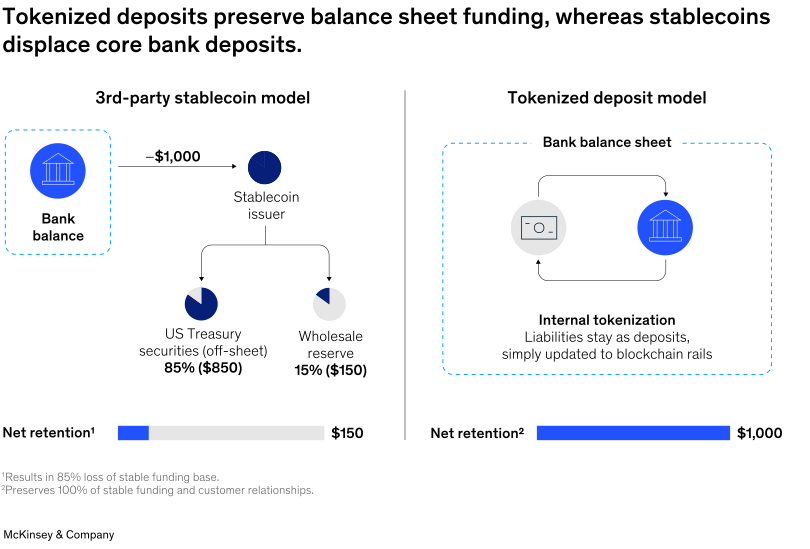
The fundamental difference between stablecoins and tokenized deposits lies in their effect on bank balance sheets. While fintech-issued stablecoins displace bank funding, tokenized deposits modernize it. This structural divergence is driven by a conflict of incentives: Stablecoins are issued by third-party private institutions and compete with and absorb bank deposits. Banks, however, can tokenize their own deposits, preserving balance-sheet funding while gaining programmability, faster settlement, and operational efficiencies.
Third-party stablecoins, such as those issued by Circle and Tether, operate by converting retail bank deposits into tokenized liabilities. This process is conceptually similar to the disintermediation with money market mutual funds, in which bank deposits are used to purchase off-balance-sheet assets such as US Treasuries. However, stablecoins provide a modern vehicle for this shift: For every $1,000 converted into a third-party stablecoin, typically only 15 percent returns to the banking system as wholesale reserves. According to McKinsey analysis, the remaining 85 percent is usually invested in off-balance-sheet assets, such as US Treasury securities.
For the banking sector, the concern is less about a novel form of leakage and more about the erosion of the primary customer relationship. When value moves to a third-party rail, the bank is no longer the primary service provider for that transaction. As these digital balances grow, they challenge traditional bank funding structures, putting pressure on net interest margins and liquidity coverage ratios (LCRs). As a result, some banks have formed consortiums to issue their own alternatives, seeking to strengthen deposit relationships that are being weakened by third-party digital assets.8
In contrast, tokenized deposits keep the full $1,000 on the bank’s balance sheet. Rather than creating a new form of private money, banks simply represent existing deposit liabilities on blockchain rails. This approach preserves the established legal, regulatory, and accounting frameworks inherent to traditional banking (Exhibit 1). By tokenizing their own liabilities, banks can counter the disintermediation threat—capturing the functional advantages of stablecoins, such as programmability, simultaneous exchange, and reduced reconciliation—without surrendering the primary customer relationship to third-party issuers.
The liquidity trade-off in fragmented rails
While banks maintain a structural advantage in balance sheet management, third-party stablecoins lead in network effects, retail accessibility, and market liquidity. The largest stablecoins, Circle’s USDC and Tether’s USDT, benefit from extensive integration across the digital-asset ecosystem and, through deep order books on major exchanges such as Coinbase, Binance, and OKX, offer users low-cost foreign exchange liquidity and interchangeability up to a few hundred billion dollars. For certain corridors, this can enable faster foreign-exchange conversion than traditional correspondent banking, albeit primarily within crypto-native environments.
Tokenized deposits, by contrast, are relatively new and fragmented. Most are issued on proprietary, permissioned blockchains that operate as closed systems, making cross-bank exchange and true fungibility no less challenging. Compared with stablecoins exchanged freely—and potentially anonymously—on public, permissionless blockchains such as Ethereum and Solana, the design of tokenized deposits limits their fungibility. Although the volume of tokenized deposits that can be issued is limited only by the issuing bank's balance sheet, a tokenized dollar issued by one bank is not easily interchangeable with one issued by another, recreating the very fragmentation that blockchain was intended to overcome.
Interoperability is therefore among the primary constraints on the growth of tokenized deposits, not because the technology is immature but because coordination across banks is slow, complex, and commercially sensitive. Several global coalitions are working to address this constraint, and if one or more succeeds in 2026, near-instant commercial bank money payments could become a reality.
The regulatory edge for tokenized deposits
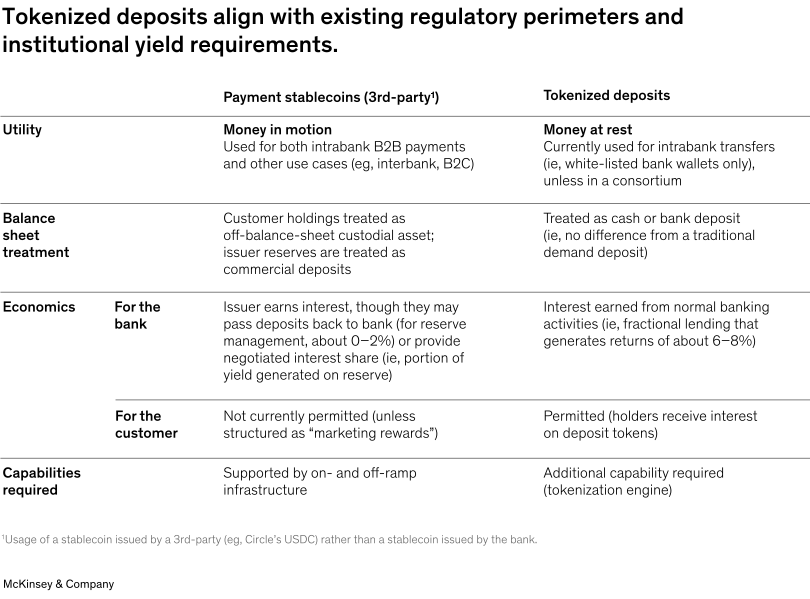
Beyond operational mechanics, the regulatory landscape favors bank-issued assets. Stablecoins are subject to regulatory frameworks, such as Europe’s Markets in Crypto Assets Regulation and the US GENIUS Act. While these regimes aim to provide consumer protections and clarity concerning licensing and high-quality reserves, they can also impose constraints, such as restrictions on interest-bearing balances. In most jurisdictions, stablecoin holders cannot earn yield from licensed issuers, which can limit stablecoins’ appeal to corporates and institutions.
In contrast, there is no dedicated, global regulatory regime for tokenized bank deposits; in nearly all jurisdictions, they fall under existing banking regulation. In Europe and the United States, they are treated as traditional deposits so long as they remain on bank balance sheets. Tokenization changes the form factor—issuing deposits on a blockchain and making them programmable and divisible—but not the legal nature of the liability, nor its LCR treatment or funding stability. This distinction is attractive for yield-sensitive corporates and institutions managing large balances because banks can continue to pay interest on deposits (Exhibit 2).
In both models, the performance of adequate know-your-customer (KYC) and anti-money-laundering (AML) checks will remain critical. Historically, stablecoin issuers have screened only the on- and off-ramps of funds. However, mandates such as the GENIUS Act now require them to perform full-spectrum KYC, AML, and Travel Rule checks on par with traditional banks.
Growing deposits through interoperability
To realize the potential of tokenized deposits, global coalitions are now moving to address the structural constraints created by their fragmentation on proprietary blockchains. While technical solutions are advancing, it will be important for banks to align on legal finality, liability, and shared rulebooks, historically the slowest part of financial innovation.
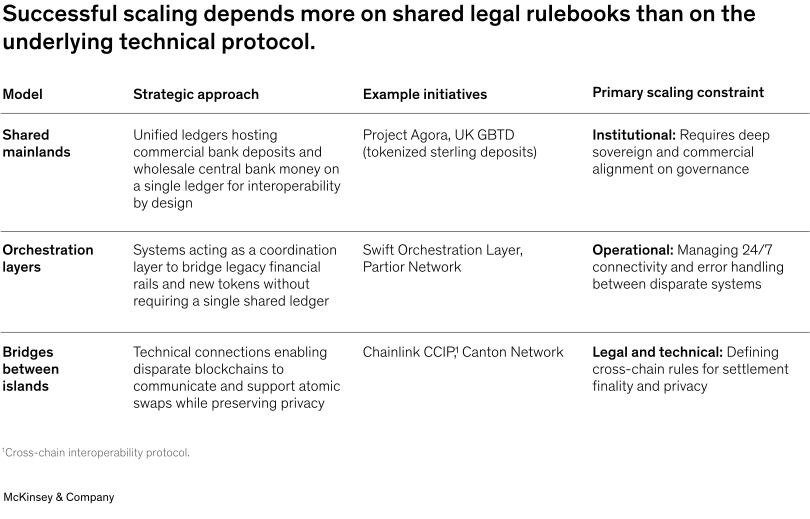
The industry is coalescing around three distinct strategic approaches to interoperability:
- “Shared mainlands.” Unified ledgers host commercial bank deposits and wholesale central bank money on a single ledger, achieving interoperability by design. Key initiatives include the BIS’s Project Agora, which seeks to integrate tokenized deposits with wholesale central bank money for global settlement, and the United Kingdom’s GBTD (tokenized sterling deposits), which focuses on creating fungible tokenized sterling deposits across a shared network.
- Orchestration and coordination layers. These systems facilitate the exchange of value between existing payment systems and tokenized assets without requiring a single shared ledger. For instance, Swift’s orchestration layer bridges tokenized assets to legacy financial rails, while Partior’s international network connects domestic tokenized deposit networks to facilitate global money movement.
- Bridges between “islands.” These connections enable disparate blockchains to communicate and support simultaneous exchange while preserving participant privacy. Examples include Chainlink’s cross-chain interoperability protocol with Swift, which provides secure cross-chain messaging across disparate protocols, and the Canton Network, an interoperable fabric for privacy-preserving simultaneous exchange of assets among diverse technical domains (Exhibit 3).
Regardless of the model, growth depends on a shared set of rules to ensure that all tokens behave the same way economically and legally. Key considerations include the following:
- defining specific parameters for par redemption of a single token unit and convertibility rights to determine who may redeem, when they may do so, and how the process is executed
- ensuring uniform base compliance across KYC and AML protocols and international sanctions, the Travel Rule, and comprehensive permissioning frameworks
- agreeing on clear rules for digital settlement finality, ensuring that the transfer of a tokenized asset is legally recognized as irrevocable at the moment of ledger synchronization
- establishing everyday operational conventions for access, error handling, and dispute resolution
- adopting a common messaging and data standard, such as ISO 20022, for tokens moving between different rails
Success in interoperability will likely be determined less by technical protocol and more by which legal rulebook gains enough signatures to create a critical mass of fungible, bank-issued liquidity.
Synchronizing the layers of global value
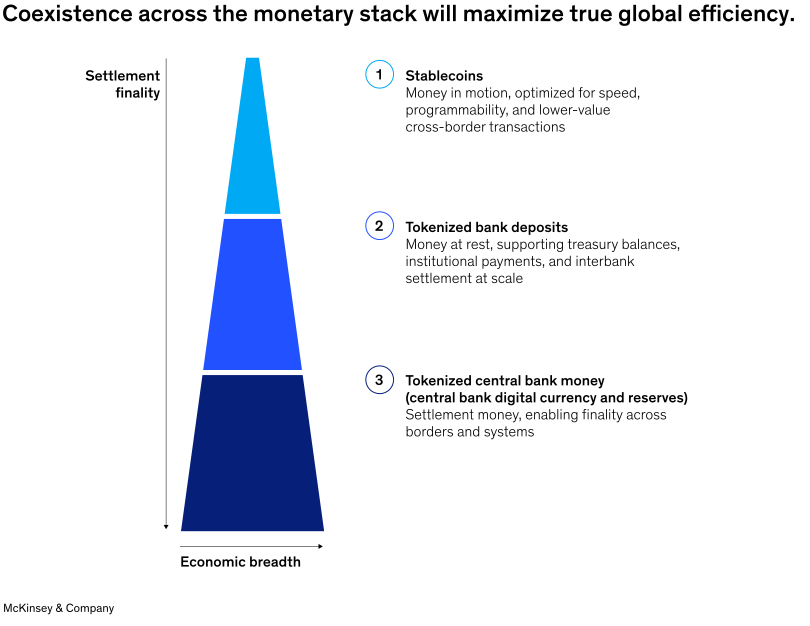
Current trends suggest that 2026 will be a pivotal year as competing consortiums and interoperability projects test which models can solve the long-standing frictions of global money movement. We expect a future of on-chain money not as a monolith, but as a layered system in which these forms of value coexist to harmonize global money flow:
- Stablecoins as “money in motion”: optimized for rapid, lower-value, cross-border transactions and automated disbursements—particularly where traditional banking access is limited
- Tokenized bank deposits as “money at rest”: supporting treasury balances, institutional payments, and interbank settlement at scale
- Tokenized central bank digital currencies as “settlement money”: the ultimate global settlement asset that eliminates counterparty risk between disparate systems, enabling irrevocable finality across borders
This multicomponent stack mirrors the complexity of today’s financial system rather than simply replacing it. The evolution of this stack could define the future of on-chain money; rather than a single dominant asset, the success of the system depends on how these three layers coexist and interoperate (Exhibit 4).
Navigating the path toward a multilayer stack
The future architecture for on-chain payments will likely involve a complementary system of stablecoins, tokenized bank deposits, and central bank digital currencies operating in concert. However, structural challenges, from liquidity and operational costs to balance-sheet impact, would need to be addressed.
Stablecoins have yet to transition from retail to institutional applications such as B2B payments and trade finance. Similarly, tokenized deposits have yet to achieve true fungibility and interoperability, and central bank digital currencies are still in their early stages. Financial institutions can accommodate this uncertainty and prepare for a multilayer solution by ensuring their infrastructure and governance are designed for compatibility with all forms of tokenized value. Stablecoins are just the beginning; they are not the whole story.