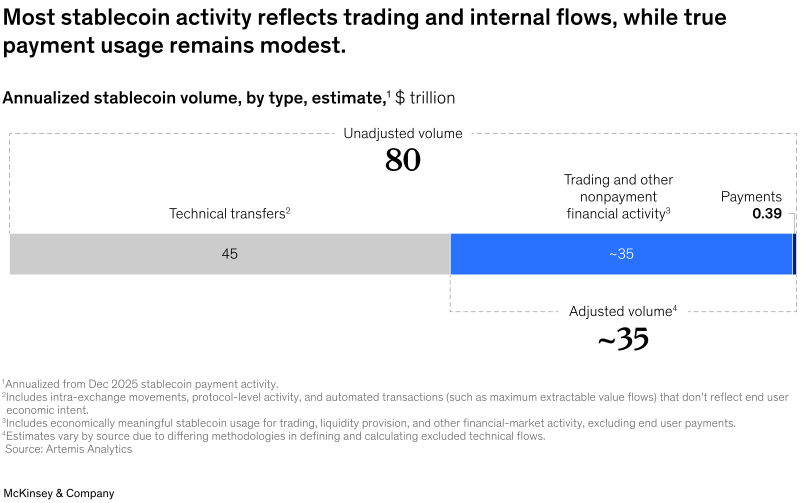
Stablecoins are gaining attention given their potential to enable faster, cheaper, and programmable payments, with reported transaction volumes of up to $35 trillion annually.1 However, most of this activity doesn’t represent true end-user payments, such as paying suppliers or sending remittances. It consists mainly of trading, internal shuffling of funds, and automated blockchain activity.
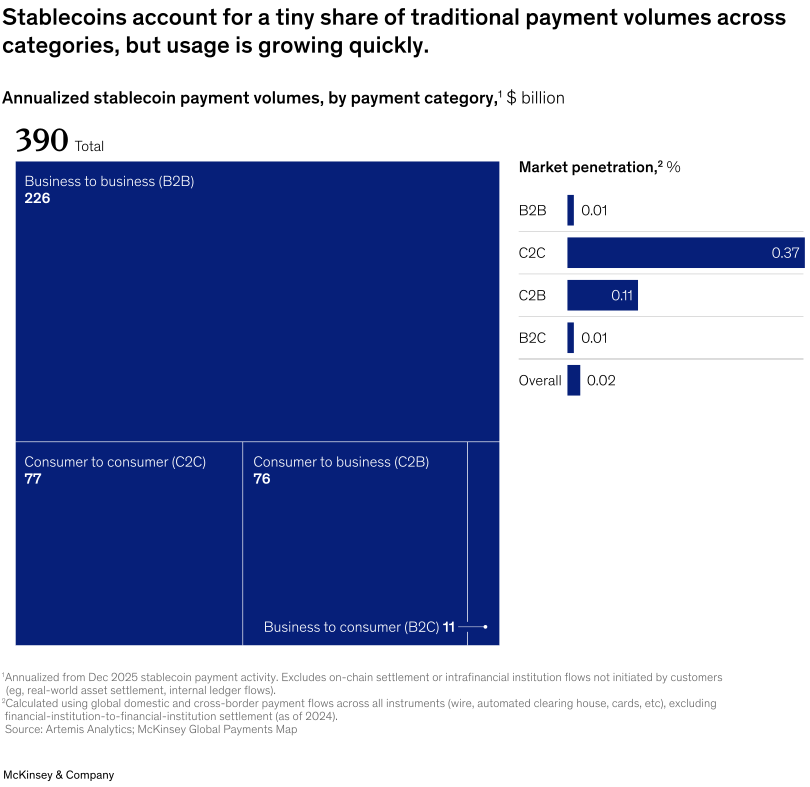
To provide clarity and gauge stablecoin payments volumes more accurately, McKinsey teamed up with Artemis Analytics, a leading blockchain analytics provider. (See sidebar “More about Artemis Analytics.”) The resulting analysis indicates that at current usage rates, the volume of actual stablecoin payments made annually is about $390 billion,2 representing roughly 0.02 percent of global payments volumes (Exhibit 1).
Our analysis highlights the need for a more nuanced interpretation of data recorded on a blockchain and a strategic, use-case-focused investment by financial institutions to realize the long-term potential of stablecoins. To be clear, the fact that true stablecoin payments are much lower than routine estimates doesn’t diminish stablecoins’ long-term potential as a payment rail. Instead, it establishes a clearer baseline for assessing where the market stands and what will be required for stablecoins to scale.
Significant expectations for growth
The stablecoin market has expanded rapidly in recent years, with circulating supply now exceeding $300 billion,3 up from less than $30 billion in 2020.4 Public forecasts reflect strong expectations for continued growth. In November, US Treasury Secretary Scott Bessent said the stablecoin supply could reach $3 trillion by 2030.5 Leading financial institutions have similarly projected stablecoin supply in the $2 trillion to $4 trillion range over the same period. These expectations have intensified interest among financial institutions, many of which are exploring stablecoins across a range of payment and settlement use cases, including the following examples:
- Global payroll and remittances. Stablecoins offer a compelling alternative to traditional remittance channels, enabling near-instant cross-border transfers at a fraction of the cost. Our research found that global payroll and remittances6 accounted for about $90 billion in annualized stablecoin payments volumes, representing less than 1 percent of the more than $100 trillion in total volumes from this segment (of which about $1.2 trillion is cross-border), as tracked by the McKinsey Global Payments Map.
- B2B payments. Stablecoins could address inefficiencies in cross-border payments and international trade, such as high fees and settlement delays. Early adopters are using stablecoins to streamline supply chain payments and improve liquidity management, especially for small and medium-size businesses. We estimate that B2B stablecoin payments account for about $226 billion a year, or about 0.01 percent of global B2B payment volumes of roughly $1.6 quadrillion, per the Global Payments Map.
- Capital markets. Stablecoins are starting to reshape settlement workflows in certain tokenized and on-chain asset classes by enabling near-real-time settlement, which can reduce counterparty risk and shorten settlement cycles compared with traditional clearing processes that can take one business day or longer. Some asset managers run tokenized funds that use stablecoins to pay dividends to investors automatically or reinvest dividends into the funds without moving money through banks. This early use case demonstrates how on-chain cash flows could streamline fund operations. We found that stablecoins are used for about $8 billion in settlement transactions annually, accounting for less than 0.01 percent of global settlement volumes of $200 trillion, per the Global Payments Map.
While these projections and early use cases point to meaningful potential, they also highlight a gap between expectations and what can be inferred from headline transaction data alone. Much of the evidence cited to support rapid adoption relies on public stablecoin transaction volumes, which are often implicitly assumed to reflect payment activity. Understanding whether these transactions relate to payment activities requires closer examination of what on-chain activity actually represents.
Why stablecoin volumes require careful interpretation
Public blockchains provide an unprecedented level of transparency into transaction activity. Every transfer is recorded on a shared ledger, enabling near real-time visibility into value flows across wallets and applications. In principle, this transparency should make it easier to assess adoption than in traditional payment systems, where activity is fragmented across private networks and disclosed only in aggregate, with some transactions not disclosed at all.
In practice, however, total stablecoin transaction volume can’t be directly interpreted as payment usage.
Public blockchain transaction data indicate that the value moved, but not the economic purpose behind that movement. As a result, raw stablecoin transaction volumes on a blockchain may include multiple forms of activity, including the following:
- exchanges and custodians holding large pools of stablecoins and moving money between their own wallets
- automated smart contract interactions repeatedly moving the same capital
- liquidity management, arbitrage, and trading-related flows
- protocol-level mechanics that can generate multiple blockchain transactions by breaking up a single action into many on-chain steps, thereby increasing gross transaction counts
These activities are integral to how on-chain ecosystems function and are likely to grow alongside broader adoption of stablecoins. However, most of these activities don’t fall under traditional definitions of payments. As a result, when aggregated without adjustment, they can obscure how much activity corresponds to actual payments. For institutions evaluating stablecoins, the implication is clear: Raw reported volumes should be treated as a starting point for analysis, not as a proxy for payment adoption or activity that could realistically generate revenue.
A clearer view of stablecoin payment activity
Our analysis with Artemis Analytics reviewed stablecoin transactions at a granular level. It focused on identifying transaction patterns consistent with payments, such as commercial transfers, settlement, payroll, and remittances, while excluding activity driven primarily by trading, internal rebalancing, and automated contract loops. (See sidebar “Methodology.”)
The true volume of stablecoin payments identified in our analysis, about $390 billion in 2025, has more than doubled from 2024 levels. While stablecoins’ share of total on-chain activity and total payment volume remains relatively small, it reflects real and growing usage in specific contexts (Exhibit 2).
Our analysis yielded three observations that stand out:
- Value propositions. Stablecoins are gaining traction where they offer advantages in specific use cases, including settlement, improved liquidity management, and reduced friction. For example, international peer-to-peer transfers can be executed nearly instantly and at lower cost compared with some traditional remittance corridors. At the same time, stablecoin-linked cards are expanding practical usability by enabling holders to spend stablecoins directly with merchants globally, without first converting funds through exchanges or banks. We estimate that stablecoin-linked card spending has grown to $4.5 billion in 2025, up 673 percent from 2024.7
- B2B leads growth. B2B payments dominate, accounting for about $226 billion, or roughly 60 percent of global stablecoin payment volume. B2B payments have increased 733 percent year over year, indicating rapid uptake in 2025.
- Asia-originated activity. Activity is uneven across regions and cross-border payment corridors, suggesting that scale will depend on local market structure and constraints. Stablecoin payments sent from Asia represent the largest source of volume, accounting for about $245 billion in payments, or 60 percent of the total. North America is next, accounting for $95 billion, followed by Europe at $50 billion. Latin America and Africa each accounts for less than $1 billion. Activity today is driven almost entirely by payments sent from Singapore, Hong Kong, and Japan.
Taken together, these patterns suggest that adoption of stablecoins is taking hold in a limited number of proven use cases, with broader scale dependent on how successfully these can be expanded and replicated elsewhere.
Potential implications for financial institutions
The gap between headline transaction volumes and actual payment usage doesn’t diminish stablecoins’ long-term potential. Instead, it clarifies where the market is growing fastest and, by association, where the industry is finding the greatest potential for utility and potential disruption. Institutions that ground their strategies in this level of insight could be better positioned to invest appropriately, shape emerging use cases, and capture value as adoption matures.
Three priorities are key for financial institutions:
- Dig into the data. Apply a critical lens to reported volumes and seek greater clarity from real-time data provided by reputable on-chain analytics firms. Assess what reported stablecoin volumes actually represent, how much overlaps with existing or future payments businesses, and what assumptions are required to translate on-chain activity into addressable payment flows and revenue.
- Ground in reality. Base business cases on actual adoption patterns and growth, accounting for user behavior, integration with existing systems, and regulatory constraints. Assume realistic timelines and recognize that only part of on-chain activity is likely to generate revenue.
- Invest with discipline. Invest selectively while building the capability to scale, paying attention to the fastest-growing use cases, which can inform defensive plays, and emerging use cases where first-mover advantage could indicate opportunity for growth. Avoid broad, undifferentiated approaches in favor of targeted bets with clear near-term returns, while developing flexible infrastructure and partnerships that can support expansion as adoption grows.
Stablecoins have the potential to meaningfully reshape payments. However, realizing that potential will call for sustained effort across technology, regulation, and market adoption. Adoption at scale will require clearer data, disciplined investment, and the ability to distinguish signal from noise in reported activity. Financial institutions that pair ambition with a realistic understanding of today’s volumes, while building toward tomorrow’s opportunities, will be best positioned to shape the next phase of stablecoin adoption.