The insurance industry represents a significant opportunity for AI to drive value creation, and the technology will continue making inroads across the industry in the months and years ahead. The opportunity for advancement in the sector is significant, with workflow inefficiencies and extensive use and ownership of data creating a meaningful entry point for the latest technologies.
What are the potential implications for private investors? In this article, we take a closer look at insurance subsectors that are already the focus of considerable private capital investment, including distributors, managing general agents (MGAs), software providers, and third-party administrators (TPAs), to assess how and where AI could make a difference. We conclude with four priorities for sponsors and other investors seeking to turn AI into an eventual portfolio differentiator.
An evolving insurance investment landscape
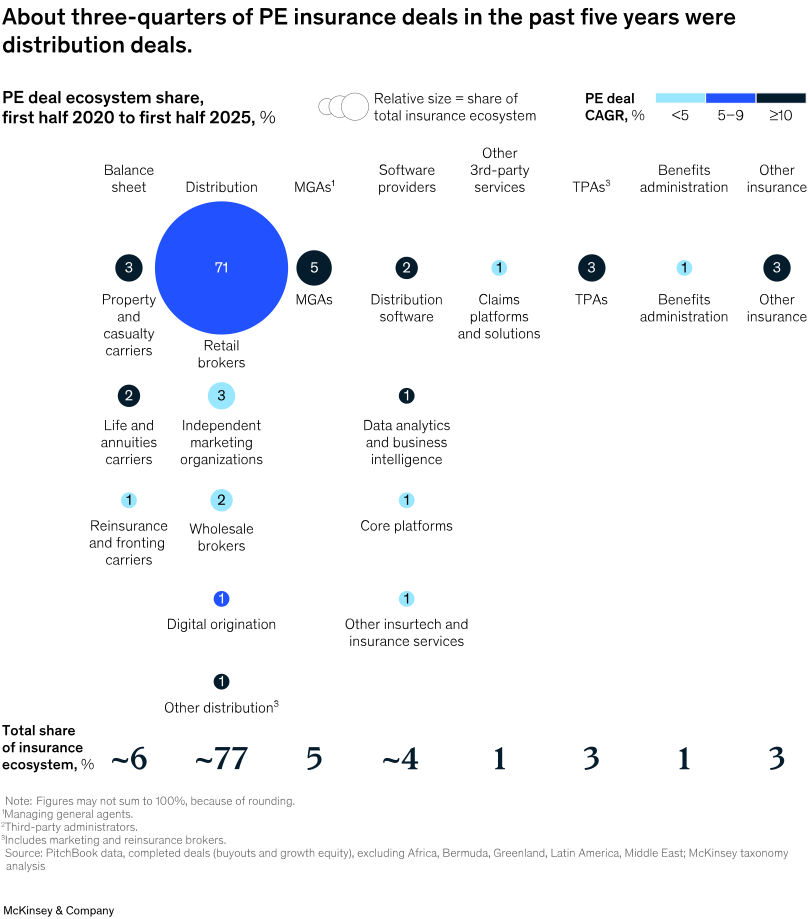
While overall deal flow softened in 2025, continued investment in the insurance sector has been driven by durable through-cycle performance. Where there was some variation in volume of deals by subsector (Exhibit 1), this variation was most apparent in the broker segment (about 70 percent of deal count), which declined by about 20 percent year-on-year because of greater deal selectivity in a maturing market. MGAs remain a steady favorite, accounting for about 5 percent of deal flow, given their capital-light and high-margin models supported by specialized underwriting expertise and/or strong distribution ties. TPAs also have seen sustained interest, with annual average growth of 15 percent over five years, thanks to sticky client relationships, recurring revenues, and scalable operations. Insurance software providers, including core platforms (for carriers and distributors) and data and analytics are likewise appealing for their recurring software-as-a-service revenues and role as the digital backbone enabling accuracy and efficiency across the insurance value chain.
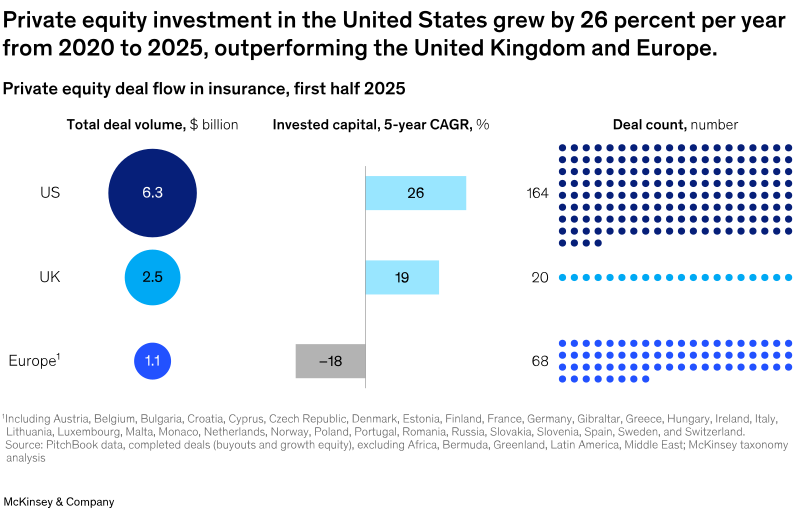
In geographic terms, the largest share of private transactions took place in the United States (Exhibit 2), reflecting the relative size of its insurance market and maturity of PE ownership of insurance assets. European investments have slowed, with invested capital declining at an annual average rate of about 18 percent between 2020 and the first half of 2025.
The potential for AI-driven portfolio value creation
The insurance industry sits on immense pools of structured and unstructured data, and many workflows across the value chain are still handled manually. At the same time, the industry has mounting exposure to complex risks, such as cyberattacks, climate-related and other catastrophes, and even AI itself. These dynamics create prime conditions for technology adoption, and we see the sector progressing along an “AI staircase”:
- Traditional AI in the form of predictive data analytics is already established in fraud detection, pricing, and risk modeling.
- Generative AI is beginning to reshape document-heavy tasks like policy issuance, submissions, and some aspects of claims handling and adjusting.
- An emerging frontier of agentic AI promises to autonomously manage end-to-end workflows, from purchasing to select risk assessment.
While AI will transform parts of the insurance value chain, we expect it is more likely to reshape existing models than to disintermediate them. Investors will need to focus less on spotting assets with potential to upend the industry, and more on understanding where and how AI is creating uneven progress and opportunities across subsectors. The goal is to methodically identify which assets are meaningfully advancing up the AI staircase and where the technology will most enhance performance and competitiveness. This identification will lead to a better understanding of the required investment to capture opportunities or defend moats, which can take the form of a build, a buy, and/or collaboration with an AI-focused partner.
Portfolio value creation is poised to expand significantly. As a baseline, sponsors and management teams who focus on operational value creation consistently outperform, achieving internal rates of return that are two to three percentage points higher than peers’ IRRs. Getting value out of AI and gen AI will be critical to alpha generation for the next vintage of insurance portfolio companies. McKinsey estimates that gen AI could unlock $50 billion to $70 billion of insurance industry revenue, with the highest impact on marketing and sales, customer operations, and software engineering dimensions.
The subsectors where AI is reshaping performance
While many use cases will still require human oversight, AI is already reshaping performance across brokers, managing general agents, software providers, and third-party administrators. Here we look at the individual subsectors and how AI is affecting the investment appetite.
Brokers (retail and wholesale)
As the market matures, value creation is focused not only on roll-ups of brokers (a major theme of the recent past) but also on vertical integration, tech-enabled placement, and data for more consultative risk guidance. AI is an important enabler of this next phase. Rather than replacing brokers and producers outright, it is likely to help them better counsel clients on their risk and expand their margins.
Early gen AI use cases are already improving efficiency and conversion. These cases include using AI for automated submission ingestion, carrier appetite matching, and use of placement copilots for renewals and cross-selling. Over time, agentic AI may begin to handle end-to-end renewal for simple risks, dynamically connecting clients and capacity providers with limited human intervention (which brokers would own).
AI not only provides an efficiency play but also is used in digital lead generation and targeting opportunities most prevalent in small and medium-size enterprise (SME) and personal lines. Based on our case reviews, such approaches have increased the volume of account rounding or cross-selling and have reduced churn by upwards of 50 percent by systematically engaging clients with the right message at the right point in their journey.
Clients continue to value brokers for tailored and trustworthy advice and access to markets. In fact, rather than replacing the role of the broker, technology is supporting it by enabling novel applications of sales lead generation, and augmented broker tooling.
At the same time, the producer model itself is evolving. With noncompete agreements under pressure in several US states, brokers that offer a stronger employee value proposition will attract and retain top producers. AI can play a role here by reducing administrative friction—for example, simplifying interactions across carrier websites for quoting, prefilling applications, or processing endorsements. In the longer term, the differentiation gap will widen between brokers that use AI skillfully and those that do not. These applications will allow producers to use the added efficiency to spend more time with clients, which eventually helps them build scale and privileged access to data through larger books of business. In addition, offering access to these resources becomes a compelling talent proposition for future producers.
Managing general agents (MGAs)
MGAs have been one of the fastest-growing subsectors in insurance. Over the last decade, US premium volumes channeled through MGAs have grown at about 14 percent annually, with direct premiums nearly doubling between 2020 and 2024, from $47 billion to $97 billion. This growth is backed by a private equity appetite for high-margin, capital-light underwriting platforms, leading to PE deals and investment dollars both growing by nearly 20 percent annually since 2020, according to PitchBook.
MGAs have become central to innovation in insurance, creating demand for more sophisticated use of data and technology. As the market further evolves, AI can create value across both underwriting and distribution. In underwriting, AI is being applied to accelerate and personalize intake and submission, perform highly granular segmentation and risk scoring, and draft tailored documents and messages to streamline communications and facilitate follow-ups as part of issuance and delivery. Furthermore, early forms of agentic underwriting “work cells” are beginning to quote and bind simpler policies with minimal intervention. Certain use cases are already delivering measurable results. We have observed that specialty risk engineering tools can generate initial risk assessments that cut quoting times from more than one month to just days, while commercial and specialty property and casualty (P&C) models incorporating predictive win rates now deliver quotes in one to two hours instead of two or three days.
For distribution, AI supports triaging, broker relationship management, and dynamic lead generation and targeting. Many insurtech-focused MGAs are integrating low-code and workflow automation tools to enable these capabilities. MGAs that fail to adapt quickly to advancing AI could be outpaced by digital-native players and platform ecosystems that combine distribution, data, and underwriting capabilities and can internalize underwriting at greater scale and speed.
In addition to effective AI adoption, owning and activating data will become a defining source of value. MGAs that can consolidate, enrich, and protect proprietary data will become indispensable partners to both brokers and carriers, as they will be able to feed better risk insights back into the ecosystem. MGAs that combine strong relationships with data ownership and advanced AI use will differentiate themselves most sharply. They will use AI to strengthen, not replace, human underwriting judgment.
Software providers
Software and data platforms remain a fast-growing area of insurance investment, rising by about 20 percent annually on average over the five years through the first half of 2025. Deal activity has continued to expand, particularly in distribution and core systems, underpinned by investor confidence in the digital infrastructure that connects carriers, brokers, and MGAs.
As AI moves from experimentation to adoption, the next frontier for software providers is being shaped not by model performance alone but also by how enterprise buyers are rethinking their architecture and procurement patterns. Our recent cases show that insurers are moving away from monolithic systems and toward modular, open environments that allow best-of-breed AI tools to interoperate—what we have called the agentic AI mesh.
In this model, both custom-built and off-the-shelf agents collaborate securely and autonomously, leveraging open standards and micro-services to avoid vendor lock-in. For insurers, this means the ability to plug specialized solutions into core systems without major re-platforming. For software providers, it signals a race to become the connective tissue of the insurance ecosystem that brings together data, models, and agents.
These evolving buyer preferences are boosting premium solution providers, including those offering specialized AI capabilities that integrate easily into carrier and broker environments. At the same time, core system and policy administration platforms must re-architect for openness (“exposing” APIs by making the system’s functions and data accessible to other systems through secure interfaces), and adopt micro-service designs that enable agentic integration.
For investors, these shifts create opportunities on both ends of the spectrum: backing interoperable specialists with differentiated AI capability and/or supporting core system platforms that can serve as the anchor for an open, agentic mesh. As insurers move toward modular architectures and multi-agent collaboration, platforms that enable this agility will command premium valuations and become the backbone of the industry’s next digital chapter.
Third-party administrators
Third-party administrators (TPAs) remain a private equity focal point; average annual growth in deals in this space has increased by about 15 percent in the past five years, according to PitchBook. While the core value proposition for investors (recurring revenues, balance-sheet-light models) remains, many are expanding beyond traditional administration into more integrated service platforms. With their access to transaction-level servicing data, they are well positioned to deploy AI to improve speed, consistency, and service levels in high-volume workflows.
At the same time, it is not yet clear how TPAs will reliably monetize AI-driven efficiency gains. Many TPA commercial arrangements still skew toward head count, activity-based constructs, or cost-plus economics (explicitly or implicitly). Under those models, automation can actually pressure top-line revenue even when performance improves, and higher accuracy or better outcomes are not always directly compensated. This creates a real strategic tension: AI can make TPAs better operators while simultaneously undermining the mechanics of how they get paid.
As a result, we expect the next phase of the subsector to be defined less by whether TPAs adopt AI (they will) and more by how they evolve their pricing models and competitive positioning. And as automation reduces the complexity advantage that TPAs have historically held, maintaining cost competitiveness and continuous innovation will remain critical. Sponsors are therefore likely to favor platforms investing early in data infrastructure and AI integration with the ultimate goal of producing a clear path to durable revenue and/or margin expansion.
Four priorities for investors
Most private insurance investors now recognize AI’s disruptive potential, but many are still determining how to act. Some are embedding AI into diligence; others are mobilizing portfolio companies to preserve market position while looking to create new value opportunities. The challenge lies in deciding where to invest based on how AI shifts value, how fast to move, and how to build lasting advantage. In general, four priorities stand out for investors in insurance seeking to turn AI into an eventual portfolio differentiator.
Embedding AI evaluation and value creation across the deal life cycle
AI now features in every stage of the investment process, from diligence to portfolio management. During diligence, investors can assess how analytics and agentic tools could reshape the target’s positioning and business model. Within portfolios, the same framework can guide value creation plans, identifying where AI can expand margins, accelerate growth, or defend share.
Instituting a firmwide AI playbook
Sponsors can codify a repeatable approach that spans both diligence and ownership, including standard templates, consistent KPIs, and a central repository of use cases, such as underwriting automation, claims efficiency, and data governance. Consistent methodology is needed for selecting the appropriate AI in portfolio companies to ensure that the technology foundations are primed for AI on top and that an agent library exists to ensure oversight and proper guardrails. This creates a shared language across deal, operations, and data teams for evaluating AI opportunity and execution. Over time, lessons from portfolio pilots feed back into new diligences, sharpening conviction and execution speed with each deal.
Scenario planning in a dynamic environment
While the playbook establishes how to evaluate and deploy AI, scenario planning helps firms decide where and when to invest as the technology evolves. The same discipline used to model multiple AI adoption curves in diligence can be extended into portfolio management. Sponsors can map AI maturity scenarios across their holdings, ranging from incremental automation to full agentic execution, and quantify the operational and financial impact of each path. This allows firms to prioritize enablement resources, identify synergistic platforms, and time their investments for when technology, data, and readiness align. When they do so, AI becomes not just a diligence lens but also a strategic planning tool across the portfolio.
Projecting how AI will change talent models
Deal and operating teams need to be able to identify changes that AI could make to the insurance workforce of the future and prepare accordingly. McKinsey estimates that today’s technologies could theoretically automate more than half of current US work hours. Two-thirds of US work hours today are devoted to nonphysical work—much like that found across the insurance value chain. Current workforces will require evolution and AI upskilling to keep pace. They not only must learn how to integrate with AI processes but also must move from basic tasks to broader framing, interpretation, and actioning of insights.
Underpinning all this is investing where the management team has an appetite to embrace change. The insurance industry has a rather limited track record of widespread innovation and speed in adoption of new technologies. Talent that extends behind technical expertise is going to differentiate businesses that are able to embrace this change, so investors cannot ignore it. As the insurance landscape evolves, AI will redefine value creation across every segment of the market. In our view, investors and management teams in the insurance ecosystem will need to harness AI in order to compete effectively over the next decade.