For many utilities, improving customer service is both a persistent challenge and a strategic priority. But adding another AI tool or pilot won’t provide the transformation that customer operations needs. Instead, leaders are using agentic AI to fundamentally change how customer service is delivered—improving customer experience while reducing costs.
Implementing this transformation can be daunting. Realizing the full potential of agentic AI requires rewiring customer operations end to end across workflows, customer journeys, systems, and teams. Many leaders aren’t sure where to start.
In this article, we highlight the need for agentic AI transformations as customer satisfaction has fallen while costs to serve customers have risen; we demonstrate the potential for agentic AI to improve customer experience and reduce costs; and we chart a practical path forward for utilities to make the leap to a new agentic operating model.
Customer satisfaction is declining
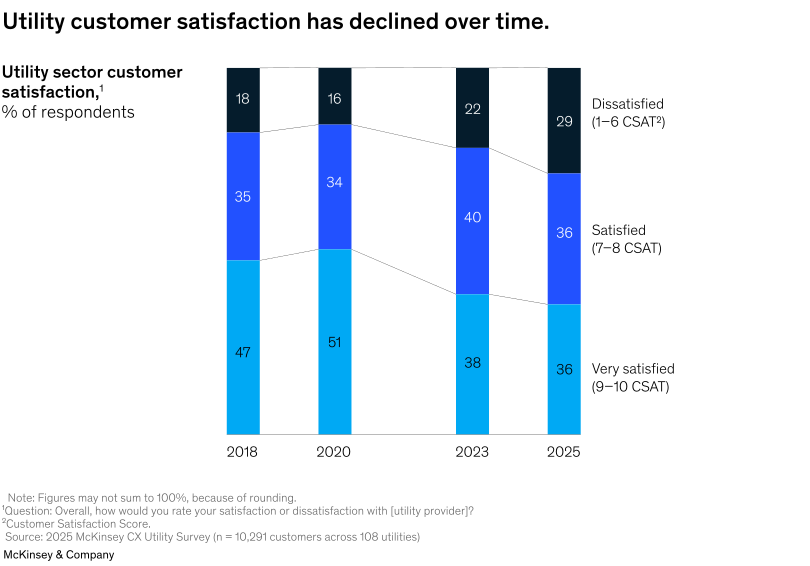
Utilities face mounting pressure. According to our 2025 survey of more than 10,000 utility customers, overall customer satisfaction has declined—the share of respondents saying they are “very satisfied” fell by 11 percentage points since 2018, while 29 percent of customers (compared with 18 percent in 2018) report dissatisfaction (Exhibit 1).
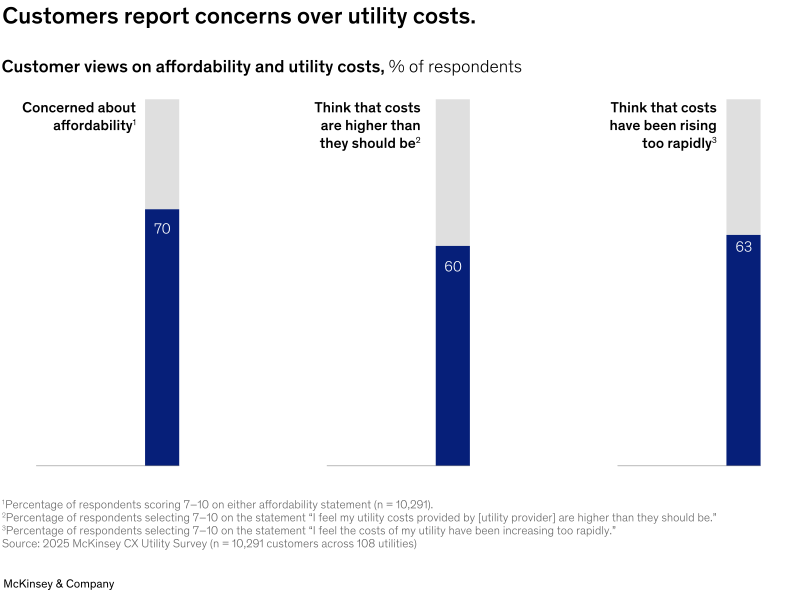
Affordability is another pressure; 70 percent of customers express concern about affordability (Exhibit 2).1
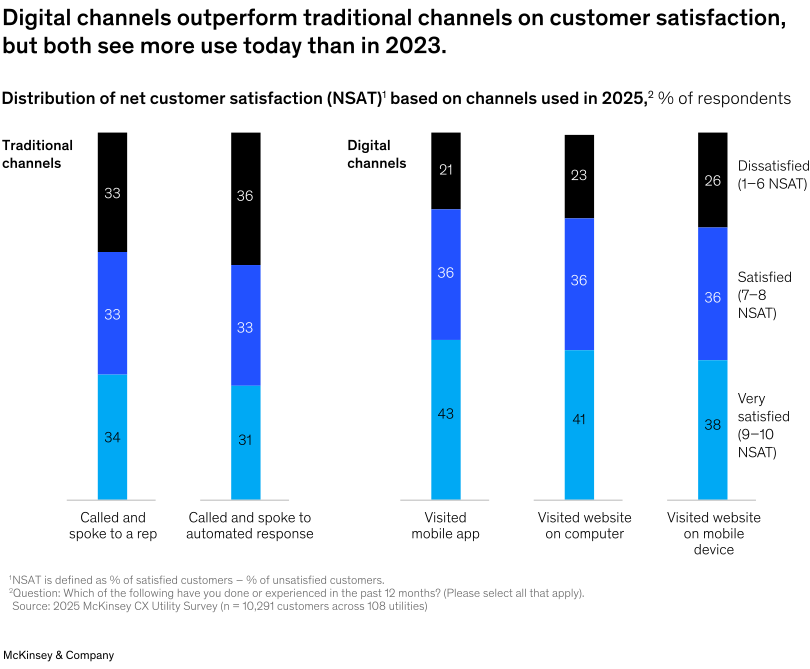
Customers are also now engaging with their utilities more than ever, increasing demand on already stretched customer operations teams. Channel usage has grown by 3 to 16 percent, depending on the channel, since 2023. At the same time, digital channels now outperform traditional channels on satisfaction, creating a path to meet rising demand while lowering cost to serve (Exhibit 3).
The mandate is clear and urgent: reduce costs while improving customer satisfaction. Agentic AI makes both possible by rewiring customer operations end to end, not via AI pilots or isolated use cases. The good news? Utilities don’t have to transform everything at once. They can start with high-value agentic workflows, capture near-term value, and build toward full transformation.
The value at stake is real and material, and leaders are capturing it
Over the past decade, utilities have invested heavily in customer service technology, including interactive voice response, mobile, chatbots, and agent-assisted tools. These investments improved but rarely changed the underlying drivers of customer demand (for example, outage management, upstream billing issues, et cetera). Agentic AI is different. It changes the unit of transformation from incremental to system-wide, shifting focus from individual channels and tasks to end-to-end journeys and workflows to fundamentally redesign how work gets done.
Leaders are increasingly deploying AI at scale to drive cost and customer outcomes. Companies across sectors are already realizing cost reductions of 30 to 50 percent while improving customer satisfaction by up to 20 percent.
An example of one of these transformations is E.ON Next. The company was receiving more than seven million customer service calls annually, but relied on anecdotal information and biased call tagging to understand the reason for customer calls. The company used an agentic voice analytics (AVA) solution to understand the purpose of customers’ calls and establish a starting point for its customer service transformation. AVA uses AI to analyze and categorize customer service calls at a large scale (see sidebar, “Using agentic voice analytics to prioritize workflows”). With this information, it developed a channel strategy for customer service, including a matrix of the preferred channels per contact reason, and outlined an action plan.
Using agentic voice analytics to prioritize workflows
Agentic voice analytics (AVA) is a tool that offers a data-driven approach to prioritizing an agentic AI transformation by analyzing large volumes of customer interactions and identifying the journeys that create the most demand and friction.
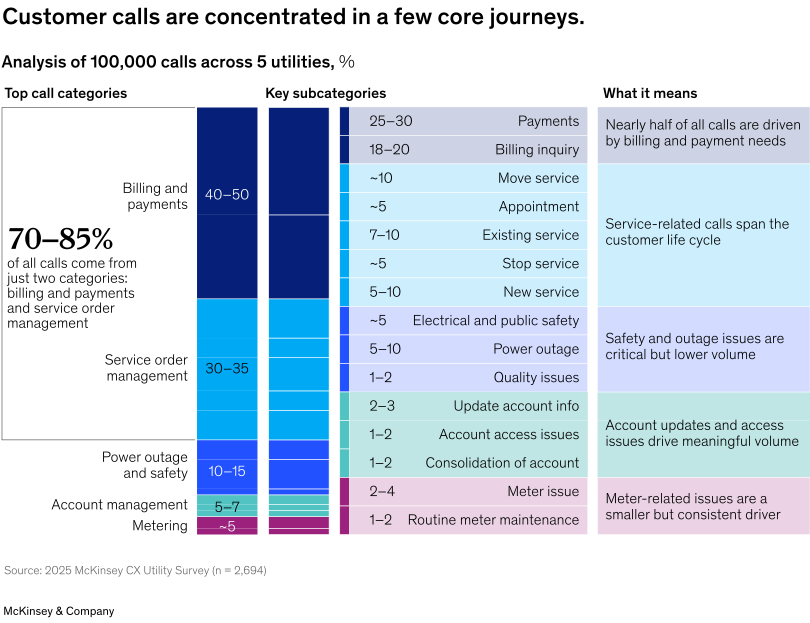
Our AVA analysis of more than 100,000 real utility customer calls across five utilities revealed that customer demand is often concentrated in a small number of recurring needs. Billing and payments and service orders accounted for 70 to 85 percent of calls, with billing and payments alone driving 40 to 50 percent of call volume (exhibit). These insights help utilities move from generic AI experimentation to targeted journey transformation. Utilities can apply these tools to their own data to identify their highest-priority opportunities.
As its first action, the company implemented an AI voice assistant that replaced the key-based interactive voice response to answer billing-related calls. The platform can be repurposed to serve other channels as part of the company’s next transformation steps. As a result of this transformation, the company has reduced inbound calls by approximately 50 percent and raised customer satisfaction by six points.
Utilities can start with the highest-value customer journeys
For many utilities, capturing AI’s value at scale requires fully transforming both the customer journey and the operational work behind it. Knowing where to start can be challenging for utility customer operations teams. One strategy is to prioritize the journeys or process workflows that cause the most friction, as evidenced by customer demand, complaints, operational complexity, and work volumes. AVA can help identify these journeys. For most utilities, these opportunities lie in billing and payments, outage management, field and meter service requests, and collections.
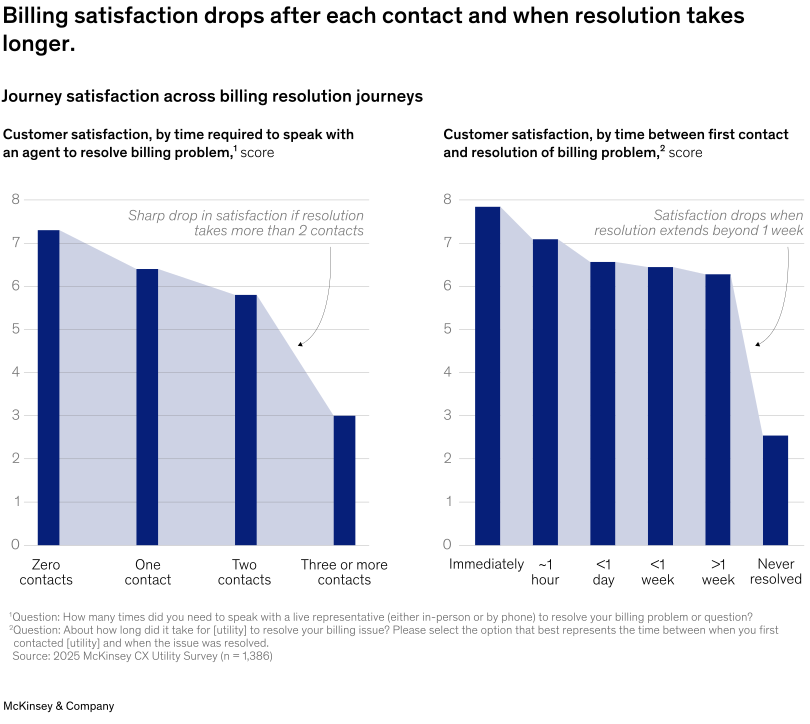
- Billing and payments represent 40 to 50 percent of total customer calls, according to McKinsey analysis, and play an outsize role in customer satisfaction. Satisfaction drops sharply when billing issues require multiple contacts or take more than a week to resolve (Exhibit 4). Agentic AI can identify root causes, explain charges, analyze usage, and recommend next-best actions to enable faster resolution, fewer interactions, and the prevention of recurring issues. We have seen utilities achieve reductions of 20 to 50 percent in billing and payment-related calls by implementing agentic solutions for tasks such as exception handling, bill inquiries, and data reconciliation.
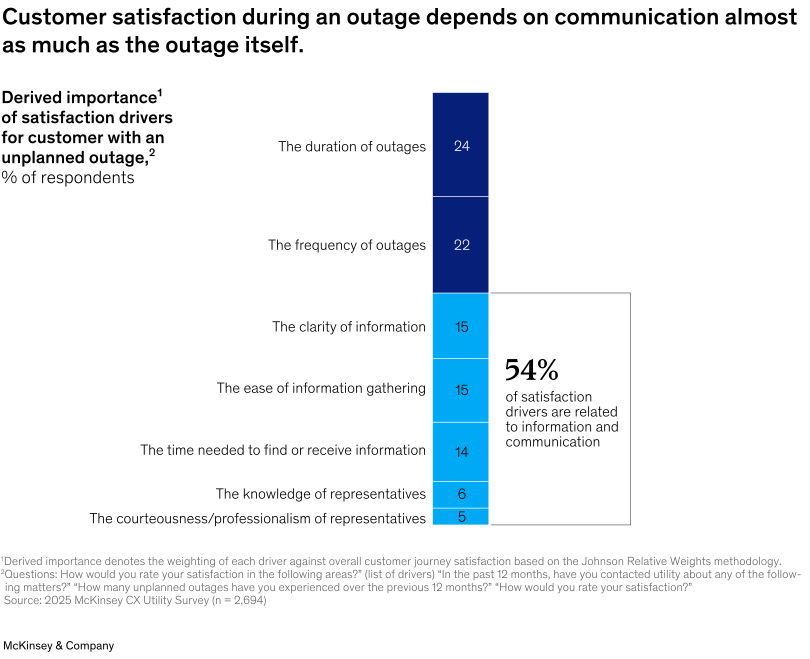
- Outage management is one of the biggest sources of customer dissatisfaction for utilities. While customer operations teams cannot control outage duration or frequency, communication fuels 54 percent of journey-related satisfaction—almost as much as the outage itself, according to our analysis (Exhibit 5). Agentic AI can help utilities keep their customers informed with proactive, real-time updates, reducing outage-related calls by up to 50 percent2 and building trust in a moment that matters to customers.
- Field and meter service requests are often slowed by fragmented processes, increasing both service cycle times and costs. Agentic AI streamlines the entire journey: diagnosing issues, scheduling appointments, coordinating documentation, and proactively updating customers. Leading utilities have achieved 20 to 25 percent gains in frontline productivity while accelerating service connections to achieve 15 to 90 day connection targets, depending on job complexity.3
- Collections have become a critical customer operations capability, with utility arrears increasing from $8.05 billion in 2019 to $20.7 billion in 2025, a change of more than 2.5-fold.4 At the same time, customers and regulators are placing greater scrutiny on affordability. Agentic AI helps identify at-risk customers early, personalize outreach, and connect customers to payment plans and assistance programs. Leading utilities have reduced arrears by 15 to 20 percent while decreasing customer complaints and escalations.5
Across all journeys, the goal is not simply to deflect interactions. Real value comes from resolving both the customer need and the operational root cause, coordinating across functions when necessary.
A phased approach offers a practical path forward
To address the greatest challenges—legacy systems, fragmented data, and regulatory complexity—utilities will likely need to undergo a rewiring transformation. Leading utilities are taking a phased approach to deliver value today with agentic AI while modernizing legacy systems in parallel.
Step 1: Build the value-backed road map, starting where value is greatest and redesigning before automation.
- Identify high volume, cost, and friction points through AVA diagnostics. For most utilities, these are billing, payments, outage management, collections, and meter services.
- Map end-to-end journeys and workflows (including customer-facing interactions, employee and back-office processes, system hand-offs, data dependencies, field activity where relevant, and follow-up communication).
- Build an opportunity set focused on root cause resolution, not just faster processing.
- Prioritize opportunities based on value, feasibility, risk, and customer impact.
Step 2: Simultaneously capture quick wins while building foundations, deploying no-regret agents and building data and orchestration capabilities in parallel.
- Start with agents that can create value without waiting for full system transformations by beginning with lower-risk, ready-heavy, or human-in-the-loop cases.
- Build a unified data foundation of customer billing, metering, payment, outage, and service data.
- Leverage APIs and other platform orchestration tools that allow agentic to work with existing systems.
- Redesign the operating model so humans and agents work together with appropriate monitoring mechanisms to detect errors and bias.
Step 3: Scale across domains through iterative, journey-by-journey transformations.
- Reuse data products, integration patterns, governance, and agent components across workflows.
- Move from isolated pilots to a scalable, rewired customer function.
- Track quantifiable gains: reduced demand, fewer repeat contacts, lower cost to serve, faster resolution, and improved customer satisfaction score.
Customer operations teams can think of AI as the foundation of a new operating model, rather than just a tool. Successful transformation will depend on people as much as technology. Utilities that make this shift will benefit from a commitment to change management throughout the transformation, helping employees understand how AI agents augment their work and aligning roles, incentives, training, and governance with the new operating model.
Agentic AI offers utilities the opportunity to transform customer operations from a reactive service function into a performance engine. Utilities that truly rewire customer operations end to end—redesigning customer journeys, workflows, and operating models around AI to deliver measurable business outcomes—stand to gain the most from this transformation.