Europe’s chemical industry is at a critical inflection point. The industry’s lagging performance continues: European chemical companies posted negative total shareholder returns between December 2022 and December 2025, underperforming the broader market1 and lagging behind other developed regions like the United States and Japan.2 In 2025, the European Union’s chemical capacity utilization was approximately seven percentage points below the long-term average of roughly 82 percent.3 Announced closures of chemical plants have surged sixfold since 2022, representing 9 percent of the region’s production capacity.4
Unlike the cyclical crises of the 1990s and 2000s, however, this challenge appears to be more structural in nature, threatening the existence of a substantial share of Europe’s chemical industry. Persisting issues such as higher input costs, administrative complexity, and regulatory burden are being amplified by two additional factors. First, global competition has radically intensified, particularly from Chinese players. Chinese companies have expanded capacity, achieved cost positions that are difficult for European producers to match, and are rapidly closing the gap in technological capabilities, accelerating product innovation at a pace unmatched by many of their peers in Europe.5 Second, Europe’s broader economic downturn has affected many of the large chemical customer industries such as automotives, with production increasingly shifting away from Europe.6
As such, the approaches that worked in prior cycles such as developing stand-alone cost programs, making selective portfolio moves or gradually shifting to more differentiated businesses may be inadequate. Companies now find themselves caught between two imperatives: radically reposition portfolios, assets, and industrial footprints for a structurally different market environment; and generate enough cash and operational performance from the current business to fund that repositioning.
Over the past four years, most chemical companies have pursued broader transformation programs, ranging from controls on discretionary spending to deeper initiatives across the value chain, which have often resulted in one to four percentage points of EBITDA improvement.7 Yet, in many cases, these gains have been offset by weakening market conditions and inflationary pressures. Incremental performance improvements alone have proven insufficient.
The companies making the most progress approach transformations differently. As we have observed during our transformation work with many European chemical companies, top-performing transformations do not treat strategy and performance improvements as separate and often sequential agendas. They pursue a holistic full transformation by reducing costs, improving operations, and increasing cash flows. And in parallel, they address strategic challenges by reshaping portfolios, adjusting footprints and operations, and structurally right-sizing corporate overheads.
Handling this dual agenda, and with exceptional speed, is difficult. Leaders recognize that reshaping portfolios, changing industrial footprints, and reallocating capital could take years. But if they wait for strategic clarity before addressing performance, they risk losing cash, time, and flexibility. As assets become less competitive, European chemical companies risk not just weaker financial performance but also the erosion of the industrial ecosystems, innovation capacity, and supply chains that support future growth. Conversely, leaders who focus only on near-term performance may stabilize earnings temporarily but leave underlying structural challenges unresolved and potentially miss the strategic opportunity.
What it takes to transform the chemical industry
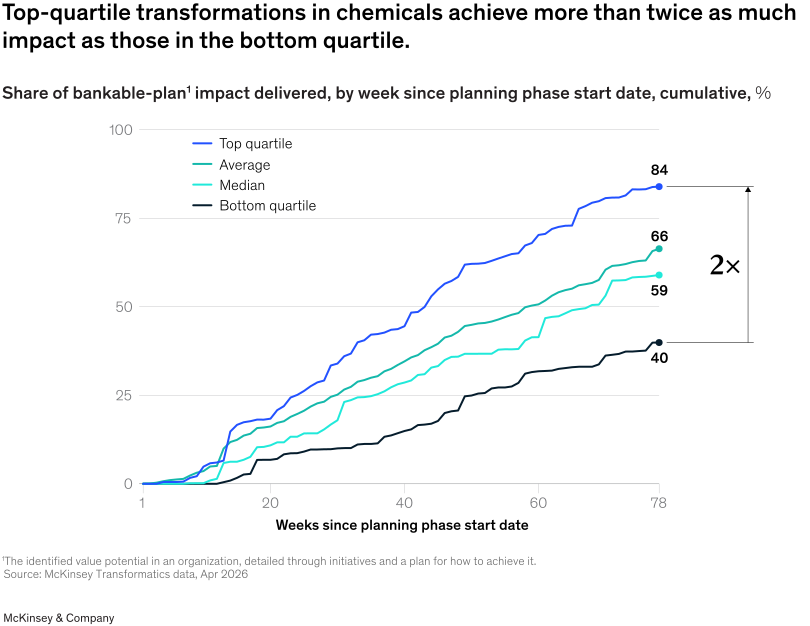
Proprietary McKinsey data shows that top-quartile transformations in chemicals achieve almost twice as much impact as bottom-quartile programs as early as 18 months into the start of the transformation (Exhibit 1). They do so by setting bigger, broader transformation ambitions anchored in strategic challenges while swiftly making decisions to convert a much larger share of planned savings, profit uplift, and cash release into impact-delivering initiatives.
European chemical companies can consider adopting nine best practices to ensure their transformations deliver such sustained improvements in performance (see table). These practices cluster around three imperatives: a company-wide direction to set the ambition of the transformation and align leadership; an activation push to mobilize a larger share of the organization behind owned initiatives; and strengthening the transformation infrastructure, cadence, and transparency to build up execution speed. Our perspective draws on an analysis of the top-quartile programs as well as McKinsey’s broader transformation work alongside Aberkyn, the firm’s leadership and culture transformation community (see sidebar, “Aberkyn and the role of change in transformations”).
European chemical companies can consider these nine best practices to ensure their transformation delivers sustained step change in performance.
| DIRECTION | ACTIVATION | EXECUTION |
| Set the highest aspirations to make structural shifts and radical step change in performance. | Ensure granular initiatives are fully owned by line leaders. | Set up dedicated infrastructure with company talents led by a chief transformation officer. |
| Insist on leadership alignment around a common vision. | Integrate health and capabilities to sustain the step change. | Implement a disciplined weekly cadence driving relentless execution. |
| Engage all employees with a compelling change story. | Establish financial and nonfinancial incentives to help achieve outcomes. | Enforce common language and principles with a single source of truth. |
Direction: Set the transformation ambition and align leadership
Leading chemical companies define the overall direction and ambition of the transformation in a way that reflects the scale of the challenge, basing it on the underlying economics of the business—not by incrementally adjusting last year’s budget.
Capturing a transformation’s full potential goes beyond a narrow performance program. It requires making difficult strategic choices about plant networks, portfolio pruning, capital allocation, and where to invest for growth. For example, a European upstream player may have to decide which integrated sites can still compete amid higher energy and feedstock costs, and which assets no longer justify capital. A more downstream chemical business may need to prune low-value grades and service models while shifting investment toward customers, applications, and innovations that still support differentiated margins.
The transformation should aim to improve the efficiency of the existing operating model. Beyond commercial and procurement levers, leading companies create value through a range of approaches, including higher yields, improved throughput using AI, lower energy and utility consumption, stronger maintenance and turnaround discipline, more efficient logistics, tighter capital spending, and improved working capital management. To achieve these gains, leaders take a hard look at which product lines, customer service models, and site footprints remain viable after considering logistics, operational complexity, and energy and capital costs. Without tackling these questions, the performance initiatives in a transformation program may only compensate for ongoing deterioration in the underlying business.
One European chemical company had recently been divested and was navigating an M&A transaction in parallel; its performance was deteriorating through repeated unplanned plant stops, rising fixed costs, and missed seasonal volumes, among other factors. The leadership team set an ambition for its transformation program to increase the company’s EBITDA by several hundred million euros, explicitly including strategic levers such as network setup, portfolio choices, and capital allocation.
A strong transformation program, like the above example highlights, can succeed when decisions on strategy and direction made in the boardroom cascade consistently across functions, business units, and layers of management. Chemical company transformations often stumble because the board sends mixed signals about direction and priorities, leading to slower decision-making, defensive behavior among line leaders, and unresolved trade-offs across functions.
Consider these two examples that highlight the importance of navigating trade-offs across functions, business units, and sites during a transformation.
Managing initiatives such as procurement savings from raw materials and sales price pass-through in parallel can offer advantages. The procurement team may secure lower input costs, while the commercial teams decide when—and how much of—that benefit should flow through to customers. Without alignment on the broader objective, companies might realize procurement savings but fail to capture the margin benefit in pricing.
Improving working capital extends far beyond receivables and payables. Inventory levels, for example, depend on the length of a production campaign, product complexity, and customer service commitments. Reducing inventory without addressing these underlying drivers may improve cash temporarily but can lead to challenges such as more production changeovers, lower plant utilization, and weaker customer service.
Top-performing transformations avoid these challenges by ensuring leadership teams are aligned on three areas: the facts, including the scale and urgency of the challenge; accountability, including the implications for their own businesses, teams, and priorities; and behavior, including consistent messaging across the organization.
The CEOs commit meaningful time, attention, and resources to signal to the organization that the transformation is a genuine priority. They lead difficult discussions directly instead of delegating them, review progress regularly (for example, recognizing the contributions of employees several layers below the senior management), and reinforce the ambition of the transformation across the entire organization.
Activation: Move the agenda from the boardroom to the machine room
Once the direction is set, the transformation agenda must move beyond the boardroom into the business.
In the chemical industry, value creation is highly tangible. Every part of the organization—site managers, plant managers, commercial leaders, supply chain planners, procurement teams, maintenance and turnaround owners, technical service, and support functions—can own parts of the transformation agenda to create value. In one large-scale transformation program, for example, thousands of employees contributed to operational improvement initiatives. A frontline employee working at a manufacturing plant identified an opportunity to replace single-use protective gloves—disposed of after exposure to hazardous chemicals—with reusable alternatives that met the same safety requirements. Reusable gloves cost more up front, but their longer lifespan led to recurring annual savings worth tens of thousands of euros for the company.
Successful transformations build a pipeline of such granular actions that can be tracked, challenged, and accelerated over time, instead of relying only on a few large initiatives. Each action is assigned to one owner who is responsible for seeing it through from completion to bottom-line impact. One specialty-chemicals player facing earnings pressure driven by demand pressure and rising costs decided not to run its transformation solely from its headquarters. Instead, the company mobilized hundreds of employees behind an actionable and quantified transformation plan, with line-owned initiatives across different business functions. Leaders carefully monitored the execution to ensure improvements translated into real financial results. These efforts resulted in a 30 percent EBITDA uplift.
The interconnected nature of chemical operations makes accountability especially important. Small issues that are not escalated or addressed quickly can have consequences that extend far beyond a single function, site, or product line. As a result, change management must be a core part of the transformation execution. Just as chemical companies rely on early escalation and rapid responses to manage safety hazards and reliability risks, they must apply the same principles to the transformation program. The quality of dialogue matters: Leaders and teams need to surface issues early, challenge assumptions, and openly discuss difficult trade-offs so that strategic priorities are translated into practical actions at the business, function, and team levels.
These behaviors can be reinforced through incentives and performance management. Where financial incentives are limited, visibility, performance reviews, and career consequences become even more important. Early successes can be recognized and celebrated, while underperformance must be addressed. Leaders must also be willing to place the best people in the roles that matter most, even when that means departing from traditional career paths.
Execution discipline: Build a machine that delivers results
In a structurally challenged sector such as chemicals, the decisive question is not whether a company has identified value but whether it can translate that value into measurable outcomes with speed and consistency.
As we noted earlier, ensuring execution discipline is harder in the chemical industry because value creation is dispersed across the value chain (sites, assets, product lines, and functions). Leaders who rely primarily on high-level transformation metrics such as EBITDA uplift or total value captured can miss hidden operational inefficiencies (for example, in specific assets or product lines, maintenance activities, energy consumption, or working capital positions). These inefficiencies can erode value even when the performance of the overall transformation appears to be on track.
Top-performing transformations tackle this challenge by creating a granular performance management system that connects the transformation’s ambition to the operational drivers of value. These systems can provide transparency site by site, asset by asset, product family by product family, and, where needed, customer by customer. One European producer, for example, identified where value was being created or lost at a particular site by using targeted planning to spot opportunities across raw materials, utilities, contractors, waste, and overhead and by using AI to optimize operating settings and reduce raw material consumption.
The strongest transformations reinforce execution through a rigorous weekly cadence of transparent communication about progress, value delivered, and emerging risks, along with fact-based decision-making. They include a dedicated transformation office led by a chief transformation officer with the authority to challenge business leaders, rapidly escalate issues, and ensure initiatives are on track to deliver value. Over time, this creates the operating rhythm many chemical companies now need to improve current performance, as well as to fund future strategic priorities with confidence and control.
To implement a successful transformation using the three imperatives described above, leadership teams may also need to make some strategic choices. These three questions in particular are worth considering: What is the strategy required to win in this environment? Which structures are needed to support that strategy—including decisions on locations, plant networks, portfolio choices, and M&A? And what is the full potential of the existing business under these conditions?
Act now—or risk losing entire value chains
European chemical companies are confronting a critical question about how their businesses will earn the right to exist and to invest in the future. Those that wait for better market conditions will likely keep running faster to stay in place—improving performance but falling behind strategically. Those who act now—boldly, clearly, and with discipline—may have a chance to rebuild competitiveness and secure their role in future value chains.
The companies that come out stronger will do three things at once. They will confront the financial realities of their business and make hard strategic choices. They will improve performance in their current operations as much as possible. And they will build the leadership, processes, and discipline required to combine the first two.
Taken together, all three decisions will determine whether a transformation becomes the engine for strategic renewal or remains a set of isolated efforts.