Shared autonomous vehicle (AVs) services are now operating in a growing number of cities across China, Europe, the Middle East, and the United States.1
Drawing on McKinsey’s latest update of our Shared AV Market Model and consumer research, this article examines the market potential of robotaxis and roboshuttles, the factors that could shape their adoption, and the potential opportunities for companies across the shared AV value chain. Several insights from our research stand out:
- Market potential is growing. In our scenarios, the global shared AV market could be worth between $190 billion and $430 billion by 2035, with a global fleet of 1.0 million to 2.5 million vehicles. China and the United States are expected to be the largest markets, followed by Europe and the Middle East.
- Consumer attitudes are shifting. Consumer interest is generally growing, with 43 percent of people who have not used shared AVs before considering them for future use, and 87 percent of those who have used them rating the experience positively, according to the McKinsey Mobility Consumer Pulse 2026 survey. Safety, accessibility, sustainability, and affordability are driving consumer’s interest.
- The market is scaling in key regions. China and the United States have the most commercial shared AV services. By September 2026, 15 cities in the United States had these services, nearly doubling the number in just nine months. Europe also has its first commercial services, in London and Zagreb.2
- Economics are reaching a tipping point. By 2035, per-mile costs for shared AVs are projected to fall by almost 80 percent, driven by declining AV technology costs, improved vehicle lifetimes and economics, and economies of scale in fleet operations.
- Stakeholders across the value chain could capture value. Opportunities for both incumbents and scale-ups are emerging; however, which players could capture the most value in various segments remains to be determined. Companies that form strategic partnerships as the value chain disaggregates, particularly in downstream segments such as operations, may be better positioned.
Following the initial wave of AV hype in the mid-2010s, which was dampened by investment pullbacks and slow technological progress,3 the industry is now entering a scaling phase, characterized by driverless commercial services, a more mature supply chain, and new partnerships between automotive OEMs, AV stack providers, fleet operators, and mobility platform providers.4
The pace of this scaling differs by region. In the United States, commercial deployments have accelerated, with services launching in several cities in 2024–26 and city counts roughly doubling within months as operators expand. Europe is showing early commercial activity in cities such as London and Zagreb, China already hosts multiple active city services, and the Middle East is launching services in cities such as Abu Dhabi and Riyadh.
The defining question for industry leaders has shifted from “Can we build an autonomous vehicle?” to “How can we scale shared AVs safely and profitably?” Our analysis suggests that what began as a deployment-led industry, paced primarily by regulation, technology innovation, and fleet economics, could gradually become a market shaped by consumer demand. For the first time, AV companies are starting to report break-even economics in selected markets on a per-vehicle basis.
This shift matters because shared AVs have the potential to fundamentally change how urban residents choose to get around. Electrification made cars cleaner and connectivity made them smarter, but shared AVs can reduce trips in privately owned cars, potentially making mobility more sustainable and efficient and cities more livable.
Customer attitudes are already shifting. The McKinsey Mobility Consumer Pulse 2026 Survey shows that growing number of users are switching from private cars and conventional ride-hailing to shared AVs, with many nonusers expressing interest in trying them.5 Yet scaling significantly will require AV technology providers and operators to become profitable.
In this article, we explore how the shared AV market could develop across Europe and the United States, as well as China and the Middle East. We present our proprietary supply- and demand-based Shared AV Market Model, which suggests the market could reach between $190 billion and $430 billion by 2035 (see sidebar, “How we built the Shared AV Market Model”).
Consumer attitudes are shifting
For much of the past decade, shared AV adoption has been determined by where leading AV players, regulators, and cities chose to launch services and by how quickly they could prove safety and unit economics. The market has therefore been deployment-paced and effectively supply-constrained.
But the focus is starting to shift from initial deployments to scaling. As technologies mature, fleet costs decline, and regulations evolve, more cities are opening up to shared AVs, including Dallas, Houston, and Orlando in the United States and London and Zagreb in Europe. In June 2026, the UN Economic Commission for Europe (UNECE) adopted the first global regulatory framework for fully autonomous driving systems, which sets uniform safety standards.6
To understand how riders are responding, McKinsey fielded its Mobility Consumer Pulse 2026 Survey that concluded in February 2026. Here, we surveyed more than 20,000 mobility users across China, Germany, Japan, the United Kingdom, and the United States, including more than 300 shared AV users in the United States. The results show a very positive picture, with 87 percent of shared AV users rating their experience positively. Trust in the service climbs even higher after the first ride, which is usually taken out of curiosity or convenience. Fewer than 20 percent of respondents remain skeptical.
Customer attitudes are also shifting in what shared AVs are replacing, although actual usage does not quite match expectations. Among US shared AV users, the top substitution is private cars (37 percent), followed by ride-hailing (35 percent), and public transit (30 percent). Future considerers expect the reverse: 43 percent assume they would mainly replace ride-hailing, then private cars (32 percent), and then regular taxis (26 percent).
Of nonusers, 43 percent said they were considering using shared AVs in the future, a figure that rises by roughly 10 percentage points among people already aware that shared AVs operate in their city, suggesting a “habituation effect” as familiarity grows.7
Consumers are expected to become increasingly open to using shared AVs, largely due to four factors:
- Safety. In our 2026 US survey, only 38 percent of respondents8 who have not used shared AVs before considered safety as the main barrier. Some operators have started to publish real-world performance data. Waymo, for example, reported 82 percent fewer injury-causing crashes than the average human-driven car over the same distance in its operating cities in 2025.9
- Accessibility. Shared AVs can provide reliable mobility options for underserved groups, such as people who cannot afford a private car or are limited by age or physical constraints.
- Sustainability. When fully electric, shared AVs could cut lifecycle emissions by 85 to 98 percent per mile compared with private diesel vehicles.10
- Affordability. Cost is a significant concern for both current and potential users of shared AVs. Currently, 37 percent of AV users cite cost as a major pain point, and nonusers are even more price sensitive.11 This highlights the need for costs to continue to fall to encourage adoption beyond early users. By 2035, per-mile costs for shared AVs are projected to drop by almost 80 percent, driven by declining AV technology costs, improved vehicle lifetimes and economics, and economies of scale in fleet operations.12
Shared AVs are beginning to scale in key regions
Shared AVs are beginning to scale in key markets, with China and the United States having the largest number of commercial shared AV services.
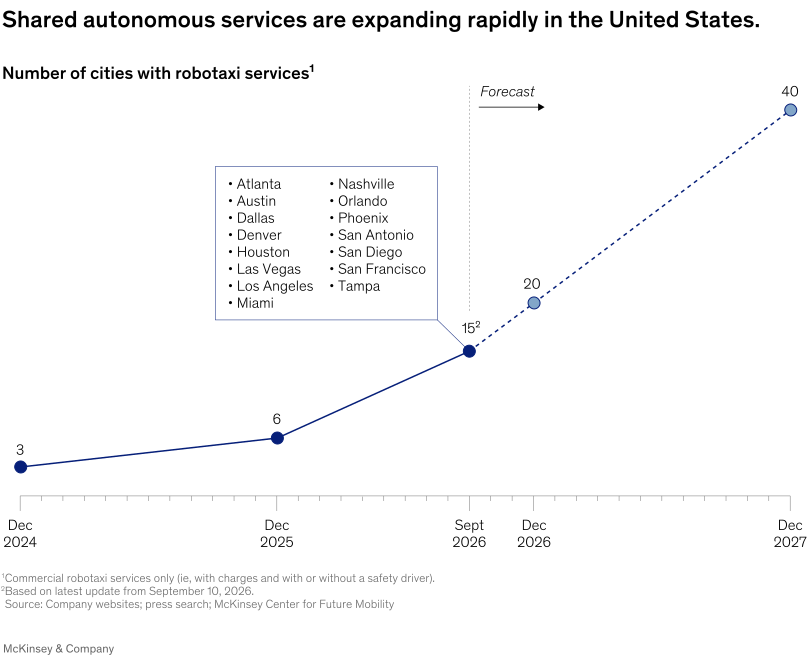
In the United States, the number of cities with shared AV services has grown rapidly. By the end of 2024, only three US cities had commercial AV services. Within one year, that number had doubled, and it more than doubled again to 15 cities within just nine months by September 2026 (Exhibit 1). If shared AV adoption continues at this pace, about 40 US cities could have these services by the end of 2027.
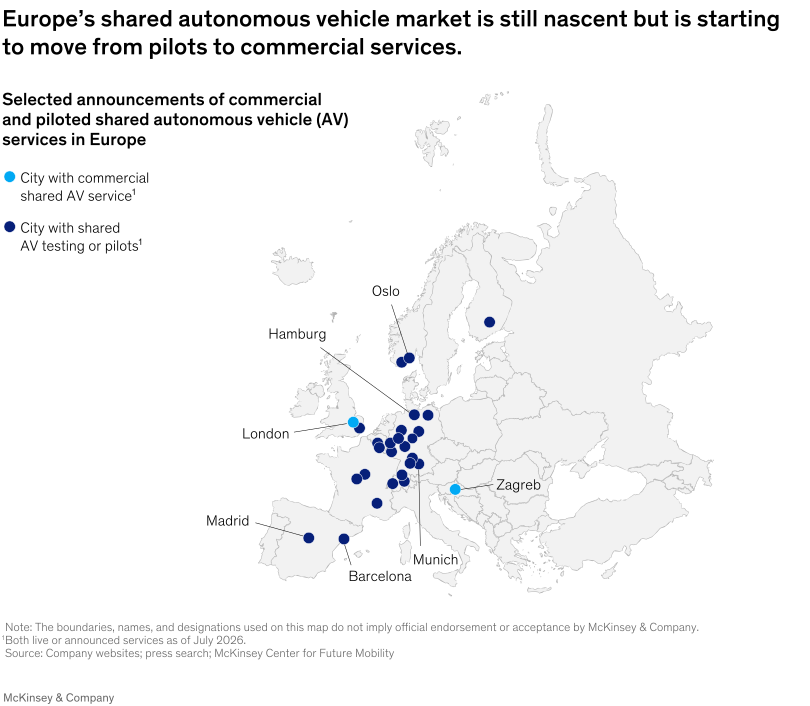
In Europe, the nascent market is just starting to move from pilots to first commercial services (Exhibit 2). Zagreb and London both have commercial AV services and more announcements are being made across for 2027.
If these projections are realized, the industry could be at the beginning of a steep scaling curve that could unlock significant market opportunity in these key regions.
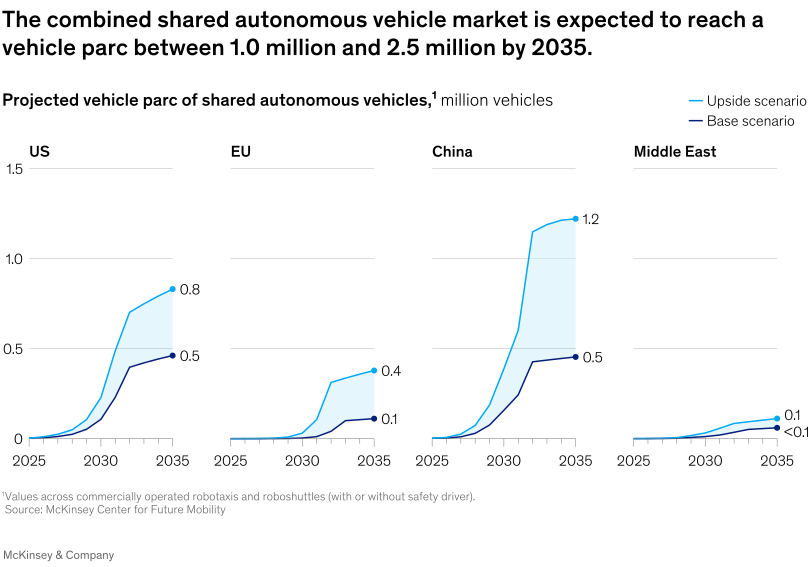
In the United States, the shared AV market could reach $100 billion to $190 billion by 2035, with approximately 400,000 to 800,000 vehicles in operation across scenarios.13
In Europe, the shared AV market could reach $20 billion to $70 billion by 2035, with a vehicle parc of 100,000 to 400,000 vehicles. Compared with China and the United States, the future European market may be led primarily by roboshuttles, with AV technology providers partnering closely with local public transport operators. These services could be deployed as feeders into existing public transit networks or as targeted substitutes in areas where expanding conventional public transport would be too costly or too slow.
By 2035, the Chinese shared AV market could reach $60 billion to $150 billion, supported by a fleet of 400,000 to 1.2 million vehicles. The difference in market size between China and the United States stems primarily from lower expected per-kilometer costs—about 50 percent lower in China—reflecting local purchasing power differences.
In the Middle East, the shared AV market could reach approximately $10 billion to $20 billion by 2035, supported by a fleet of 60,000 to 100,000 vehicles in the base and upside scenarios, respectively.
Across the four regions, the total shared AV vehicle parc could reach between 1.0 million to 2.5 million units (Exhibit 3).
The total shared AV market could reach about $190 billion to $430 billion by 2035, depending on the scenario (Exhibit 4).
But how the shared AV market will actually develop remains highly uncertain. Regulation is still fragmented globally, which has slowed implementation in the past, but new frameworks such as the one developed by UNECE could help address this. Operational bottlenecks remain, including the need for charging infrastructure, safety drivers, and depots. The sector continues to require high levels of investment, with unit economics at scale still to be proven. Broader adoption could also have significant effects on workers, which could affect regions differently.
Stakeholders across the value chain could capture future value
As shared AVs scale, stakeholders across the value chain could create and capture value through targeted, strategic moves.
New partnerships are forming as the shared AV ecosystem begins to disaggregate. Rather than vertically integrating across every step, companies are now increasingly specializing in their core capabilities. For example, OEMs are focusing on vehicle integration, tech companies on the virtual driver and safety case, and fleet operators on operations and customer experience. Companies within the shared AV ecosystem are starting to partner to scale faster, reduce capital intensity, and accelerate the path to revenue. Each stakeholder across the value chain has a significant role to play.
OEMs can industrialize AV hardware integration. OEMs can modify vehicles so that AV stack providers can efficiently access sensors, safety-critical components such as redundant brakes or steering systems, and controllable elements such as doors and windows. OEMs can also design high-utilization vehicles, such as robotaxis or roboshuttles, but these have more complex technical requirements than private cars in terms of durability, maintenance costs, predictive maintenance capabilities, modular battery sizes, and faster charging options. Over time, OEMs may move from selling units to selling availability, relying more on fleet leases, uptime guarantees, and maintenance bundles.
AV tech providers could play an equally important role. To be competitive, AV tech providers may need to continue productizing the AV stack to make it cheaper, safer, more modular, cover more complex traffic situations, and easier to validate in cities, update remotely, and integrate across vehicle platforms and geographies. Because today’s rollout is still happening city by city, AV tech providers may need to design expansion strategies that reduce the effort required to launch in each new city, including less mapping, validation, remote operations support, and engineering effort per deployment. Continuous measurement and improvement of safety performance through robust validation and field monitoring will be essential, too. At the same time, AV tech providers may need to improve unit economics through purpose-built vehicle platforms and operational excellence, clarify their long-term role in local operations, and establish partnership models with vehicle OEMs and fleet operators.14
Financing providers are critical enablers of the pilot-to-scale phase. Large shared-AV deployments require substantial capital before the full unit economics are proven, creating a role for financiers who can provide staged facilities that expand as operators demonstrate safety and utilization. There is also an opportunity to bundle the financing of surrounding infrastructure, such as data centers, depots, charging infrastructure, and related assets, which could make shared AV financing more attractive. To reflect the true economics of shared AVs, financing models may increasingly need to underwrite utilization rather than just the vehicles, taking into account paid and empty miles, uptime, permit status, and access to charging. In other words, returns may be linked to revenue‑generating miles and the performance of the broader ecosystem, not only to the asset value of the vehicles themselves, particularly in the early years, when utilization is still ramping up and risk premiums need to compensate investors for greater uncertainty. In the future, individual owners of AVs could make use of peer-to-peer shared AVs, by renting out their vehicles for ride-hailing when they are not using them.
Fleet operators could capture value by improving operational excellence. Operations are expected to become the major cost by 2035; therefore, maximizing utilization while minimizing empty miles is likely to become essential. Operators could improve their demand forecasting, reposition their fleets (that is, deploying the fleet when and where demand is highest and scheduling maintenance and cleaning during off-peak hours), and optimize their charging strategies. Building an AV-specific workforce—including remote assistance specialists, depot technicians, customer support agents, and incident response teams trained for autonomous operations—could also be beneficial. The most successful operators are likely to be those that develop a repeatable city-launch playbook that defines incident responder protocols, curb rules,15 accessibility procedures, and local-language passenger support.
Mobility platform providers can use dynamic pricing, pooling, and real-time information on events and commuter peaks to improve utilization. This will be important for enhancing the economics of shared AV fleets. Mobility platforms could focus on complementing public transport, for example, as feeders in less-connected neighborhoods or as options for off-peak times. Providers can also tailor services for different use cases, offering small vehicles for solo travelers, larger vehicles for groups, and differentiated premium or economy options.
While these example actions are by no means exhaustive, they demonstrate what stakeholders across the value chain can do to capture value.
Shared autonomous mobility is moving from pilots to commercial services in a growing number of cities. For companies across the value chain, the question is how they can create substantial value that works well for the cities and communities in which they operate.