The shipbuilding industry is highly exposed to geopolitical volatility. Shipbuilders commit capital to programs that can span several years (and that rely on shifting global supply chains), so new tariffs, sanctions, and export controls can flip margins and trigger delays. Similarly, shipbuilders lock in multiyear specifications and designs that must meet evolving regulatory and technology compliance requirements. At the same time, shifting government subsidies and demand signals are creating pockets of opportunity for players nimble enough to capture them.
The most successful shipbuilders are seizing novel opportunities presented by these geopolitical currents while taking steps to mitigate the associated risks. As we explore in this article, once shipbuilders establish an understanding of the new forces shaping the industry, they can build the resilience and flexibility they need to succeed in today’s market. This development can be realized by running a tested playbook built on five pillars: rethinking portfolio strategy, seizing the growth window, derisking supply chains, improving cost structures, and building future-proof organizational capabilities.
The dynamics of geopolitical change: Four key value drivers in shipbuilding
While shipbuilders cannot predict the future, they can prepare for a range of scenarios—and be the first to act. Such preparation requires a deep understanding of the drivers of geopolitical changes that shipbuilders are exposed to. McKinsey has written previously about ten value drivers and the actions they are prompting in the wake of geopolitical shifts.1 Four of these drivers, detailed below, are especially pertinent to shipbuilding:
- Trade agreements and tariffs. Global commerce in shipbuilding is increasingly affected by foreign direct investment (FDI) screening, tariff regimes, and local-content rules that are compelling supply chain rerouting. Recent trade policy moves have also introduced new uncertainty into the markets for direct inputs such as iron and steel. US tariffs on steel, for example, were reinstated at 25 percent and rose to 50 percent in the first half of 2025.2 They remain in flux as the scope of US tariffs shifts alongside the trade deals governing those tariffs.3 This state of heightened variability means greater input cost volatility, narrower vendor pools, and less-consistent delivery schedules.
- Industrial policies and incentives. State-directed investment continues to expand capacity and compress costs in shipbuilding. This investment has contributed greatly to intensifying competition and increasing asymmetry in scale and productivity. This driver (and its impact) can be observed in multiple geographies: In 2024, the Chinese market alone accounted for 53 percent of projected global shipbuilding output,4 and the Korean government launched a refund guarantee program as an insurance policy for shipbuilders to secure new orders.5 Additionally, Spain’s Ministry of Industry and Tourism launched a direct subsidy for shipbuilders in 2022.6
- Import, export, and capital controls. Export controls and licensing systems are increasingly restricting access to dual-use electronics by shrinking the pool of available, qualified suppliers. Critical materials such as specialty steels and other inputs exposed to tariffs add another layer of complexity. For example, the Chinese government’s export restrictions on seven critical rare earth elements have created sourcing delays that are holding up equipment deliveries to shipyards—which, in turn, can delay final outfitting and vessel delivery.7 Export volumes for rare earth elements fell sharply in the immediate wake of controls imposed in early 2025.8 And even as trade values recovered, rare earth prices in importing countries remained elevated. European market prices for rare earth elements surged to six times the prices in the Chinese market. Additionally, the Chinese government further tightened its export controls on products related to rare earths in late 2025, adding a requirement for government-approved licensure to export rare earth elements and approval to export any products containing rare earth elements or rare earth element technologies sourced in China, regardless of where the products are manufactured.9
- AI and technology. Capabilities afforded by AI, automation, and software-defined systems can be force multipliers for productivity in shipbuilding. The market for digital shipyards (defined as shipyards that use digital technologies such as AI, the Internet of Things, robotics, and digital twins from design to decommissioning) could grow at a CAGR of 15 to 20 percent between 2025 and 2035.10 But if these capabilities are implemented improperly, they can drain an organization’s time and energy.
While most geopolitical value drivers affect both commercial and naval shipbuilding, the latter is more exposed to the resulting risks—but also positioned to seize more of the resulting opportunities. In terms of risks, naval shipbuilders are most exposed to FDI restrictions, sanctions, and export controls (on propulsion systems, for example). In terms of opportunities, changes in defense postures, new multilateral alliances, and technological breakthroughs represent sources of growth for both legacy shipbuilders and new entrants, whether start-ups or commercial players.
Once shipbuilders understand the particular risks they face as well as the opportunities available, they can begin developing strategic plays to gain competitive advantages with guardrails that help create buffers and support flexibility.
From value drivers to strategic best practices: Implementing a five-pillar playbook for outperformance
In our experience, shipbuilders that implement strategic best practices can realize a range of benefits. The resulting improvements help them build value and create the resilience to shifting geopolitical dynamics that they need to outperform their industry peers. These best practices fall within a playbook consisting of five pillars.
Pillar 1: Rethinking portfolio strategy with future-proof platforms
To meet the moment and future-proof their operations amid geopolitical changes, shipbuilders must revisit their product and platform road maps. This process demands an unsentimental, analytical assessment of the facts on the ground, unencumbered by legacy decision-making, personal favorites, and interest groups. Segmentation based on that assessment lays the groundwork for smarter resource allocation (such as for R&D and production capacity) and rethinking organizational setups and commercial strategies (exhibit).
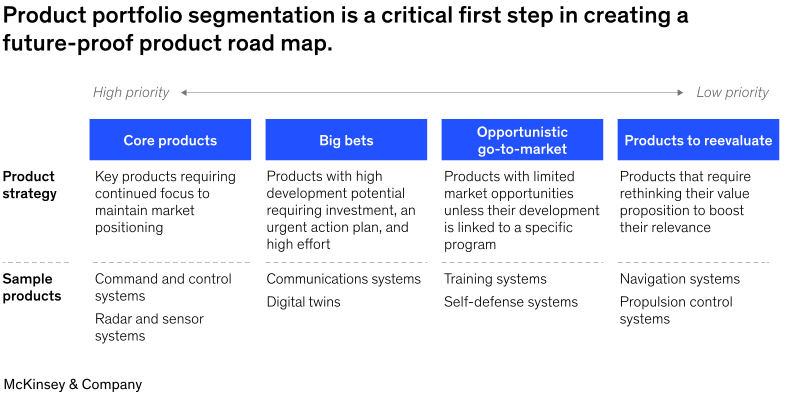
Big bets for commercial shipbuilders could include entering the naval shipbuilding segment by building entire ships or modules and components; for both naval and commercial shipbuilders, big bets might include investing in autonomy, software, dual-use technology, or eco-fueled propulsion.
For example, one naval shipbuilder revisited its platform road map in response to rising demand for naval vessels and novel capabilities, increases in public sector spending, and a shift in value pools toward technological capabilities. After identifying a naval software product as a big bet, the shipbuilder went all in, hiring engineers, co-locating them in the shipyard, working based on agile principles and iterative approaches, and rethinking its commercial strategy. The investment paid off with double-digit revenue growth, full control over future-proof capabilities, and a model playbook for future portfolio moves.
Pillar 2: Seizing the growth window by accelerating production to meet spiking demand
Many naval and commercial shipbuilders are facing elevated demand, which is reflected in growing order books. For example, commercial shipbuilders in the Chinese and South Korean markets are carrying backlogs that push deliveries into 2028.11 Similarly, spikes in demand for naval shipyards have many sovereign programs filling capacity well into the 2030s.
Shipbuilders can derisk and accelerate their production timelines to capture opportunities presented by the current geopolitical context of growing defense budgets, complex alliances, and frequent industrial policy shifts. To achieve these objectives, organizations should pair fundamental operational best practices with targeted uses of novel technology:
- Fundamental operational best practices. Adopting time-tested continuous-improvement methods—for example, root cause analysis via the “five whys,”12 isolating and removing bottlenecks via the theory of constraints, and eliminating waste and rework via frontline leader engagement during Gemba walks13—can help shipbuilders develop more efficient processes, increase time on task, and improve responsiveness. Successfully deploying such lean management practices typically improves quality drivers (weld defect prevention and coating thickness precision, for instance) and reduces variation and rework. Critical path optimization and work standardization further accelerate performance.
- Targeted technology enablement. Technological innovations targeting well-defined use cases can help unlock considerable efficiency when implemented successfully. Increased numbers of vendors and cost reductions are accelerating technical proliferation, and shipbuilders have a historic opportunity to take advantage of these developments. For example, AI can enable dynamic scheduling as well as iterative improvements and responses to fluctuations in material inventory, workforce levels, and available capacity. Digitized workflows (for example, keeping drawings and parts tracking on tablets or switching to electronic inspection records) can help accelerate feedback and increase productivity, while digital twins can help optimize layouts for faster material flow and resource allocation.
The benefits from some shipbuilders’ efforts to boost throughput have already become evident. For example, one shipyard facing long-standing scheduling bottlenecks developed and deployed an AI-driven production scheduler across all key shops during a six-month period. Early results showed a tremendous improvement in critical path job throughput. This demonstrates how technology, paired with disciplined execution, can quickly enhance performance to take advantage of a growth window and even turn a chronic constraint into a source of competitive productivity and agility.
Notably, this breakthrough is enabling the shipbuilder to reimagine core workflows. The shipyard is embedding the AI scheduling tool into its daily routines, including production meetings, dispatch planning, and shop floor decision-making. Governance and clear accountability ensure that the AI-driven insights are sustainably embedded and continue to improve the shipyard’s productivity and long-term resilience.
Pillar 3: Derisking supply chains to reduce vulnerabilities and withstand shocks
Since the COVID-19 pandemic, supply chain risk has been top of mind for maritime executives. Recent geopolitical changes—including tariffs, sanctions, and regional conflicts—have once again exposed vulnerabilities in shipbuilders’ supply chains for items ranging from steel to specialty components and electronics. Nonetheless, deploying the following two best practices can help mitigate supply chain vulnerabilities:
- Continuous exposure assessment. Advanced illumination models can enable multitiered supplier transparency, helping companies pressure test their supply chains and identify common sub-supplier choke points, exposure to sanctions, and other risks. Quantifying the risks identified can focus mitigation efforts, while real-time monitoring offers early-warning detection at a supplier or commodity level.
- Mitigation planning. Plans should include a range of actions, including qualifying alternative suppliers, transferring risk in contract structure, insourcing capabilities, localizing or friendshoring sourcing, developing strategic partnerships to ensure suppliers can handle demand spikes, and sending stable demand signals.
One advanced industries manufacturer, for example, identified a path to reducing the extent to which its margins were exposed to tariff-related risks by more than 50 percent. To do this, the organization conducted a diagnostic of end-to-end value-chain exposure via harmonized tariff schedule (HTS) mapping and assessed mitigation options for impact and feasibility. Based on this diagnostic, the organization has derisked its supply chain. It now uses a live model with ten tariff and growth scenarios to continuously monitor tariff risks and flag tipping points that trigger further mitigation measures.
Pillar 4: Improving cost structures to boost resilience and competitiveness
As geopolitical tensions reshape trade routes, supply chains, and defense priorities, shipbuilders face unprecedented volatility in input costs. In such an environment, cost management is no longer a routine efficiency exercise; it is a strategic imperative. As outlined below, the three largest cost categories are the most exposed to rising geopolitical disruption and require more active, risk-based management than traditional cost-control approaches:
- Material costs (procurement). Material inputs—steel, composites, and advanced alloys—represent one of the largest cost drivers in shipbuilding. Fluctuations in commodity prices, often triggered by sanctions, export restrictions, or regional instability, can erode margins. Constructing supplier base risk profiles for each country, supplier, and commodity can help direct mitigation efforts such as diversifying suppliers, unbundling material packages, negotiating escalation protections in long-term contracts, and pooling volume to stabilize pricing.
- External labor costs. Shipbuilders rely on subcontractors and specialized external labor to supplement internal capacity during schedule surges and provide specialized skills. Availability and cost vary widely by region and often tighten during geopolitical disruptions. To manage these risks, shipbuilders can reduce dependence on any single source by developing multiregion vendor pools, prequalifying alternate subcontractors, and shifting toward more modular work packages with standardized scopes of work to reduce cost inflation and improve predictability.
- Internal labor costs. Managing internal labor costs requires preserving critical expertise as an aging aerospace and defense workforce coincides with rising geopolitical uncertainty and tighter national labor markets. Compared to materials or subcontracted services, optimizing internal labor affords less flexibility and requires more time. Shipbuilders can mitigate internal labor cost exposures by codifying institutional knowledge via digital work instructions and standard work, increasing prefabrication to reduce labor intensity, and cross-skilling critical trades to build resilience. Smoothing workloads across programs and tightening trade-level performance management further protect against retirement-driven gaps while maintaining cost discipline.
One international shipbuilder achieved over $100 million in annually recurring savings by targeting material costs. By expanding its supplier base, strategically unbundling, and adding escalation protections to long-term agreements, the shipbuilder managed its cost base while reducing exposure to geopolitical risks. Other levers, which the shipbuilder applied to more than 130 purchasing categories, included preassembly, should-costing, and volume pooling.
Pillar 5: Building organizational capabilities to develop a future-proof workforce
To weather geopolitical changes, shipbuilders need a steady workforce capable of adapting to changing schedules, workflows, and platforms while increasing throughput rates. But many shipyards struggle to attract and retain talent, particularly young trade-based workers, because of a perception of limited growth opportunities, low pay, and tough working conditions. At the same time, the industry faces a significant retirement bubble (one-third of US aerospace and defense manufacturing employees are older than 55).14
McKinsey has published previously on talent in shipbuilding, outlining recommendations for improving the maritime talent pipeline and talent management.15 Shipbuilding companies that set themselves apart do so by taking a data-based approach to talent, as described below:
- Holistic talent strategy and planning. Closing critical talent gaps is essential to meet cost, schedule, and quality commitments. The process of pinpointing skill gaps starts with translating the build strategy and production schedule into specific engineering and craft capabilities that must be onboarded to support sequencing and system-integration milestones. Connecting these capability needs to head count forecasts enables earlier surge hiring, reduces late-stage trade stacking, and strengthens overall program execution. Moreover, higher attrition in the sector strains the talent strategy and may exacerbate skill misalignment in new hires. Recruiting laterally from adjacent sectors may help shore up near-term talent gaps (particularly for critical tradespeople and supervisors) and provide a lower-cost option for meeting projected labor demand as the sector grows.
- Sourcing and selecting top talent. Granular labor market mapping across regional shipbuilding clusters, adjacent heavy industries, and military-to-civilian pipelines can help identify hidden sources of talent. In addition, analyzing the existing workforce for predictors of distinction can help shipbuilders select high performers systematically. As relevant education pipelines shrink, shipbuilders could help shape supply by partnering with educational institutions to align curriculums and increase graduates’ placement in priority roles. Opportunities could be marketed via job-shadowing initiatives and preenrollment site visits for prospective hires. The impact of such initiatives on talent attraction could be sizable; the National Career Development Association found in 2022 that more than 80 percent of participants in job-shadowing programs reported increased confidence about their career decisions.16
- Enhancing onboarding and development. Shipbuilders can cut the time it takes to achieve proficiency by using a combination of standardized onboarding boot camps and hands-on, practical learning. Quantifying the ROI of training programs in terms of competency gains in skills can help identify specific focus areas to increase employee productivity and shape future onboarding and development.
- Rethinking performance measures. Selecting the right measures of performance and tying them to actions that improve those measures can help uncover high-potential employees in both craft and engineering roles and identify what roles they may be best suited for. AI can make KPI tracking and talent assessment more consistent at scale, and technology adoption can reinforce the system by improving productivity while strengthening attraction.
- Determining the underlying causes of attrition. Gathering structured employee feedback throughout their tenure and at the point of departure helps isolate the root causes of turnover, from shift patterns and overtime demands to supervisor effectiveness. Such insights can enable interventions to help preserve critical trades as well as production throughput. These diagnoses are especially important given the dual challenge of an aging workforce and weak recruitment of younger workers. Understanding which drivers matter most by cohort can help refine the employee value proposition for early-career talent while protecting critical expertise as retirements rise.
Select shipbuilders are already deploying people analytics with demonstrable benefits. One shipbuilder facing an acute attrition challenge realized a twofold reduction in turnover for key trades as well as a pathway to $100 million in attrition-related cost savings. The shipbuilder established a cross-functional people analytics unit that monitored shipyard employee pain points consistently and fast-tracked mitigations. The unit segmented the employee base into common archetypes that enabled it to develop custom value propositions rather than being limited to a one-size-fits-all approach.
Despite the volatile geopolitical landscape, shipbuilders can bolster their resilience and gain enduring competitive advantages with the right strategic moves. But the time to run the playbook is now. As shipbuilding rises as a national priority for countries around the world and technology advances rapidly, tolerance for cost overruns and schedule delays is shrinking. Challenges notwithstanding, lasting success in shipbuilding is eminently achievable, even as geopolitical uncertainty becomes the norm.