For decades, growth for commercial aerospace suppliers followed a familiar script. A steady cadence of new aircraft and engine platforms allowed suppliers to turn their R&D investments into long-term revenue streams that expanded alongside programs such as the 787 and A320neo. Successive product launches rewarded presence, patience, and engineering excellence.
That model is now under pressure.
Aircraft demand remains robust but is concentrated in existing platforms rather than in new cleansheet programs. With few new launches on the horizon, OEMs increasingly focus on accelerating deliveries, leading some to reassess supply relationships to secure capacity and improve economics.
As a result, commercial capability is becoming a more important driver of financial performance. Suppliers that win more share, negotiate more favorable terms, and better manage contract economics over the life of their programs outperform peers.
Recent transformations in the sector underscore the opportunity. Leading suppliers have secured 25 percent price increases on long-term supply agreements, raised enterprise-wide margins by about 10 percent, and recovered millions of dollars in value previously lost through unenforced contract terms.
How suppliers’ growth model changed
The economic hurdles facing new commercial aircraft platforms are high. In an April 2025 Aviation Week–McKinsey survey of 135 industry executives, respondents estimated that production costs for an entirely new single-aisle platform would be about 30 percent higher than for current models—while expected efficiency gains would only be around 12 percent. Little surprise that half of survey respondents said they do not expect to see a new single-aisle program until at least 2034.
In the meantime, airlines’ demand for existing platforms remains strong: Forecasts point to about 7 percent annual growth for new aircraft deliveries over the next five years. But raising output to reduce order backlogs and book revenue more quickly has proved difficult. Supply chains are still fragile, and expanding capacity requires multiyear capital investments and increasingly scarce specialized talent.
These conditions have changed OEMs’ priorities. Securing reliable capacity now sits alongside traditional cost, quality, and innovation concerns, prompting greater use of multisourcing. Some OEMs have even sought broader intellectual-property rights to enable greater flexibility in the supply base.
For suppliers, the lesson is that long-held positions are now increasingly contestable. With new platforms unlikely over the coming years and more competition within existing programs, growth now hinges on how effectively a company secures new business, realizes economic value from its deals, and sustains margins over time.
The shifts within commercial aerospace mirror those emerging in the defense sector. Although defense programs tend to be governed more rigidly by long-term contracts—and draw from a narrower supplier base—competitive intensity is rising. As in commercial aerospace, growth opportunities are expanding within existing platforms, and suppliers face greater scrutiny on quality, cost, accelerated delivery, and capacity.
Building commercial muscle in a changing supply chain
Adapting to these market conditions is not straightforward. Capacity expansions take years to materialize and generate a strong return on investment, while platform road maps are largely outside a supplier’s direct control. Given these constraints, suppliers may perceive market demand as the primary growth driver—the rising tide that lifts all boats—rather than purposeful management actions.
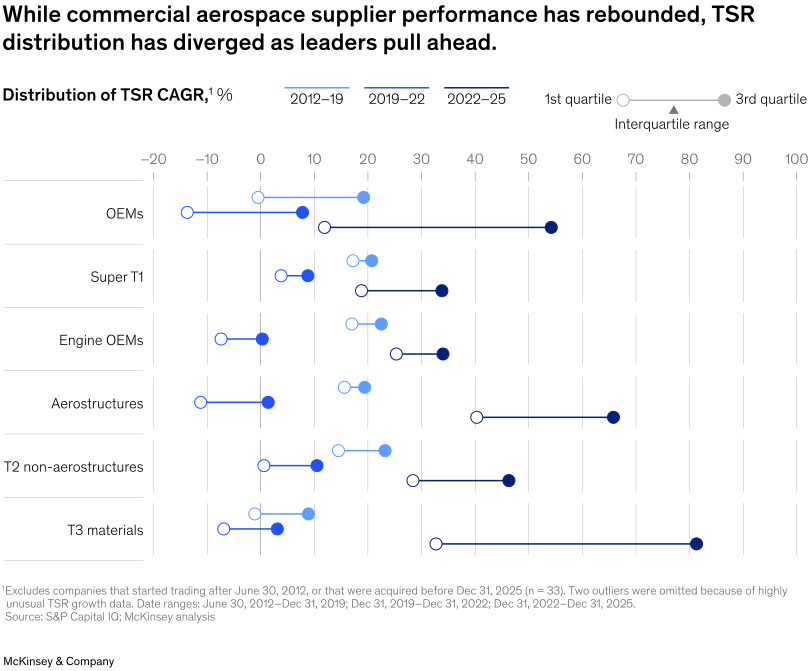
Our analysis of the industry’s recent performance suggests otherwise, however. While many aerospace and defense (A&D) suppliers have regained profitability since the pandemic, total shareholder returns are diverging (Exhibit 1). Market growth sets the baseline; execution determines who pulls ahead, with high-performing companies showing stronger commercial capabilities.
Even the strongest suppliers can no longer rely on selecting the “right” new platform and riding multiyear supply agreements. Our survey findings indicate that long-held supplier positions are becoming contestable as OEMs introduce additional sources and strengthen their supply bases.
In February 2026, we conducted an in-depth survey of 16 aerospace and defense experts about the state of the commercial aerospace supplier market. Their responses indicate that components, subsystems, and systems once considered effectively “closed”—protected by long-term sole-source arrangements or limited competition—are opening to new entrants across multiple categories (Exhibit 2).
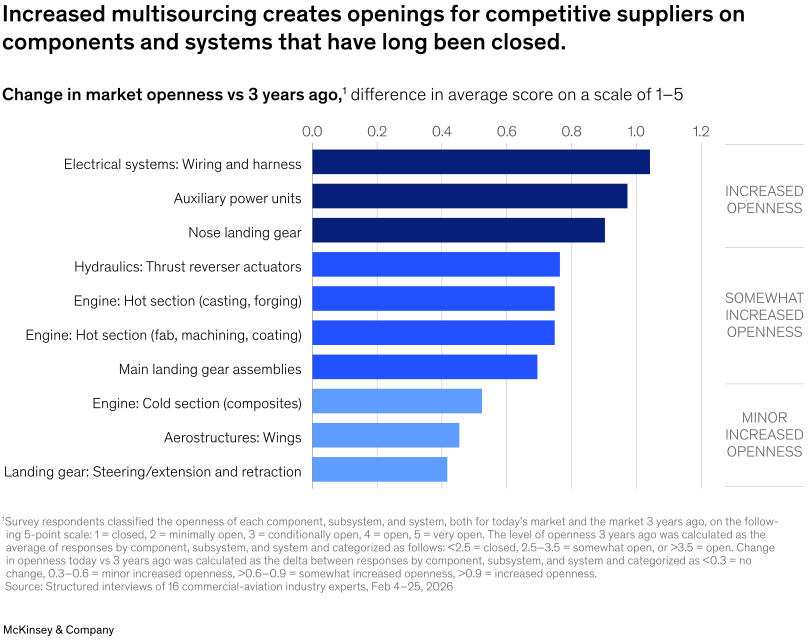
In many cases, the components showing increased openness to competition share common characteristics: sufficient replacement volumes to justify capital investment by a challenger; attractive legacy margins that motivate OEMs to introduce a second source; or delivery and quality shortfalls that increase OEM willingness to pay for supply security. Even contracts that appear ironclad may still leave room for challengers.
Short- and medium-term growth now depends on maximizing returns from the existing customer portfolio while building stronger commercial capabilities over the long haul. The urgent task facing leaders is to pressure-test their organizations against three questions that can help them achieve commercial excellence: Are we hunting in the right places? Are we making the right deals? And are we realizing all of the value we negotiate (table)?
In commercial aerospace, commercial excellence centers on three questions.
| Q1: Are we hunting in the right places? | Q2: Are we making the right deals? | Q3: Are we realizing all of our deals’ value? |
| Play in the right market(s) (geo, vertical, prod, category adjacencies) | Set list prices and discount parameters based on value to customer and market dynamics | Establish contract governance processes to standardize term enforcement |
| Define clear customer segmentation and verticals to inform prioritization and service levels | Improve pricing discipline to ensure we “get the price” each time | Invest in technology to monitor revenue flows, track change orders, and improve cross-functional accountability |
| Consistently identify new customer-level opportunities covering new, adjacent, and underpenetrated market openings | Review commercial terms for opportunities to enhance risk sharing, particularly for inputs subject to high pricing volatility | Standardize interpretation of contractual scope across business units and sites |
| Align sales coverage, type of seller/specialist, and account strategy to each customer and segment | ||
| Revamp incentives and role definitions to clarify expectations and reset mindsets |
Are we hunting in the right places?
In an execution-driven market, growth begins with deliberate choices. With fewer new platform launches, suppliers can’t count on major revenue jumps from such projects. Instead, they need a clear view of where demand and profit pools are likely to expand within the installed base of aircraft and engines already in production—and where their own capabilities are most distinctive.
Where should we compete?
Leading suppliers translate that strategic view into an explicit set of growth priorities across core, adjacent, and new market verticals (such as different airframes). Practically, this starts with building a perspective by vertical and component, grounded in production-rate outlooks, fleet age profiles, aftermarket dynamics, and the degree to which OEMs are likely to open the supply base. When sufficient data are available, AI-powered market analysis tools can accelerate both the identification and prioritization of growth opportunities. This perspective is then paired with a sober assessment of what it takes to win in each arena: existing customer relationships, technical differentiation, relevant qualifications and certifications, available capacity, reliable delivery performance, and the ability to commit to ramp profiles.
The output is a “where to play” heat map that makes opportunities explicit (Exhibit 3). It highlights which components show potential underpenetration with existing customers, with strong sales in some platforms and little in adjacent ones. Some components may show even greater spikiness: High sales across a subsystem (such as aerostructures) may reflect distinctive manufacturing capabilities, which could potentially be replicated in current platform types that the supplier has not yet worked on. A third opportunity comes from transferring strong capabilities in one component to related components that rely on the same capability, such as within different landing-gear components.
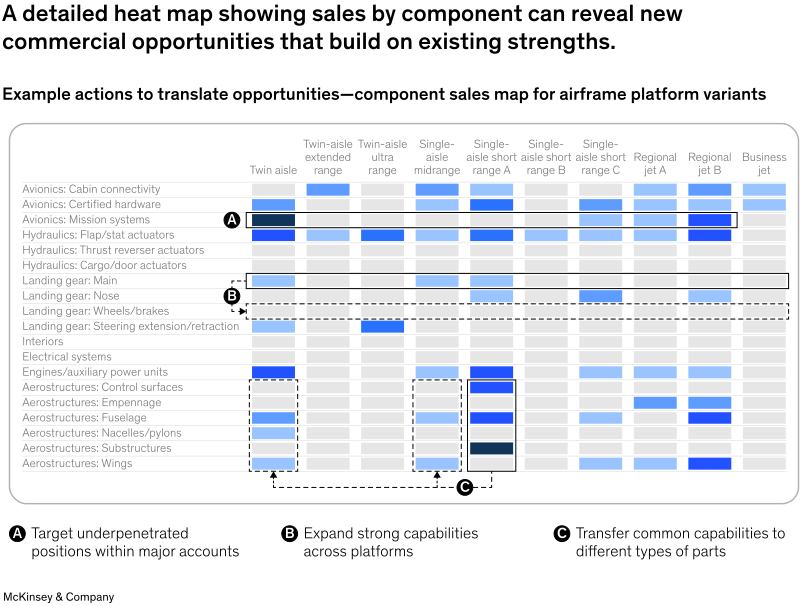
With the right data, suppliers can take this idea even further. When a large North American supplier experienced a sales drop, it conducted a market analysis covering the entire commercial-aviation sector. The output uncovered several large accounts that served only narrow slivers of each customer’s business—and where the company had made little effort at cross-sales to other units. Armed with these insights, the commercial team validated an additional $100 million in high-potential opportunities at targets that bore close resemblance to existing contracts.
Are we managing our platform risks thoughtfully?
Fewer new programs can lead suppliers to focus more on keeping their current contracts than on finding new ones, increasing their reliance on just a few programs to sustain their business. Rather than placing all bets on a single platform, customer, or component family, leading suppliers take a portfolio management approach by pursuing multiple opportunities that can move the revenue needle. This diversification matters in an open supply chain environment where sourcing shifts can occur quickly and where a single disrupted position can materially affect a supplier’s trajectory.
To take advantage of the opportunities from a more dynamic market, many suppliers may go beyond servicing the installed base by creating more business development capacity—dedicated roles charged with identifying underserved customers, originating deals, and boosting demand. Aligned sales coverage and account plans can reinforce these efforts, especially across adjacent customers and programs where the supplier intends to take share.
Existing incentives and role definitions are often a hidden constraint when attempting to intensify new business development. If the organization rewards only near-term volume, account size, or preservation of legacy accounts, it may underinvest in the behaviors required to capture new work on existing platforms. Leaders can reset mindsets by clarifying expectations for time allocation across hunting versus farming, defining measurable new-business objectives, and designing asymmetric incentives that encourage sales teams to focus on new growth.
Are we making the right deals?
As new-platform tailwinds fade, deal quality becomes more critical. Pricing methodology, negotiation preparation, governance discipline, and sales enablement determine whether suppliers secure their contracts’ full economic potential or leave value unrealized.
Are our prices right?
Many aerospace suppliers historically relied on internally anchored pricing approaches—cost-plus logic, historical benchmarks, or plan-driven targets. While straightforward, these methods often overlook market-based factors such as customer economics, supply-demand imbalances, switching costs, and analysis of credible competitive alternatives. In a capacity-constrained environment, these omissions can be material. Emerging forms of AI—such as deep learning models that quantify price elasticity—could help close these gaps, enabling more systematic incorporation of market dynamics into pricing decisions.
Solutions based on currently available technology can already be quite powerful. One advanced materials supplier recognized that pricing proposals varied significantly across business units and were rarely grounded in a rigorous external fact base. Negotiations were often shaped by legacy contract structures rather than forward-looking market dynamics. To address these issues, the company built a comprehensive market-backed pricing framework.
Engineering teams collaborated to estimate customer switching costs, including capital expenditures required to establish alternative capacity, testing and certification requirements, potential production delays, and associated penalties. Quantitative models were then constructed to estimate product pricing based on the net present value of customers’ next-best alternatives. In parallel, governance mechanisms were strengthened: Structured milestone plans clarified preparation steps before entering negotiations, and recurring deal reviews increased transparency of pricing terms and aligned aspiration levels across business units.
The first major long-term agreement renegotiated under the new approach achieved an approximately 25 percent price increase—representing more than $100 million in annual value. Two subsequent negotiations increased price aspirations by roughly 30 percent compared to prior cost-plus logic. Across the enterprise, margins are expected to improve by 5 to 10 percent as the methodology scales.
Are we getting the right price consistently?
Pricing discipline also requires a coherent architecture. A tier-two components supplier faced fragmented pricing models and limited governance across a portfolio of more than 10,000 SKUs. More than 10 percent of recent sales had been delivered at a negative margin, reflecting inconsistent logic and limited oversight.
The company’s transformation started with an intensive cleanup of its SKU data into a standardized hierarchy across more than two dozen families of components. In just five weeks, the company developed and rigorously tested a new pricing tool designed to balance deal-level flexibility with enterprise-level consistency. The tool assigned new margin guidelines by part family, with attribute-based adjustments reflecting contract type, commercial complexity, and performance expectations. Crucially, these new targets were embedded directly into the company’s established costing governance, reinforcing their continued use as a new “business as usual.” The initiative is projected to increase enterprise-wide margin by about 10 percent—equivalent to roughly $70 million annually.
Are our commercial terms right?
A further risk, given broader economic and geopolitical uncertainty, focuses on supply chains and pricing volatility. With margins in the industry often in the low double (or even single) digits, a price spike in a critical mineral or component can have a disproportionate impact on a contract’s profitability. One supplier found that more than one-tenth of its contracts were losing money because of input-cost increases. By taking a more consistent approach to negotiating escalation clauses into its agreements—and, equally important, ensuring that its accounts-receivable systems passed the agreed costs on as specified—the company reduced its cost exposure by more than $10 million.
Are we realizing all of our deals’ value?
Finding attractive new opportunities and negotiating better terms is only part of the challenge. Without disciplined contract governance and value management, realized margins can erode quickly. Scope creep, expedited requests, engineering changes, and inconsistent interpretation of contractual terms can materially undermine performance.
A diversified aerospace component supplier discovered that it was routinely absorbing customer-driven scope changes—including expedited shipments and engineering modifications—without sharing these costs with customers. Contractual scope was interpreted inconsistently across sites, roles and responsibilities were unclear, and enterprise resource planning (ERP) systems lacked reliable tracking functionality. As a result, cost pass-throughs went unenforced and potential revenue went uncollected.
When the company finally noticed the problems, it implemented a repeatable governance process anchored in cross-functional accountability. Monthly meetings among finance, operations, and account management documented and verified contractual terms and revenue flows. The company also standardized scope interpretation across sites through training workshops while improved technology enabled formal tracking, monitoring, and escalation pathways.
Within six months of deployment, the company realized approximately $7 million in savings—almost double the initial $4 million target. Beyond immediate savings, the new process fostered commercial discipline and reinforced a culture of value capture.
Commercial aerospace is entering a phase where the gap between leading suppliers and the rest is widening, and commercial excellence is becoming decisive. Companies can measure what’s at stake quickly: A focused effort over four to six weeks can quantify the impact—often on the order of 10 percent top-line growth and 5 percent margin uplift—and pinpoint where to focus. That clarity sets the agenda.
Suppliers that institutionalize pricing discipline and manage contracts to their full potential are best positioned to capture the opportunity. In short, they can go to market rather than wait for the market to come to them.