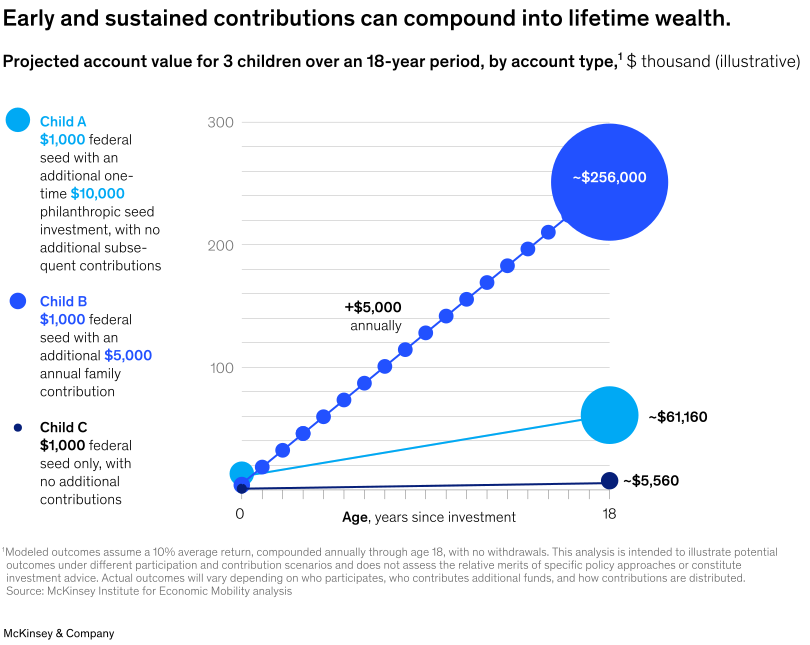
Economic mobility is often associated with education, employment, and income growth, but it is also shaped by asset ownership. Beginning in July 2026, eligible US newborns can receive a $1,000 government-funded seed investment through federally authorized 530A accounts, or “Trump Accounts.” While these accounts could meaningfully increase asset accumulation for lower-wealth households, uneven participation and contribution patterns may allow higher-wealth households to capture a disproportionate share of the benefit, say McKinsey’s Duwain Pinder, Jimmy Sarakatsannis, Shelley Stewart III, and their coauthors. For example, a child receiving only the $1,000 federal seed contribution could accumulate nearly $6,000 by age 18, compared with roughly $61,000 with a one-time $10,000 philanthropic contribution, and more than $250,000 with sustained annual contributions from families or other contributors.
Image description.
Line chart illustrating how early and sustained contributions can compound into lifetime wealth over an 18-year period for three hypothetical children's accounts. Child A receives a $1,000 federal seed plus a one-time $10,000 philanthropic contribution at birth, with no further contributions. Assuming a 10% annual return, the account grows steadily to about $61,160 by age 18. Child B receives a $1,000 federal seed plus $5,000 in annual family contributions. With the same assumed return, the account grows rapidly each year, reaching about $256,000 by age 18. Child C receives only a $1,000 federal seed with no additional contributions, resulting in a final balance of about $5,560. The exhibit demonstrates that while an early one-time investment can grow substantially through compounding, sustained annual contributions produce significantly greater long-term wealth. Values are illustrative and assume a 10% annual return with no withdrawals.
This image description was completed with the assistance of Writer, a gen AI tool.
Source: McKinsey Institute for Economic Mobility analysis.
End of image description.