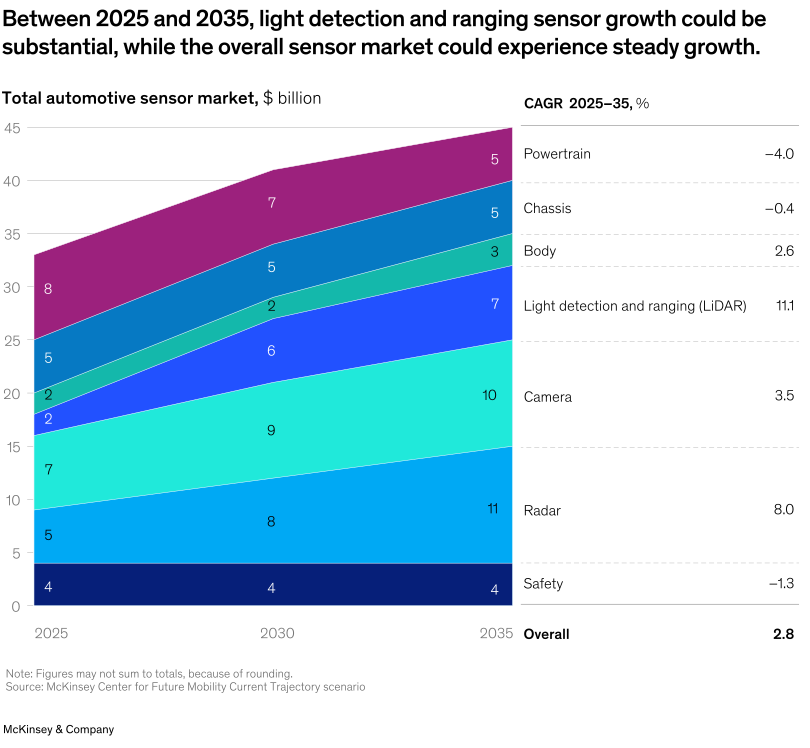
The automotive software and electronics market is moving toward zonal and centralized computing architectures to support software-defined vehicles. Growth is being fueled by evolving consumer expectations, safety regulations, and advances in high-performance computing, advanced software, and light detection and ranging (LiDAR) sensors. The overall sensor market could reach $45 billion by 2035, and the LiDAR sensor market is poised for exceptional growth as advanced driver assistance systems and autonomous driving (AD) adoption accelerates, while demand for traditional powertrain sensors slowly decreases with the rise of electric vehicles. OEMs broadly agree that level 3 and higher AD systems depend on LiDAR sensors to operate reliably, say McKinsey’s Dominik Hepp, Martin Kellner, Sören Jautelat, and coauthors.
Image description:
A stacked area chart illustrates the projected growth of the total automotive sensor market from 2025 to 2035, measured in billions of dollars and segmented by sensor type. The chart shows that the market is expected to increase from approximately $25 billion in 2025 to just over $40 billion by 2035. Each segment is color-coded to represent different sensor categories: powertrain; chassis; body; light detection and ranging (LiDAR); camera; radar; and safety. LiDAR increases from $2 billion in 2025 to $7 billion in 2035, with a compound annual growth rate (CAGR) of 11.1 percent—the highest among all categories. Radar is expected to grow from $5 billion to $11 billion (CAGR 8.0%) and camera from $7 billion to $10 billion (CAGR 3.5%). In contrast, the powertrain and safety segments decline, with powertrain dropping from $8 billion to $5 billion (CAGR –4.0%) and safety remaining flat at $4 billion (CAGR –1.3%). The body and chassis segments show modest changes, with body increasing from $2 billion to $3 billion (CAGR 2.6%) and chassis holding steady at $5 billion (CAGR –0.4%). The overall sensor market is projected to grow at a CAGR of 2.8 percent over the period.
Note: This image description was completed with the assistance of Writer, a gen AI tool.
Source: McKinsey Center for Future Mobility Current Trajectory scenario.
End of image description.