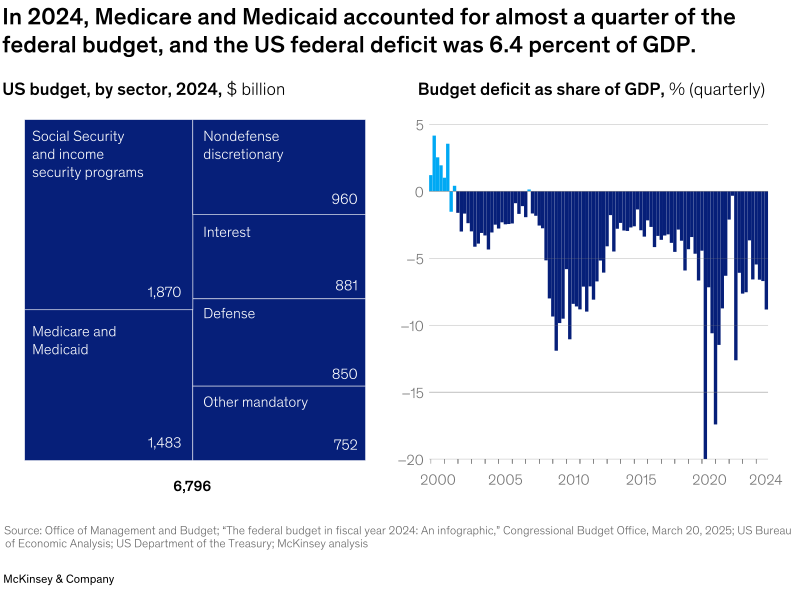
Still recovering from the COVID-19 pandemic, the US healthcare industry now faces new pressures from tectonic shifts in the trade, economic, and security order. Healthcare sits squarely on the fault line of these shifts. In 2024, the US federal budget totaled $6.8 trillion, and the federal deficit was 6.4 percent of GDP—well above sustainable levels. With Medicare and Medicaid accounting for approximately 22 percent of the 2024 federal budget, healthcare is likely to face continued pressure. Yet the opportunity to improve healthcare outweighs the headwinds if leaders can successfully tap into advances in AI, automation, efficient sites of care, medical science, and care model innovation, say McKinsey’s Drew Ungerman, Jason Azzoparde, Shubham Singhal, and coauthor.
Image description:
This exhibit combines a tree map and a bar chart to illustrate the scale and trajectory of the US budget deficit. On the left, the tree map breaks down federal spending by sector for 2024 in billions of dollars, with Social Security and income security programs constituting the largest share at $1,870 billion, followed by Medicare and Medicaid at $1,483 billion. Other significant expenditures include nondefense discretionary spending ($960 billion), interest payments ($881 billion), defense ($850 billion), and other mandatory programs ($752 billion), bringing total spending in these categories to $6,796 billion. On the right, the bar chart tracks the US budget deficit as a percentage of GDP on a quarterly basis from 2000 to 2024, revealing a persistent and increasingly negative trend. The deficit regularly falls below zero, deepening to more than –10% of GDP during periods such as the global financial crisis and the COVID-19 pandemic, and remaining well below –5% in recent years—highlighting the current unsustainable level of the deficit relative to the nation’s economic output.
Note: This image description was completed with the assistance of Writer, a gen AI tool.
Source: Office of Management and Budget; “The federal budget in fiscal year 2024: An infographic,” Congressional Budget Office, March 20, 2025; US Bureau of Economic Analysis; US Department of the Treasury; McKinsey analysis.
End of image description.