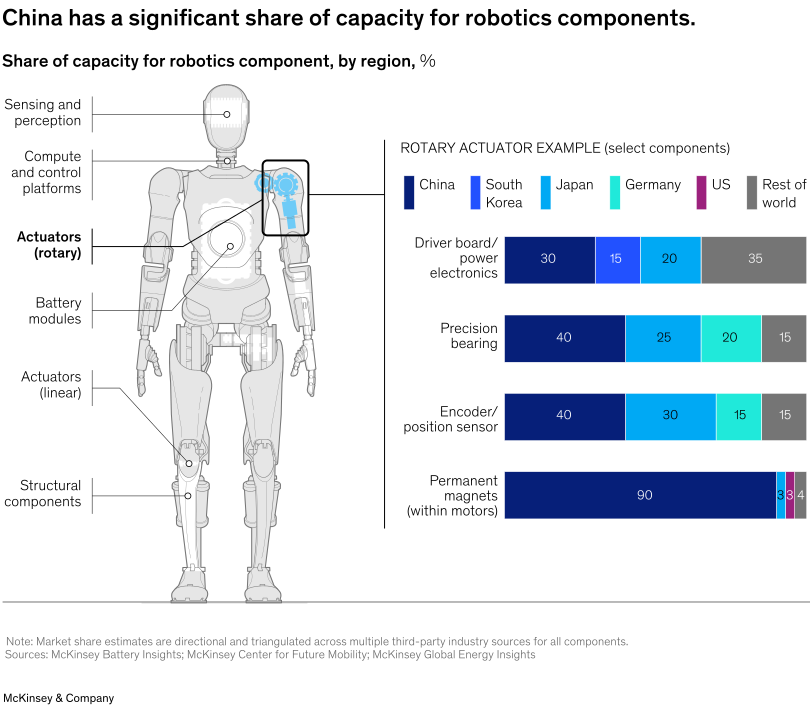
Humanoid robots are approaching an inflection point, and their path from prototypes to real-world deployment is accelerating. How the supply chain matures will shape the pace and economics of humanoid deployment over the next decade. What makes the supply chain picture distinctive is the mismatch between where value concentrates and where the supplier ecosystem is ready for high-volume production, note McKinsey’s Ani Kelkar, Christian Jansen, Erik Sparre, Mark Patel, Mikael Robertson, and coauthors. Many high-impact humanoid components overlap structurally with the electric-vehicle (EV) value chain. As a result, China—with its strong EV ecosystem—benefits and holds a significant share of capacity for several humanoid components.
Image description:
An illustration and bar chart show a humanoid robot labeled with key component categories—sensing and perception, compute and control platforms, rotary actuators, battery modules, linear actuators, and structural components—and highlights a rotary actuator in the shoulder with regional capacity shares for selected subcomponents. For driver boards and power electronics, China accounts for 30%, South Korea 15%, Japan 20%, and the rest of the world 35%; for precision bearings, China holds 40%, Japan 25%, Germany 20%, and the rest of the world 15%; for encoder and position sensors, China has 40%, Japan 30%, Germany 15%, and the rest of the world 15%; and for permanent magnets within motors, China dominates with 90%, followed by Japan and the US at 3% each and the rest of the world at 4%.
Note: This image description was completed with the assistance of Writer, a gen AI tool.
Source: McKinsey Battery Insights, the McKinsey Center for Future Mobility, and McKinsey Global Energy Insights.
End of image description.