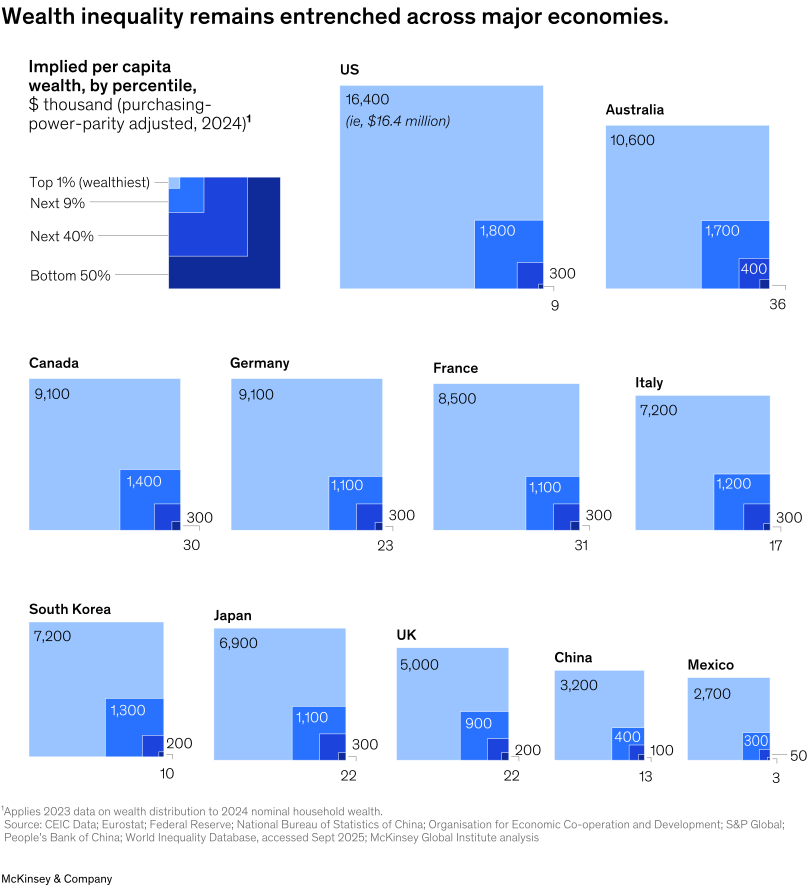
Entering 2025, global wealth reached a record $600 trillion. However, much of this growth was driven by rising asset prices rather than new savings or investments. When assets outpace economic growth, inequality deepens. In 2024, the top 1 percent owned at least 20 percent of national wealth across major economies. In the United States, the top 1 percent owned 35 percent, or $16.5 million, while the bottom 50 percent held just $9,000, less than their counterparts in China in terms of purchasing power. Households without assets struggle to build wealth, note McKinsey’s Arvind Govindarajan, Ezra Greenberg, Jan Mischke, Michael Birshan, Olivia White, Rebecca J. Anderson, and Sven Smit. Their research introduces a “global balance sheet” to gauge whether policies can put economies on the ideal path of productivity acceleration, which could narrow global wealth and financial disparities.
Image description:
A series of area charts illustrates the implied per capita wealth by percentile across 11 major economies, with each chart divided into 4 sections representing different wealth percentiles: the top 1%, the next 9%, the next 40%, and the bottom 50%. The charts show that the US has the highest wealth among the top 1%, at $16.4 million, followed by Australia at $10.6 million. The wealth distribution is similar across most countries, with the top 1% holding the largest share, followed by the next 9%, then the next 40%, and the bottom 50% having the smallest share. Specific values for the bottom 50% include $9,000 in the US, $36,000 in Australia, $30,000 in Canada, $23,000 in Germany, $31,000 in France, $17,000 in Italy, $10,000 in South Korea, $22,000 in Japan and in the UK, $13,000 in China, and $3,000 in Mexico.
Note: This image description was completed with the assistance of Writer, a gen AI tool.
Source: CEIC; China National Bureau of Statistics; European national agencies; Eurostat; Federal Reserve; IHS Markit; OECD; People’s Bank of China; World Inequality Database; McKinsey Global Institute analysis.
End of image description.