Asia is a powerhouse of global GDP growth and a major driver of the world’s energy system. But the region has become steadily more dependent on energy imports to fuel its accelerated development over recent decades.1 For a long time, that dependence was a fact of life rather than a source of immediate strategic risk.
The 2026 disruption in the Strait of Hormuz changed that. The global supply shock highlighted Asia’s energy system vulnerabilities and refocused regional attention on the question of how to secure sufficient affordable energy to power Asia’s next phase of growth and development.
Governments are already responding to today’s structural energy security challenges in different ways, based on their energy system profiles and unique endowments and constraints. With resilience and energy security top of mind, countries are rethinking how energy is sourced, moved, and consumed.
The region’s race for energy resilience could dictate how it will continue to develop in the coming decades. And it will come at a cost: McKinsey analysis estimates that $1 trillion a year in energy investment in Asia may be needed over the next 15 years.
Following the release of the Global Energy Perspective 2026 and McKinsey Global Institute’s report Aftershocks: Energy security beyond the Strait of Hormuz crisis, this article explores why Asia’s energy system needs to be redesigned, how different countries are approaching today’s energy challenges, and five priorities that could help direct investment toward genuine, lasting resilience. All projections in this article are based on the Continued Momentum baseline scenario in the Global Energy Perspective 2026, unless otherwise stated.
Building resilience in a new era of energy security
McKinsey’s Global Energy Perspective 2026 captures four key insights across overall energy demand, coal, gas, and renewables that are particularly relevant to Asia, compared with previous editions of the report (Exhibit 1).2
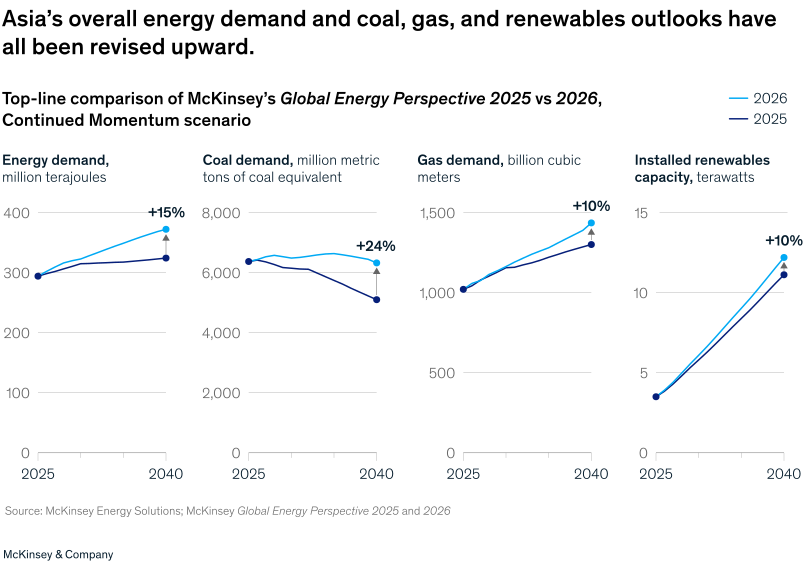
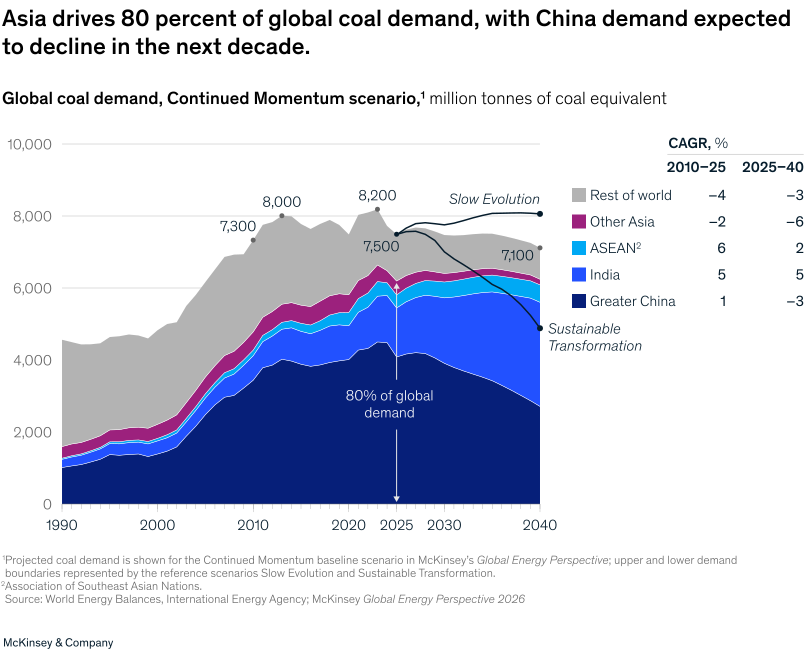
Energy demand in the region continues to climb, driven by industrial expansion, increased data center buildouts, and rising cooling needs. In all but the Sustainable Transformation scenario in this year’s Global Energy Perspective, coal is projected to remain in the energy system for longer than expected. Demand is forecast to be largely flat in Asia for the next ten years as a moderate decline in demand from China is offset by demand growth in India and Southeast Asia. Gas continues to be resilient, despite significant short-term disruption, with a projected slowdown in demand in the next five to ten years as countries prioritize coal and renewables where possible. This is likely to be followed by significant demand growth for gas in the longer term, driven by industrials. Renewables continue to accelerate, particularly in India and Southeast Asia, with China holding its place in the region as the largest installer of renewables in absolute terms.
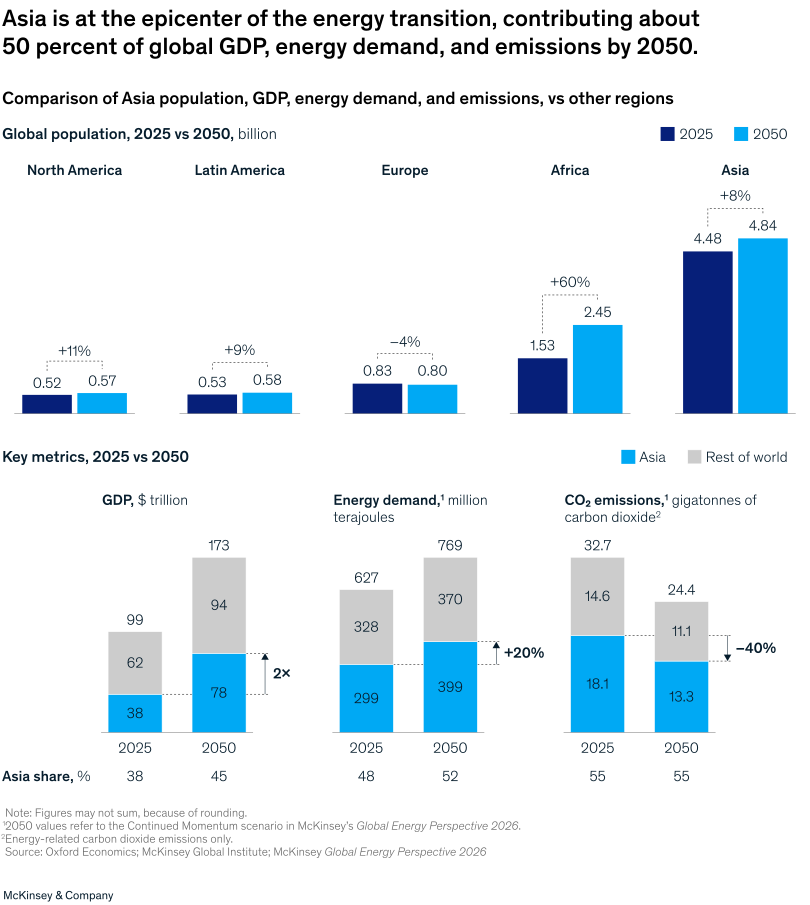
Asia already accounts for nearly 50 percent of global energy demand, alongside 38 percent of GDP and 55 percent of the world’s total greenhouse gas emissions (Exhibit 2). More importantly, it is expected to drive about 70 percent of global net energy demand growth through 2040, as demand in more mature markets such as Europe levels off.
Asia’s energy needs have long outpaced its in-continent fossil fuel resource base, embedding import dependence into its energy system. Despite housing more than 55 percent of global renewable capacity, mostly in China and India, Asia continues to consume about 40 million barrels per day (MMb/d) of oil. However, it produces only about 10 MMb/d of crude oil domestically.3 Gas has a similar imbalance, with Asia importing approximately 135 million to 140 million metric tons per annum (MTPA) of liquefied natural gas (LNG) from outside of the region in 2025.4
This gap between regional demand and supply is likely to widen given that many of Asia’s upstream resource basins have passed their peak, with production expected to decline sharply without reinvestment. In the Continued Momentum scenario, regional crude oil production could fall from an already limited 10 MMb/d today to an estimated 7 MMb/d by 2040, while gas self-sufficiency could decline from around 76 percent to about 60 percent as energy demand continues to outpace local supply.5
These structural demand–supply imbalances mean that meeting energy demand growth will require more than simply adding more domestic supply. Asian countries would also need to build resilience against the vulnerabilities that stem from structural import dependence.
Hormuz exposed Asia’s structural vulnerabilities
The 2026 disruption in the Strait of Hormuz revealed what Asia’s fossil fuel import dependence means in practical terms.
The region has historically relied on the Strait of Hormuz for more than half of its crude oil imports and more than 40 percent of its LNG imports.6 Because so much of the region’s energy flows through this single chokepoint, the effects of the disruption traveled rapidly through the region’s economies.
Pakistan, for example, faced significant liquefied petroleum gas (LPG) shortages, while rolling blackouts in Bangladesh disrupted core manufacturing sectors.7 In India, many restaurants had to close or reduce operating hours due to LPG shortages, with up to 40 percent of the restaurants in one of India’s main cities affected at the peak of the disruption.8
Higher oil and gas prices have contributed to year-to-date depreciation of more than 5 percent in both the Indian rupee and Indonesian rupiah against the US dollar at the time of writing.9 Governments across the region have incurred more than $30 billion in incremental fiscal costs since March 2026 from fuel subsidies, tax relief, and stabilization measures.10 High-income economies, such as Japan and Singapore, have leveraged existing inventories to dampen supply shortages while also increasing supply from the United States and other non-Gulf states.11
The disruption could be a wake-up call for stakeholders in Asia, much as Russia’s invasion of Ukraine was for Europe’s energy system. But Asia cannot simply replicate Europe’s response, which combines supplier diversification, storage and efficiency solutions, and demand reduction. Rapid energy demand growth limits how far efficiency and demand reduction can go, and Asian economies differ substantially in their starting points, natural endowments, infrastructure, and fiscal capacity. The path to energy resilience will likely look different market by market within the region.
In the immediate aftermath of the closing of the Strait of Hormuz, Asian countries responded by drawing on reserves, diversifying hydrocarbon supplies, debottlenecking approvals for renewable energy projects, and increasing biofuel blends where possible. For some Asian countries, the disruption has meant greater reliance on coal as the cheapest source of available energy.
Changing suppliers or routes, however, does not eliminate the underlying vulnerability created by import dependence; it could simply shift the risk to another potential chokepoint. The Strait of Malacca, for example, carried more than 23 MMb/d of crude oil in the first half of 2025—more than the roughly 21 MMb/d passing through the Strait of Hormuz before the disruption—with most of it headed to North Asia.12
To improve energy independence, stakeholders across Asia would need to rethink how energy is sourced, moved, and consumed, and place security and resilience at the center of how governments and companies invest and operate.
Countries are responding differently, based on individual starting points
Asia is diverse, and there is no single response for the region. The options available to each country depend on its resource position, import exposure, and existing energy system structure (Exhibit 3).
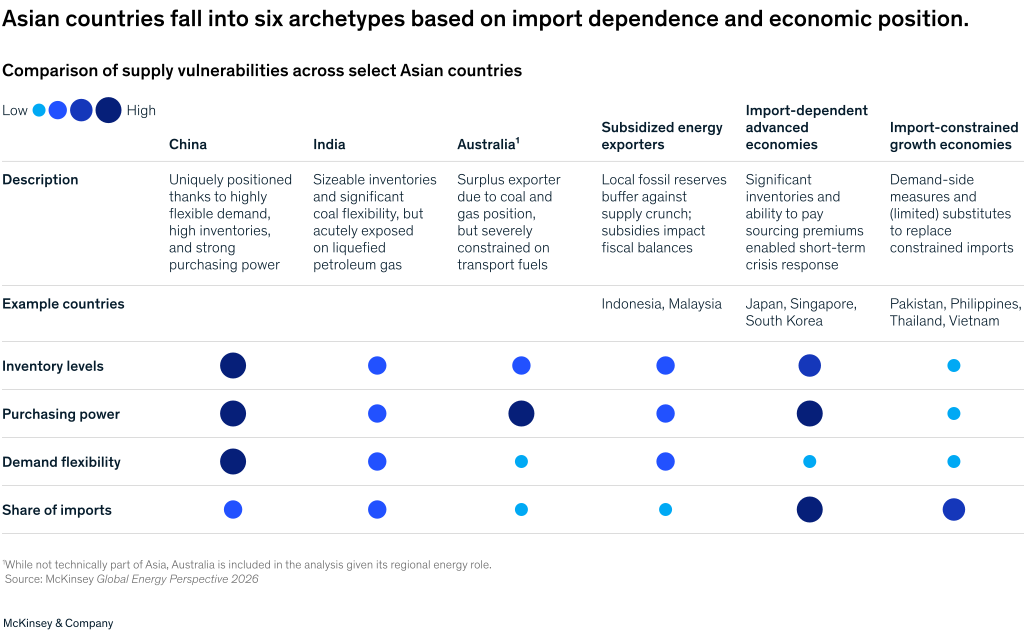
Import-dependent advanced economies such as Japan, Singapore, and South Korea have established storage facilities that served as a first response to the Hormuz disruption. Their economic position also enables them to purchase oil and gas on spot markets at higher prices while exploring ways to stimulate domestic exploration and renewables generation for the long term. Japan is also restarting nuclear capacity, and Singapore has announced intentions to explore its nuclear options.13 Australia, as a selective importer, occupies a very different position.14 Its surplus LNG and coal supply provide an economic buffer against the higher costs of transport fuels where it remains reliant on imports. The comparison illustrates how a country’s position can differ across the gas, coal, and liquids value chains, even within the same region.
China, meanwhile, has multiple levers for absorbing a supply shock, given its strategic petroleum reserves and built-in redundancy across its energy system. In the wake of Hormuz, China was able to reduce demand from transport and refining, draw on reserves, and lean on domestic renewables, coal, and nuclear. From March to June 2026, compared with the same period in 2025, China’s imports of LNG decreased by 12 percent and crude oil by 25 percent. This import decline—effectively made possible by China’s response to the disruption—absorbed part of a supply shock that might otherwise have spilled over to the rest of the world.
India has continued to rely on domestic coal and renewables while managing acute exposure to LPG through sourcing and demand measures. The country would likely need to pursue an “all-of-the-above” energy response in creating energy system resilience because its rapidly growing energy needs outpace even its fast-expanding renewables supply, as explored in the All of the Above Energy scenario in the Global Energy Perspective 2026.15
Indonesia and Malaysia both combine domestic resources with significant consumer subsidies.16 Their resource bases give them more options for localization—including oil and gas production and biofuels—but demand growth continues to strain their domestic supply. Higher prices also create a significant fiscal burden: The cost of Malaysian fuel subsidies is now about 8.0 to 10.0 percent of its annual budget, representing a 3.5 to 4.5 percent increase against pre-Hormuz levels.17
Import-constrained growth economies such as Bangladesh, Pakistan, and the Philippines have faced more acute choices on demand management, reverting to coal and strengthening alternative supply chains.18 Pakistan and the Philippines are also looking to solar to reduce their longer-term import dependence.19
Although these responses matter, many are tactical and designed to operate within the constraints of today’s energy systems. The next phase of response is likely to be more structural in nature, with countries increasingly considering options to redesign their energy systems and channel investment toward longer-term resilience.
Five investment priorities to build resilience to 2040
Asia’s required energy system redesign is substantial and will come at a steep cost. While the exact pathway and opportunities differ by country, there are five overarching priorities stakeholders could consider to direct investment toward resilience.
1. Reinvest in domestic energy and scale local substitutes
The first priority would be localizing energy supply where it is economically and operationally feasible. What “feasible” means is market-dependent, as the following value chain analysis shows.
In upstream oil and gas, energy security concerns could catalyze another cycle of investment, particularly by national oil companies (NOCs). Asia’s mature basins require continued investment simply to stop production decline, while some resources with historically marginal returns, including projects in China, Indonesia, and Thailand, may warrant reconsideration for investment.
Since the Hormuz disruption, Petroleum Sarawak Berhad (PETROS) has committed to exploration and development across multiple projects and studies in Sarawak, while PetroChina has increased exploration capital expenditure.20 South Korea has also approved offshore exploration licenses.21 Many of these projects are expected to have breakeven costs slightly above the projected long-run equilibrium oil price of about $70 to $80 per barrel, meaning they would not be economic independently but could become viable with additional resilience-linked incentives or government subsidies, for example.22
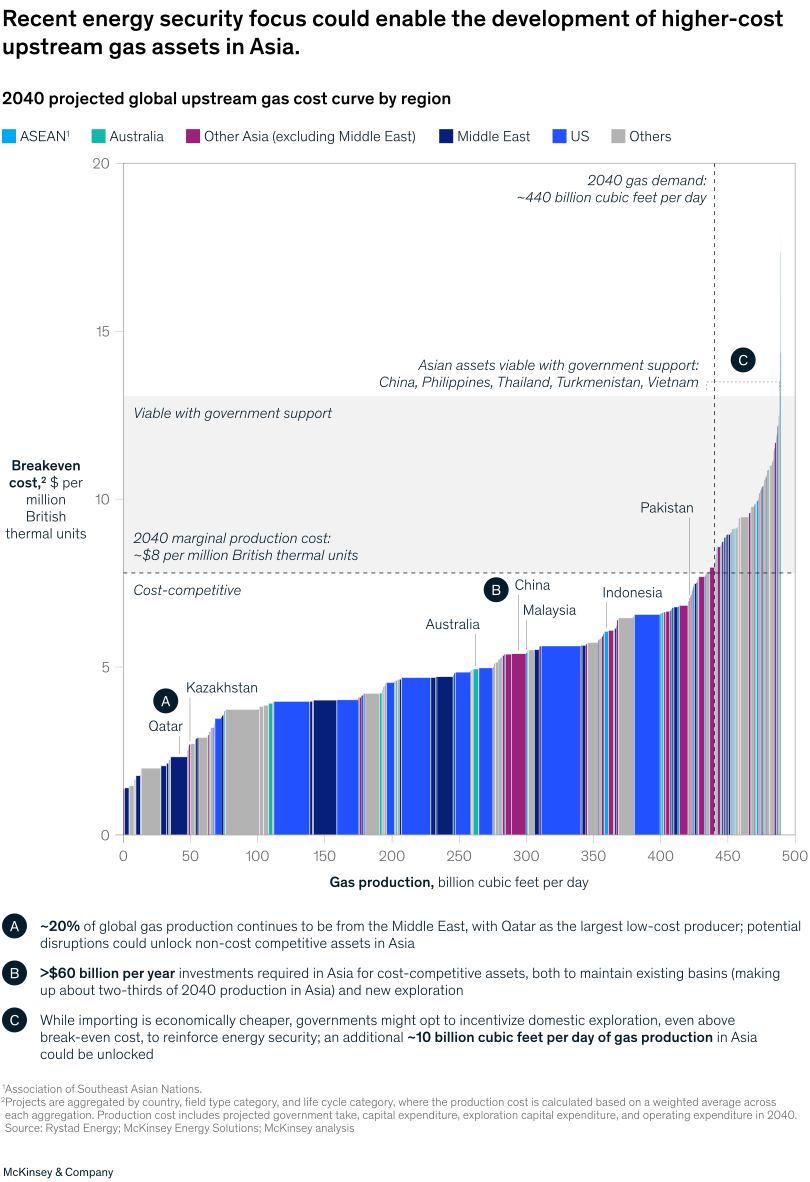
Gas faces a similar cost challenge. More than $60 billion of annual investment could be required to keep Asian gas production flat as existing fields mature.23 Additional investment could unlock another 10 billion to 15 billion cubic feet per day (bcpd) of domestic production, particularly across the Association of Southeast Asian Nations (ASEAN), Central Asia, and China (Exhibit 4).
Coal has meanwhile resurged as an energy-security and industrial-resilience lever in some countries. India’s coal demand could rise by more than 50 percent by 2040 and Indonesia’s by about 40 percent (Exhibit 5). In China, while usage in power is projected to slowly decline, coal is expected to be increasingly used for industrial applications such as coal-to-chemical, which already makes up about 8 percent of China’s coal demand and is expected to continue expanding in line with growing petrochemicals consumption globally.24
Gas is projected to remain an important part of Asia’s longer-term power mix, even as the Hormuz disruption has prompted a near-term reassessment of LNG exposure. In the medium- to long-term, gas-fired capacity is expected to more than double by 2040, increasingly providing flexible and peak capacity alongside renewables.25 Over the next five to ten years, however, LNG growth is projected to be more constrained in a Continued Momentum scenario, given the impacts on upstream LNG supply following the Hormuz disruption.
As a result, some markets are recalibrating the pace of adoption of individual LNG-dependent projects. Vietnam, for example, has canceled its LNG-to-power project, while at the same time renewing its nuclear plans.26 Despite immediate-term postponements, the impacts on LNG are more likely to result in a near-term rebalancing of the generation mix, rather than a structural move away from gas.
Other countries have more readily available local substitutes for imported fuel. Biofuels are particularly relevant for feedstock-rich Southeast Asia: Indonesia is moving from a mandated biodiesel blending of 40 percent (B40) toward 50 percent (B50), while Malaysia and Thailand have also increased blending mandates.27 Biofuels could replace about $90 billion to $100 billion in fuel imports in 2026, creating the potential for a longer-term reduction in import dependence.
Renewables remain the region’s largest energy-investment value pool, with about $300 billion in annual solar and wind investment expected through 2040. China leads the region by a distance, having reached its 2030 wind and solar capacity target six years early.28 ASEAN, India, Japan, and South Korea are expected to account for an increasing share of incremental renewables growth over the next decade as the levelized cost of electricity becomes more competitive with fossil fuel generation (Exhibit 6).29
Nuclear adds a further source of firm domestic power and there are signs it is being explored more seriously in several markets. Japan is restarting reactors, while Indonesia and Vietnam have announced their own nuclear development plans.30 China provides the region’s most mature example of sustained nuclear buildout.31
2. Diversify imports that cannot be localized and invest in greater control over the end-to-end value chain
Increasing the domestic supply base will not eliminate Asia’s need for imported oil and gas, given the region’s energy demand growth. Countries would need to diversify their sources of energy imports and secure additional upstream supply through greater ownership of the upstream value chain by participating in exploration or reserves or by owning the midstream shipping and infrastructure value chain.
Asian players are increasingly seeking direct positions in overseas resources through both greenfield investment and mergers and acquisitions. For example, ONGC Videsh has secured an upstream license in Venezuela, Petroliam Nasional Berhad (PETRONAS) has expanded in Suriname, and PT Pertamina-backed Maurel & Prom (M&P) has acquired upstream assets in Latin America.32 Japanese power generation company and gas trader JERA has also strengthened its position in the upstream LNG value chain with upstream US shale gas acquisitions and increased equity positions in Australia LNG.33
Countries are also broadening their supplier portfolios. South Korea has increased Canadian crude sourcing, and India has diversified LNG purchases beyond its historical reliance on Qatar toward suppliers including Angola, Nigeria, Oman, and the United States.34
Diversification also increases the importance of trading and optimization capabilities as well as access to shipping and logistics to move molecules. A broader supply portfolio creates resilience only if countries and companies can actively manage it as market conditions change.
3. Build the infrastructure that turns supply into resilience
Greater domestic generation and more diversified supply will strengthen resilience only if energy can reach consumers reliably.
As the energy system electrifies, grid capacity itself becomes an energy-security issue. Annual grid investment in Asia could rise from around $185 billion today to more than $300 billion by 2030, according to our analysis. Storage will increasingly form part of the same flexibility requirement to support the expansion of variable renewable generation.
Infrastructure would also need to connect resources to demand areas. China and India are developing high-voltage direct-current transmission to link resource-rich regions with major demand centers, for example, connecting inland renewable resources with coastal demand in China.35
The same logic could eventually extend across borders. The proposed ASEAN Power Grid could allow renewable-rich locations to serve demand elsewhere in the region as well as provide flexibility for disruptions.36 For example, Singapore’s ambition to source up to 40 percent of its green electricity could only be met through such regional infrastructure.37
Resilience also requires physical buffers for hydrocarbon fuels. High-income importers are investing in oil and gas storage, while China, Japan, and South Korea have relied on strategic reserves during the current disruption.
4. Build the energy system around the new shape of demand
Resilience is not only about securing supply. The shape, location, and speed of demand growth are changing, requiring generation and infrastructure to be planned differently.
Data centers and AI provide the clearest example. A data center can be built in about one to three years, whereas major grid upgrades can require five years or more because of complex and lengthy approval and planning timeframes.38 Malaysia, as an example, has already received more than 12 gigawatts (GW) of data center power applications—equivalent to about 40 percent of its installed capacity.39 Generation, grid capacity, and flexible supply therefore need to be planned ahead of and alongside large new loads rather than after they materialize to ensure sufficient and timely energy access. For example, Ireland, an established data center hub, introduced the Large Energy User Action Plan policy in January 2026, requiring new data centers to be colocated with power to support, not strain, the energy system.40
Electrification and electric vehicles (EVs) create a similar planning challenge, changing not only how much electricity is consumed but also where and when demand occurs. The Netherlands offers a cautionary example where rapid electrification, including EV charging, has moved faster than grid expansion, contributing to severe congestion and waiting lists for new connections.41 Faster-growing Asian markets may need to coordinate electrification with grid expansion, flexible demand, and smarter charging, rather than treating each independently.
5. Mobilize capital—and make it deployable and executable
Ultimately, Asia’s energy resilience challenge is also one of financing and execution, with system redesign requiring an estimated $1 trillion in annual investment in Asia over the next 15 years, according to our analysis.
The first step would be to make projects investable. Particularly in emerging Asian markets, high financing costs, foreign exchange exposure, and uncertain investment environments can raise hurdle rates for otherwise viable projects. Sovereign and credit guarantees, long-term power-purchase agreements, regulated returns, and blended finance could help reduce those risks. Singapore’s Green Investments Partnership provides one emerging example, mobilizing about $800 million of public and philanthropic capital for sustainable infrastructure across Asia.42
But capital alone is insufficient—projects would also have to be executable. Stakeholders across government and the private sector could consider ways to coordinate policy, permitting, land, grid development, and infrastructure so that committed capital becomes operating capacity at the pace required by growing demand.
One potential path for government stakeholders could be active system orchestration—for example, establishing cohesive national energy roadmaps, cross-border supply frameworks, and streamlined permitting pathways for critical infrastructure. Clear, long-term policy architectures can be a critical bridge for transforming ambitious capital allocations into secure, diversified, and operational energy assets.
Questions to focus decision-making
The Hormuz disruption has made Asia’s energy vulnerabilities impossible to ignore. Governments and companies can learn from this disruption to build resilience into longer-term strategic planning. Five questions stand out for executives across volatility, balance sheets, investment, coordination, and execution:
- How resilient are we to the next energy shock? Where are the critical vulnerabilities and concentrations, and how much redundancy across suppliers, routes, fuels, and reserves is enough?
- How much resilience can we afford, and who should pay? What is the right trade-off between efficiency and resilience, and how should the burden be shared across public and private balance sheets?
- Where should we place our bets as Asia’s energy system is redesigned? What must be invested in now to secure energy access in the years to 2040, and which emerging value pools represent the most attractive opportunities for companies?
- How do we turn capital into capacity? What policy, regulatory, and infrastructure bottlenecks need to be addressed, and where is public–private coordination needed to accelerate delivery?
- How can we move from scenario thinking to strategic execution? Multiple disruptions in the last six years have resulted in profound changes in energy systems and their future outlooks. The Global Energy Perspective 2026 outlines key elements executives could consider when translating scenario planning into strategic action.
Asia’s energy system was already undergoing profound change before the disruption in the Strait of Hormuz. The crisis has added a sharper imperative: The system must not only grow and evolve but also become more resilient.
Governments may need to make deliberate choices about security, affordability, decarbonization, and investment while creating the conditions for projects to be delivered. Companies and investors need to understand where vulnerabilities could threaten their core business, and where the redesign of Asia’s energy system could create the next generation of opportunities.
The actions taken now will determine whether Asia is prepared for the next energy shock and equipped to meet the coming decade-and-a-half of demand growth to support continued socioeconomic development.
Related Articles