In 2025, total wealth across all sectors globally reached $600 trillion, with households owning 95 percent of that wealth. Global household wealth hit a record $570 trillion, up $40 trillion from 2024. The United States continues to hold the largest share, at 30 percent, followed by the eurozone and China, at 14 and 13 percent, respectively. Global household wealth grew faster than GDP, posing questions about its health and stability, note McKinsey’s Rebecca J. Anderson, Jan Mischke, Arvind Govindarajan, Sylvain Johansson, Nick Leung, Shubham Singhal, and Carlo Tanghetti. Only 20 percent came from real capital formation, with equity values driving growth in the United States and Canada.
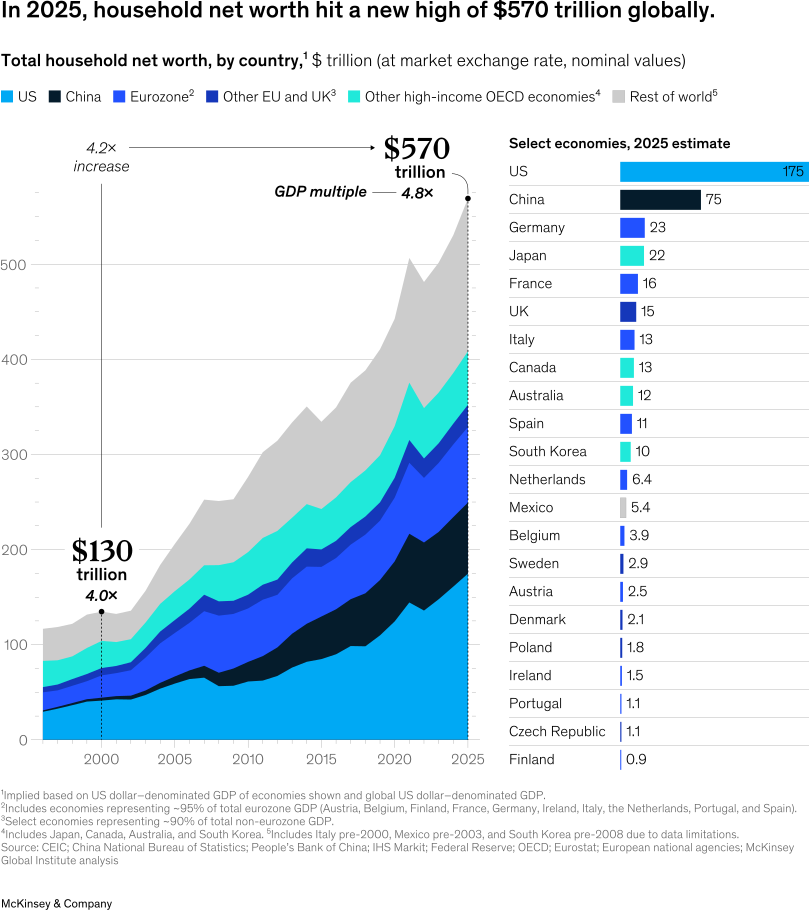
Image description.
Global household net worth, measured at nominal market exchange rates, increased from about $130 trillion in 2000 to an estimated record $570 trillion in 2025—a more than fourfold rise and the equivalent of 4.8 times global GDP. The stacked area chart shows contributions by the United States, China, the eurozone, other EU countries and the UK, other high-income OECD economies, and the rest of the world, with growth accelerating after 2020 and the United States accounting for an increasing share of the total. A companion ranking of selected economies for 2025 estimates the United States as the largest holder of household net worth at $175 trillion, followed by China at $75 trillion, Germany at $23 trillion, Japan at $22 trillion, France at $16 trillion, the UK at $15 trillion, Italy and Canada at $13 trillion each, Australia at $12 trillion, Spain at $11 trillion, South Korea at $10 trillion, and smaller totals for the Netherlands, Mexico, Belgium, Sweden, Austria, Denmark, Poland, Ireland, Portugal, the Czech Republic, and Finland.
This image description was completed with the assistance of Writer, a gen AI tool.
Source: CEIC; China National Bureau of Statistics; People’s Bank of China; IHS Markit; Federal Reserve; OECD; Eurostat; European national agencies; McKinsey Global Institute analysis
End of image description.
To read the report, see “The global balance sheet 2026: Imbalance and divergence,” July 23, 2026.