Amid stagnating global demand, rising protectionism, labor constraints, and regionally disadvantaged energy costs, corporate transformation has become a strategic necessity. European industrial firms in particular face margin and cash flow pressure and stressed operating models. Although these transformers consistently track extensive sets of KPIs, many struggle to determine which metrics truly matter for effective control and critical decision-making during their transformations.
In a proprietary analysis of 18 companies conducted in 2023, McKinsey found that companies use only 29 percent of their defined and tracked KPIs in decision-making. This disconnect reflects a fundamental challenge: Leaders are often overloaded with data. As a result, they lack a clear view as to whether—and to what extent—their transformations are actually creating value. Furthermore, many transformations focus on KPI improvements without considering cost and market pressures, leaving leaders without a clear view of the net balance sheet impact.
A dedicated finance team within the transformation office can fix this problem by implementing a measurement system that links strategic value drivers to a focused, P&L-relevant set of steering KPIs. This article describes components of a solid process for selecting these KPIs, starting with an explanation of why an ROIC driver tree provides the optimal architecture for selecting the KPIs with the greatest P&L impact. It then proposes a set of specific KPIs for value-based steering that have proven relevant and effective across a broad range of transformation programs. It concludes by recommending that transformers use an integrated revenue driver tree to identify the KPIs most critical to managing top-line growth, and that teams conduct monthly assessments of headwinds and tailwinds so they can dynamically adjust transformation targets.1
Tools to build the value architecture for transformations
Effective transformation steering requires KPIs that link directly to value creation and P&L outcomes rather than to broad sets of functionally oriented metrics. An ROIC driver tree is a crucial tool for drilling down to the KPIs that really matter. Gen AI can help with many parts of a transformation, but in its current incarnation, it has some steep limitations.
How an ROIC driver tree defines the value guardrails
ROIC captures how efficiently a firm converts invested capital into operating profit and reflects core economic performance largely independent of capital structure, financial engineering, and accounting effects. Relative to EPS, P/E, and ROE, ROIC offers a purer measure of operational effectiveness and is the main driver of enterprise value. Comparing ROIC with the weighted average cost of capital (WACC) further sharpens its usefulness as a steering metric, as value is created only when ROIC exceeds WACC.
While ROIC is too high level and complicated to guide day-to-day decisions on its own, it provides a clear top-line objective that can be translated into actionable operational levers through an ROIC driver tree. The driver tree decomposes ROIC into its fundamental components: operating profitability and capital efficiency. Operating profitability is driven by cash generation, operational costs, and revenues, while capital efficiency is driven by the level and productivity of invested capital. These dimensions can be further disaggregated into concrete revenue, cost, and capital intensity drivers (exhibit).
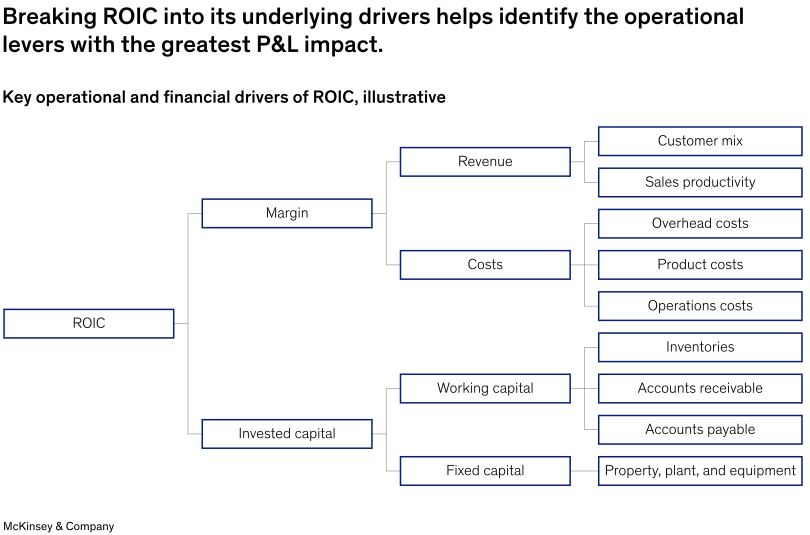
KPIs need not be selected arbitrarily; instead, they can be systematically derived from value drivers. By anchoring KPIs to the ROIC driver tree, transformation leaders can address the common problem of KPI proliferation with weak P&L and balance sheet linkage. Each KPI can thus provide a traceable connection to enterprise value, transforming the KPI system into a value-based steering instrument rather than a collection of functionally optimized measures.
How gen AI helps—and how it doesn’t
Gen AI represents a significant productivity leap and can meaningfully support transformation analytics. Our experience has demonstrated that gen AI is effective at producing initial hypotheses, structuring first-level driver trees, and serving as an ideation and sanity check tool. It provides useful early views on value drivers and can reliably construct single-dimension structures.
However, gen AI reaches clear limits when designing comprehensive ROIC driver trees. Decomposing complex business models, resolving cross-dimensional interdependencies, and translating strategy into a coherent value architecture require economic judgment and business intuition that current models cannot replicate. The construction of a robust ROIC driver tree, therefore, remains a human-led task, supported by enterprise resource planning data and systems. Gen AI can work as an accelerator and support tool, but the value logic and KPI architecture must remain with finance and business leadership.
Selecting and managing KPIs in three important areas
While every company’s transformation priorities differ, some areas tend to have a greater effect on financial performance. Industrial transformations often focus on optimizing operating costs, improving personnel efficiency and overhead structures, and increasing operational and production performance. Below are some KPIs that can be helpful in these areas and illustrate a connection to P&L impact.
Optimizing product costs
Companies can track how specific initiatives, including supplier negotiations, product redesigns, and manufacturing or logistics improvements, translate into measurable cost savings. Three metrics illustrate how these improvements can be captured:
- Purchase price variance (PPV) indicates whether procurement efforts are actually lowering material prices. The formula is straightforward: PPV is the actual price minus the standard price. For example, a packaging and container producer may typically pay 12 cents for a bolt. After the producer renegotiates with the supplier during the transformation, the supplier’s invoice shows ten cents per bolt. The resulting PPV is negative two cents, indicating a cost reduction of two cents per bolt, indicating improved cost control.
- The value analysis and value engineering (VAVE) methodology captures cost reductions achieved through smarter product design while maintaining the same function and quality. It compares the cost of a product’s bill of materials (BOM) before and after design changes are made to improve efficiency. For example, a truck company’s original seat frame may have a BOM cost of $120. After a redesign and supplier optimization, the cost falls to $105. The $15 per unit reduction, or 12.5 percent improvement, reflects the financial benefit.
- A change in logistics cost intensity provides insight into supply chain efficiency and cost competitiveness by indicating whether less logistics expenditure is required to support a given level of output or revenue. It is calculated as total logistics cost divided by output, which may be measured per vehicle, per part, or per dollar of revenue. For example, an automotive company with annual logistics costs of $50 million and annual vehicle output of 500,000 units would have a logistics cost intensity of $100 per vehicle. A reduction in total logistics spending or an increase in output would lower this figure, signaling improved supply chain efficiency or cost competitiveness.
Improving overhead costs and personnel efficiency
Personnel and overhead expenses often make up a large share of an industrial company’s cost base and serve as direct indicators of whether the organization is becoming more agile, focused, and aligned with its strategic goals. Leaders often track how workforce-related initiatives and organizational adjustments translate into measurable efficiency gains. Four metrics illustrate how these effects can be captured:
- A change in the overtime ratio provides insight into workload balance, staffing adequacy, and labor cost pressures by showing the share of total labor hours attributable to overtime. It is calculated as overtime hours divided by total hours worked, often expressed as a percentage. For example, on a bus assembly line, employees may log 1,200 total hours in a week, of which 180 are overtime. The overtime ratio is 180 divided by 1,200, or 15 percent. A consistently high ratio indicates understaffing or inefficient scheduling or execution.
- A change in the contractor ratio provides insight into staffing efficiency by showing the proportion of the workforce made up of contractors and the organization’s reliance on external, temporary labor. It is calculated as the number of contractor workers divided by the total workforce (employees plus contractors). For instance, if a defense supplier employs 850 permanent workers and 150 contractors (comprising a workforce of 1,000), the contractor ratio is 150 divided by 1,000, or 15 percent. A high ratio can provide flexibility but may also create cost or knowledge risks.
- Freed-up capacity from waste reduction captures how much labor capacity is released by eliminating waste (muda, the Japanese term for non-value-adding activity) through process improvements that don’t reduce output. The time saved by removing inefficient steps is converted into a full-time equivalent (FTE) measure (essentially, the number of FTE positions’ worth of capacity gained). For example, if process improvements in a plastic container assembly line eliminate 1,800 labor hours per year, and one FTE represents 1,800 annual hours, the freed-up capacity equals one FTE.
- A change in the share of indirect labor provides insight into the organization’s overhead structure and efficiency by showing how the proportion of the workforce not directly involved in production is evolving. It is calculated as the number of indirect employees divided by the total labor head count. For instance, if a machinery-equipment-manufacturing plant has 200 indirect workers (such as maintenance, logistics, quality, and administrative employees) and 800 direct production workers, the share of indirect labor is 200 divided by 1,000, or 20 percent.
Increasing operational and production efficiency
Operational and production efficiency metrics reveal how well a company’s factories and equipment convert resources into high-quality output. Leaders can connect improvements in yield, uptime, and throughput to financial results. Four metrics illustrate how progress in these areas can be measured:
- A change in on-time production volume (OPV2) reflects increased scheduling accuracy and supply chain reliability. It shows the percentage of required parts or production volume delivered within a defined delivery window and is calculated as the on-time delivered quantity divided by the total required quantity. For example, if an assembly line requires 10,000 door modules in a week and 9,500 arrive within the OPV2 delivery window, OPV2 equals 9,500 divided by 10,000, or 95 percent.
- A change in overall equipment effectiveness (OEE) reflects shifts in how efficiently machinery is utilized. OEE combines equipment availability, performance speed, and output quality, and is calculated as OEE equals availability multiplied by performance multiplied by quality. For example, in an automotive welding cell, a robot may be scheduled for eight hours but can run for seven (in which case, availability is about 88 percent); operate slightly below optimal speed (meaning performance is about 90 percent); and produce 95 percent of parts within quality standards (indicating quality is about 95 percent). Multiplying these factors yields an OEE of roughly 75 percent. Lower OEE values highlight downtime, slow running speeds, or quality issues.
- A change in yield shows what portion of total production meets quality standards. It is calculated as goods units divided by total units produced. For example, in an automotive stamping plant, a press may produce 1,000 body panels per shift, of which 950 pass quality inspection. The resulting yield is 950 divided by 1,000, or 95 percent. A lower yield indicates losses from scrap or rework.
- A change in profit per hour captures how much more profit the company generates for every hour of productive labor or machine time. It is calculated as total operating profit divided by total productive hours. For instance, if an automotive assembly plant earns €500,000 in profit during a week and logs 25,000 productive hours, profit per hour equals €500,000 divided by 25,000, or €20 per hour. Tracking this measure helps assess how efficiently resources are being converted into financial results.
- A change in “on time, in full, quality” (OTIFQ) measures how much more reliably orders are delivered by the promised date, in the correct quantity and configuration, and without quality issues. It is calculated as the number of orders delivered on time, in full, and at the required quality standard, divided by total orders. For example, if 168 out of 200 orders in a quarter meet all three criteria, OTIFQ is 84 percent. This KPI reflects delivery reliability, customer satisfaction, and operational-execution quality.
Managing top-line growth and systematically coping with volatility
Many industrial companies report revenue primarily as a single, consolidated figure. But because top-line performance varies widely across industrial sectors, a revenue driver tree is often the most effective way to identify relevant KPIs. Another important component of effective transformation management—even where the optimal set of KPIs has been identified—is a dynamic steering approach that continuously adapts to changes in external and internal conditions. This can be achieved through a systematic assessment of headwinds and tailwinds that affect financial performance over time.
Building a revenue driver tree and putting it into action
An effective revenue driver tree breaks the business down into the factors that shape financial results, showing how much performance depends on selling more, charging more, or improving the product and customer mix (see sidebar, “An illustrative revenue driver tree for the automotive sector”). By linking these revenue components to specific transformation initiatives, the tree reveals how operational changes and external forces translate into financial outcomes. The following are four key principles:
- Trace impact to the most specific measurable factor. Each transformation initiative should link to a concrete revenue element, one whose assumptions can be tracked and tested over time.
- Separate volume from mix effects. Distinguish between selling more and earning more per unit to avoid double counting. Volume reflects changes in units sold, service throughput, or asset utilization, while value captures shifts in price, product and customer mix, and margin structure.
- Use consistent definitions for each specific factor that influences revenue. This allows results to be compared directly and prevents overlap when estimating total financial effects.
- Define clear KPIs at both the revenue driver and operational levels. Examples include conversion rates, share-of-wallet indexes, and product-mix profitability measures. These metrics should be tracked regularly as part of the transformation review.
Coping with volatile market environments
At the outset of a transformation, companies set targets based on expected revenues, an anticipated cost base, and defined profit objectives. However, as the year unfolds, deviations inevitably emerge. Revenue shortfalls may arise from customer order reductions, delayed contract wins, or weaker market demand, while additional cost pressures may result from supplier price increases, higher-than-expected wage inflation, or delays in the realization of value-creation initiatives. To preserve the overall profit target, these adverse effects must be identified early and translated into incremental improvement requirements for the transformation program.
A monthly assessment of headwinds and tailwinds allows companies to dynamically adjust transformation targets. Any negative deviations must be added to the original ambition level, resulting in more demanding work stream objectives. KPI-based steering systems play a critical role in this process by translating updated financial targets into concrete, operational performance requirements across functions.
Transformations are complex, as is the task of measuring them. That’s why the smartest course of action for many industrial transformers is to begin by building an ROIC driver tree that helps identify the KPIs with the strongest links to P&L impact. For some companies, the KPIs this article describes will be the most useful, but no one list of KPIs fits every company; the right metrics depend on an organization’s strategy and operating model. To find the KPIs for managing top-line growth, a revenue driver tree is a crucial tool.
Once a dedicated finance team within the transformation office has helped identify the correct KPIs to track, it can also ensure the larger team has the right processes, including for assessing headwinds and tailwinds that allow companies to adjust transformation targets. Once all of these elements are in place, industrial transformations have the best chance of success.
Related Articles