It has been a year of reflection and action for Finland’s largest publicly listed companies. Last year, our research revealed the country’s largest publicly listed companies by market capitalization grew revenue by just 3.4 percent annually between 2013 and 2023 compared with the global average of 8.4 percent.1 While about one-fifth of the growth gap may be explained by differences in industry mix and the closure of the Russian market,2 the balance was clearly attributable to two factors: the modest growth targets of Finland’s largest publicly listed companies and capital allocation strategies that prioritize dividend payouts and debt reduction over investments in growth.
Closing this gap is critical: The relatively sluggish growth of Finland’s largest publicly listed companies reduces the country’s gross domestic product (GDP) growth by an estimated 0.5 to 1.0 percentage points per year.3 Last year’s research sparked active discussions on how accelerating company growth could strengthen the economy, as well as significant owner, boardroom, and management conversations on how to achieve it. But, because increasing topline revenue takes time, the moment of truth is only starting to approach. Has enough been done to close the growth gap? Here are our observations on what has been achieved over the past 12 months and the remaining opportunities for companies to turn aspirations into action (for more, see sidebar “About our research”).
Taking stock: Moves to close the growth gap
Only a year has passed since our first report, a short time for a rise in ambition to materialize in revenue. Yet the signs are encouraging: owners have taken the message about slow growth seriously, more companies are setting higher growth targets, and the market appears to be rewarding the shift. What has not yet had time to change as much is how companies reallocate capital and how boldly they act.
Finnish companies began setting more ambitious growth targets
In September 2026, 21 of Finland’s most significant company owners and their representatives personally pledged to commit to higher growth ambition, invest more, adopt new technology, and deliberately accept more risk.4 What gives this weight is who signed: not only founders, owners, and shareholders of the country’s largest private and public companies but also the chief executives of Finland’s three largest pension investors and the director general of the Government Ownership Steering Department, which sits in the office of the prime minister.
This broad shift in mindset is a critical starting point as ambition sits at the top of the ownership chain. And when the leaders of Finland’s largest publicly listed companies openly demand faster growth and reposition capital to fuel it, it lifts the ceiling on ambition that constrains everyone else. While our research last year found few of Finland’s large-cap companies set annual revenue growth targets of more than 5 percent, during the past year, one in four raised their implicit or explicit growth ambitions by approximately two percentage points (Exhibit 1).5 This positive development means several companies now have public targets close to global average growth rates.
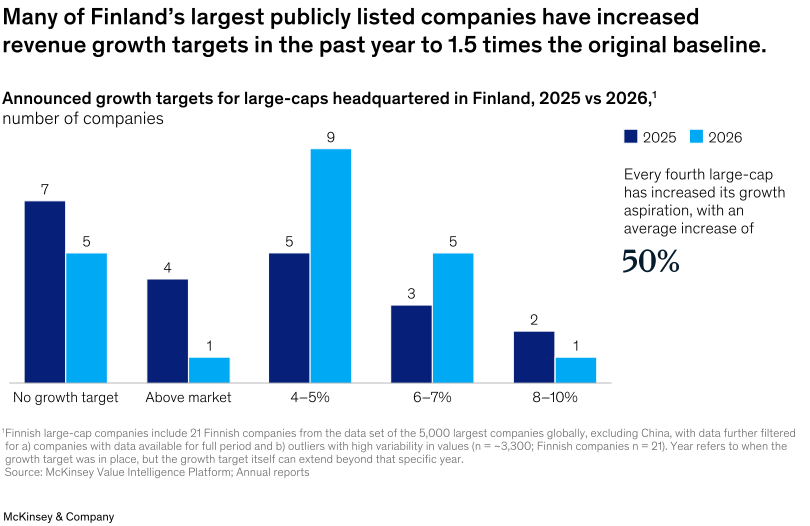
There are also signs the market is beginning to value the growth shift. Returns for Finnish large-cap companies have accelerated: Total shareholder returns for large OMX Helsinki-listed companies reached on average 25 percent in 2025, while the global top 5,000 averaged 12 percent.6 While some of this can be explained by performance, more seems attributable to an improving market outlook and expectations of companies achieving higher growth.
Yet while the growth targets of Finland’s largest publicly listed companies have increased materially, there is still way to go. The average public growth aspiration of large-cap companies still hovers around 5 percent, compared with an average of 9 percent for their Swedish peers.7 Even if public growth targets often exclude inorganic growth (such as through M&A), the gap is clear. To truly catalyze growth, Finnish large-cap companies have room to continue to elevate the stated growth aspiration.
Capital allocation approaches were largely unchanged
Beyond ambition, capturing growth requires strategic resource allocation and flexibility. For most Finnish large-cap companies, dividend policies remain highly fixed from year to year rather than providing the flexibility to support big growth moves. For instance, only about 10 percent of Finnish large-cap companies consider investment needs in their dividend policies, compared with almost 50 percent among Swedish peers (Exhibit 2). In 2025, the dividend payout ratio in Finland was 93 percent (up from 92 percent in 2024), while it was 58 percent in Sweden.8
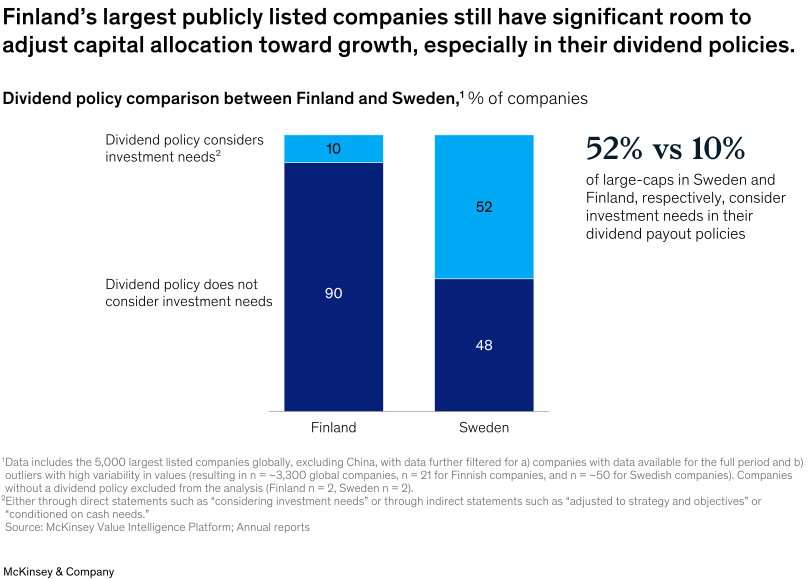
One of the key findings one year ago was that Finnish large-cap companies reinvest significantly less of their profits and distribute a larger share of their profit to shareholders: 70 percent compared with 55 percent for the global peer group.9 While this average between 2016 and 2025 has now risen in Finland to 83 percent—with the 2025 average being 93 percent—five out of 21 companies have returned less profit to shareholders than the peer group, leaving more room for growth investments. This number should increase as higher growth targets call for more growth investments.
Though Finnish large-cap companies are still to formalize policies that drive strategic resource allocation toward growth, there are some signs that corporate activity is picking up. M&A value in 2026 through the middle of the third quarter has jumped 280 percent compared with the first nine months of 2025, and it is now at its highest level since 2021, based on corresponding periods.10
Finnish companies don’t act big enough
Our research found that Finnish large-cap companies still made too few ‘big moves’ in 2025 and that the strategic areas they prioritized did not differentiate them sufficiently from their peers. These five big moves, identified by McKinsey’s decade-long study of nearly 2,400 of the world’s largest companies,11 dramatically increase the likelihood of companies outperforming the peer group:
- Programmatic M&A, defined as a steady stream of small to midsize acquisitions, systematically building to total at least 30 percent of market capitalization in a decade, but with no individual deal over 30 percent of market capitalization. None of the 21 Finnish large-cap companies meet this bar.
- Dynamic resource reallocation, which shifts 10 to 30 percent of revenue across industries and segments over a decade to gain exposure to new markets while staying anchored to a core. Just eight of the 21 Finnish large-cap companies met this criterion.
- Big investments, where a capital-expenditure-to-depreciation ratio (R&D and capital expenditures) in the top 20 percent of the industry globally is maintained. Only three of the 21 Finnish large-cap companies achieved this.
- Productivity improvement, such that labor productivity outpaces 80 percent of industry peers. Just one out of the 21 Finnish large-cap companies met this bar.
- Differentiation, where innovative products, services, or business models expand gross margins faster than 80 percent of the global industry. Only seven out of the 21 Finnish large-cap companies fit this criterion.12
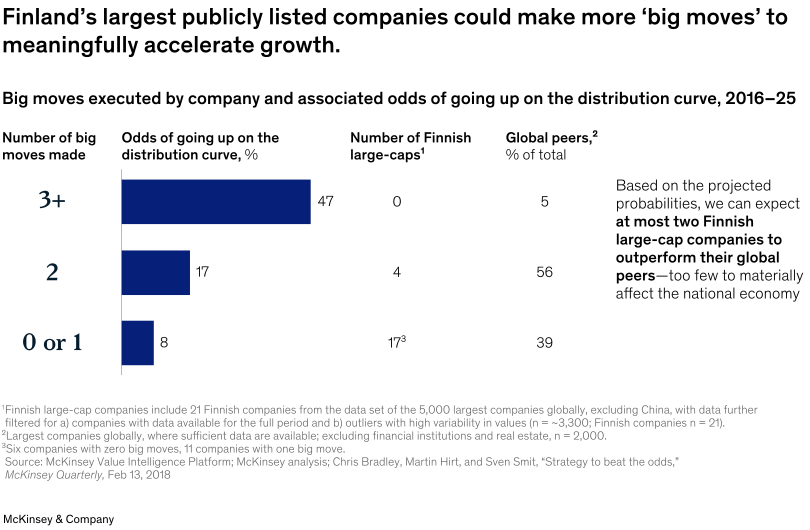
The number of big moves executed by a company directly correlates with the odds of a company meaningfully accelerating growth. No Finnish large-cap company completed three or more big moves, which would result in close to a 50 percent probability of moving toward being a higher-performing company, while 17 executed no more than one big move (Exhibit 3). Based on these numbers, the probability-adjusted expectation is that a maximum of two large-cap companies in Finland could move toward the top quintile of economic profits, which is an indicator highly correlated with long-term growth.
How Mehiläinen’s big moves created big growth
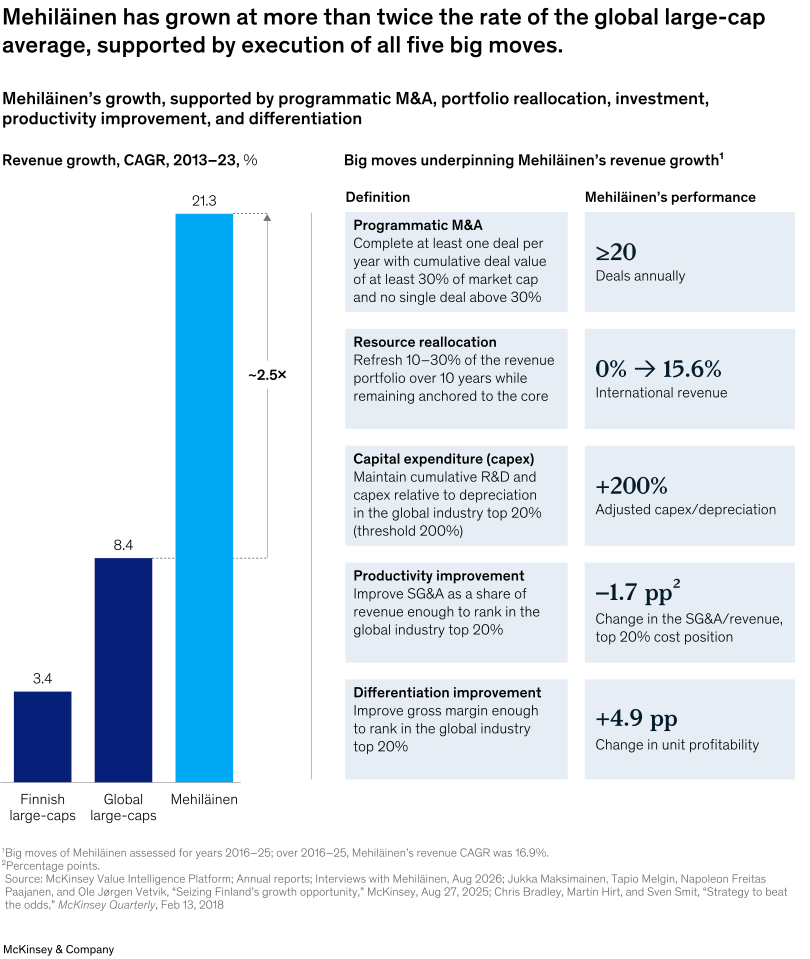
Outside publicly listed companies, there are powerful examples of Finnish enterprises successfully executing multiple big moves to achieve exceptional growth. One is Mehiläinen, a private healthcare provider that achieved a CAGR of 21.3 percent from 2013 to 2023, compared with a growth rate of 3.4 percent among Finnish large-caps and 8.4 percent among global large-caps in the same period (exhibit). A large portion of the top leadership remains internationally experienced executives of Finnish origin: Both CEO Janne-Olli Järvenpää and Chairman Andreas Tallberg are Finnish business executives, and roughly half of the top executives are also of Finnish origin.1
When Järvenpää became Mehiläinen’s CEO in 2015, the company had been growing at around 5 percent annually. He had co-founded Mediverkko a decade earlier, which then merged with Mehiläinen. Järvenpää sought to shift its culture, starting with an ambitious growth target and the pursuit of a portfolio of growth initiatives, many of which he said required ‘naive optimism’ to believe in them. These ambitions were supported by the company’s broader leadership team, whose incentives included an ownership stake in the company of about 10 percent.
A key criterion for expansion to new business lines has been whether a business has the potential to grow to be worth more than €100 million. Mehiläinen has realized about 15 such businesses, delivering growth and value to shareholders. Individual executives have been held accountable for getting agreed upon steps implemented, while Järvenpää has explicitly taken accountability for the business risk related to uncertain growth initiatives. About half of Mehiläinen’s EBITDA growth has been delivered organically and the rest through systematic acquisition, with the company undertaking close to 250 smaller acquisitions in the past decade.
Supported by these big moves, the company’s revenue has shifted meaningfully toward new geographic markets and segments, it has improved productivity and differentiation faster than 80 percent of the industry globally, and it has improved its already strong SG&A ratio by 1.7 percentage points.
In short, Mehiläinen has executed big moves to support not only significant revenue growth but also a doubling of EBITDA in the past decade. Today, the company is reaping the benefits of the positive reinforcing cycle: Larger size enables better profitability, which in turn enables it to invest in growth opportunities that may have long timelines to realize.
We are not suggesting that undertaking big moves—and undertaking them successfully—is easy. Yet it is possible, as illustrated by Finnish private-owned company Mehiläinen, which has executed all five big moves during the past decade to deliver extraordinary growth (for more, see sidebar “How Mehiläinen’s big moves created big growth”). The company’s performance is a strong case of how big moves lead to high growth.
Three bold actions to accelerate growth
Having identified the continuing need for ambitious growth targets and strategic investment, despite some movement in the past year, we have determined three concrete actions the Finnish business community could focus on that are most likely to deliver growth: busting the long-standing myths that hold back growth, removing obstacles to attracting leadership talent, and demanding more aggressive action on growth.
1. Busting the long-standing myths that hold back growth
There are three deeply rooted myths in corporate Finland that act as a brake on growth:
- Myth 1: Dividends are valuable because they are used to fund growth. The reality is that buying shares from secondary markets does not bring new capital for growth for companies unless those companies issue new shares—which only three Finnish large-caps have done in the past decade. Rather, ownership policies advocating for high dividend payouts often drive similar non-growth policies in other companies invested in, perpetuating the cycle of low growth.
- Myth 2: Foreign executives in Finnish companies have stronger track record in growing companies than their Finnish counterparties. We find no correlation between the revenue growth of Finnish large-cap companies during the past decade and their respective share of Finnish versus non-Finnish senior leadership. Eight local companies had a Finnish CEO and chairperson during the past ten years; four achieved above-average and four below-average growth. Similarly, those companies that had more exposure to non-Finnish chairpersons and CEOs did not achieve above-average growth.13
- Myth 3: Growth comes at the expense of profitability. Evidence suggests the opposite. Growth creates value only for companies that have higher returns on invested capital than their cost of capital, with the sweet spot for sustainable value creation at annual revenue growth of 10 to 25 percent.14 This means that companies with challenging market cycles are correct to undertake cost-oriented transformations, but it should not come at the expense of halting activities that may generate growth when the cycle turns.
2. Removing obstacles to attracting leadership talent
The structure of board fees is an important step toward solving the lack of ambition in Finnish large-cap companies. Finland already has a genuine head start: 81 percent of large-cap companies pay non-executive board remuneration partly in shares, clearly the highest adoption rate in the Nordics. Two changes could be considered.
First, large-cap companies could change how non-executive board members are incentivized. Currently, most of these companies pay boards 40 percent in shares (an in-kind payment scheme), with the remaining balance paid in cash to cover taxes. This model could be developed further by shifting remuneration toward more performance-based and/or front-loaded equity grants: shares awarded at a locked-in price at the start of the board membership term and vesting over subsequent years, or shares earned based on achieved long-term total shareholder return, subject to a lock-in preventing sale until, for example, two years after the board member steps down. Second, while the total board remuneration is on par with the Nordics, it is significantly below that of, for example, the United Kingdom (1.4 to 1.6 times) and the United States (3.5 to 3.8 times), making it harder to attract the best growth-oriented non-executive board members to Finnish large-cap companies.15
With regard to senior executives, incentive structures in Finland are currently often asymmetric across the organization: Employees’ financial upside is often capped, while the downside of missing agreed targets can be severe and lasting for their professional careers. This can quietly discourage ambition, rewarding a safe number more than reaching for a bold one. It would be worth assessing the scale of stock-option use and its tax treatment relative to peer countries. Furthermore, based on a large number of qualitative comments, the philosophy in recruiting is often to favor the least risky candidate, even if they are not the top candidate for the position through the lens of achievement potential. We believe bolder recruitment could benefit organizations, candidate potential being more important than full prior skill coverage from past experiences.16
Together, these measures could help attract talent and ensure that rewards for leadership are tied to an organization’s long-term growth, converting the incentive system from a brake on ambition into an engine for it.
3. Expecting faster and more ambitious action on growth
Executive and non-executive leaders have a decisive responsibility: to actively debate, challenge, and keep raising the ambition set for senior leaders. Growth targets need not be accepted as a given, nor should they be benchmarked purely against GDP growth, underlying market growth, or a company’s own history; they should be tested against the full set of large publicly listed companies globally. Any persistent gap between the growth ambitions of Finnish companies and those of their global peers is a question boards may wish to put to management. Companies confident in their ability to win in their markets could aspire to above-peer growth.
Of course, growth initiatives are inherently uncertain, and their probability of being successful rises with maturity. The later the stage, the better the odds: A typical growth project that has completed the pre-feasibility phase successfully has about a 30 percent chance of materializing, while one that has reached the end of the feasibility phase is closer to 50 percent (though this varies between sectors).17 In Finnish companies, this reality appears too often ignored. Planning tends to carry an implicit assumption that nearly every initiative will come to fruition, and this mentality is even extended to performance-based compensation. It also implies that companies may need to be prepared to lose some of their growth investments, which may require higher overall allocation to hit the targets across the portfolio of options. Hence, management could have more growth initiatives early in their pipeline, follow those through as meticulously as performance programs, and link compensation more clearly to the success of the growth program and its initiatives.
One approach worth considering is a shift in this mental model. Rather than sizing the pipeline of growth initiatives to reach an overall target, boards and management aim for 1.5 to 2.0 times the growth target in anticipation of natural attrition of uncertain projects. (The same logic applies to M&A, where only about 1 percent of all opportunities screened convert into a transaction in private equity, for example.)18 In this approach, the board’s role can extend to reviewing the details of the growth pipeline, challenging its composition, testing underlying probabilities, and building confidence that there is a realistic chance of delivering an ambitious growth target.
That means companies could consider establishing a standing practice where top leadership presents the board with a credible plan capable of delivering more than 8 percent annual revenue growth (with some sector variance), matching the pace of leading global peers. The value of demanding such a plan is not only the target but also the discipline it forces: Reaching that level of growth leads management to surface the real trade-offs it might otherwise leave implicit—notably, the allocation of capital between returning cash to shareholders (through dividends and buybacks) and reinvesting in growth through R&D, capability building, capital expenditure, international expansion, and M&A.
By insisting on a plan at this level of ambition, boards can turn abstract aspirations into explicit sets of investment decisions they can scrutinize, sequence, and hold management accountable to over time. The point is not to mandate a single number but to change the default so that growth ambition becomes the starting hypothesis the executive team would need to actively argue against rather than a ceiling quietly set from below. Finland could consider going even further, taking Japan as a model for shifting the nature of its Corporate Governance Code (for more, see sidebar “How Japan re-engineered corporate governance”).
A year ago, we highlighted a growth deficit among Finland’s largest publicly listed companies. While we have since seen the beginnings of a shift in mindset and encouraging changes, this movement has yet to accelerate to bridge the gap between aspiration and action. That requires Finnish companies to work systematically toward more ambitious growth targets, spending enough on growing core businesses while expanding through new products and into new geographies and adjacent markets. That could be funded by Finnish companies expanding gross margins through differentiation and improving SG&A productivity, underpinned by changes in governance to further encourage growth.
The template already exists. Finland has repeatedly been the first to develop leading innovations with the potential to address enormous global markets: for example, the lithography technology now used by ASML; consumer-facing technology, such as Erwise, the first graphical web browser; and the opensource innovations IRC and Linux, on which commercial players worth trillions of dollars have built their businesses. The challenge now is to build on the momentum of the past year and commercialize innovations at global scale by setting ambitious targets, aligning capital allocation with them, and executing bold, strategic ‘big moves.’ Standing still is the greatest risk. We hope that over the next 12 months Finnish companies will continue to increase their aspirations while also acting on resource allocation, growth programs, and eventually realizing growth.