Like gold, the value of resilience in Asia is nearing record highs, fueled by geopolitical uncertainty, trade friction, debt and cost headwinds, and the growing threat of climate change. Many of these risks are long standing, and business leaders and policymakers in Asia are accustomed to thinking carefully about their resilience capabilities. But faced with multiple risks in parallel, some are now going further, embracing new approaches to risk management and embedding resilience into their controls, operations, and supply chains.
Recent disruptions resonate on a global scale, but their impacts in Asia take on a local flavor, reflecting the continent’s uneven economic development, exposure to natural disasters, unique geopolitical relationships, and diverse approaches to governance. Leading Asian organizations are responding not by relying on borrowed playbooks, but by harnessing local strengths in culture, economy, and governance—and by thinking radically to adapt quickly to change.
In this article, we highlight the unique approaches and capabilities that are helping Asian organizations manage through uncertainty (see sidebar “Where resilience meets results: Capability building in action”). Drawing on real-world examples, we show how these organizations have not only fostered a unique culture of resilience but also used challenges as a launchpad to create lasting competitive advantage.
Asia: Risks, complexity, and collaboration
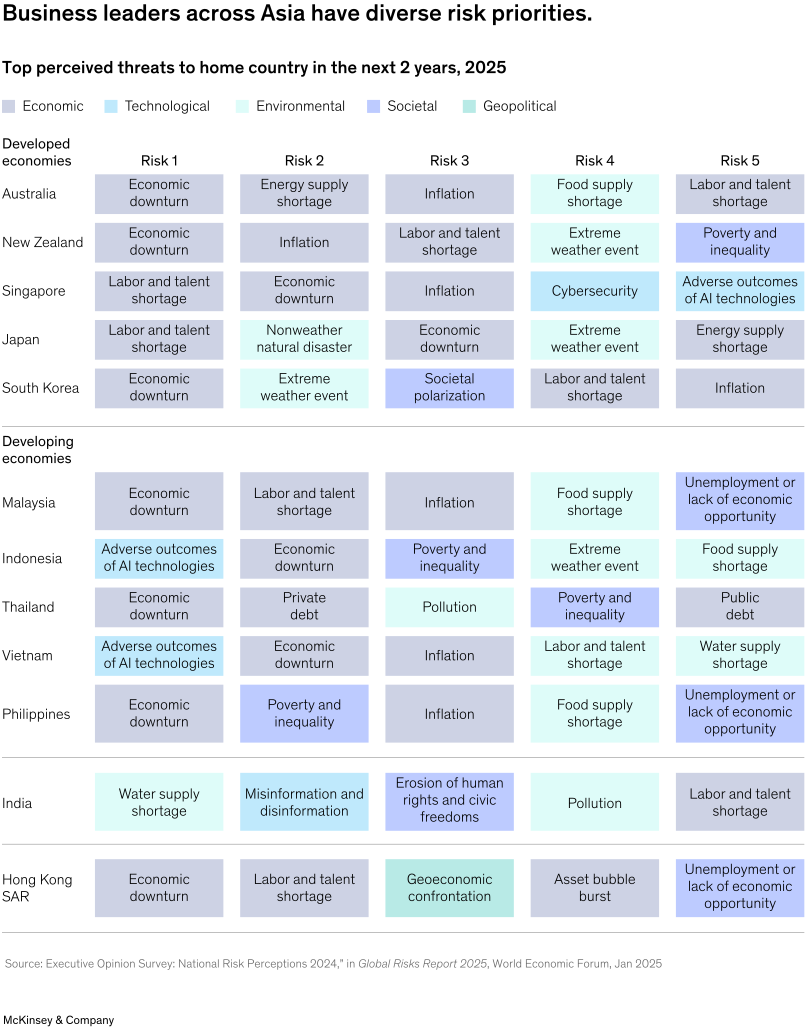
Economically, Asian countries are on a range of trajectories, creating a patchwork of risk profiles. Some countries are still developing economies and carry high levels of COVID-19-era debt. For these countries, the risk of a sovereign debt crisis in the next five years is a primary concern. Across the region, in countries such as Indonesia, Vietnam, and India, economic uncertainty continues to challenge policymakers and societies. Developed economies such as Australia and Singapore, on the other hand, are more concerned about inflation and the rising cost of living.
Asia faces a unique set of environmental risks, with typhoons, hurricanes, earthquakes, and floods becoming increasingly common. In 2024, the economic cost of natural disasters in the Asia–Pacific region was estimated at $74 billion.1 The Philippines is considered the fourth most vulnerable country to climate change, with a high exposure to natural disasters such as rising sea levels.2 In India, more than 80 percent of the country’s land area is exposed to climate hazards, affecting nearly 90 percent of its population.3 Furthermore, climate-related stress in many countries is causing displacement and involuntary migration, which are among the region’s most complex humanitarian and policy challenges.
In parallel with managing climate risk, leaders in highly populous Asian economies face challenges directly associated with growth. For example, they must balance rising food and energy demand against the environmental and social consequences of activities such as intensive agriculture and the mining of rare earth minerals.
Politically, Asian nations are highly heterogeneous. Yet their economies are closely interconnected, so the knock-on effects of geopolitical shifts can be far reaching. China’s strained trade relations with the United States, for example, affect many countries, including Australia, Japan, and South Korea, which rely heavily on trade with China. Rising geo-economic tensions are manifested through tariffs, sanctions, and investment screening.
Asia has some of the world’s most advanced levels of digital skills. Indeed, the region is a nexus for innovation and home to some of the world’s biggest technology companies. But elevated levels of digital trust and massive data volumes amplify the risk of cyberattacks and IT disruptions. Asia–Pacific continues to experience the highest rate of cyberattacks globally, with organizations facing an average of about 3,400 attacks per week.4
The multifaceted Asian risk landscape is reflected in regional leadership concerns. Data from the World Economic Forum’s National Risk Perceptions survey show that across countries in Asia, 20 different risks feature among the top five concerns.5 Some dimensions are more prevalent in certain geographies than in others (Exhibit 1). But across the region, risks are increasingly systemic and interconnected, reinforcing the need for coordinated responses.
While Asian countries face unique risks, they also boast distinct advantages. One example is a societal model in many countries that facilitates collaboration. In countries such as South Korea and Singapore, for example, populations showed a willingness to rally together during the COVID-19 pandemic and align closely with public health restrictions.6 That said, the ways in which communities build consensus during times of disruption are changing, driven by trends such as digital misinformation and social polarization.
Holistic resilience—embracing simplicity, agility, and innovation
How should leaders in Asia navigate a complex and evolving risk landscape while ensuring that their organizations thrive and grow? Resilience is the key. Confucius famously said, “Our greatest glory is not in never falling, but in rising every time we fall.” When organizations see disruption as an opportunity to build resilience and mobilize for performance, they bring that axiom to life. McKinsey’s research shows that companies that responded fastest to the 2008–09 financial crisis and more recent shocks—for example, by accelerating digitization or adopting new business models—outperformed their peers in revenue and profit growth by 20 to 30 percent.7 Across Asia, organizations are increasingly applying these principles in response to tariffs, supply chain disruptions, and geopolitical tensions by diversifying supplier networks, regionalizing operations, and strengthening operational flexibility to sustain growth amid uncertainty.
Institutions that build growth-enhancing resilience typically think holistically about adaptation and foresight (Exhibit 2). As McKinsey research has highlighted, this often comprises six dimensions8:
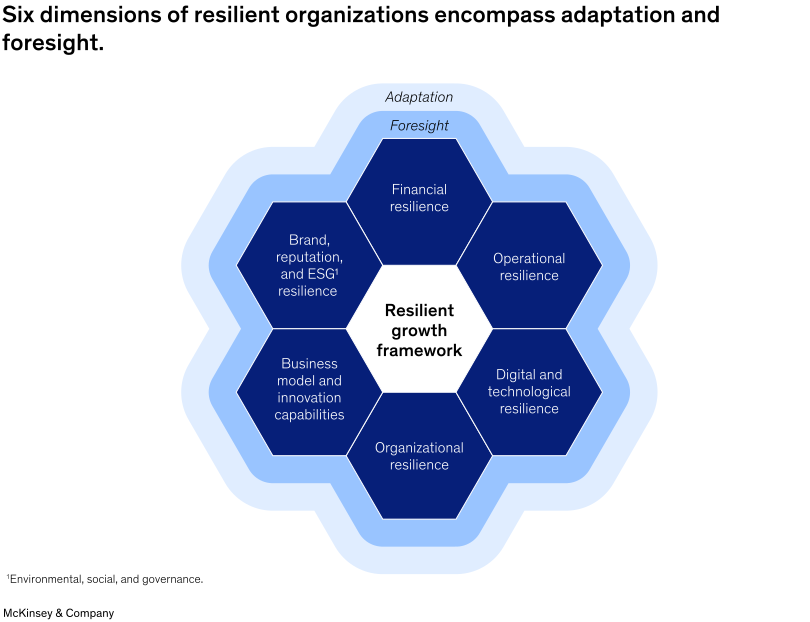
- Financial resilience. Resilient organizations ensure they have a solid capital base and sufficient liquidity to weather declines in revenue, increases in costs, or credit deterioration. When they need to strengthen financial resilience, they are prepared to rethink their capital structures, run simplification and cost programs, or tune up their balance sheets. Experience shows that targeted financial interventions can help organizations stabilize operations and unlock long-term value. By focusing on turnaround strategies, organizations can boost sales performance, deliver superior financial results, and generate millions of dollars in recurring savings.
- Operational resilience. Resilient institutions fortify supply chains and delivery mechanisms to maintain operational capacity and the delivery of goods and services. Effective steps include reducing concentration in supplier networks, cutting spending on high-risk suppliers, trimming operational complexity, and increasing productivity. Optimizing capacity across production and supplier networks can strengthen operational resilience by improving delivery performance and generating financial value across the value chain, illustrating how targeted operational measures can enhance resilience while delivering economic benefits.
- Digital and technological resilience. To manage cyberthreats and avoid technology breakdowns, resilient organizations invest in strong, secure, and flexible infrastructure. Potential actions include consolidating technology stacks, accelerating digitalization, and shoring up cybersecurity. As AI becomes embedded in business processes, leading organizations are strengthening governance and controls around AI systems to ensure transparency, reliability, and protection against misuse. Thus, resilience extends beyond managing cyber risks to preparing for disruptions caused by algorithmic failures, data integrity breaches, or adversarial manipulation of AI models.
- Organizational resilience. Two vital elements of building resilience are attracting and developing talent for growth and preparing to scale the workforce in times of crisis. This means clarifying roles and decision rights central to core business activities and increasing agility and velocity in workforce management. Establishing structured governance mechanisms and cross-functional coordination can enable faster decision-making, unlock near-term value, and drive sustained operational impact.
- Reputational resilience. Resilient organizations align around a strong mission, clear values, and a meaningful purpose to guide their actions and communications—from their brand promise to their stance on environmental, social, and governance (ESG) issues. Steps to strengthen reputational resilience include embedding ESG principles in value chains and developing decarbonization plans. Aligning business practices with ESG priorities can simultaneously strengthen stakeholder trust and deliver measurable improvements in performance and customer engagement.
- Business model resilience. Resilient organizations adapt to shifts in customer demand, the competitive or regulatory landscape, and technological changes. Often, they do so by driving a culture of innovation and entrepreneurship. Common strategies include investing in innovation, diversifying revenue streams, exploring new markets, and embedding tools and processes to navigate uncertainties such as geopolitical risks. Embedding risk tools into decision-making enables organizations to better prioritize opportunities and sustain resilience in the face of evolving global dynamics.
Four enablers: Simplicity, agility, a change mindset, and innovation
The six dimensions of resilience work across both business and government, but tackling them all at once can feel overwhelming. Forward-thinking leaders approach the challenge with a Confucian mindset: In the face of complexity, they cultivate simplicity and agility, adopt a change mentality, and embrace curiosity and innovation.
Consider simplicity. Organizations that build holistic resilience focus on simplifying their business processes, infrastructure, and organizational design. Often, they consider process simplification and streamlining from a cost perspective, strengthening their financial resilience. Holistic resilience also encompasses operational, digital, and technological strength. This may include finding innovative ways to embed manual and less digitized processes into established operations.
One Asian medtech company responded to a semiconductor shortage by running procurement scenarios and establishing a cross-functional task force led by senior management. Through close coordination across its supplier and manufacturing ecosystem, the company made fast inventory and sourcing decisions that boosted inventory optimization by nearly 15 percent in nine months.
Agility is also important because it can help organizations scale their responses proportionately, reallocate resources quickly, and realign their business models.
Consider the case of a digital platform company in Southeast Asia that saw a sharp decline in mobility-related activities at the onset of the COVID-19 pandemic. As customer appetite surged, the company rapidly pivoted to digital capabilities, enabling contactless delivery and real-time tracking. It also accelerated the rollout of adjacent services, including digital payments and financial offerings. This transformation was executed within a matter of months, illustrating the agility of the region’s fast-evolving digital ecosystem, where platform companies often operate integrated “super app” models spanning mobility, commerce, and financial services. The example illustrates how organizations can quickly pivot their business models and capabilities in response to changing market conditions.
A change mindset can be reinforced through practices that rebalance and mobilize talent.9 In many countries, leading organizations tailor behaviors and talent management strategies to support their business objectives. In Japan, the concept of omotenashi represents a widespread organizational focus on putting customers first—not just meeting their needs, but anticipating them. While in Singapore, the government is working with companies to promote digital upskilling and set up AI centers of excellence.
One organization that demonstrated these qualities was the Commonwealth Bank of Australia (CBA), which in 2018 launched an inquiry into its business practices following financial crime and conduct incidents. This led CBA to embark on a three-year risk and culture transformation program. The independent reviewer commented in 2021 that “CBA worked hard to change its previous reactive and insular culture into one that is more proactive, inquiring, and receptive to challenge.”10
Finally, it is vital to cultivate curiosity and innovation. Resilient organizations encourage experimentation, learning, and a willingness to explore emerging technologies in responsible ways. In today’s agentic AI era, algorithms are reshaping how organizations address risks and seize opportunities. Singapore’s AI Pinnacle Program, for example, is designed to support enterprise AI adoption through collaboration, capability building, and exploration of sector-specific use cases.11
Our recent interview with the managing director and CEO of India’s National Stock Exchange offers further insights into how long-term resilience can be built through sustained technology and operating-model transformation.
Building resilience now and for the future
To prepare for an uncertain future, it pays to take a firm grip on the status quo, assessing the organization’s preparedness for both short-term challenges (internal and external) and long-term resilience. Armed with these insights, and knowledge of the value at stake, organizations can adapt—and continue to adapt—as the risk landscape evolves. Leading companies often kick off with three foundational steps:
-
Develop foresight capacity. Resilient companies demonstrate an uncanny ability to spot threats on the horizon. But there is no magic involved. Instead, they start with a diagnostic to evaluate current resilience across critical areas such as supply chains, technology infrastructure, workforce capabilities, and financial stability. They develop scenarios for the most relevant risks, and for each scenario, they analyze the value at stake. They then define the most appropriate short- and long-term interventions to increase resilience and mitigate potential damage. Additional steps include stress testing the organization, developing early warning systems, and operationalizing processes to sharpen foresight.
Consider the approach taken by a leading Australian mining company. To understand its inflation exposure, the company undertook an assessment of expected changes in its cost base. This helped it both provide guidance to investors and identify levers to mitigate rising cost pressures. In addition, it established a process to identify key inflationary risk drivers. This led to the identification of ten points for continuous monitoring and the implementation of controls in prioritized risk areas, including stronger negotiation and contracting strategies for both suppliers and customers.
-
Shape an effective response. The second step is to ensure the organization has the right capabilities to respond effectively to crises, while taking advantage of opportunities in real time. Proven tools include crisis response playbooks, cross-functional response teams, and redundancy and flexibility levers, backed by diversified supply chains and scaled technology infrastructure. Properly prepared, leaders can identify gaps, fix problems fast, and maintain a growth mindset.
Many organizations in Asia have demonstrated the ability to respond decisively to crises. Following recent trade tensions, we have seen businesses take steps to diversify their supply chains and reduce reliance on any single country or region. Governments have often been closely involved. In March 2020, Japan initiated a $2.2 billion program to help companies relocate production from China back to Japan or to other Asian countries.12 Other countries secured critical supplies by supporting local production and stockpiling essential goods. For example, India launched a $1.3 billion plan to boost domestic manufacturing of medical equipment and pharmaceuticals (see sidebar “How Vietnam responded to tariff challenges”).13
-
Build constant adaptation into resilience strategies. Following a crisis, it can pay to pivot quickly. This includes ensuring the organization does not “snap back” to old ways of working and upskilling organizational capabilities in agility, innovation, and leadership. Leading organizations conduct postevent reviews to identify lessons learned and guide investment. The results inform moves to bolster institutional resilience, foster agility, accelerate innovation, and embed resilience in leadership functions. Reviews can also guide the adoption of technologies such as agentic AI, which help organizations expand automation, monitor disruptions in real time, and dynamically adjust workflows to the business environment.
In response to the COVID-19 pandemic, several Asian governments drew lessons from past crises, including swine flu and bird flu. They were quick to launch cross-departmental response teams and run premortem and disaster-planning sessions, accelerating the development of control measures including lockdowns, border closures, and the use of face masks. Countries such as Singapore and South Korea rapidly activated centralized crisis task forces, digital contact-tracing systems, and real-time monitoring mechanisms to adapt their responses as conditions evolved. These measures were implemented flexibly, with some countries modifying strategies based on the changing circumstances of the pandemic. A few years on, the challenge now is to maintain and retain adaptive capabilities.
How Vietnam responded to tariff challenges
In mid-2025, when the United States imposed new tariffs on Vietnamese exports, policymakers responded by coordinating with local firms to improve product standards, diversify export markets, and reduce reliance on the United States. At a regional level, the Association of Southeast Asian Nations reaffirmed the bloc’s commitment to constructive dialogue and intraregional trade cooperation rather than retaliatory action. This helped maintain stability and confidence across member economies.
Leading Asian companies don’t see foresight, response, and adaptation as one-off exercises. Instead, they work continuously to embed these capabilities into their ways of working. Through a structured approach, they create layers of resilience and adaptability that both protect them from risks and help them create value for the long term.
With resilience now firmly established as a strategic priority, organizations in Asia face the challenge of continuously strengthening their capabilities and embedding them across their operations. But equipped with dedicated controls and productive mindsets, resilience leaders turn challenges into catalysts. As a result, they not only navigate volatility with greater confidence than their peers but also turn disruption into a driver of opportunity.
Related Articles