


The second edition of McKinsey’s Rewired, our State of AI global survey, and a growing body of enterprise-scale deployments are teaching us more every year about what it takes to make AI work at scale. The McKinsey Global Institute estimates AI-powered agents and robots could unlock $2.9 trillion in annual US economic value by 2030. Our latest data shows that 79 percent of organizations have adopted gen AI, yet only 39 percent of respondents attribute any level of EBIT impact to AI, and just over one-third report scaling AI beyond pilots in their organizations.
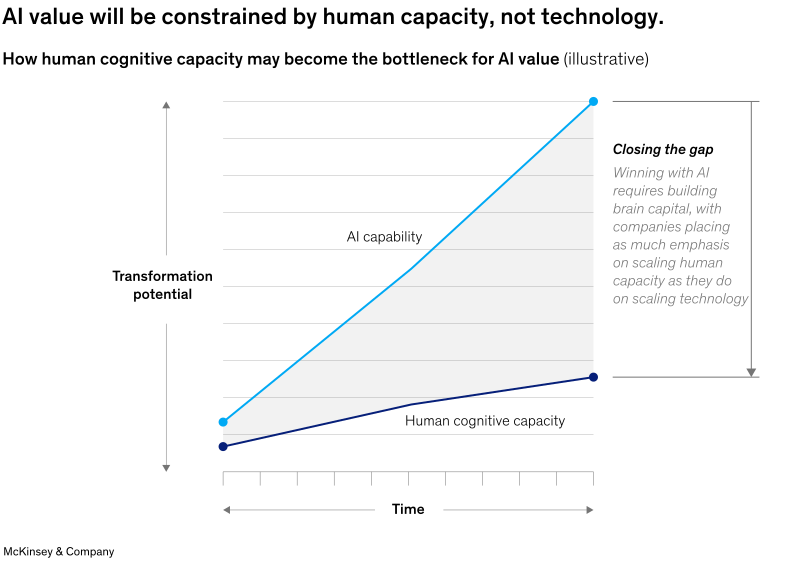
The constraint is not the technology. Poor implementation can be a factor, as can failing to connect deployment to actual value. But increasingly, we’re seeing another key constraint: the capacity of the people using it. In other words (Exhibit 1), the bottleneck might be human.
A range of evidence points to the fact that the implementation of AI can drain the mental capacity of an organization’s talent. Peer-reviewed research confirms that frequent AI use leads to cognitive offloading—when people passively delegate reasoning to the machine, their independent analytical skills decline measurably.1 The American Psychological Association warns that such AI overreliance can erode confidence and independent reasoning in professionals (though active editing and challenge can preserve confidence).2
A study of 1,488 US employees found that intensive oversight of AI tools can contribute to “brain fry,” a form of cognitive fatigue characterized by mental fog, difficulty focusing, and slower decision-making.3 There’s even the possibility of a longer-term cost. Early, non-peer-reviewed neuroscience insights from MIT suggest that heavy cognitive offloading—even by proficient users—may weaken the brain’s own infrastructure. Heavy AI users showed reduced neural connectivity and poor memory retention when the tool was removed, the research showed.4 Put simply, a brain that stops practicing recall, synthesis, and independent reasoning may gradually lose the capacity to do so.
This may be bad news for a workforce that’s already struggling: A study by the McKinsey Health Institute (MHI) found that in 2023, 22 percent of employees globally reported burnout symptoms. And it’s equally bad news for companies, which need mentally healthy workers to drive their technology and AI transformations.5
The next frontier of the AI agenda, then, is resolving the human capacity equation. MHI refers to this as “brain capital”: the idea that brain health and brain skills are treated as a strategic asset.6 MHI leaders, working with the World Economic Forum, have outlined a set of system-level actions to build brain capital: safeguard brain health, foster brain skills, study and measure brain capital, invest in solutions, and mobilize a coordinated global movement.
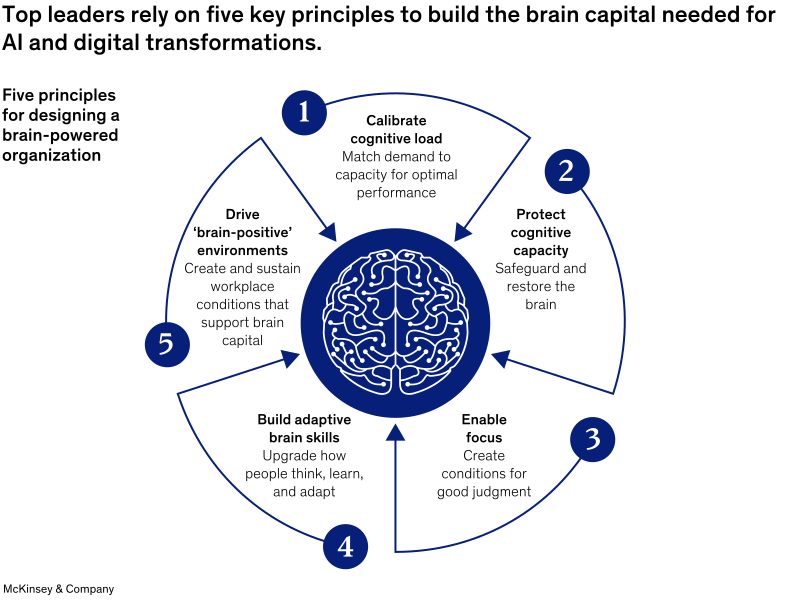
This article offers five operating principles for leaders who want to build brain capital as they rewire their companies (Exhibit 2). The core idea is putting humans at the steering wheel and AI in the loop—not the other way around. These principles matter for both technical design (how we design AI programs and systems) and behavioral design (how we lead and collaborate) and underscore the importance of rethinking how work gets done rather than simply layering AI onto existing processes.
Calibrate cognitive load: Design what the brain is asked to do
This principle is about the demand side—the composition and intensity of the work itself. Automation drives this change: McKinsey research estimates that today’s technology could, in theory, automate about 57 percent of total hours worked in the United States. Automation changes the nature of work. Freed of simpler duties, workers can instead address more cognitive tasks, the ones requiring judgment, oversight, and an ability to cut through ambiguity. Automation could reduce total hours worked. It could also increase cognitive intensity per hour.
The fix is not less AI. Rather, it is load architecture, which means designing roles so that cognitively intense work is interspersed with lighter tasks, ensuring that AI handles the noise while humans retain the thinking that creates value.7 This would give the brain much-needed variation.
Think of frontline sales representatives who spent most of their days on administrative work and prospecting—tasks now handled by AI. Now they can spend their days handling back-to-back customer calls, an experience that can be draining. And what about customer service agents who no longer see any easy tickets and spend every hour on complex, escalated cases? The volume went down, but the intensity went up. If they don’t work on lighter tasks (that still create value), their brains never get a rest.
Without designing variation into employees’ days, companies could find it difficult to maintain initial gains from AI shifts. At first, leaders may celebrate efficiency gains. But if the research we cited above holds true, talent whose workdays consist entirely of higher-level, higher-pressure tasks are likely to be making worse decisions than before the automation. Again, nothing is wrong with the technology. The problem is that nobody has calibrated the cognitive load.
Finally, part of recalibrating load architecture is ensuring that talent isn’t underloaded. When AI absorbs work that once built skills, companies can redeploy that capacity toward new challenges that grow people’s employability. Organizations that use time freed up by AI to rotate talent, build adjacent skills, or open internal mobility paths turn a calibration risk into a talent advantage.
Protect cognitive capacity: Protect what the brain has to give
If the first principle is about managing demand—how much load we place on the brain—then the second is about supply, or how much capacity the brain has to give. Brain capacity depletes with sustained effort and restores through sleep, movement, psychological detachment, and more. Neuroscience is clear: The brain’s glymphatic system clears metabolic waste 60 percent more effectively during sleep and recovery.8 Without adequate sleep and recovery, learning and memory consolidation are significantly impaired.
No amount of role redesign helps if people are running on empty. For example, imagine that a company introduces a well-intentioned upskilling program on AI. If leaders haven’t designed recovery time into the process, they’ve simply layered more cognitive demand onto an already depleted brain. Investing in reskilling without addressing brain capacity is a recipe for failure.
On the other hand, leaders who help talent ensure that they have sufficient capacity subtract before they add: for example, by retiring legacy processes, canceling low-value meetings, and building recovery into the operating rhythm. This isn’t a wellness perk. It’s a requirement for any leader seeking strong performance.
Enable focus: Create conditions for good judgment
Research by Gloria Mark at the University of California, Irvine, shows that modern work is characterized by near-constant context switching. Workers spend an average of just 47 seconds on a screen before shifting attention, creating hidden costs in focus, productivity, and cognitive energy.9 According to one report, it can take an astonishing 23 minutes or more to fully refocus after each interruption.10 AI is fast, but to unlock its potential, humans need uninterrupted time to evaluate what it produces. What a waste, for example, for a pharma team aiming to use AI to accelerate compound screening to be undermined by relentless email threads.
Teams like that need protected deep work.11 People need space to develop good decisions. Leaders can address this by instituting practices such as notifications batched by default, one-person triaging AI output instead of everyone checking everything, and “stop doing” lists that carry as much weight as to-do lists. Companies that emphasize productive deep work are redesigning the attention architecture around the technology—ensuring that people can go about the business of redesigning systems and processes to make the most of AI.
Build adaptive brain skills: Protect the muscle or it atrophies
Peer-reviewed research confirms that AI-driven cognitive offloading reduces active recall and problem-solving capacity, creating the cognitive dependency we’ve already mentioned.12 AI augments what people already know, and it can accelerate tasks. But it cannot fully substitute for the judgment, pattern recognition, and tacit knowledge that develop through repeated real-world experience and that are also essential for personal connection, creativity, and innovation. Junior analysts who used to spend hours building slides and cleaning Excel files can now produce the same output in minutes—a massive efficiency gain. But AI can’t teach them how to tackle the things that are possible with all that free time: read a skeptical client, reframe a failing argument on the fly, or remain steady in an ambiguous conversation. Those muscles only develop through use.
This is why, in the context of the new AI-empowered workplace, companies should invest in the skills that AI cannot replace: cognitive, interpersonal, self-leadership, and digital skills, including critical thinking, emotion regulation, learning agility, stress management, sustainable performance, and team collaboration. For example, in addition to training these skills through learning programs, companies could create spaces where brainstorming happens with zero input from AI. Thinking without AI improves thinking with AI.13 The brain physically remodels through deliberate practice,14 but only if you use it.
Drive brain-positive environments: Shape the culture for positive outcomes
Leaders who create brain-positive environments treat AI adoption as a cultural question as well as a technical one.15 They know that many aspects of the work environment can determine whether working with AI builds people up or hollows them out. And they know that their words and actions can establish an atmosphere of psychological safety. Imagine introducing two identical AI pilots. One leader introduces the pilot by saying, “Who knows if this will work?” Another introduces it as, “Here’s a first-rate thinking partner for you,” and encourages team members to discuss what’s needed to ensure they have the cognitive capacity to engage this partner. Which group do you think will succeed? The latter, of course. Have leaders created a physical workspace that encourages creativity? Does the culture help activate the brain or stultify it? Do employees have access to the resources and tools needed to support positive brain health?16 Put simply, employees need a brain-positive environment to do their best work.
The next transformation agenda
Technology, operating models, change management, and organizational design are essential, and many businesses do them well. The five principles we’ve described build on that foundation by ensuring that the humans leading the transformation have the cognitive capacity to sustain it. Organizations that treat their people like elite athletes—investing in recovery, flexibility, and skill building alongside intensity—outperform those that simply push harder.17 When you rewire the technology and design for the brain, the ceiling lifts.
Our research on employee health shows that moving beyond burnout toward holistic health is not just a moral imperative; it is an economic one.18 This is not a wellness program bolted onto a transformation. It is a deliberate choice to keep humans at the steering wheel and AI in the loop. Calibrate the load. Protect the capacity. Enable the focus. Build the skills. Design the environment. Get these right, and AI can deliver on its promise. Get them wrong, and you will automate your way to exhaustion.
The authors wish to thank Alex Vaught, Barbara Jeffery, Brooke Weddle, Charlotte Seiler, Cheryl Healy, Claire Lomas, Darshini Mahadevia, Elizabeth Newman, Erica Coe, Hannah Wagner, Harris Eyre, Imad Zard, Jioo Lee, Johanne Lavoie, Kana Enomoto, Laura Pineault, Lucy Pérez, Manish Chopra, Nicolette Rainone, Rick Tetzeli, Sandra Durth, and Yocheved Rabhan for their contributions to this blog.
1 Michael Gerlich, “AI Tools in Society: Impacts on cognitive offloading and the future of critical thinking,” Societies, 2025, Volume 15, Number 1; Yong Kong et al., “From cognitive need to problematic use: A chained mediation path moderated by academic stress and AI literacy,” Frontiers in Psychology, March 2026, Volume 17.2 “Overreliance on AI programs may undermine confidence at work,” American Psychological Association, April 2026.
3 Julie Bedard et al., “When Using AI leads to ‘brain fry’,” Harvard Business Review, March 5, 2026.
4 Nataliya Kosmyna et al., “Your brain on ChatGPT: Accumulation of cognitive debt when using an AI assistant for essay writing task,” MIT Media Lab, June 10, 2025; Daron Acemoglu, Dingwen Kong, and Asuman Ozdagla, “AI, human cognition and knowledge collapse,” MIT Economics, February 20, 2026.
5 Jacqueline Brassey, Brad Herbig, Barbara Jeffery, and Drew Ungerman, “Reframing employee health: Moving beyond burnout to Holistic Health,” McKinsey Health Institute, November 2, 2023.
6 The human advantage: Stronger brains in the age of AI, World Economic Forum and McKinsey Health Institute, January 15, 2026.
7J. Sweller, “Cognitive load during problem solving: Effects on learning,” Cognitive Science, April 1988, Volume 12, Number 2.
8 Lulu Xie et al., “Sleep drives Metabolite Clearance from the Adult Brain,” Science, October 2013, Volume 18, Number 342; Sabine Sonnentag and Charlotte Fritz, “Recovery from job stress,” Current Directions in Psychological Science, February 2015, Volume 36, Number S1.
9 Gloria Mark, Attention Span: A Groundbreaking Way to Restore Balance, Happiness and Productivity, 2023, Hanover Square Press; University of California, Irvine, field studies on digital interruptions.
10 Gloria Mark, Daniela Gudith, and Ulrich Klocke, “The cost of interrupted work: More speed and stress,” in Proceedings of the SIGCHI Conference on Human Factors in Computing Systems, April 2008.
11 Cal Newport, Deep Work: Rules for Focused Success in a Distracted World, Grand Central Publishing, 2016.
12 Ginto Chirayath, K. Premamalini, and Jeena Joseph, “Cognitive offloading or cognitive overload? How AI alters the mental architecture of coping,” Frontiers in Psychology, 2025, Volume 16, Number 1699320; Binny Rose et al., “The cognitive paradox of AI in education: Between empowerment and cognitive dependency,” Frontiers in Psychology, 2025, Volume 16, Number 1550621.
13 Jeffrey D Karpicke and Janell R Blunt, “Retrieval practice produces more learning than elaborative studying with concept mapping,” Science, January 2011, Volume 331, Number 6018.
14 Bogdan Draganski et al., “Neuroplasticity: Changes in grey matter induced by training,” Nature, January 2004, Volume 427, Number 6972; Adele Diamond, “Executive functions,” Annual Review of Psychology, 2013, Volume 64.
15 The State of Organizations 2026, McKinsey, February 2026.
16 Hannah Mayer, Lareina Yee, Michael Chui, and Roger Roberts, Superagency in the workplace: Empowering people to unlock AI’s full potential, McKinsey, January 2025.
17 “To defend against disruption, build a thriving workforce,” McKinsey, May 8, 2024.
18 Jacqueline Brassey, Brad Herbig, Barbara Jeffery, and Drew Ungerman, “Reframing employee health: Moving beyond burnout to holistic health,” McKinsey Health Institute, November 2, 2023.