Procurement in the resources sector is hard in ways not seen in other industries. Services and contractor spend dominate, OEMs hold the leverage, contracting is site-led and fragmented, data is uneven, and the whole system runs on a feast-famine cycle.
Most of the sector is now asking how to point AI at that complexity. That is the wrong first question. The right one is what the cycle does to capability. The scarcest asset in resources procurement is not a clean data set. It is category judgment.
Every downturn in resources strips category expertise out of the function. Every upturn finds procurement short of the judgment it needs most, with know-how concentrated in a few OEM-facing experts who are often at the end of their career. The real prize AI could offer the sector is not faster RFPs or another copilot, but the ability to turn scarce, hard-won judgment into a compounding asset that endures across cycles (Exhibit 1).
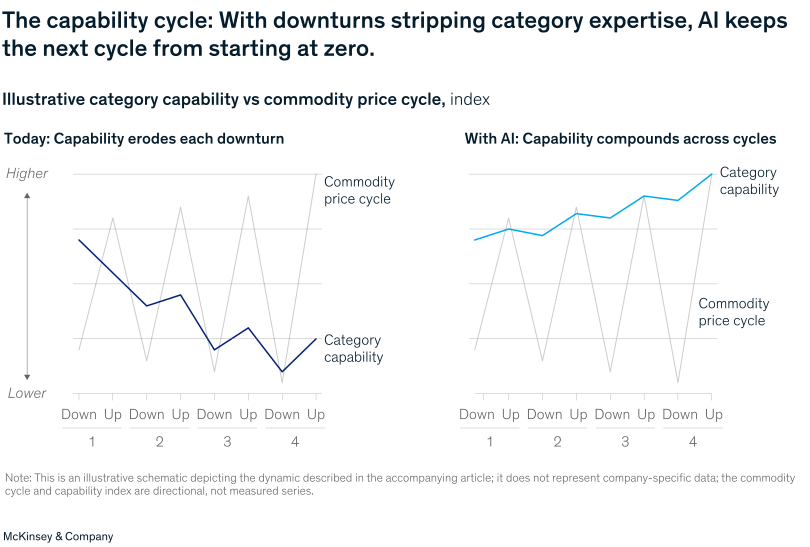
That reframing also settles the deployment debate. Start value-first, not data-first. Anchor each deployment in a quantified savings ambition and strengthen the data foundation in parallel. Waiting for perfect master data risks the loss of another cycle. The highest-value “move” for the chief procurement officer (CPO) is not to launch tools designed to address the sector’s complexity—it is to rewire the function around capability.
Why the resources sector is structurally different
Five characteristics shape the work of the procurement function in the resources sector, and each one makes capability hard to build and easy to lose.
- Services and contractor spend dominates. Maintenance, shutdowns, engineering, and logistics drive rate opacity and scope creep, eroding margin through variance no one can see. Procurement value depends as much on control of scope and specification as on the optimization of unit costs.
- OEM dependence can lead to single sourcing of critical spares and proprietary consumables, constraining leverage and embedding switching costs. Controlling these risks requires a deep understanding of asset reliability and criticality, combined with broad market knowledge to identify alternative suppliers and substitution opportunities.
- Site-led sourcing produces thousands of vendors, inconsistent terms, and fragmented data, with little enterprise-wide leverage.
- Rate transparency is weak, especially in services, which makes should-cost views hard to build and variance hard to detect.
- Commodity cyclicality drives feast-famine capacity: supplier constraints and price escalation in booms; cost pressure and capability retrenchment in downturns. This fifth point compounds the other four. Cyclicality does not just move prices; it removes people, and with them the judgment that kept the first four problems manageable.
Yet the same traits that have limited transparency, leverage, and consistency in the sector are the ones AI is best placed to convert into durable advantage. That’s because they are problems of encoded knowledge, not just problems of data.
Rewiring the function: The workflow is the unit of value
The evidence from early movers is consistent. Impact does not scale with the number of AI pilots. Instead, the more fragmented the portfolio, the lower the impact. Value comes from rewiring whole workflows, not from launching use cases. It involves embedding AI into four dimensions of the function at once: the technology stack, the intelligence beneath it, the talent model, and the operating model. What follows are three workflows worth rewiring first. Read each one as the same move: scarce category judgment, captured and made reusable. The three workflows also carry the full value logic at once, not just the easiest third of it: Category management sharpens a traditional lever; continuous sourcing and leakage control unlock levers that did not exist before AI; and the capacity shifted from repetitive work to judgment is the efficiency lever most programs forget to count.
Category management rewired around captured expertise
One chemical company faced the retirement of its leading category managers. Rather than accept the capability loss, it built a platform that codified time-tested sourcing methods, pairing historical strategies with advanced analytics. Ahead of the next tender, the platform found 14 percent in ocean-freight rate improvement and helped new people step into the category role faster.
This shows that AI can capture expert judgment and make it reusable, which is the durable win in a sector that loses that judgment every downturn. Similar success stories are emerging in other sectors. A technology player unified fragmented postmerger spend across multiple enterprise resource planning (ERP) systems and is now projecting 6 to 10 percent incremental category savings.
In each case, the rewired workflow harmonizes data across ERP, computerized maintenance management system (CMMS), and enterprise asset management (EAM) platforms. It identifies rate variance, benchmarks contractor services at scale, and gives category leads a cross-site fact base to put tension into long term, OEM-dependent relationships.
Sourcing, rewired into a continuous engine
In resources, sourcing has always been episodic, gated by shutdowns, turnarounds, and spot buys, with mid-market and tail spend left untouched. Rewiring changes the economics of that work. AI agents draft and level RFPs, compare scope across competing bids, detect anomalies, and trigger a re-sourcing event the moment a market signal moves, reaching spend that was never economical to touch by hand. In a cyclical sector, sourcing velocity is itself a hedge. When contractor leverage swings with the cycle, the ability to go to market faster and more often turns volatility into savings capture rather than exposure.
Public proof points are emerging here. Early deployments that score total landed cost against live market and tariff feeds are already changing outcomes in oil and gas sourcing, and should-cost-driven review of engineering, procurement, and construction (EPC) and equipment bids is starting to move the needle in energy procurement.
Leakage, rewired into continuous control
Value is negotiated centrally and leaked locally. The rewired workflow monitors compliance with rate cards and clauses, flags scope creep in service agreements, detects deviations between agreed-on and invoiced rates, and surfaces billing anomalies across thousands of vendors, in real time rather than as a periodic audit. One regulated energy company managing more than $4 billion in vendor spend intercepted invoices before payment, identified leakage of over 1.2 percent of spend, and unlocked a path to roughly $55 million in annual impact. A North American utility reconciled more than one million invoices across 600-plus contracts at over 99 percent accuracy, delivering more than $10 million in annual run-rate value. In shutdown-heavy, capital-intensive environments, small variances compound quickly, so the control must run continuously to matter.
From disparate tools to rewired workflows
For its own procurement rewiring effort, one Asia-based metals player prioritized the source-to-contract workflow, which offered significant value potential and a rapid path to implementation. Instead of building a single, siloed AIrfps agent, the company developed a set of agents that could interact with each other to cover the end-to-end process. In parallel, it built a new resources intelligence spine: the underlying data layer and agent set needed for procure-to-pay and spend intelligence. A central orchestrator coordinated agents across all three workstreams, and a data enrichment agent closed the gap on legacy records while new data was captured cleanly by design. The new workflow achieved reductions in indirect spend of around 12 percent. In direct spend, largely on commodities, it achieved a smaller but still meaningful reduction of around 2 percent, along with significant improvements in reactivity: catching risk ahead of the market rather than responding to it after the fact. Within the procurement function, productivity improved by up to 50 percent in select processes.
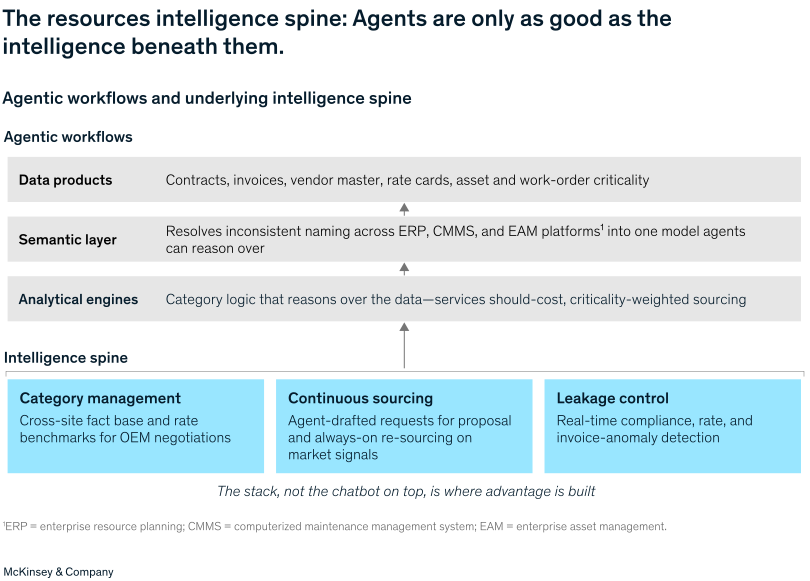
As this example shows, a key factor that differentiates rewired workflows from smart tools is the connective tissue beneath them. The first layer is the intelligence spine (Exhibit 2). A clean data foundation is necessary but not sufficient. What creates advantage is what sits on top: data products for contracts, invoices, vendor master, rate cards, and asset and work-order criticality; a semantic layer that resolves inconsistent naming in different software platforms into one model agents can reason over; and analytical engines that carry the real category logic, such as services should-cost and criticality-weighted sourcing. Agents are only as good as the intelligence beneath them.
The second layer is the operating model, and it is the one most deployments skip. Each workflow needs explicit decision rights: what an agent can approve automatically, where it executes within set thresholds, what needs category approval, what needs site or maintenance input, what requires finance validation, and where engineering must sign off. The same sourcing or leakage workflow can run human-led and agent-enabled for high-stakes categories—agent-led with a human in the loop for the broad middle, and fully agentic with human audit for routine, rules-based spend (table). Without that design, agents stall at pilot.
Decision rights, by workflow and by stakes: The same workflow can run human-led, agent-led, or fully agentic.
| Human-led, agent-enabled High-stakes, OEM-critical spend | Agent-led, with human in the loop The broad middle | Fully agentic, with human audit Routine, rules-based spend | |
| Category management | OEM-dependent, single-source categories: Agent surfaces cross-site fact base and rate benchmarks; lead sets strategy and negotiates | Multisourced, moderate-complexity categories: Agent recommends strategy and terms; lead reviews and approves | Standardized, low-risk categories: Agent sets and refreshes strategy against defined rules; human audits periodically |
| Continuous sourcing | High-value shutdown and turnaround sourcing: Agent drafts and levels RFPs and flags anomalies; buyer negotiates and awards | Recurring mid-spend categories: Agent runs sourcing events and shortlists bidders; human confirms the award | Commoditized tail spend: Agent triggers and executes re-sourcing on market signals; human audits outcomes |
| Leakage control | Complex service contracts: Agent flags scope creep and rate deviation; category lead investigates and resolves | Standard vendor invoices: Agent detects and holds anomalous invoices; human approves release | Rate-card-compliant routine invoices: Agent auto-clears within threshold; human audits a continuous sample |
Note: This is an illustrative application of the decision-rights framework described in the accompanying article across the three priority workflows.
Another layer is talent. Structural gaps call for both upskilling and tools that codify expertise, turning AI into a force multiplier for scarce category talent rather than a replacement for it. Finally, companies need mechanisms to drive their AI transformation and keep it on track. These include agile teams working in short cycles to develop and test new approaches; persistent funding based on outcomes; and regular business reviews to reallocate resources, fix issues, and reprioritize work.
Done this way, the value frame also extends beyond price optimization and leakage control. Connect spare-parts inventory to asset and work-order criticality and supplier lead time, and the same intelligence spine begins to manage working capital, uptime, capex discipline, and supplier risk, not just unit cost. The critical data is already in the spine. The opportunity is to use it (see sidebar, “A practical CPO road map”).
The bottom line for resources-sector CPOs is direct. Start value-first and treat this as an operating-model redesign rather than a tool rollout. The question that separates leaders is not whether you are rewiring. It is what the rewiring encodes. Technology is converging fast. What lasts is the procurement-native intelligence underneath it: transforming should-cost logic, OEM and services economics, and hard-won category judgment into a compounding asset that endures through downturns. In a sector that loses capability on a cycle, the function that codifies its expertise does not just capture more value—it becomes cycle-proof.