A forecast isn’t worth much if it arrives after the opportunity to act has passed.
Pricing, inventory, capital allocation, and commercial decisions can’t wait for planning reviews. Yet many financial planning processes still move more slowly than the decisions they are meant to inform.
For years, continuous planning proved too hard to sustain. Maintaining forecasts across thousands of operational drivers and incorporating external signals required more effort than most organizations could justify. AI is beginning to remove those constraints. Organizations can now connect operational and financial information continuously, while drawing on external signals that previously sat outside the planning process.
Organizations that recognize emerging risks and opportunities sooner gain something competitors do not: more choices. They have more time to weigh alternatives and mobilize a response before performance is affected.
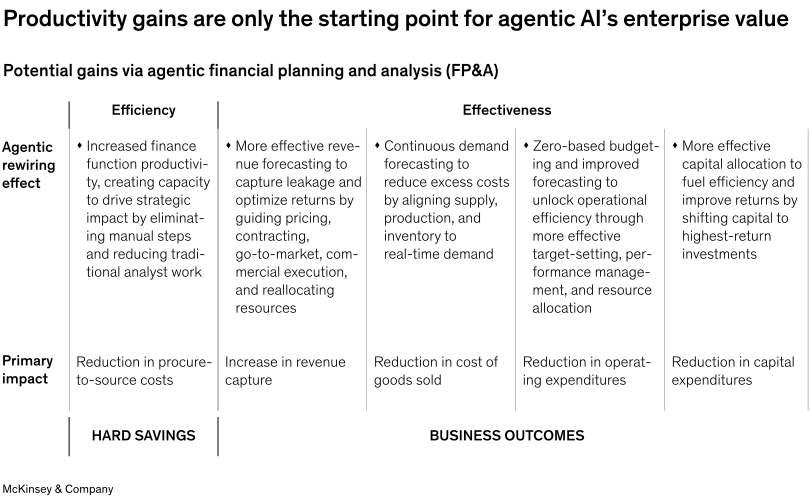
Leading organizations are already reorganizing their financial planning and analysis (FP&A) department around this new reality. Rather than only identifying where agents could play a role in planning, budgeting, reporting, and steering activities, they recognize that a full rewiring of the end-to-end workflow, roles, governance, data ownership, and working practices is required. At a Fortune Global 500 telecommunications company, forecasting is now three times faster than it was two years ago, giving leaders more time to respond to dynamic markets. In a planning and performance management transition, a leading auto parts manufacturer is aiming to connect operational and financial planning more closely with the goal of improving visibility into margin pressures before they appear in reported results (Exhibit 1).
Why the planning cycle is broken
In many companies, strategic planning, budgeting, forecasting, reporting, and execution still operate separately, according to their own priorities and timelines. Information moves sequentially across the organization, often requiring repeated reconciliation and review before any action can be taken. Business conditions may change overnight, but critical decisions such as pricing, inventory, hiring, and capital allocation remain stuck.
At the telecommunications company, for example, forecasting cycles stretched to six weeks or more and relied on more than 1,000 separate Excel models distributed across the organization. Roughly 70 percent of FP&A time was devoted to processes like cleaning data, reconciling inputs, and producing reports instead of helping business leaders respond to changing conditions. Targets were frequently reset midcycle, creating additional rounds of revisions and rework; static forecasting models limited the company’s ability to assess alternative scenarios as market conditions evolved.
Signals are distorted
These constraints become most visible when operational variables move faster than organizations can coordinate decisions around them. Changes in customer demand may appear in sales data almost immediately while inventory, production, pricing, and spending decisions remain tied to fixed planning cadences. By the time revised forecasts move through review and approval processes, conditions may well have changed again.
The auto parts manufacturer encountered this problem during a broader finance transformation. Budgeting processes remained largely disconnected from the operational drivers shaping business performance, making it difficult to connect financial outcomes to changes in material costs, freight, production yield, or sales mix. Forecasting cycles also provided limited visibility into emerging threats to profitability and cash flow. Rising freight costs and declining production yield often surfaced operationally before finance teams could determine how severely margins would be affected.
Precision prevents decisions
Many finance organizations still operate within systems optimized primarily for precision, reconciliation, and reporting cadence. One finance leader described the challenge as moving from a “precision culture” to a “decision culture.” In practice, that means spending less time reconciling immaterial forecast variances and more time understanding which factors are moving, what the implications are, and which actions deserve attention first. The underlying planning architecture reflects a reporting model designed to explain performance after the fact rather than support intervention in the moment.
Companies that are getting finance involved early are starting to address this. Instead of entering the process after forecasts have been consolidated, FP&A teams are being asked to participate earlier in decisions related to pricing, spending, production, and commercial execution.
How to rewire decision-making
Leading organizations are redesigning their FP&A processes around a different assumption: Many of the decisions shaping business performance can no longer wait for reporting cycles to close. And AI can help reduce the gap.
Forecasts now serve a different purpose. Instead of documenting expected performance periodically, teams can use forecasts to test assumptions, examine alternatives, and coordinate responses across pricing, production, inventory, spending, and commercial execution. The companies taking this approach get ahead of performance gaps, rather than reacting when it’s too late.
Connect business drivers to financial outcomes
Demand spikes, pricing pressures, production constraints, and supply disruptions come to light at the front line. Finance teams often see the effects only after margins deteriorate, inventory imbalances build, or commercial performance weakens.
Organizations that identify operational pressure early can often respond with smaller adjustments—relatively minor pricing moves, for example—before larger and more disruptive actions become necessary. They also find more strategic room to respond. At a global toy manufacturer, AI-enabled demand forecasting incorporated a broader range of customer and market signals, giving teams earlier visibility into changing customer buying patterns. Managers adjusted inventory levels, production schedules, and distribution plans before larger imbalances accumulated later in the cycle.
At the auto parts manufacturer, budgeting targets often failed to reflect shifts in freight costs, production yield, or sales mix until reporting cycles were already underway. A production problem might be visible on the factory floor days or weeks before its effect on margins became clear. The new planning tools are designed to close that gap. There are multiple goals: improve visibility into margin leakages by linking operational and financial performance; better integrate planning and cross-functional decision-making between finance, operations, and commercial teams; and improve scenario planning and faster planning. Teams also want to test pricing, demand, and supply scenarios earlier in the operating period. Once improved visibility is built into the system, teams should be able to evaluate how changes in pricing, demand, supply, or market conditions could affect performance on a much faster timetable than relying solely on quarterly or annual planning cycles.
Teams also began testing pricing, demand, and supply scenarios earlier in the operating period. Rather than revisiting assumptions only during quarterly or annual planning cycles, teams started evaluating how changes in pricing, demand, supply, or market conditions could affect performance on a much faster timetable.
Most planning systems still depend on people to recognize changes in the business and communicate them to finance. AI increasingly assumes part of that sensing function. Supplier communications, customer feedback, market reports, and other unstructured information can be monitored continuously and linked directly to operational and financial drivers. Risks surface sooner, assumptions are challenged earlier, and leaders have more time to respond.
Intervene earlier for higher impact
The telecommunications company used AI agents to redesign its broken forecasting workflows. The agents ingest, clean, and format data (with FP&A staff validation as a guardrail), build a “first-pass forecast” (anchored in analytical models) for human review, and then have gap closure agents identify the main actions that can be taken to reduce or eliminate risks to the financial plan. The redesign reduced cycle times by threefold. Teams that had spent roughly 50 percent of their time sourcing and aggregating data could focus on higher-value actions, refreshing forecasts and tackling trade-offs earlier in the cycle. AI-supported forecasting models and automated data pipelines reduced reliance on the more than 1,000 spreadsheet-based models previously used across the organization.
Cross-functional coordination accelerated as well. Automated ingestion and reconciliation reduced the time required to validate inputs before forecasts moved forward. Finance, operations, and commercial leaders began working from the same assumptions within the same decision window, allowing them to respond to changes in demand, pricing, and channel performance that might otherwise have materially affected results.
Those changes reshaped the substance of planning meetings, replacing tedious consolidation and reconciliation exercises with strategic discussions about which actions could realistically close emerging performance gaps. Managers adjusted pricing assumptions, reallocated resources across markets, and reevaluated commercial priorities before variances hardened into reported results.
As planning systems converge, forecasts increasingly function as coordination mechanisms inside the operating period, not static reporting outputs at the end of it. Finance teams continue to oversee financial stewardship, but they now participate more directly while pricing, spending, production, and commercial decisions are still being negotiated.
Pivot at the speed of business
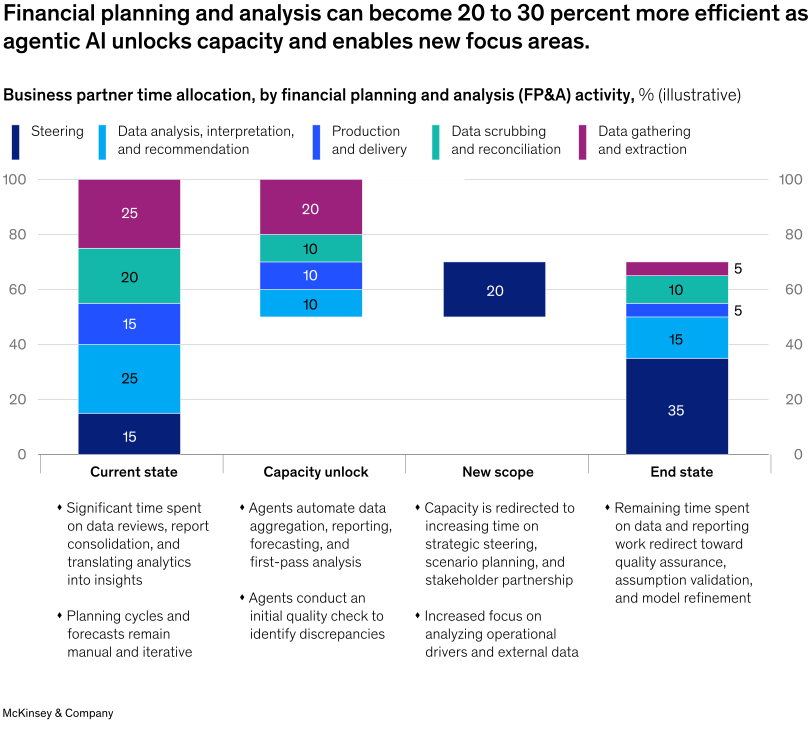
Responding earlier changes more than forecasting workflows. Organizations also begin redesigning how decisions move across functions, who owns planning mechanics, and where finance teams spend their time—freeing up talent for more complex work (Exhibit 2).
Separating decision support from reporting production
At the telecommunications company, redesigning forecasting workflows with agents that extracted, validated, and synthesized data reallocated more than 40 percent of FP&A capacity away from data gathering and manual reporting work. FP&A teams based in business units could refocus on assessing the potential shortfalls identified by AI, challenging assumptions, and working with both “gap closure” AI agents and business leaders on strategic pricing, commercial execution, and resource reallocation opportunities.
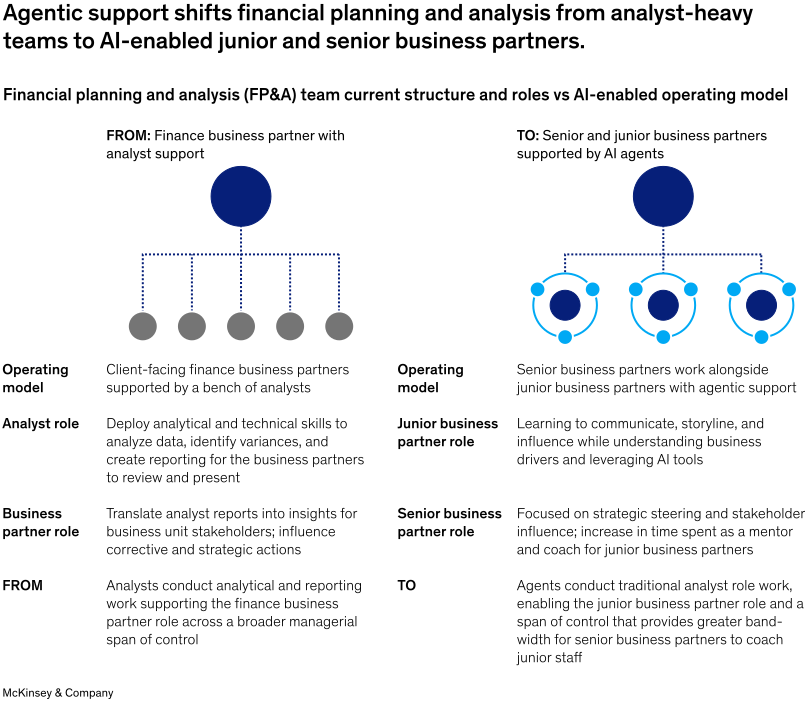
The operating model changed along with the workflow. More centralized teams began managing forecasting mechanics, analytical models, and data governance, while business unit finance teams focused more directly on performance steering and operational decision support. Shared forecasting logic and standardized data structures reduced reconciliation work across business units and allowed teams to evaluate performance using the same assumptions and drivers.
Such structures are becoming more common, with forecast generation and business intervention increasingly becoming distinct responsibilities. In both the corporate center and in the business units, analysts who previously spent most of their efforts gathering data, reconciling inputs, and producing recurring reports now focus on identifying emerging risks, weighing scenarios, and helping business leaders determine which actions remain available before performance gaps widen further. Business leaders increasingly access forecasts, variances, and performance drivers directly through conversational tools with embedded AI agents that surface the causes of gaps in order to plan ahead, rather than waiting for recurring reports. Problems surface earlier, while decisions are still being shaped.
From analysts to strategic translators
These operating models change what organizations expect from FP&A teams. As automation absorbs more recurring reporting and reconciliation work, finance professionals spend more time interpreting operational developments, challenging assumptions, and helping leaders navigate hard choices.
Career paths are evolving as well. Traditional analyst-heavy structures are giving way to smaller groups of business-facing finance professionals supported by centralized analytical capabilities and AI-enabled workflows (Exhibit 3). Communication, judgment, and the ability to translate complex analysis into practical business actions are becoming more important as finance teams participate earlier in operational and strategic decisions.
Organizations are also investing in capabilities that historically sat outside FP&A, including data analytics, workflow design, data governance, and AI-product ownership. In many cases, the challenge is no longer generating more analysis but ensuring the business can act on it quickly and consistently.
Building AI into financial decision-making
Many organizations now use AI to continuously monitor operational, commercial, and external signals that previously sat outside the planning process. Forecasts refresh faster, anomalies surface earlier, and teams can evaluate a broader range of operational and financial outcomes before decisions are finalized.
But let’s be clear: Leading organizations are not removing human oversight from the process. Instead, they are redesigning workflows around clearer interactions between automated analysis and managerial review. At the telecommunications company, for example, finance teams compared AI-supported forecasting outputs against existing human-led processes over multiple forecasting cycles before expanding adoption more broadly. Teams reviewed forecast differences, refined assumptions, and monitored how model accuracy evolved over time before relying more heavily on automated workflows.
These changes also require clearer decision rights. As intervention cycles accelerate, organizations are defining which actions can be automated, which require escalation, and where human review remains mandatory. Managerial behavior often needs changing as well: One finance leader noted that teams often spent disproportionate effort reconciling immaterial forecast variances while greater operational volatility was already affecting business performance.
AI-informed operating models expand what finance can influence. FP&A teams still oversee financial control and reporting discipline, but they can also help leadership identify which interventions remain available before operational problems reach the bottom line. To ensure that the changes to these operating models are truly meaningful, leaders should ask themselves a set of questions about how quickly information is turning into decisions:
- How much time passes between a meaningful change in the business and a decision in response?
- Which decisions create the most value when made earlier?
- Where are leaders operating with fewer choices than they should have?
- Which decisions matter most to performance and how does finance prioritize them to steer the business to the best financial outcomes?
With the help of AI, FP&A is poised to address all these questions. When it has the visibility, coordination mechanisms, and organizational credibility to evaluate trade-offs early, it can help the business redirect resources, adapt faster, and capture opportunities before competitors do.