The world needs more batteries. While the automotive industry’s transition to electric powertrains has been bumpy, demand for electric-vehicle (EV) batteries is rising again. The market for utility-scale battery energy storage systems (BESS) is growing, too, as rapidly increasing power demand puts grids under stress, and electricity networks add more generation capacity from intermittent renewables such as wind and solar power. As a result, the market for high-performance batteries is forecast to exceed 6.8 terawatt-hours (TWh) by 2035, up from around 1.6 TWh today.1
Modern battery production happens in “gigafactories,” large-scale facilities costing $1 billion to $7 billion to construct and capable of producing five to 100 gigawatt-hours (GWh) of lithium-ion cells every year. And to meet rising demand, the world needs a lot more gigafactories. Meanwhile, changes to market regulations and customer demand mean battery supply chains are expected to become increasingly localized, with gigafactories built to supply customers in their own regions.
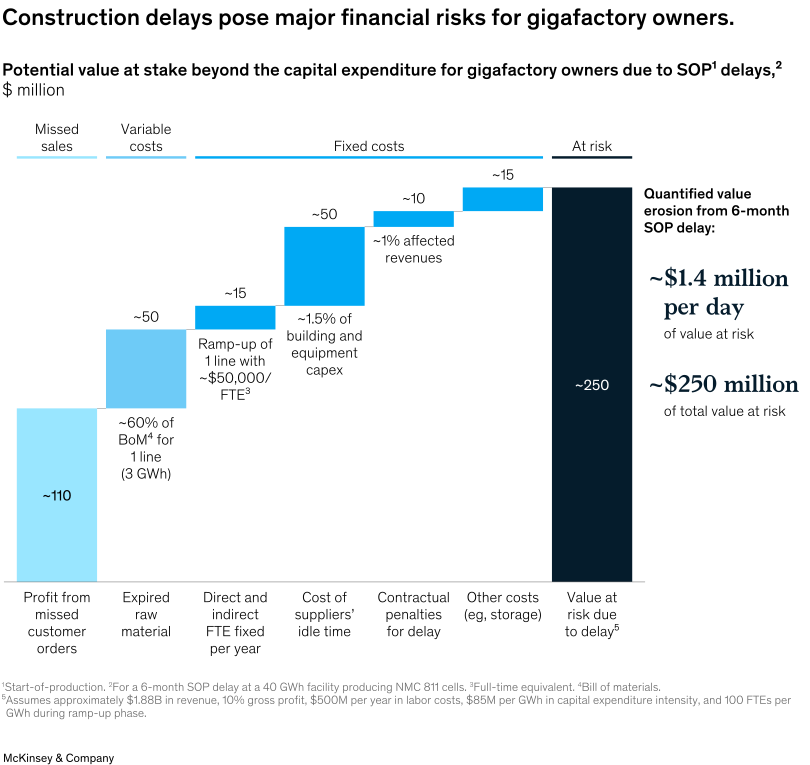
Time to market is a key competitive advantage in the battery cell manufacturing sector. Many players struggle, however, to benefit from accelerated market entry, or to meet factory start-of-production (SOP) timelines promised to their customers. Schedule overruns during project delivery have become the norm in the sector, pushing SOP back by six to nine months on average and causing significant disruption and financial impact across the value chain. For example, a six-month delay at a 40 GWh facility producing NMC 811 cells can put $250 million of value at risk (Exhibit 1). Best-in-class players, on the other hand, are managing to bring gigafactory projects online in just 18 to 24 months from start of construction.
Why SOP timelines slip
Several structural challenges increase the complexity and risk of gigafactory construction projects, leading many projects to miss their targeted SOP date and exceed budget expectations (Exhibit 2).
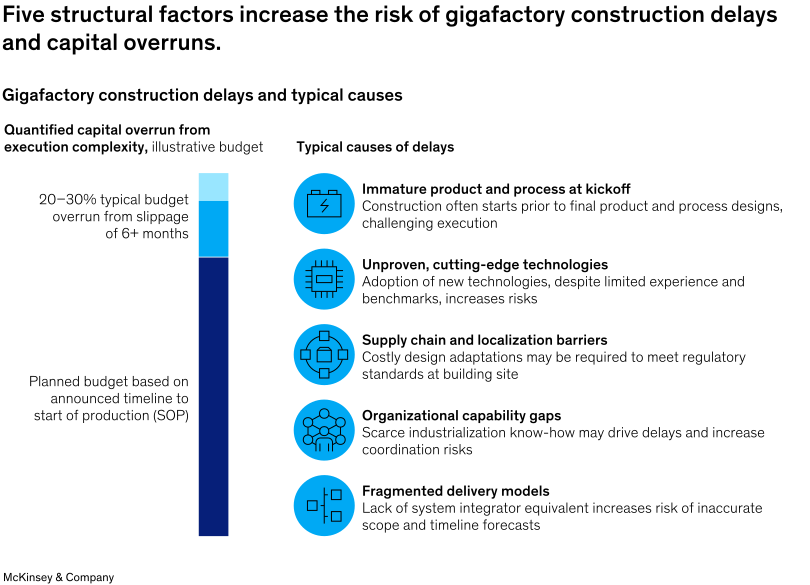
First, product and process designs are often immature at factory project kickoff. Battery manufacturers frequently begin construction while both the product architecture and production processes are still under development. Unlike commodity factory designs, battery gigafactories must be tailored to unique process flows, especially in electrode and cell assembly. This codevelopment of product, process, and plant introduces considerable uncertainty into design, equipment selection, and utility requirements—significantly increasing complexity for scheduling and cost forecasting.
Second, manufacturers often pursue the latest process technologies, either to optimize cost at scale or because of pressure from downstream customers seeking integration of cutting-edge capability into their supply chains. However, teams typically have limited experience with these new technologies, and market data to support planning is sparse. This lack of proven benchmarks increases industrialization risk and undermines the credibility of equipment readiness and yield projections.
Third, global supply chain dependencies can further complicate execution. Much of the process equipment supply chain is concentrated in Asia, including China and South Korea. Constructing facilities in other regions—such as Europe or North America—creates two additional challenges. Logistics become complex, with the need to move delicate equipment over long distances, and associated challenges accessing support from OEMs during installation and commissioning. In addition, projects must align equipment and facility designs with different health, safety, environmental, and fire-protection codes. While often manageable, these differences can require additional engineering, certification, and validation work, increasing both cost and schedule risk.
Fourth, owner teams often lack the capabilities and experience to manage such complexity. Talent shortages impose constraints on organizations’ ability to hire experienced talent, and few organizations have internal teams with end-to-end experience delivering gigafactories at speed and scale. This limits their ability to foresee integration risks, adapt to delays, or apply lessons learned across lines or sites. Additionally, product and process responsibilities typically sit with the owner’s engineering team, while factory delivery is split across several contractors—leading to coordination and accountability issues.
Finally, ecosystem partner management is often immature. Gigafactories involve a web of partners—contractors, equipment suppliers, technology licensors, and local authorities—without a single system integrator to ensure alignment. Misaligned incentives, limited definition of interfaces, and inconsistent communication between these stakeholders frequently result in scope creep, schedule slippage, and quality issues. Owners who fail to orchestrate these relationships and define information flows proactively often face avoidable delays and cost overruns.
The experience of some early movers underscores these challenges. In many cases, battery manufacturers have faced long delays and cost overruns as they have attempted to scale multiple production lines across different program stages in parallel and across different geographies (and therefore with variable regulatory requirements). Consequently, product road maps are in flux as manufacturers respond to customer needs during production line buildup.
Winning the gigafactory sprint
How do best-in-class players manage to overcome these challenges and execute gigafactory projects in 18 to 24 months from start of construction to SOP? Best-in-class project delivery depends on three dimensions: access to talent and organizational capabilities, an efficient execution framework, and effective gigafactory design and delivery. Success across these dimensions can mitigate risks and ensure timely and in-budget construction, safeguarding SOP and maximizing value.
1. Talent and capabilities
Successful delivery starts with a fit-for-purpose project organization and strong governance mechanisms (Exhibit 3):
- A dedicated project delivery organization: Industry leaders establish a dedicated project delivery organization, supported by a global transformation office with direct links to top management. A tandem setup between project and facility operations functions ensures alignment during ramp-up and a smooth handover post-SOP.
- A defined governance model with escalation pathways: High-performing teams implement a clear weekly meeting cadence, standardized deliverables, and a well-communicated escalation pathway to top management. This enables swift resolution of bottlenecks and fast recovery when critical issues arise.
- Embedded continuous improvement: A transformation team operates alongside project delivery, enabling ongoing refinement of execution and applying learnings in real time to improve program outcomes.
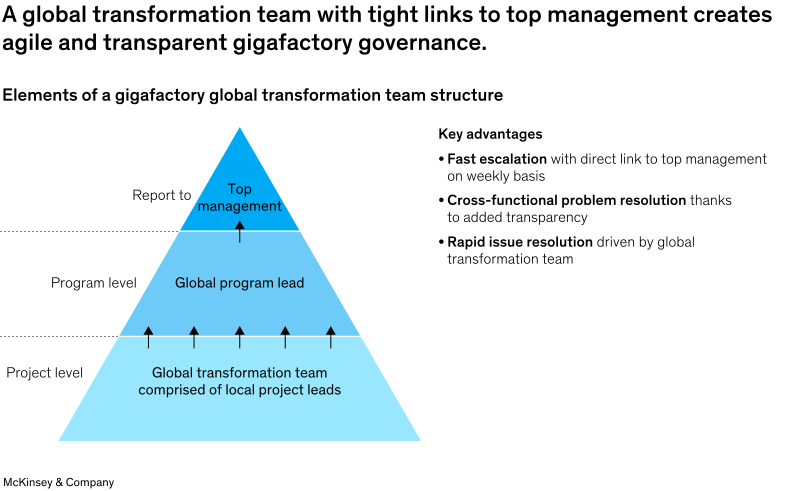
Clear escalation mechanisms are especially important in gigafactory projects and can prevent small issues from turning into major bottlenecks. For example, when equipment suppliers are unfamiliar with regional, national, and local regulations, legal challenges inevitably arise throughout the course of the project. The resulting delays can quickly build up to several months. A quick escalation pathway helps either prevent or mitigate the impact of these legal challenges.
2. Execution framework
Tightly integrated project controls and contractor management are essential to delivering against ambitious timelines:
- Contracting strategy tailored to project needs: A holistic project contracting strategy, including risk-sharing contract structures, incentivizes contractors to maximize their own performance. Failures often stem from insufficient scope and milestone definition, and from lack of accountability by contractors on the critical path.
- Integrated project milestone planning: Best-in-class organizations adopt a single, unified project tool to track and align critical milestones across stakeholders, and use advanced analytics and AI to optimize project execution planning. They continuously challenge the critical path, run root-cause analyses on delays, and implement corrective actions to maintain momentum.
- KPI dashboarding for decision support: Leading players define joint project-progress KPIs with contractors and stakeholders, translating them into dashboards that are regularly updated, user friendly, and aligned with top management reporting standards. This enables early identification of slippage and timely executive intervention.
For illustration, most contracts with equipment suppliers are missing fundamental performance-based metrics, such as legally binding delivery schedules. That can lead to unjustified delays without legal consequences, but with major repercussions for the overall project timeline.
3. Gigafactory design and delivery
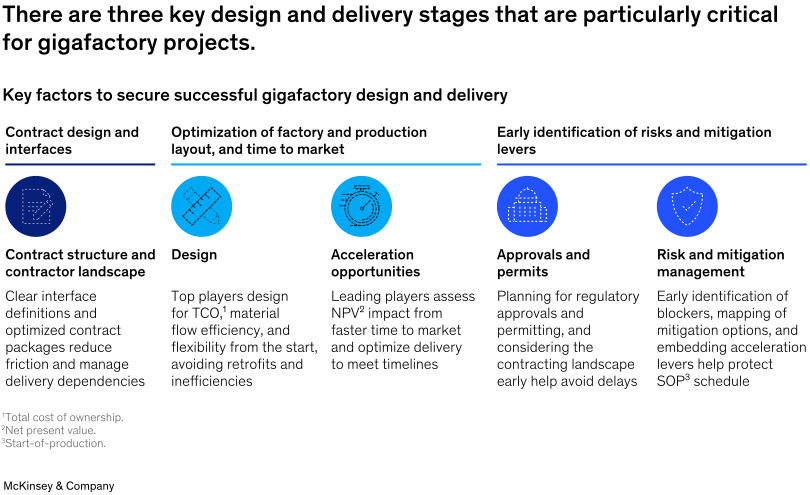
Given the structural challenges and evolving nature of battery factories, managing design and delivery is crucial (Exhibit 4):
- Project-specific contract package design and interfaces: Given the specific delivery model—typically split across facility, clean and dry room, and equipment contractors—clear interface definitions and scope boundaries, based on an optimized contract package design tailored to specific project needs, are vital to reducing friction and managing delivery dependencies. Ensuring alignment across the contractor landscape and building accountability through well-structured contracts minimizes interface risks and keeps stakeholders focused on SOP.
- Optimization of factory and production layout, and time to market: Top players design for total cost of ownership (TCO), material flow efficiency, and industrial flexibility from the outset, avoiding costly retrofits and inefficiencies downstream. By tightly designing product, process, and facility layout to the minimum technical solution based on value-add, they derisk execution and secure operational readiness. At the same time, advanced analytics approaches such as generative scheduling help them automatically build resource-loaded and logically tied schedules. Furthermore, these tools enable companies to conduct rapid scenario planning and embed targeted acceleration levers, such as resequencing activities or fast-tracking long-lead items. Generative scheduling systems can produce hundreds of thousands of potential schedules using an advanced analytics engine, then rapidly evaluate each one based on predicted cost and schedule outcomes. That improves cash flow, safeguards SOP, and maximizes net present value (NPV) by optimizing gigafactory delivery across scope, schedule, and cost.
- Early identification of risks and mitigation levers: Proactive planning around regulatory approvals, permitting, and the contracting landscape is essential. Forward-planning for permits, coupled with quantified risk tracking and management, enable teams to spot potential blockers early and deploy mitigation options before they escalate. This approach includes mapping critical risks, defining contingency plans, and incorporating acceleration measures into the schedule to protect SOP from unexpected delays.
- Poor supplier interface management: To mitigate this risk, a single integrated planning tool is an essential part of the supplier management process. Ideally this planning tool is maintained in real time on one single platform. This has multiple benefits beyond day-to-day project management, as it acts as an early warning system in case of timeline clashes, avoiding project bottlenecks and delays.
Securing on-time SOP requires battery manufacturers to treat gigafactory delivery as a core industrial capability. This means establishing a dedicated program organization with clear governance and decision rights; integrating product, process, and factory design from the outset; and enforcing disciplined project controls. Clear contractor interfaces, forward-planned permits, and quantified risk tracking must be embedded early to avoid downstream disruptions.
By systematically applying these measures—supported by robust milestone management and targeted acceleration levers—manufacturers can reduce schedule uncertainty, contain costs, and achieve best-in-class delivery timelines. The winners will be those that make gigafactory delivery a C-level priority and treat it as a core competitive advantage to safeguard product time to market and unlock value generation.