Maintenance turnarounds sit at the core of the asset life cycle in capital-intensive industries, including oil and gas, chemicals, power generation, mining, metals, cargo shipping, cruise lines, and airlines, among others. These planned shutdowns are essential to sustain, repair, and upgrade critical infrastructure, and they disproportionally influence long-term economics. In oil and gas facilities, for example, turnarounds represent 5 to 15 percent of a site’s cost base and account for 25 to 50 percent of total downtime. In mining, they’re responsible for 50 to 70 percent of downtime. These events have significant cash flow implications too, reducing a site’s output, while greatly increasing capital and maintenance expenditure.
Cost and schedule compliance challenges that affect turnarounds have become even more acute in recent years. That’s due to high labor cost inflation and structural shortages of the skilled personnel required for complex, safety-critical maintenance work.
Turnarounds also shape long-term reliability, availability, and profitability. A poorly planned or executed turnaround can affect longer-term production and introduce reliability risks that erode margins for years. Conversely, a well-executed one can reset reliability and production performance and unlock sustained value. For asset leaders, these events are often make-or-break moments.
Despite this, many organizations continue to treat turnaround performance as an operational issue, rather than as a strategic lever. There’s an opportunity to rethink this. Improving turnaround performance isn’t about incremental efficiency gains. It’s about fundamentally enhancing cost competitiveness, asset availability, reliability, and capital productivity.
Why turnarounds are difficult to execute consistently
Turnaround outcomes vary widely across organizations and even between sites within the same portfolio. This variability reflects a combination of structural constraints and operational complexity.
Structural and organizational challenges
Large-scale turnarounds are episodic at the site level. A major event may occur only every few years, making it difficult for organizations to institutionalize learnings and systematically transfer experience from one event to the next or across sites.
Accountability structures further complicate execution. Turnarounds are typically delegated to site-level management teams, whose experience with events of this scale can vary significantly. At the same time, skilled craft labor and experienced frontline supervisors are becoming scarcer.
Many organizations also rely heavily on contractors for planning and execution. Outsourcing critical decisions can further dilute internal ownership, decrease capability, and limit knowledge retention.
Operational complexity
The operational challenge is equally significant. Coordinating turnarounds across a network of assets requires balancing multiple constraints, including timing, scope alignment, shared resources, and cash flow considerations.
Process adherence is another persistent issue. Even where standardized turnaround methodologies exist, their application is uneven. Leadership rotation, local practices, and time pressure can all lead to deviations, undermining consistency and performance.
At the event level, organizations must optimize four interdependent dimensions: interval, scope, schedule, and execution. Weakness in any one dimension can cascade into cost overruns, extended downtime, and compromised reliability.
What excellence looks like
High-performing organizations take a systematic approach to turnarounds, tending to converge on a common set of practices.
- Standardize and institutionalize. Enforce rigorous adherence to well-defined processes and establish a turnaround center of excellence (COE) to capture and disseminate lessons learned.
- Set aspirational, credible targets. Apply a “challenge-in” mindset to cost, duration, and scope decisions early, before constraints become embedded in plans.
- Invest in people and capabilities. Build frontline leadership and craft capability through explicit career paths within maintenance and turnarounds—rather than treating them as episodic roles—and bring in experts from the COE to reinforce site teams at critical points.
These practices enable companies to achieve stronger results, more consistently across their assets. They extend turnaround intervals by 5 to 20 percent through disciplined risk management and targeted interventions. They reduce turnaround duration by up to 10 percent through tighter scope control and critical path optimization. They improve annual availability by one to five percentage points by aligning scope with asset strategy and ensuring execution quality. And they lower turnaround costs by 10 to 20 percent by eliminating non-value-added work while protecting reliability (exhibit).
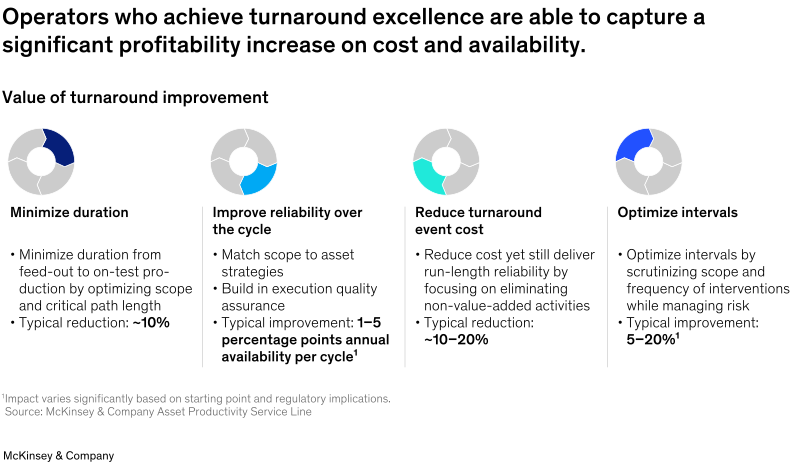
Together, these improvements translate into meaningful financial impact. In refining, for example, moving from average to top-quartile turnaround performance can increase EBITDA by 5 percent.
The expanding role of digital and AI-enabled tools
Today, the most advanced organizations are adopting more-advanced digital solutions to reinforce, sustain, and scale best practices across turnarounds. They are using these tools not just as stand-alone innovations, but as enablers to adhere to rigorous processes, augment capabilities, and enable better decision-making.
The latest tools improve transparency, standardization, and analytical rigor across the turnaround life cycle. They embed institutional knowledge into workflows, helping close experience gaps and supporting less-experienced teams. Importantly, they augment human judgment rather than replace it.
Their impact is visible across each of the four core dimensions of turnaround performance.
Interval optimization
Optimizing turnaround frequency across multiple assets requires balancing safety, compliance, reliability, market demand, and operational constraints. Some players are now using gen AI tools to systematically analyze the factors that determine the maximum turnaround interval for their assets. These tools combine top-down benchmarks with bottom-up knowledge of the specific limiters affecting each piece of equipment. They improve organizational learning by facilitating the use of knowledge gained on one asset and unit to inform decision-making on other assets and units in the portfolio.
This approach helps operators identify equipment and process modifications that could optimize turnaround intervals. They can apply structured scenario modeling tools to automatically evaluate the impact on capital expenditures and operating expenditures and the risk of different combinations of interventions and interval adjustments. Traditionally, such calculations would be completed manually, making comparisons between different interventions time-consuming.
A refinery operator utilized this solution, paired with strong process fundamentals, to extend a crude unit’s full turnaround interval by 30 percent by replacing time-based inspections with a refreshed risk-based inspection (RBI) program. By combining RBI analytics and corrosion monitoring, the team reduced the intrusive inspection scope for vessels and exchangers and introduced continuous monitoring to actively manage degradation. The operator complemented the change with a mid-cycle pit stop to address targeted work, deferring a full turnaround while reducing costs, boosting margins, and preserving reliability and safety.
Scope definition
Scope setting remains one of the most critical and most contested aspects of turnaround preparation. Traditional approaches often rely on subjective judgment, leading either to scope inflation or excessive cost cutting. A shutdown once every five years may be the only opportunity the operator has to complete planned work, and their instinct is to include more work items in each event. Yet that thinking can have a compounding effect. On top of starting with additional work item costs, the extra complexity associated with a larger site workforce and more-complex schedules increases the risk of budget and schedule overruns. Or, companies can make the opposite mistake: aggressively cutting scope to limit the cost and duration of the turnaround, which leaves the site exposed to the risk of equipment failures and unplanned downtime before the next turnaround.
Digital scope optimizers apply historical failure data and ROI logic to individual work items to calculate a risk-based ROI. This can be used to set clear payback criteria or approval thresholds to optimize scope in an objective, data-backed manner. One mining company implemented an early-failure-prediction system for key assets. The system, which compared real-time operational data against defined limits, reduced total downtime by 5 percent. The same approach helped the company make informed decisions about turnaround scope. In one example, the system predicted the likelihood of failure of one conveyor at more than 90 percent, while it gave another, similar asset a failure probability of less than 10 percent. Replacement of the second conveyor was removed from the turnaround scope, and it continued to work reliably through the next operating cycle.
Schedule optimization
Turnaround schedules can include tens of thousands of interdependent activities, exceeding the analytical capacity of even the most experienced schedulers to optimize manually, regardless of robust scheduling systems.
Generative scheduling can address this challenge by rapidly testing multiple scenarios and contingencies. One chemicals company used generative scheduling to remove three days from its original 35-day turnaround window. By testing thousands of different scenarios, the generative system allowed the company to identify two key changes that would deliver the improvement. First, it moved the start-up times for certain systems earlier, allowing them to operate while mechanical work continued elsewhere on the site. Second, it increased the night shift capacity of a specific resource by 50 percent, moving a key task off the critical path. These tools also enable better contingency planning, particularly for managing “discovery work” during execution.
Execution management
The complexity and fast pace of turnaround events means that managers need to respond rapidly to emerging issues, with decision cycles measured in hours, not days. Yet turnaround leaders often lack timely, integrated data during execution. Furthermore, a turnaround can increase a site’s maintenance workforce tenfold. Site leaders may not have the experience, skills, or tools to manage those teams effectively.
Real-time execution analytics and digital control towers provide visibility into productivity, contractor performance, and schedule adherence. AI-enabled dashboards don’t just offer greater transparency on real-time progress; they can also provide prompts and advice on appropriate strategies to get work back on track if schedules start to slip.
One refining company introduced a combination of digital cameras and digital ID badges to track worker locations in real time. The new systems helped monitor the safety of workers performing tasks in confined spaces, and gave turnaround leaders real-time productivity data by measuring the true wrench time achieved by different teams. As a further benefit, the cameras allowed some site inspection tasks to be completed remotely, without disrupting ongoing work.
Scaling digital solutions: From pilots to enterprise impact
While the potential of digital tools is clear, capturing their full value requires more than technology deployment.
First, organizations must get the basics right. Digital tools amplify existing practices. Strong underlying processes provide a base for those tools to bring impact to the next level and sustain performance. Workflows can be adapted to digital solutions, but digital tools shouldn’t be relied on to fix underlying process issues.
Second, they must shape decision culture. Leaders need to trust data-driven insights and apply them consistently, even when those insights challenge established norms or experience-based judgment.
Third, they must pilot first, then think enterprise-wide. Successful solutions start small, showing meaningful impact through a single event first. They can then be embedded into processes and the broader operating model through a road map to scale across assets. This helps clarify the necessary system shifts over time and helps deliver the full potential of those solutions across the enterprise.
Maintenance turnarounds will remain a key driver of capital-intensive operators’ performance. Their scale, complexity, and economic impact ensure that they will continue to be challenging. Organizations that treat turnarounds as a strategic capability, supported by disciplined processes, are already capturing disproportionate value. Now, the most advanced operators are taking the next step, embracing a new generation of digital and AI tools to enable faster, more effective decision-making, embed institutional learnings, and improve turnaround outcomes across their assets.