Procurement functions across industries are rushing to adopt agentic AI on the promise of outsized returns and efficiency gains. But for many, the value being captured is yet to match the size of the effort and the capital investment required to deploy agentic AI at scale. We are seeing the same pattern again and again across organizations of all sizes: enthusiastic adoption and sizeable investment, followed by lackluster returns and disappointment.
A recent McKinsey survey of chief procurement officers (CPOs) and senior procurement leaders confirms the “sizeable investment–limited scale” conundrum. Some 80 percent of respondents say they plan to increase procurement technology and AI investment in the next 12 to 18 months, yet only 2 percent reported AI embedded at scale and 55 percent remain in pilot mode.1
As investment increases and the scrutiny on value intensifies, the question is becoming: Is agentic AI’s potential overhyped, or is something holding investments back from translating into broader impact across procurement?
Our work suggests the latter. Many procurement leaders are still focused on deploying agentic AI against individual use cases rather than reimagining how work could be done end to end. While these use cases can create value, they often leave today’s workflows largely unchanged.
The bigger prize for procurement is in enterprise value and strategic sourcing—not simply automating today’s processes, but rethinking how decisions are made. Agents can continuously assemble data, identify opportunities, and optimize spend by improving quality and resilience, accelerating supplier innovation and shortening time to market.
To capture this opportunity, CPOs can start by taking a value-driven approach that targets sourcing decisions with the greatest potential for return. With a clear business case established, procurement teams can then turn to more technical considerations that support smooth implementation and scaling. Chief among these is building an orchestration layer that mobilizes the right agents, models, data, and tools across categories.
Organizations that get both aspects right—pointing agentic AI at the right areas to create enterprise value and rewiring end-to-end workflows to capture it—will need to go well beyond deploying technology. They will need to reenvision the capabilities, organization, policies, decision rights, and governance that surround the work. Those that do so could find that agentic AI really is worth the effort.
Spend optimization: A significant value pool for agentic AI
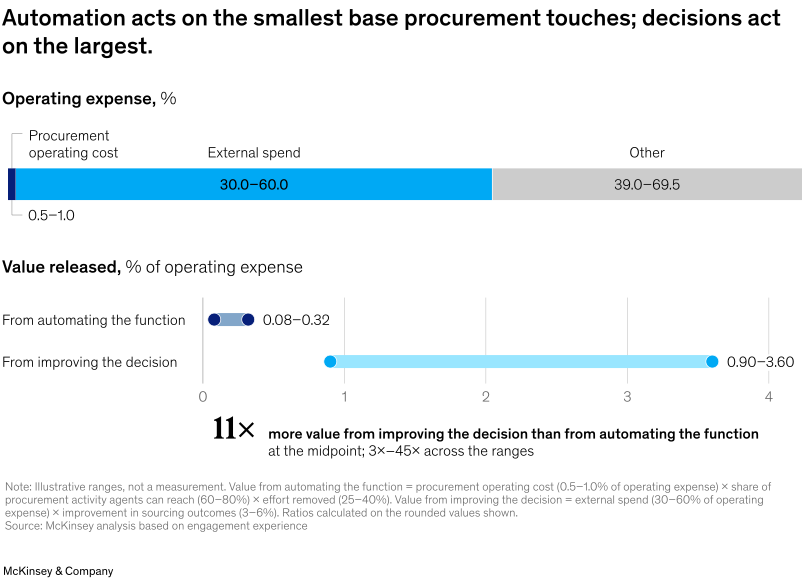
Agentic AI can create value through procurement efficiency, shorter procurement cycle times, and better enterprise decision-making. In strategic sourcing, the opportunity is particularly significant because the decisions influence external spend, which typically represents 30 to 60 percent of an organization’s operating expenses (Exhibit 1).
Capturing that opportunity requires meaningful investment in time, talent, and capital. For a medium-size organization, a first production workflow can run into the millions of dollars once data foundation, orchestration, controls, and change management are factored in. The business case therefore depends on targeting sourcing decisions where the value at stake and potential cycle-time improvement can justify that investment.
When conceived and deployed correctly, we frequently see that agentic AI can add 3 to 6 percent savings on external spend by acting on demand, supplier portfolios, negotiation strategy, and category hypotheses. In a blended portfolio, improving sourcing decisions delivers approximately 11 times more value than automating the procurement function, based on the midpoints of the ranges. This value can be materially higher when the focus is on an individual spend category. What’s more, this potential represents real savings only and does not account for other advantages realized through, for example, shorter procurement and launch timelines, revenue protection during disruption, or working capital released.
A sourcing team at a leading financial institution captured value by rethinking its sourcing workflow around external spend optimization, instead of applying agents to individual use cases. Rather than starting with requisitions as they arose, the team pointed agents at its technology vendor portfolio to systematically identify and pursue opportunities. The redesigned workflow brought together contract history, consumption data, and comparable pricing across the estate to assemble negotiation positions, set targets and walk-away points, and prioritize actions supplier by supplier. Rewiring how the category was managed end to end resulted in 10 to 15 percent savings on the addressed spend. (The savings are higher than the average portfolio-blend savings because they are measured in one category rather than across all external spend.)
From point-in-time planning to continuous decision-making
Agents pointed toward operational procurement tasks tend to reproduce today’s process at lower cost, because the process was designed around the sequence of work, not the decisions themselves. Decisions related to spend optimization, by contrast, do not follow a fixed path, as savings are captured in decisions that shift as new evidence arrives.
To capture the value of agentic AI in spending decisions, organizations need an orchestration layer that can turn a sourcing objective, or a new signal, into a coordinated sequence of analysis and action. This orchestration layer builds and revises the task graph at runtime, selecting agents, models, data, and tools, and changing course based on new evidence (Exhibit 2).
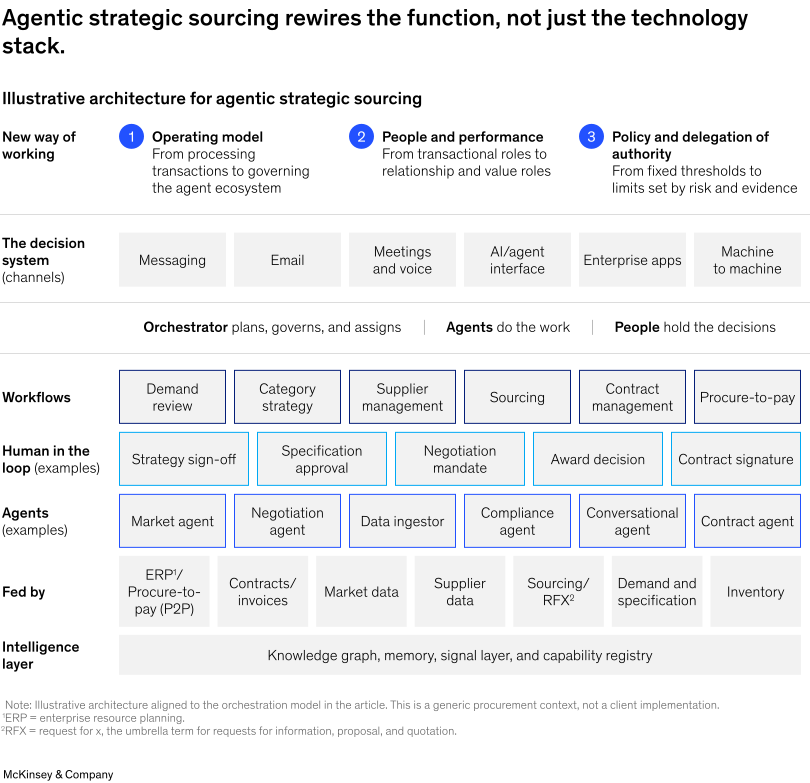
One orchestration layer can serve a strategy refresh, a renewal, and a supplier crisis alike, because while each problem is different, they all share the same task requirements—an objective, contested evidence, and options that interact.
The orchestration layer becomes the environment through which category managers mobilize sourcing intelligence, replacing AI copilots bolted onto today’s processes. Category managers can engage agentic AI at whichever level suits the spending decision, setting a broad objective such as reducing category cost while preserving dual-source capacity, or invoking a single task such as challenging a supplier increase, modeling an award, or preparing a negotiation.
A shared decision record or “decision object” carries the objective, evidence, assumptions, scenarios, constraints, and current state for one decision. The orchestration layer then determines the next best action and returns to the category manager when commercial judgment or authorization is needed. In this way, agents earn their place in planning, hypothesis generation, synthesis, and interaction, while should-cost calculation, forecasting, risk scoring, bid normalization, and award optimization remain deterministic services that the orchestration layer invokes.
Making this model work at scale is not just a question of the correct orchestration and decision architecture setup; it also requires a broader operating-model shift. Policies, delegations of authority, and decision rights that are largely static today have to evolve to accommodate agents that can recommend, execute, and act within defined boundaries, with clear rules around human intervention.
Four questions to define the minimum context for orchestration
In our experience, arriving at quality commercial decisions with agentic AI depends less on any single AI model than on whether every agentic capability sees the same commercial picture and the same ontology: a common definition of the entities, relationships, and commercial concepts that matter.
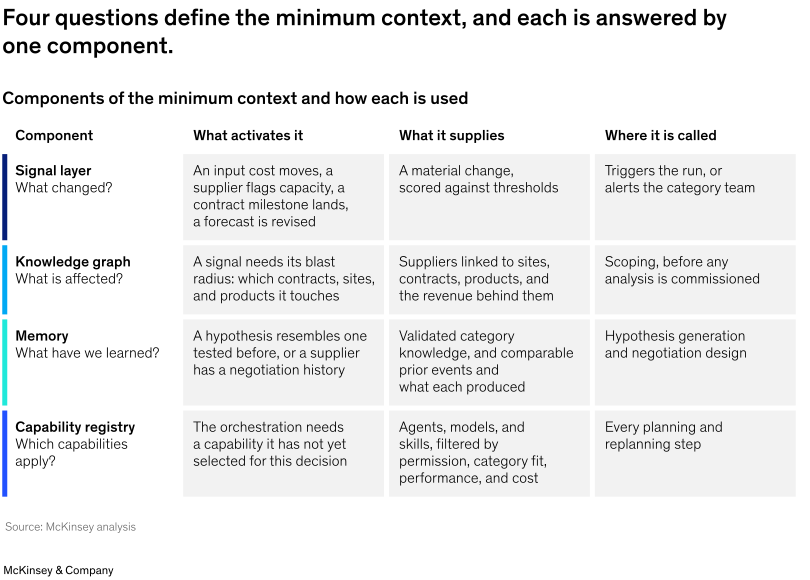
One commercial picture, shared by every capability, is what separates a system that decides from a set of tools that answers. Four questions can help define the minimum context required for the orchestration layer (Exhibit 3):
What changed? A signal layer monitors input costs, supplier capacity, contract milestones, and demand revisions, then alerts the category team or triggers a workflow.
What is affected? A knowledge graph, for example—a structured map of suppliers, sites, contracts, products, and revenue links using a common ontology—shows which agreements a commodity movement reopens.
What have we learned before? Memory holds validated category and supplier knowledge, and comparable prior events and negotiations—together with the outcome each one produced—and is retrievable at decision time.
Which capabilities apply now? A capability registry makes agents, models, and skills discoverable by permission, category fit, performance, and cost, while standardized tool access exposes the systems they call upon.
From sourcing activity to enterprise value
Disproportionate value in strategic sourcing typically sits in three moves: what to go after, how to capture the value, and how to execute.
What to go after: The largest opportunities often emerge from analysis before suppliers are ever asked to bid. That analysis spans structured and unstructured data: spend records, bills of materials (BOMs), and forecasts alongside contracts, specifications, and market intelligence. Historically, much of the evidence category managers needed sat in unstructured data and was difficult to use systematically. AI changes that. But transparency only matters if it leads to a clear “So what?”: Which assumption no longer holds? Which cost, risk, or constraint is addressable? Which lever can move it? The orchestration layer turns those answers into a ranked backlog of value opportunities, each with an estimated value, supporting evidence, and a trigger for action.
How to capture the value: A continuously refreshed backlog requires procurement to move from annual category planning toward event-driven strategy. Category strategy becomes a live portfolio of hypotheses: what to pursue now, what requires engineering or business agreement first, and what should wait for a renewal date or market window. Many of the highest-value levers are not procurement’s alone to pull. Specification changes, demand reduction, supplier innovation, and resilience decisions often require action from engineering or the business. Procurement’s role therefore shifts from bringing a savings target and deadline to bringing evidence, alternatives, trade-offs, and the value associated with each choice.
How to execute: Once a path is chosen, the orchestration layer can run negotiation and allocation as one iterative loop. Supplier discovery, total-cost analysis, award optimization, and prior supplier behavior feed a common view across cost, quality, resilience, and concentration. As offers change, targets and allocations recalculate—and a weak outcome can send the team back to demand levers, specifications, or alternative suppliers.
Consider, for example, autonomous sourcing across a direct-materials portfolio. Agents scan thousands of materials and suppliers, using benchmarking, should-cost models, and index analytics to identify specific opportunities, determine the right sourcing path, and execute negotiations—while category managers retain objectives, constraints, and judgment (Exhibit 4).
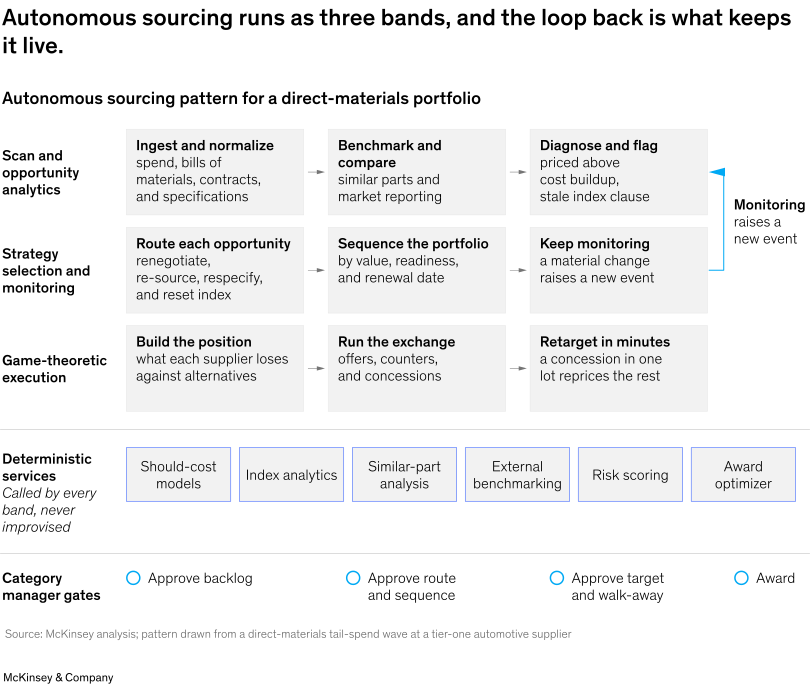
A tier-one automotive supplier applied this model to $150 million of fragmented tail spend across four business units and more than 1,000 suppliers. Agents set supplier-specific targets and conducted tailored negotiations, delivering more than $5 million in savings in under six weeks—over 10 percent of the portion of the spend addressed in the first wave.
The compounding advantage
Importantly, system value compounds only when spending outcomes change how the next workflow is assembled. Each decision becomes a case, each case improves the orchestration, and each improvement raises the value of the next decision.
Storing past conversations is not the same as learning, however. Memory and the registry are what the system reads at decision time; compounding is what writes back to them, and that requires realized results to alter how future workflows are built. All decisions leave a trace, including the objective, the evidence, the capabilities selected, the interventions, and the outcome. Evaluation runs twice: first, in flight on evidence quality and constraint compliance, and after execution on market-adjusted savings.
That evidence then feeds back in three ways. Context selection considers which signals and prior cases proved predictive. Capability routing decides what models perform in which market structure. And skill formation determines which sequences become reusable capabilities. For example, the system might learn that a should-cost model holds in engineered components but fails in capacity-constrained markets, or that a play that works on dependent incumbents destroys value with innovation partners.
To ensure quality and reduce execution risk, a named owner governs the improvement, with new plays entering the registry only after historical replay and shadow testing. And, critically, the orchestration layer never modifies itself without human validation.
To agentify or not to agentify: Testing system feasibility
For procurement leaders wanting to point agentic AI at spend optimization, two constraints determine feasibility and, ultimately, the value-creating potential of an orchestrating layer: the infrastructure to run it, and the cost per decision.
On infrastructure, the reality is that most procurement functions are not yet fully ready to deploy this capability. For example, when our survey asked procurement leaders about the greatest barriers to realizing a return on their gen AI investments, data quality was the top challenge, selected by 30 percent of respondents. Poor system integration and limited talent or support came next, selected by 23 percent and 18 percent of respondents, respectively.
As we have noted previously, procurement functions often use less than 20 percent of the data available to them, and much of the spend-related evidence agents need still sits within contracts and specifications rather than in enterprise resource planning (ERP) fields. Before gen AI, procurement struggled to connect its fragmented data across systems and sources. Agentic tools now make unstructured commercial data usable—once spend, supplier, and contract context are linked for the first workflow.
To get started quicker, procurement teams can treat the data foundation as an output of the first workflow, rather than a prerequisite program. A “good enough” foundation is often narrower than many functions assume. The sequencing of the data foundation also usually matters more than its breadth. First comes spend visibility, then supplier intelligence, then contract intelligence, and only after that, autonomous execution. In our experience, the stage most often skipped is contract intelligence—the one that negotiation decisions really depend upon.
With the right data and sequencing in place, the orchestration layer can be built from parts that mostly already exist. The effort involved is in the customization of category logic, the data model, the controls, and the memory.
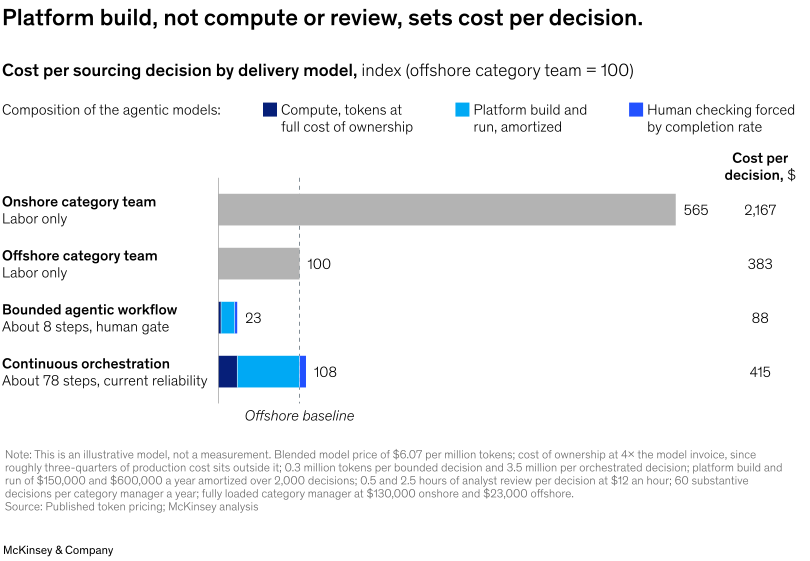
The other constraint, cost per decision, can help procurement leaders decide whether the effort and investment needed to deploy agentic AI is worth it. Generally speaking, an in-house team is the most expensive way to make a routine decision; an offshore category team is cheaper, and a bounded agentic workflow—a fixed sequence with a model in the loop and no planning at runtime—can be cheaper still. An orchestration layer costs more than a bounded workflow because it takes many more steps, and every step rereads the context accumulated to date.
In other words, the platform build determines the cost per decision, and procurement leaders need to have a clear-eyed view on the potential value before they embrace an agentic AI strategic sourcing transformation (Exhibit 5). The optimal approach is often to point the orchestration at decisions where the value at stake clears the decision cost, leaving requisition traffic and repeatable analysis to bounded workflows and process automation.
How to get started: Scope, sequencing, and safety
The organizations that get the best returns from agentic AI in sourcing tend to start with one workflow, govern the exposures that matter, and let the reuse of that workflow for other use cases prove scale.
To avoid both a multiyear platform build and a collection of disconnected agentic pilots, procurement functions can start with one repeatable, high-value workflow, such as negotiation and award, and deploy that workflow across a representative set of live sourcing events. The objective is not simply to agentify the workflow, but to use it to build the common capabilities that support the next use cases: shared data products, memory, a capability registry, learning loops, traceability, and controls.
The operating model needs to evolve in parallel. Policies, delegations of authority, decision rights, and governance must explicitly define what agents may recommend, what they may execute within set boundaries, and where human approval is needed.
For the initial phase, a small cross-functional team is often sufficient to prove value—combining category and procurement expertise with data engineering, AI/machine learning or data science, software engineering, product ownership, and risk and control capabilities. Cost concentrates on the first workflow, because the second workflow reuses the data products, controls, and governance established in the first.
It is then important to take the first one or two categories through three stages: Replay against the last 12 months of completed events, run in shadow alongside the live team, then enter human-approved live decisions (Exhibit 6). From a risk and control point of view, only actions that have a defined way to be undone should be delegated.
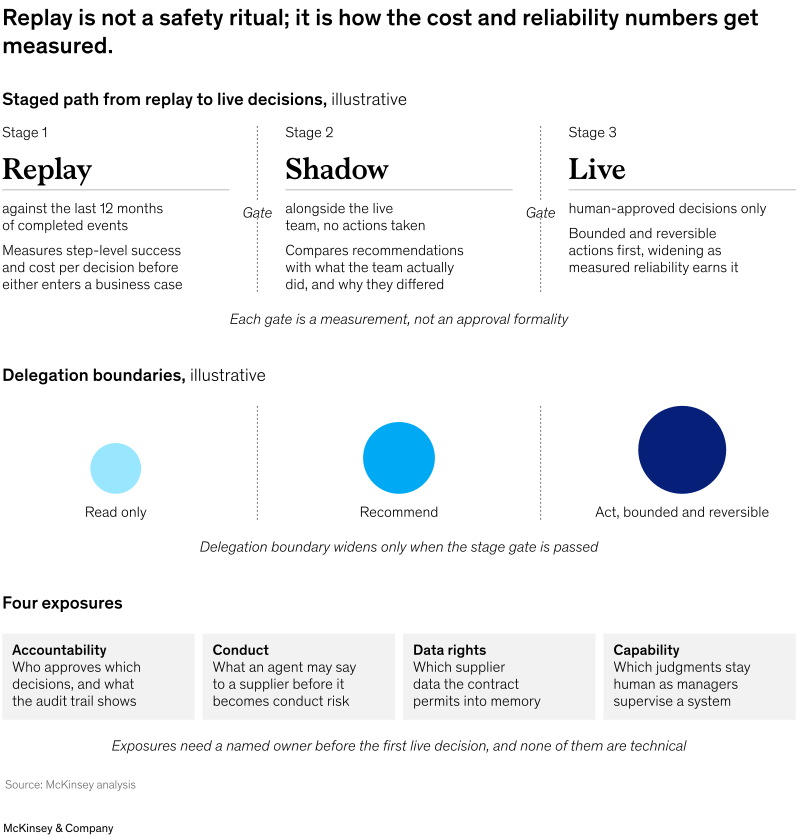
Before the first live decision is made, owners also need to be assigned to four exposures: who approves which decisions and what the audit trail must show; what an agent may say to a supplier before automated negotiation becomes a conduct risk; which supplier data the contract permits into memory; and which judgments remain human.
The second workflow reuses the first wave’s data products, skills, controls, and memory to test whether the organization is indeed building a decision system. Learning comes last, and that is the right order. A system that retrieves the right evidence and reaches a good decision is already worth running, while the write-side needs a year of traced decisions before it has anything to learn from.
As procurement functions continue to adopt AI and agentic AI at speed, the question for leaders to now pause and consider is: at what cost and for what value? Simply pointing agentic AI at procurement processes is unlikely to deliver a return comparable to the effort and investment involved in doing so.
For those procurement functions that are ready to move ahead with agentic AI in strategic sourcing, the advantage may flow from an orchestration layer that: lets category managers mobilize the right intelligence on demand, acts when conditions change, and learns from every commercial outcome.
With the right focus and setup, agentic AI has the potential to live up to its hype and become a procurement hero.