


Over the past decade, companies across industries have leveraged data for an ever-broader range of use cases, including those related to governance, operations, and technology infrastructure. Taken as a whole, the potential—and potential value—of data is enormous. For example, McKinsey research indicates that gen AI—which relies on the abundant availability and easy use of data—could deliver total value in the range of $2.6 trillion to $3.4 trillion a year in economic benefits across industries.
This potential is spurring increasing numbers of companies to embark on major data transformations. But according to McKinsey’s 2024 Data Summit survey, only a small share of these transformations have yet succeeded in generating significant value at scale.1 What explains this gap between the potential value of data and the average impact of a data transformation?
In a nutshell, data talent is hard to find. Talent pools for data engineers, data architects, and data scientists are limited and can be hard to access. In addition, attractive employee value propositions (EVPs) and career pathways may look different in each of these talent communities. McKinsey’s survey found that 77 percent of companies report that they lack the necessary data talent and skill sets to perform the required tasks in mission-critical areas, such as cybersecurity and data management.
Despite these issues, many companies lack a dedicated data talent strategy. For example, only 12 percent of survey respondents have established targeted programs to attract and retain key data talent. In this post, we discuss the common mistakes that companies make when looking for data talent and lay out targeted strategies that could help them source, attract, and retain the best people. Organizations that can develop a best-in-class approach to data talent could fully realize the value of their large-scale data transformations. In doing so, they could cement a long-term source of competitive advantage.
What companies get wrong about data talent
With higher churn rates than tech talent2 and a smaller pool of potential candidates, data talent can be tough to pin down. Much of the challenge, however, comes down to how organizations think about their data needs and requirements, where they source potential data workers, and the EVP they offer.
The differences between data talent and tech talent
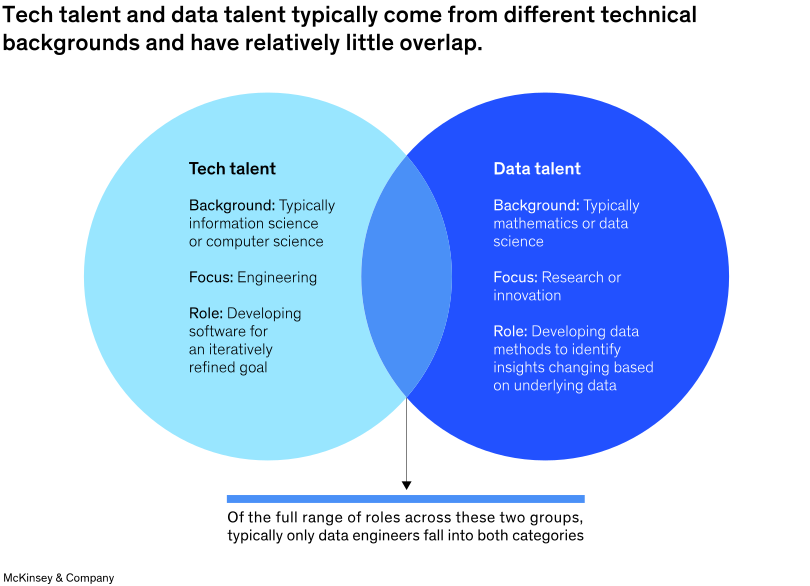
While companies often assume data talent is the same as typical tech talent, the technical backgrounds of the two groups are quite different (exhibit). While data roles fall under the broad umbrella of tech, they are often nonengineering profiles—though with STEM backgrounds—and need a blend of technical skills (such as coding, statistics, data manipulation), advanced skills and experience in machine learning and gen AI, and business understanding. Data talent also belongs to dedicated communities—such as those related to agile and software development—that don’t overlap with typical tech communities, making them difficult to identify. To compound the challenge, data talent may search for career opportunities only at top tech organizations, overlooking companies in other industries or smaller organizations.
A lackluster talent strategy
Companies can miss the mark with their talent strategies in several ways. First, the strategy needs to be tailored to address issues that are specific to data talent, such as a higher churn rate and the need to build an attractive EVP.
Second, many organizations invest substantially in external hiring and contracting rather than managing these processes internally. External hiring can involve an unstructured, transactional approach to finding candidates. Seemingly relevant candidates may be identified using social media, for example, and then contacted without further filtering. Practices such as this can result in underqualified new hires.
Additionally, external hiring vendors may not know or recognize the different skills and capabilities that are necessary for certain tech stacks. Experience with a particular programming language, for example, may not prepare a worker to undertake new tasks using that same programming language with a different underlying data set or set of integrations.
Overlooking current talent
Organizations that focus on hiring external data talent often overlook the potential within their existing talent pools. It can be easy to pigeonhole employees based on their current roles, which may explain why workers with nontech backgrounds are almost 30 percent more likely than those in tech roles to leave their current employer for a new position as a systems software developer.
Hiring external talent is typically more expensive than sourcing talent from within the organization, and incoming candidates may not be a cultural fit. Because of this, companies should ensure they have an inventory of the capabilities already available to them, and they should use the opportunity to upskill and retain internal talent where possible.
It might be counterintuitive that data talent is not easily identifiable in an organization. But we often see numerous entry-level roles for data talent in distributed setups, and not all of them offer a defined career path for further development within that same area of specialization. In addition, the profile of data talent may not be easy to identify from the résumés or CVs submitted during the hiring process, because core skills—for example, mathematical modeling—can be obtained through a variety of different educational backgrounds.
Companies that are unable to attract the data talent they need may be forced to outsource critical parts of their data organization. Outsourcing can lead to dissatisfaction among employees in other parts of the business. This risk is particularly high when a disconnect between the data team and the rest of the organization threatens the ability to pilot promising data use cases or to scale these initiatives from proof of concept to real impact.
Rethinking your approach to data talent
By implementing a best-in-class approach to data talent, companies could not only supercharge their data transformation but also realize significant untapped business value.
While many organizations have experienced challenges in building and retaining relevant technology talent, a number of businesses have successfully undertaken large-scale initiatives. A major bank in Europe set up a program dedicated to identifying and building the data talent required to drive its transformation—including within its international entities. Similarly, a major bank in the United States defined a central pool for data talent and then leveraged university graduates and key anchor hires to build an internal team to drive the transformation across business units. The impact of these initiatives can be substantial. For example, we saw a financial organization triple its data talent base within 18 months. In doing so, the organization generated an additional 10 percent of revenue through dedicated data initiatives.
To leverage the full potential of data talent, companies need to create a data-driven culture by prioritizing a thorough review of their current data talent pool and key challenges. While the precise levers necessary to address their specific issues and attract the profiles they need will vary by company, most will need to take action across three areas: updating their hiring strategy, fine-tuning their EVP, and reskilling and training existing talent.
A differentiated hiring strategy
Companies searching for best-fit data talent need to know how and where to look for them. Regarding the “how,” data-enabled talent “win rooms” can be an efficient hiring engine. These groupings bring together cross-functional teams of key stakeholders, including personnel from HR and business functions, as well as subject matter experts. Stakeholders use a central repository for hiring data and an iterative working model to inform and drive the hiring process. Social media can be an important source of relevant talent, but the team will also need to use targeted filtering and identification techniques to find high-quality individuals.
In terms of where to look, hiring teams should broaden their search beyond workers who are currently in target roles to consider talent with nontraditional educational and professional backgrounds. According to McKinsey research, 44 percent of women tech professionals and 26 percent of male tech professionals have a non-STEM educational background. Channels not traditionally used for recruitment—such as hackathons, developer conferences, entrepreneurship programs, niche job boards, and open-source communities—can also be fertile ground to locate and recruit talent. Acqui-hiring, or acquiring a company for its talent, can provide access to additional data talent.
Finally, pinpointing gender and racial gaps in data teams can also widen the talent pool and attract top talent. Repairing “the broken rung” and promoting women into top tech roles, for example, could result in 50 percent higher profits and share performance. Companies could also empower Black technology talent with a skills-based hiring approach and “ready to learn” training platforms.
Attractive employee value propositions
An effective and dedicated employee value proposition is critical to entice skilled data talent to join an organization and stay there. EVPs should ensure that good career opportunities are available to data talent, which includes setting up dedicated central data teams and job families related to data skills so that there are clear, data-centric career progression pathways for employees. Additionally, dedicated expert tracks, as opposed to managerial ones, may be more desirable to data talent.
Reskilling and training existing talent
Some of the best data talent may reside within the company, and leveraging this existing talent can also be cheaper and more convenient than external hiring. Many companies already recognize, and are acting upon, this opportunity. A recent McKinsey survey of executives found that most organizations (57 percent) plan to build their gen AI capabilities predominantly internally—through upskilling, reskilling, and redeploying talent—rather than doing so through external hiring and contracting. Offering dedicated learning paths can enable employees to build expertise in relevant areas. Employees could participate in bespoke courses and trainings, and an accessible training portal could provide access to further off-the-shelf resources.
The right data talent is critical for organizations that want to successfully execute large-scale data transformations. Using a targeted data talent strategy rooted in a data-driven culture, organizations can not only attract the data talent they need but also unlock the immense value that data can offer.
Asin Tavakoli is a partner in McKinsey’s Düsseldorf office, Henning Soller is a partner in the Frankfurt office, and Suman Thareja is a partner in the New Jersey office.
1 McKinsey’s 2024 Data Summit survey (n = 70 respondents working in the data space globally).
2 McKinsey’s 2024 Data Summit survey.