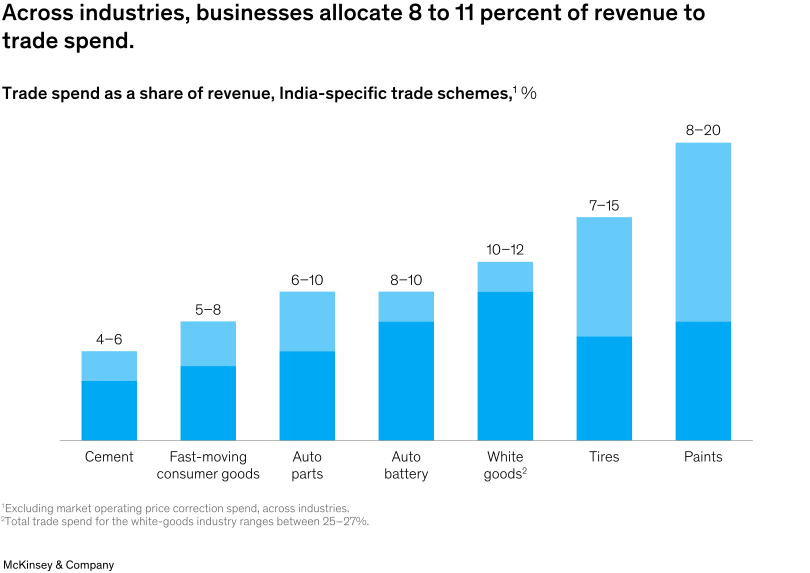
Trade incentives constitute one of the largest but least disciplined forms of business investment for most organizations. Many allocate 8 to 11 percent of their revenue to trade incentives, with some spending up to 20 percent. Yet these investments frequently fail to deliver the expected returns.1 Unlike pricing or media investments, trade incentives sit at the intersection of growth, margins, channel health, and brand trust, making them both a powerful growth lever and—if poorly managed—a dangerous source of value erosion. As executives reset budgets amid margin compression, cost volatility, and intensifying competition, spend on trade incentives has become a pivotal area of scrutiny for CEOs and chief marketing officers (CMOs).
Understanding the challenges with their implications and resetting the approach to designing and governing trade schemes could turn what has long been treated as a tactical cost center into a strategic driver of growth.
The untapped potential of organizational trade spend
Across industries, organizations routinely spend 8 to 11 percent of their revenue on trade incentives (Exhibit 1). Despite this scale, trade spend is often managed as a tactical sales lever rather than a strategic investment.
Ask any CEO or CMO which cost line demands greater transparency, and the response is nearly unanimous: trade incentives.
Beneath that concern lies a deeper unease. Many leaders remain uncertain whether current trade schemes genuinely drive sustainable growth or serve as tools to manage market pricing, often at the expense of long-term channel profitability.
Fragmented visibility into competitive pricing and incentive structures compounds the challenge. While bits of relevant data exist across sales teams and channel partners, they are rarely consolidated, standardized, or analyzed through a rigorous, data-driven lens to yield strategic insight. As a result, one of the largest discretionary spends in most organizations continues to be driven by instinct rather than insight, leaving significant value untapped.
Why trade spend underdelivers
Why does trade spend rarely translate into meaningful impact? McKinsey’s experience across sectors points to five structural flaws in the management of trade incentives:
- Fragmentation across regions and managers. Trade schemes are often designed and executed at the regional level, with limited oversight and only a few central guardrails. In industries such as paints, this results in dozens of parallel, uncoordinated schemes that vary by state or territory, diluting the overall impact and leading to interregional product transfers.
- Limited transparency and ROI visibility. Many trade scheme designs remain intuition driven, guided by anecdotal competitor benchmarks rather than empirical data. Many organizations lack visibility into which incentives truly generate incremental volume versus those that merely subsidize existing sales. At one consumer goods company, frontline managers set discount rates based on gut feel and simplistic competitor parity, with little insight into actual ROI.
- Using trade incentives as a pricing lever. Under competitive pressure, companies frequently deploy trade discounts as a defensive response to rival pricing, treating incentives as de facto price reductions. This creates a dangerous trap: Incentives may temporarily “buy down” prices, but they distort the market’s perception of pricing and value, creating a cycle of dependency without fixing the underlying problem. In one fast-moving consumer goods case, we observed that trade discounts were frequently used to match competitors’ pricing, leading to growing retailer dependence on continuous incentives and contributing to long-term price instability.
- High proportion of fixed, nongrowth-linked payouts. Our observations show that across industries, more than half of channel partners experiencing stagnant or declining sales continue to receive incentives, often because volume-based slab structures reward absolute scale rather than incremental growth. This limits differentiation between performing and underperforming partners.
- Overreliance on primary sales incentives. Aggressive slab differentials disproportionately reward the largest channel partners, steering incentives toward primary sales billing rather than true sellout to end consumers. This results in price disparities across retailers, inconsistent pricing for consumers, and eroded economics for smaller partners. In the cement industry, nearly all primary incentives have led to the creation of “power buyers,” who use price equalization to widen market disparities, leaving small and medium-size retailers noncompetitive.
Unfocused trade incentives erode value across brand, channel, and growth
The structural issues are not just operational details; they create three serious business risks:
- Market price distortions and brand erosion. When incentives prioritize channel push over true consumer sell-through, price fragmentation emerges across markets. Inconsistent street pricing erodes brand equity, undermines consumer trust, and clouds perceived value. In one situation, rebalancing the incentive mix from 80:20 (primary: secondary) to 40:60 stabilized market operating prices, restored channel discipline, and rebuilt trust among both trade partners and consumers.
- Channel profitability erosion. Volume-based slab incentives, often amounting to between 30 to 40 percent of total trade incentives, create sharp margin differences between large and small channel partners. This imbalance squeezes the profitability of smaller partners and weakens long-term channel health. Over time, margin pressure can drive smaller partners to disengage or migrate to competitors, eroding channel breadth and loyalty.
- Low return on trade investments. When trade programs lack clear growth-linked objectives, funds tend to flow disproportionately toward underperforming partners, diluting overall ROI. This crowds out investment in growth impact activities such as distribution expansion, portfolio premiumization, and local demand generation, all of which yield better returns.
Strategic design principles for best-in-class trade spend
Leading organizations now treat trade spend not as a form of discretionary discounts but as a system designed around clear principles. Our work with organizations suggests that trade spend effectiveness can be improved by adopting a principle-based design and stress testing every incentive scheme against these guardrails before launch. Across industries, organizations that embed disciplined design principles, rigorous governance, and AI-led decisioning are already achieving ten-to-15-percentage-point reductions in trade spend while redeploying it to fuel growth.
Six design principles underpin best-in-class trade spend performance:
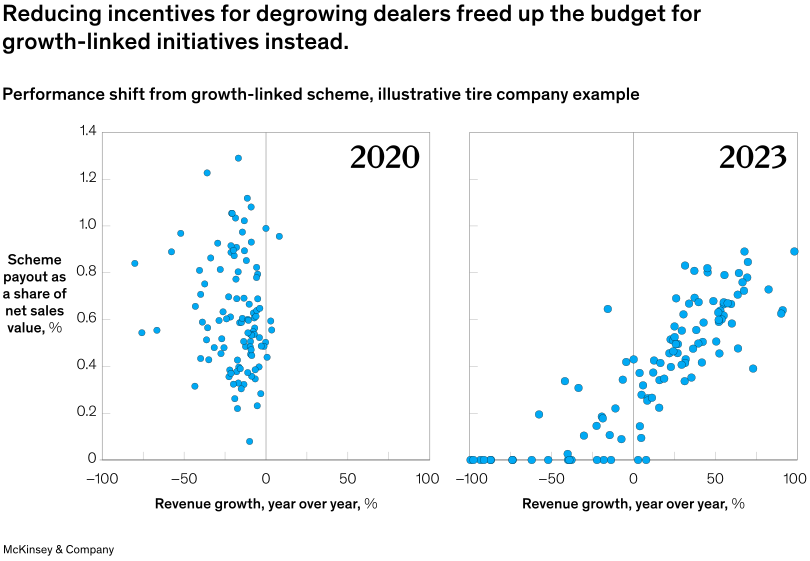
- Anchor incentives to growth. Link most incentive payouts to incremental growth volume or value beyond baseline rather than absolute volume or entitlement. This ensures that incentives directly reward growth and remain self-funding. In one example, approximately 70 to 80 percent of payouts were linked to growth relative to baseline-stabilized market pricing, thereby improving overall performance. A tire company reduced incentives paid to degrowing dealers from more than 50 percent to 15 percent over three years, freeing up the budget for growth-linked initiatives such as secondary expansion and linking payouts to growth targets (Exhibit 2).
- Limit slab dispersion. Keep the spread between the smallest and largest incentive slabs narrow to reduce distortions while preserving motivation. Wide slab differentials can over-reward scale, encourage purchase clubbing, and hurt market balance. Benchmarks across industries suggest that an approximate 1.0-to-1.5-percentage-point differential drives strong channel participation without overincentivizing large players.
- Maintain channel parity. Ensure equitable incentive structures across traditional distributors, modern retail, and online channels. Keeping differences within one to 1.5 percentage points minimizes channel conflict, curbs company-driven price competition, and reinforces fair play across the go-to-market model.
- Allocate budget to leading indicators. Carve out some portion of the total trade incentive budget for programs that strengthen growth fundamentals. These include expanding secondary outlets, broadening product assortments, and driving local demand activation. For example, in the case of an auto components player, linking approximately 10 percent of the overall payouts to input metrics improved channel health and overall profitability by enhancing focus on high-margin products.
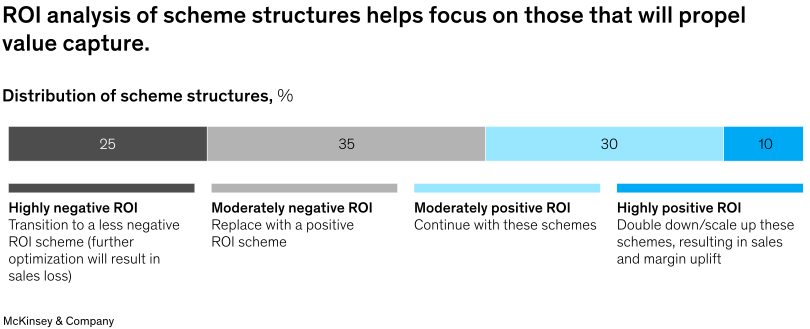
- Institutionalize governance with SOPs. Leading organizations adopt formal governance systems with clear standard operating processes (SOPs) to sustain trade spend discipline. These systems include setting scheme objectives aligned with strategic business goals, such as growth, penetration, and premium mix; validating the design against core principles such as growth linkage, slab limits, and channel parity; and conducting upfront financial impact analyses covering expected payout, ROI, and channel margin impact. Postscheme evaluations are mandated to compare actual versus projected ROI, assess pricing impact, and review dealer participation and growth dispersion (Exhibit 3).
- Focused team setup. Sustained success depends on a dedicated trade spend organization setup, which is typically a small, specialized team with expertise in analytics, design, and governance of trade spend schemes.
What does an advanced-analytics-based trade spend engine look like?
AI-powered transformation in trade spend optimization

Organizations should consider developing dashboards to capture the market outcomes of their trade schemes. By examining where sales, growth, and payouts ultimately land, such as in the illustrative dashboard (Exhibit 4), it becomes clear whether trade spend is genuinely driving incremental performance or merely being absorbed into the system (see sidebar, “AI-powered transformation in trade spend optimization”).
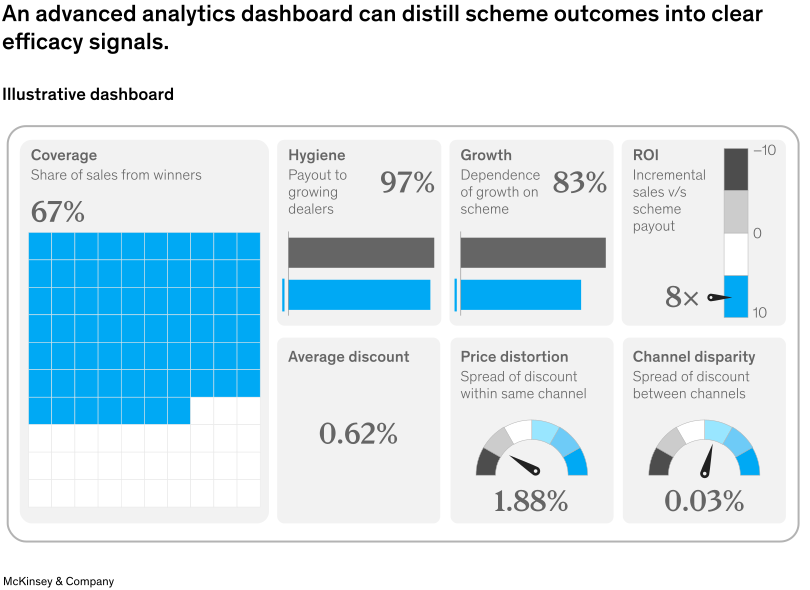
The dashboard shows the following illustrative examples:
- Coverage. Dealers availing of the scheme accounted for 67 percent of current-year sales, indicating targeted deployment of incentives rather than blanket spend.
- Hygiene. Ninety-seven percent of payouts flowed to growing dealers, with minimal leakage to degrowing accounts, ensuring that trade spend rewarded performance.
- Growth. Eighty-three percent of total system growth was delivered by scheme beneficiaries, showing a clear correlation between incentives and incremental sales.
- ROI. For every 100 units of scheme payout, 800 units in incremental sales were generated, delivering an eight times volume return on trade investments.2
- Discount, price distortion, channel disparity. While average discounts remained low, an approximately 2 percent spread within the same channel led to a pricing disparity.
The dashboard shows that the scheme delivered concentrated growth with high efficiency and strong discipline; most incremental sales were driven by incentivized dealers, reinforcing that well-governed trade spend can be both growth accretive and value protective.
As organizations plan for 2026 and beyond, the question is no longer whether trade spend can be optimized but whether leadership teams will commit to reclaiming it as a strategic growth lever. The capabilities and tools to transform trade spend are now proven. Unlocking this potential requires breaking down silos across sales, marketing, and finance and instilling a fact-based, ROI-focused culture for trade investments.
For senior leaders, the mandate is clear: elevate trade spend management to the same level as strategic investments in pricing, product, and media. Those who do can unlock superior growth and profitability.