Government subsidies, investment incentives, and other industrial-policy actions have almost quadrupled since 2017. But recent policies have often focused on specific industries and technologies, note Senior Partner Cindy Levy and coauthors. They analyzed subsidies across 26 product categories and found that in 2023 and 2024, 13 captured 96 percent of global incentive value, with the top five categories comprising about two-thirds of this total. In today’s geopolitical landscape, companies can gain a competitive advantage by integrating industrial-policy considerations into strategic decisions to lower capital costs, reduce risks in key innovation projects, and uncover new growth opportunities.
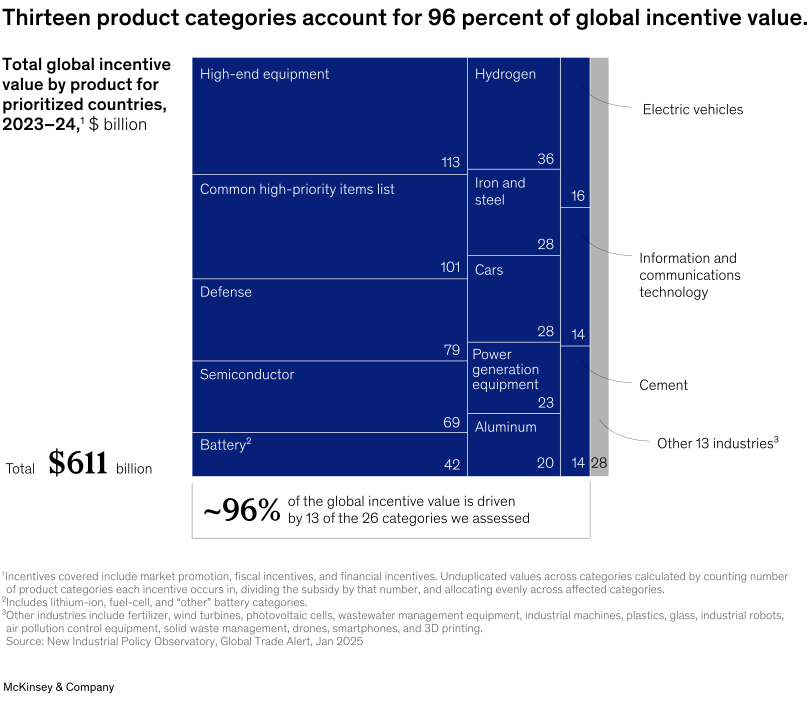
Image description:
A treemap shows the total global incentive value by product for prioritized countries, 2023–24, in billions of dollars. The total value is $611 billion. Thirteen product categories account for 96% of global incentive value. The values are: high-end equipment ($113 billion); common high-priority items list ($101 billion); defense ($79 billion); semiconductor ($69 billion); battery ($42 billion); hydrogen ($36 billion); iron and steel ($16 billion); cars ($28 billion); power generation equipment ($23 billion); aluminum ($20 billion); electric vehicles ($16 billion); cement ($14 billion); information and communications technology ($14 billion); and other 13 industries ($28 billion), which represent 4% of the total.
Note: This image description was completed with the assistance of Writer, a gen AI tool.
Source: New Industrial Policy Observatory, Global Trade Alert, January 2025.
End of image description.
To read the article, see “From protection to promotion: The new age of industrial policy,” May 16, 2025.