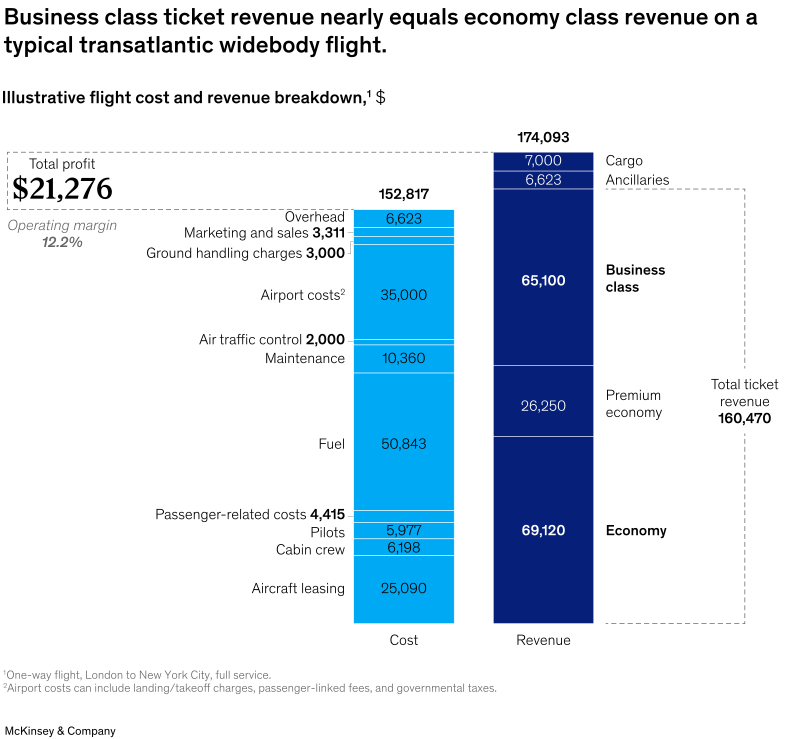
Airlines’ premium cabins—which typically encompass business-class, first-class, and sometimes premium-economy sections—account for an increasing percentage of total seats, passengers, and revenue in North America and Europe, and play a growing role in airlines’ profitability equations. On heavily trafficked transatlantic routes, a business-class cabin might now contribute nearly as much revenue as an economy cabin while using far less space on the plane and delivering higher margins (Exhibit 1).
Airlines differentiate premium cabins from economy offerings across many dimensions—including better seat pitch, more personal space, higher-grade amenities and service, and steeper fares. But premium cabins also require a different management approach. The premium profit pool is becoming too large for airlines to handle in the same ways they have in the past.
Some premium-cabin complexities are long standing (such as the higher proportion of seats occupied by corporate travelers and loyalty award passengers, which complicates pricing and inventory decisions). Others are new and evolving (such as the shifting and less predictable shape of premium demand). But the result of these collective complications is that premium revenue approaches at some airlines have become inadequate or outdated. Managing these products as scarce, high-value assets with coordinated oversight across pricing, sales, and revenue management could help airlines get the most from their premium offerings.
The value of getting premium right is significant, and airlines that handle premium effectively are already capturing that value. At airlines where premium typically accounts for roughly 20 to 30 percent of revenue, networkwide shifts in premium revenue management can drive unit revenue gains, with some analyses suggesting potential increases in the range of 1 to 3 percent.
Evidence of the potential for premium growth is already visible in some airlines’ fiscal year 2025 reported results: Delta Air Lines’ premium revenue grew 7 percent year over year (while main cabin ticket sales fell), and United Airlines’ premium revenue grew 11 percent year over year, with both airlines noting that they achieved this growth against a backdrop of softening economic demand. In Delta’s case, premium revenue exceeded main cabin revenue in the fourth quarter of 2025 for the first time ever. A recent Wall Street Journal article cites research indicating that “since January 2020, the number of scheduled business and first-class seats on domestic flights has grown 27 percent … nearly three times higher than scheduled economy seats, which rose just 10 percent over the same span.” Meanwhile, premium margins are strong: In 2024, for example, Delta stated that margins in its premium cabins were 15 percentage points higher than those in its economy cabins.
This article details the evolving challenges that airline premium revenue management teams face and offers potential solutions that could improve premium-cabin returns.
Premium cabins account for an increasing share of passengers—and profit
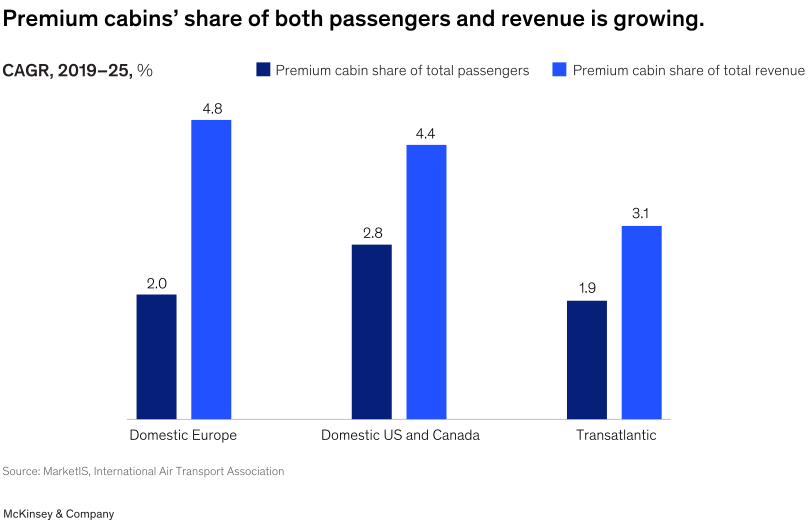
Premium airline cabins are accounting for an increasing share of total offered seats, ticketed passengers, and overall revenue. From 2019 to 2025, the business-class and first-class cabins on US and Canadian domestic, European domestic, and transatlantic flights contributed a growing share of total passengers and an even faster-growing share of revenue (Exhibit 2).
Some airlines have not yet adjusted their revenue management approaches to keep pace with this shift. They may dedicate insufficient resources to maximizing revenue from premium cabins, in part due to legacy processes, operating models, and commercial philosophies that haven’t evolved in line with industry changes. Revenue management teams could benefit from placing greater focus on the specific needs and constraints of their premium offerings.
A new mix of premium travelers creates less predictable booking patterns
The mix of people flying in premium cabins has changed. Prepandemic, airlines could safely assume that the bulk of premium travelers were business fliers who booked late and were less sensitive to price. That assumption no longer holds. More leisure travelers, remote and hybrid workers, and “treat yourself” customers are buying premium seats. The lines between business and leisure travel demand have blurred, with more people choosing premium seats based on personal preference—not because it’s standard corporate policy.
To respond to the greater price sensitivity of many “premium leisure” travelers, some airlines have begun rolling out new “business light” products. These fares unbundle elements traditionally included in business class, such as advance seat selection, checked bags, lounge access, and change or refund flexibility. It’s a move that mirrors the creation of pared-down, basic economy fares within the main cabin.
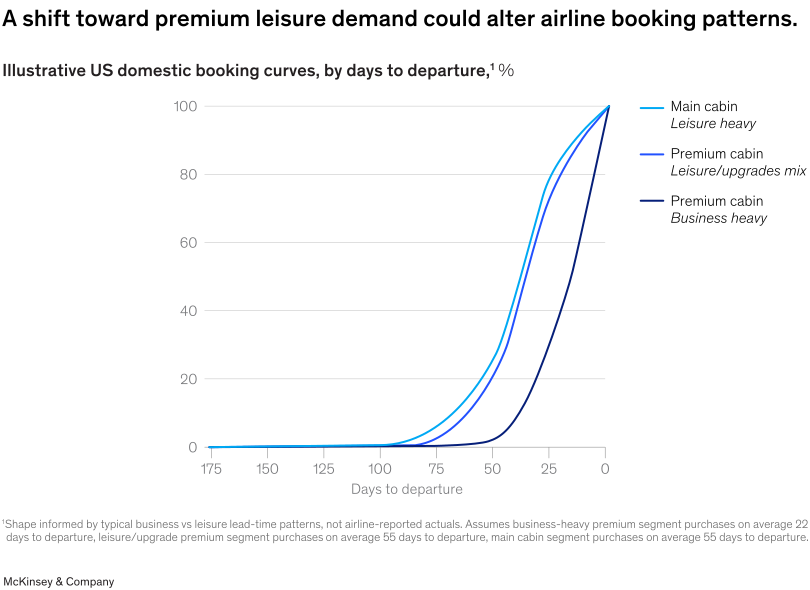
The shift toward leisure-heavy demand has also spurred some airlines to revise their long-established assumptions about when premium passengers are likely to book (Exhibit 3). At a large US airline, about half of premium seats are booked more than 21 days before departure—a significant change driven in large part by leisure travelers, who tend to book earlier and now make up close to half of the airline’s premium bookings overall.
This shift in premium demand composition has in some cases boosted the resilience of premium cabins during downturns. In downturns, more price-sensitive elements of leisure demand tend to soften first as discretionary spending tightens, followed by adjustments in corporate travel as companies manage budgets. But the premium leisure demand segment has proved more inelastic than standard leisure demand, especially in K-shaped economies.
Meanwhile, premium tickets are being bought through more channels. Customers may book directly with the airline, through corporate travel agencies, or via company booking platforms and will often switch between them. This indicates the importance of airlines understanding who their premium customers are and how they make buying decisions to price and sell premium seats effectively.
Premium leisure demand can spike suddenly around big events (which fill smaller premium cabins faster than economy cabins), large corporate bookings for premium-cabin space can appear all at once, and waves of rebooked passengers can fill seats unexpectedly after a disruption. Premium travelers also tend to react more quickly in response to changes such as major global events or a competitor adding or removing flights, in large part because their choices are more closely linked to convenience (and less closely linked to price) than those of economy travelers.
As a result of these shifts, postpandemic forecasting for premium seats is less able to rely on historical booking data.
Long-standing complexities make premium products difficult to manage
Loyalty programs, upgrades, corporate agreements, and complex pricing structures can make revenue management of premium seats a difficult balancing act. What’s more, pricing teams can struggle to control premium inventory when airline commercial policies are inconsistent and coordination across functions is weak. At many airlines, no single function fully controls premium inventory: Revenue management, loyalty, sales, and operations teams may all consume premium inventory for different reasons.
Heightened cost from forecasting errors
With fewer and pricier seats, making the wrong decision in premium can have a bigger impact. Selling too cheaply or misallocating seats to the wrong customers can result in substantial lost revenue.
Consider that in a typical transatlantic wide-body configuration of 40 business-class seats and 200 economy seats, a demand forecast error of plus or minus five seats would represent 12.5 percent of premium capacity, versus only 2.5 percent of economy capacity. And because premium spillage (the cost of selling a seat too early and turning away last-minute, high-paying demand) is generally more detrimental than premium spoilage (the cost of leaving a seat empty), it’s especially important for airlines to forecast premium demand accurately in order to sell more seats under optimal revenue management conditions. Reducing forecast errors from, say, 10 percent to 5 percent could result in considerably more revenue per flight.
A lack of clear pricing comparables
Premium-cabin product offerings (for example, seat configuration, catering, and amenities) can differ widely between airlines, unlike economy products, which tend to be more comparable within a given market. That makes it harder for airlines to decide how their premium offerings should be priced relative to competitors—premium seats aren’t interchangeable commodities, so pricing isn’t just about matching competitors’ fares. Instead, airlines can price the full experience, including flight schedules, seat comfort, service, loyalty benefits, airport lounges, and ticket flexibility. Indeed, premium fares tend to show higher price dispersion than economy fares within the same markets, indicating that airlines are not simply matching fares (Exhibit 4).
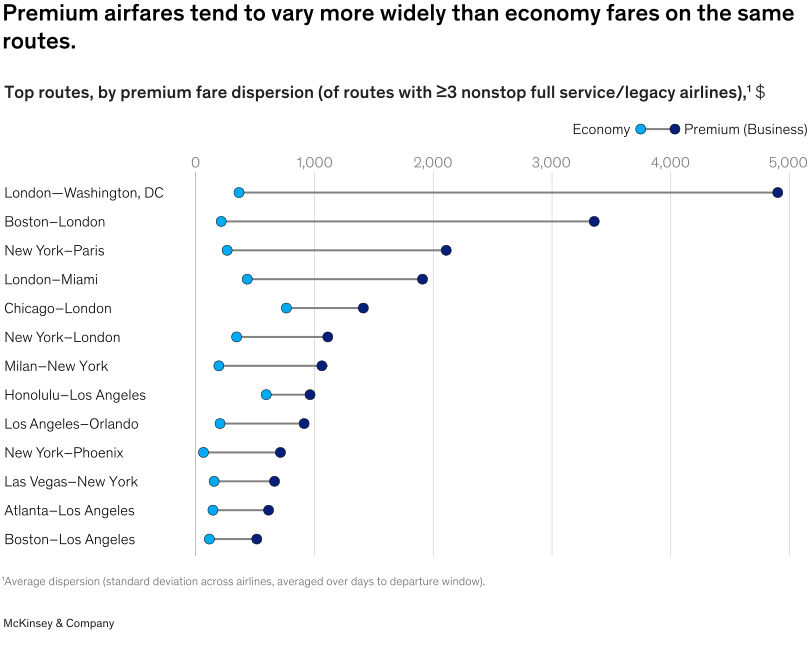
It’s sometimes hard to know which factors premium customers consider when comparing airlines. These travelers don’t look only at a competitor’s fare. They may be thinking about company travel policy limits, special corporate deals, how their frequent-flier status is recognized, the value of being able to change flights easily, or whether the flight schedule fits their needs.
The impact of upgrades on revenue
Upgrades aren’t just a perk for frequent fliers. They function almost like an alternative form of payment, taking up seats that could otherwise be sold for cash. If not managed carefully, upgrades can affect airlines’ ability to optimize premium-cabin revenue, especially when a significant share of premium seats is allocated as award tickets.
In some cases, premium-cabin revenue is driven more by loyalty program rules and upgrade promises than by standard ticket pricing. Because it’s hard to predict demand for premium seats far in advance, airlines sometimes release their reward seats early, only to discover later that travelers would have been willing to pay full price.
While some airlines have a clear hierarchy in their upgrade logic, others offer a wide range of upgrade options, including postpurchase upgrades, bidding for upgrades, miles redemptions, elite status upgrades, and operational upgrades. These options are often managed through separate processes, which can make it more difficult to maintain consistent prioritization.
This patchwork approach creates inconsistency: A business-class ticket might cost more than an economy ticket plus an upgrade—or it might cost less. Across different airlines and routes, the price to upgrade from economy can vary wildly. Award tickets and cash fares don’t always align, sending mixed signals about what a seat is worth. Some airlines still rely in part on fixed or semifixed price differences between cabins instead of adjusting prices based on real-time demand.
When free or mileage-based upgrades are allocated early in the booking cycle or across multiple channels without coordination, airlines may limit their ability to capture higher fares closer to departure and create inconsistencies in perceived value. As a result, revenue management teams may need to optimize performance after a portion of demand has already been fulfilled through upgrades. At the same time, teams may also consider customer lifetime value, particularly for frequent travelers and corporate accounts, when determining upgrade strategies.
A structural dependence on corporate accounts
Premium cabins are often chosen by business travelers—and the corporate accounts associated with business travel are shaped by many factors beyond ticket price alone.
Airline sales teams often play a bigger role in filling premium seats. Business-class revenue can be especially influenced by long-term relationships, negotiated contracts (including agreed-upon perks), rules about rebooking when disruptions occur, and price constraints set by company travel policies. Airlines might need to honor commitments to give a company a certain share of seats, and companies can be limited to using only certain booking channels. All these factors can curb how effectively airlines manage premium revenue.
Problems can arise when pricing teams manage fare availability in isolation while sales teams sell discounted packages or extra benefits to corporate clients. Such misalignments can affect customers’ willingness to pay and introduce conflicting expectations about the airline’s obligations, especially in the event that a flight is disrupted.
How can airlines maximize returns from premium cabins?
In our work with airlines, we’ve identified successful approaches to improving premium-cabin revenue management. While airlines are at different stages of maturity in these efforts, many can consider adopting solutions such as the following.
Sharpening forecasting
Airlines could incorporate premium-specific “event calendars”—monitoring sports finals, cruise turnarounds, major conferences and exhibitions, and so forth—into weekly forecasting reviews. They could also establish premium-focused teams to strategize for peak periods (such as holidays or the summer transatlantic rush), bringing together revenue management, sales, and loyalty teams. Gen-AI-assisted tools can help identify which events are likely to be most relevant to front-cabin demand, reducing the research burden on analysts.
Airlines could also consider moving toward forecasting based on customers’ expected willingness to pay (WTP). Some airlines have successfully implemented WTP-based forecasting, though mostly in the economy cabin. Given the growth of leisure demand in premium cabins, WTP estimation and forecasting could potentially be applied separately to business and leisure booking segments.
Some airlines have yet to experiment with WTP forecasts at all, mostly because of the difficulty of estimating price elasticity of demand using existing booking data. There is also reluctance to accept uncertain estimates of WTP, given the risk of overestimating and subsequently ending up with empty seats. Estimating WTP for premium seats is especially challenging because it requires an understanding of the trade-offs that premium-business and leisure travelers make when choosing a cabin and itinerary—though if this can be solved in economy cabins, it is likely solvable for premium too.
Implementing automated and continuously updated pricing
To improve premium seat revenue, some airlines are increasingly looking to automate pricing processes instead of relying on manual adjustments. New AI-based systems can handle routine pricing tasks—such as fare filing, augmenting data signals to present recommendations to analysts, and one-off postmortem analyses—faster than human analysts can.
Using AI to support pricing processes, airlines could conduct A/B tests of small pricing changes in the marketplace. This kind of rapid, continuous testing is especially useful in premium cabins, where it’s harder to know the “right” price because products differ so much across airlines. Some airlines are already using machine learning systems that track performance, retaining prices that perform well and dropping those that don’t. While this approach can improve pricing outcomes, it may also introduce risks if not appropriately managed. To mitigate these risks, airlines often establish guardrails such as minimum price levels, competitor response rules, and safeguards during disruptions to ensure alignment with broader commercial strategies.
Understanding the interaction between economy- and premium-cabin pricing can help inform pricing decisions. The ability to predict how changes in one cabin affect the other—and avoid setting prices that cannibalize seats, simply shifting passengers around instead of increasing total revenue—would be beneficial for airlines. There is ongoing debate within some airlines about whether it’s better to protect premium seats at all costs or to aim for the highest combined revenue across all cabins. Some airlines are experimenting with more flexible approaches, which can yield value over single-cabin views but require good forecasting to succeed.
Over time, continuously updating prices, paired with better estimates of what customers are willing to spend, could allow airlines to price premium seats more accurately and capture more value without constant manual intervention.
Upgrading the upgrade system
A more structured approach to managing upgrades and loyalty redemptions can help support clearer prioritization and sequencing:
- Sell premium seats at full price first.
- Offer paid upgrades or upsells next.
- Allow mileage redemptions at reasonable levels, based on opportunity costs tied to forecasts of future demand. (Products such as at-check-in, miles-based upgrades can help optimize this calculation, as they can offer a “release valve” at the last minute with no displacement of paying customers.)
- Offer free upgrades only later in the process, in a limited and targeted way—while still giving consideration to the lifetime value benefits that can be derived from surprising and delighting loyal customers.
To address governance gaps, airlines could align shared goals across teams—such as how many premium seats are paid for, how much revenue is lost to upgrades, and how often reward tickets replace paying customers.
Building corporate-account dynamics into decision-making
To help improve their approach to handling premium demand from corporate and other key accounts, airlines could build their corporate contract rules and the holistic value of corporate customers into decisions about offering or protecting premium-cabin seats. Airlines could aim to ensure that what they sell to corporate clients matches up with how seats are actually allocated. For example, when booking premium seats for a major account, an airline might make concessions (such as waiving change fees and offering priority re-accommodation during disruptions) but not offer last-seat availability (meaning a corporate rate on the last remaining seat or seats in premium cabins) or discounts on full-fare business-class tickets.
Cross-department collaboration is an important factor when it comes to serving corporate accounts, given the potential for conflicting objectives between revenue management, loyalty, sales, commercial, and operations teams. Solutions could involve equal parts process, people, and tools. Regular cross-functional meetings between teams, multifunctional roles that cut across teams, and standardization of internal data sources can all play a role.
Premium-cabin inventory can be viewed as a high-value, capacity-constrained asset rather than simply a step up from economy class. Some airlines have already made major strides or are heading in this direction.
As customer mixes diversify, demand patterns evolve, and pricing complexity deepens, airlines that can rethink forecasting, pricing, and upgrade strategies in concert—aligning commercial, loyalty, and sales functions around a single view of value that considers both the opportunity cost of a seat and overall customer lifetime value—will likely be at an advantage. In an environment where a handful of seats can swing profitability, getting premium right is a strategic imperative.