Shortages of aviation maintenance technicians (AMTs) can drive up aviation costs, delay aircraft turnaround times, and hamper aircraft reliability. Analysis suggests that, at current rates of AMT retirement, recruitment and training will not be sufficient to bridge a shortfall that is projected to reach approximately 60,000 technicians (roughly 20 percent below needs) by 2029.
To overcome this shortage, some aviation maintenance, repair, and overhaul (MRO) organizations are enhancing their employee value propositions to attract more technicians, partnering with training institutions to expand the talent pipeline, and intensifying recruitment efforts. But an additional approach could help MRO organizations sidestep this competition for talent. Instead of merely seeking to attract external AMTs, some leading MRO organizations are also placing higher priority on improving the productivity of their existing AMT workforces.
Across the industry, the productivity rates—or “wrench times,” meaning the share of hours spent on hands-on technical work—of AMTs vary between 15 and 45 percent. Productivity rates can be influenced by work volume and type of work (for example, engine shops typically deliver higher productivity than would occur in a line maintenance environment) and by the quality and maturity of planning and preparatory processes (for example, parts and tooling availability, AMT qualifications for the job at hand, and alignment of shift starts with aircraft arrivals).
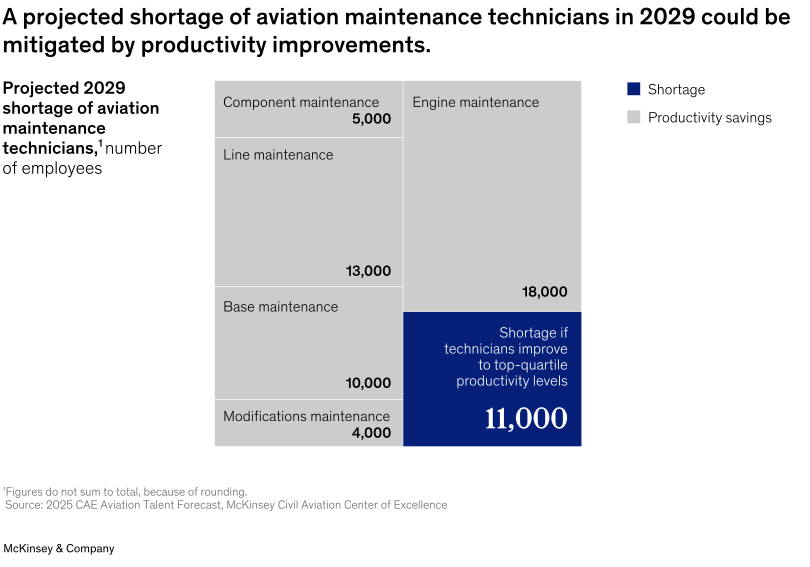
Our analysis suggests that raising technician productivity to best-quartile levels across the industry could mitigate more than 80 percent of the projected 2029 AMT shortage. MRO organizations can achieve this productivity boost through a combination of three levers:
- Getting back to basics by improving fundamental operations has the potential to increase wrench time by ten percentage points or more.
- Implementing digital and AI solutions can contribute to a 15 to 35 percent increase in technician productivity.
- Offering learning-based skill building can liberate technician capacity by accelerating the time to proficiency.
Confronting a projected shortage of AMTs
Over the past five years, the availability of qualified AMTs has been limited, due in large part to a wave of early retirements and job cuts at the onset of the COVID-19 pandemic, lower industry attraction rates, and increased attrition to higher-paying industries. To offset this shortage, MRO employers in the United States raised their pay rates, leading to an hourly wage increase of more than 20 percent since 2019.
This AMT shortage is expected to persist, and potentially intensify, due to the continued strength of MRO demand. Compounding this effect is the challenge MRO employers face in ensuring that their AMTs have the required skills and certifications to service both new-generation aircraft (which typically have more complex maintenance needs) and an aging fleet of legacy and sunsetting aircraft.
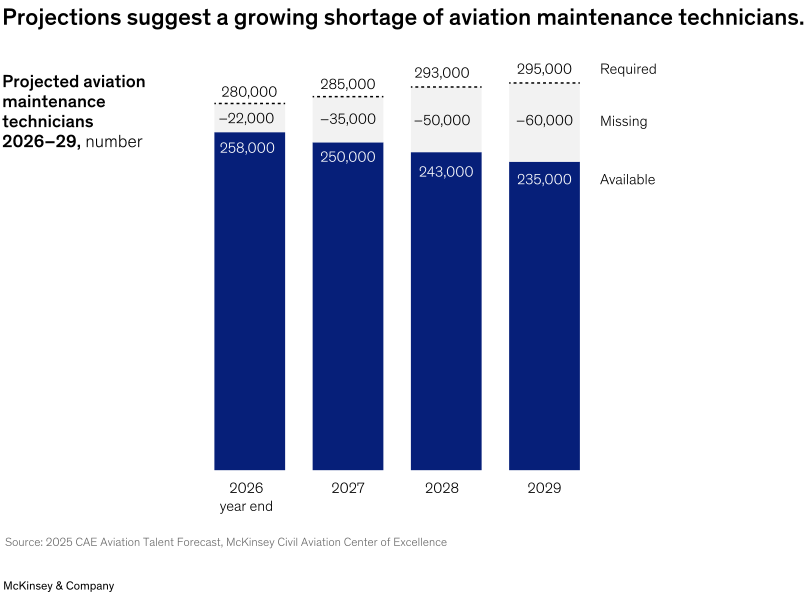
Analysis indicates that the global AMT shortfall could reach roughly 22,000 full-time employees by the end of 2026. Given projected MRO demand growth, this shortage is projected to nearly triple over the following three years (Exhibit 1).
In addition to raising wages and bolstering their recruiting efforts, some leading MROs are placing increased focus on improving productivity to boost capacity. Productivity rates among frontline AMTs can vary significantly across different players and maintenance activities. In some instances, wrench time can fall below 20 percent—particularly in cases where daytime line maintenance crews are forced to act more like “fire brigades” handling spot issues that arise, or when base maintenance crews experience significant parts challenges.
Boosting technician productivity: Three levers
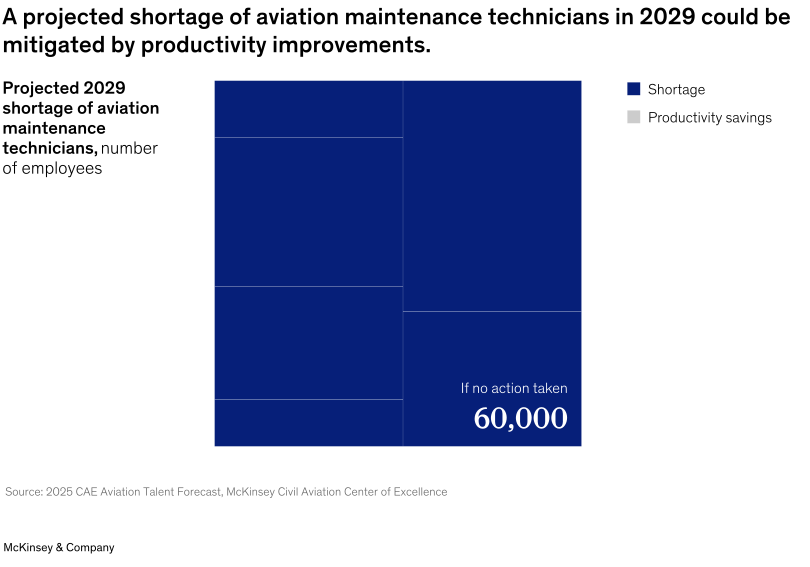
Our analysis indicates that if global MRO players were to raise their AMTs to top-quartile levels of productivity, more than 80 percent of the anticipated AMT shortage could be mitigated (Exhibit 2).
MRO organizations can realize short- to mid-term impact by implementing a selected set of interventions in three categories.
Get back to basics
During the pandemic and the subsequent recovery, many MRO players sustained meaningful levels of attrition in several functional areas beyond AMTs. This led in some cases to degradation in critical processes, such as production planning, day-of-operations steering, and continuous improvement. Before moving on to more advanced (for instance, digital) measures, these MROs could achieve significant improvements by reinforcing operational fundamentals.
In many airframe operations today, performance losses are driven not by a lack of technical capability, but by inadequate operational steering. Core management routines—such as check planning, day-of-operations control, and issue escalation—are often undefined, inconsistently applied, or lacking in real-time transparency. As a result, technicians often spend a significant share of their time waiting for information, materials, decisions, or handovers instead of performing value-adding maintenance work.
For example, during an in-hangar A-check on a wide-body aircraft with a planned turnaround of roughly 20 hours, it is critical that all required materials, components, and tools are ordered in a timely manner and properly staged so technicians don’t have to search for them. If parts are delivered too late or not properly staged, technicians can find themselves wasting critical time that’s needed to complete the check on schedule.
Standardize activities around critical moments. Best-practice MROs use a simple but rigorous operating model focused on actively managing the critical path of a maintenance check. At the core of this model is a standardized “critical moments” framework that prioritizes and concentrates management attention and support infrastructure at points where the execution risk is highest. Getting this right can recover up to ten percentage points of lost wrench time.
A small set of recurring critical moments tends to regularly occur during checks, potentially causing disproportionate impacts on turnaround times and overruns:
- preparation, when work is deliberately shifted upstream before aircraft induction (for example, cleaning immediately after landing, or prestaging tools and materials)
- aircraft intake, when inspections are executed as early as possible to surface findings while schedule flexibility remains
- critical findings, when technical and planning experts rapidly assess impact on scope, skills, and parts
- shift handovers, which are tightly structured to avoid productivity dropping to near zero during crew changes
For each critical moment, standard work can be defined—who does what, by when, and with which inputs—reducing variability and preventing avoidable delays.
Enable proactive supervision and intervention. Standardization alone is insufficient without active supervision. Best-in-class MROs deploy leads, supervisors, and planners as a visible support layer that energetically intervenes in critical moments. Rather than passively monitoring progress, these roles are explicitly accountable for:
- resolving constraints (such as skills, materials, and engineering support) in real time
- making fast trade-off decisions when findings threaten the plan
- ensuring rapid escalation when deviations occur
This approach shifts supervisors from being administrative coordinators to becoming operational traffic controllers who direct and protect wrench time.
Propel performance through clear, visible KPIs. Leaders can actively manage performance by linking a small set of operational KPIs to each critical moment—for example, inspection completion within the first X percent of check duration, handover-quality scores, or response times to findings. Progress can be tracked daily at check, area, and site levels, creating transparency and enabling rapid course correction. Stable, predictable execution tied to meeting KPIs enables MROs to shorten planned turnaround times, reduce overruns, and materially increase effective technician productivity.
Our analysis suggests that checks that perform well on these key indicators are more likely to be completed on time than checks that do not. During a recent shopfloor transformation, a leading MRO sustained higher-level performance in part by emphasizing these indicators, which in turn required developing an extensive operating model playbook and instilling new ways of working across the entire workforce. A critical enabler of success is a structured capability-building program for operational leaders, from shop floor leads to area managers, to embed these routines consistently. MROs that adopt a disciplined, critical-moment-based operating model have demonstrated sustained improvements in wrench time of up to ten percentage points.
Implement digital and AI solutions
Deploying technology, including AI, can unleash 15 to 35 percent more capacity for maintenance technicians. Gen AI and digital tools can act as virtual maintenance and repair experts, handle administrative tasks, conduct automatic quality control, and make supply chains more efficient. With the support of these tools, AMTs have the information, processes, materials, and time to perform their most valuable tasks swiftly and accurately.
Innovative MROs are turning these gen AI possibilities into reality beyond initial use cases. For instance, a global airline’s maintenance department recently developed proof of concept for a gen AI–powered tool to improve issue reporting for its minimum equipment list backlog. This tool uses limited employee input, such as fault names and ATA system codes, to suggest missing information—such as job duration, skill codes, and material requirements—thus enabling better maintenance planning and faster defect resolution. Using this tool has, in some cases, created time savings of 60 to 70 percent. Early results also show a positive impact on workforce morale, with many technicians excited about the proof of concept and its potential applications.
Such implementations, along with more comprehensive gen AI integrations (for instance, in planning departments), could dramatically boost productivity—enabling more efficient processes, increased wrench time, and reduced turnaround time—and could lead to fewer aircraft on the ground. However, many MROs are still early in their digital journeys. While individual use cases can generate excitement and show value, realizing full potential requires a holistic, end-to-end road map to address needed investments, training and upskilling requirements, and process changes.
To scale beyond pilots, MROs need to address some key prerequisites: structured and standardized job cards, secure access to high-quality data (such as records, manuals, findings, and parts), and tight integration with maintenance and engineering systems so that AI sits inside workflows and systems of record, not alongside them. Just as critical is change management, including updated standard operating procedures; role clarity across planning, engineering, and shops; and targeted upskilling intended to propel adoption and consistent ways of working.
Given the safety- and compliance-critical context, deployments also require strong controls: human-in-the-loop approvals for consequential outputs, rigorous QA and traceability to source documentation, proactive engagement with regulators, and formal model risk governance (including validation, drift monitoring, audit trails, and access controls).
Offer learning-based skill building
The MRO industry still relies heavily on apprenticeship. Junior technicians learn by shadowing experienced AMTs and accumulating logged hours toward licensing and company approvals. While it can be effective, this model can also be highly variable because it depends on the scarce availability of senior mentors and is constrained by instructor and examiner capacity.
It’s time to modernize maintenance training. MRO players embracing more structured development approaches could upskill their workforces, accelerating the path to proficiency at a pace not achievable using traditional apprenticeship models.
In today’s tight labor market and regulatory environment, which limit throughput and lengthen the path to independent release authority, leading MROs are shifting toward structured capability acceleration anchored in three elements: a competency framework, clear progression milestones, and measurable time-based KPIs.
Establish a competency framework. High-performing organizations define progression by capability instead of tenure. A structured competency matrix maps required skills across core domains—such as airframe, engine, avionics, composites, and structures—with progressive authorization levels (assisting, supervised, independent, and authorized to complete final inspection or Certificate of Release to Service sign‑off, as permitted by the approval basis).
This creates transparency regarding who can perform which tasks, aligns certified capability with forecasted workload, and exposes bottlenecks (for example, having insufficient personnel with avionics sign-off authorization available on certain shifts). Upskilling becomes targeted instead of generic, with training and on-the-job learning directed at remedying specific gaps rather than moving through broad, nonprioritized curricula.
Pair skill building with outcome KPIs. To improve capacity, skill development must be managed with operational rigor. Two KPIs in particular tend to be especially useful:
- Time to proficiency is the time required to meet defined competency standards or sign‑off eligibility for a given task family or skill category.
- Time to independent task execution is the time required to perform tasks autonomously at required safety, quality, and productivity levels.
Traditional metrics (such as training hours or courses completed) measure inputs. These KPIs measure productive output. Reducing time to independent execution directly increases effective wrench time and lowers supervisory burden—a pattern already evident in some competency‑based, OEM‑led training programs that have reported substantial productivity gains.
Systematic tracking across cohorts and sites can help reveal where training flow slows—and where interventions such as standardized curricula, simulation, coaching, structured on-the-job experiences, or digital aids can accelerate progress.
Address pipeline constraints beyond the shop floor. Skill acceleration is also an ecosystem challenge. Throughput is often constrained by limited instructor availability, examiner bottlenecks, regulatory gates, and restricted access to training assets. Even well-designed programs stall when certification queues build.
Forward-looking MROs manage the entire capability pipeline. They increase instructor leverage through standardized modules, use simulation and virtual or augmented reality to reduce dependence on physical assets, smooth examiner demand, plan for regulatory checks, and partner with training institutions and OEMs to align curricula with operational needs. The objective is not to replace apprenticeship but to industrialize it—making expertise reproducible, measurable, and less dependent on a shrinking cohort of senior technicians.
Structured competence management is already established as a regulatory and business requirement in many MRO facilities. The shift that leading organizations are making now is to treat it as a core operations process instead of a support function. A 20 to 30 percent reduction in time to proficiency or time to independent execution can materially expand effective capacity and improve utilization of existing hangar, tooling, and line‑maintenance slots. In a highly constrained labor market, structured capability building is not a support activity—it is a direct productivity and resilience lever for MRO networks.
The projected shortage of aviation maintenance technicians is unlikely to be solved by recruiting alone. While strengthening the talent pipeline remains essential, our findings suggest that the industry already holds a significant, underused source of capacity within its existing workforce. By reinforcing operational fundamentals, embedding digital and AI solutions directly into workflows, and industrializing skill development to accelerate time to proficiency, MRO organizations can materially increase effective wrench time. Raising productivity levels could offset much of the anticipated worker shortfall while improving turnaround times, reliability, and cost performance.