Sharing a meal is “the oldest social act known to humankind,” says Brett Schulman, cofounder and CEO of fast-casual Mediterranean cuisine restaurant Cava. But what happens when that ancient act gets an AI-era upgrade?
Schulman’s answer is already taking shape. Over the past year, the restaurant chain has piloted AI-powered camera vision across its in-restaurant food-prep areas, invested in technology that can automate digital-order workstations, and trialed data-driven labor-forecasting models—technologies designed to make operations smarter while keeping hospitality and human connection at the center.
Founded in 2006 by three childhood friends, each the son of Greek immigrants, Cava began as a full-service restaurant; Schulman later joined as cofounder and CEO to guide its evolution into a limited-service concept. It’s now a publicly traded business with more than 400 locations across the United States. In 2024, it generated more than $950 million in revenue, up 33 percent from the year prior.
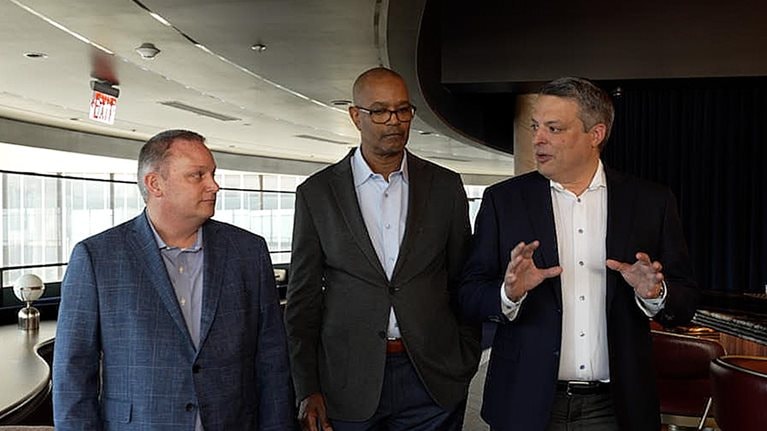
In September, Schulman met with McKinsey Partner John Moran at one of Cava’s newly renovated Virginia restaurants to discuss how shifting demographics, AI, and automation are redefining what—and how—Americans eat.
This interview has been edited for length and clarity.
McKinsey: As consumer palates and demographics have diversified, the desire for authentic ethnic food is growing in the United States. How does Cava navigate that tension between authenticity and broad appeal?
Brett Schulman: Our authenticity starts with my cofounders, all sons of Greek immigrants, who wanted to bring a modern American perspective to their families’ culinary heritage. They were inspired by the simplicity and quality of the food they experienced in small Greek villages, which was very different from the “Greek” cuisine they grew up with in the US. From there, we’ve layered in modern flavor trends and perspectives to evolve the cuisine they knew.
Now, look at what’s going on across the country. Over 49 percent of Gen Z identify with an ethnic minority group, compared with 39 percent of millennials. Gen Alpha is expected to be the first generation to cross that 50 percent paradigm. We know that as the country has gotten more diverse, people’s palates have shifted. They’re seeking bolder, more adventurous, spicier food. And with modern health and wellness trends, people are becoming more interested in what they’re eating, but they don’t want to compromise on taste and flavor.
As consumers look beyond the traditional categories that I grew up with—Asian, Italian, or Mexican cuisines—they are looking to that next frontier of new, adventurous cuisine. The beauty of Mediterranean food is it can meet so many different needs. It can be spicy, mild, salty, and sour. It’s got all these different layers of flavors that are rooted in naturally healthy ingredients. That’s why we see so much potential in the Mediterranean category.
McKinsey: As you’ve mentioned, some consumers are paying greater attention to their health, whether because they’re on a GLP-1 medication1 or simply because they’re more health conscious. What’s Cava doing to meet the demand for healthier options?
Brett Schulman: Mediterranean cuisine is so adaptable. If you’re focused on being gluten or dairy free, we can meet your needs. Now, with increased knowledge of GLP-1 effects, people are seeking more protein. We have many protein-rich main items on the menu. It’s really about highlighting the components of our menu that can adapt to these emergent dietary trends. But also, this is timeless food; it’s been around for about 4,000 years. People, especially here in the United States, are just coming to recognize the benefits of it.
Using tech to enhance, not replace
McKinsey: Restaurants are becoming increasingly digital, and diners often opt for grab-and-go meals. How do you maintain a connection with the customer when they’re interacting with the brand more often through a screen?
Brett Schulman: I’ve spoken in the last few years about how I believe the demise of the dining room is greatly exaggerated. There’s certainly been a shift to digital, and we’re well positioned to take advantage of it. We have second digital make lines in every restaurant, for example.
But we don’t think it’s an either-or. We think it’s an “and”: great digital and physical experiences. As technology continues to evolve—and in some ways replace—the way humans connect with others, especially with the advent of AI, people are really seeking to fill that void. One trend I’ve noticed is the rise of the all-day café. It’s another indicator that people want to have this human connection.
To maintain the connection with diners in the restaurant, you have to give them a space, an ambiance, and an experience that’s evocative. Here, in our Mosaic2 location, which embodies the aesthetic of our Project Soul redesign initiative, we’ve introduced softer seating, more greenery, softer lighting—a warmer brand palette from what our historical design language was—to make it evocative of the oldest social act known to humankind, which is sharing a meal.
McKinsey: That said, technology is going to play a bigger role in the restaurant of the future. How is Cava planning to use automation in its operations?
Brett Schulman: Technology plays an enormous role in helping us become more efficient operators that can then invest in our team and our guests, which ultimately delivers our financial results. It’s about using technology to enhance the human experience, not replace it.
I can envision Cava’s second make lines—back of house for digital orders only—being automated in the future with our recent investment in Hyphen.3 Our guests have different needs depending on the channel they’re interacting with us on. When they are short on time and want to order digitally, for instance, they want speed, accuracy, and convenience. That’s where automation can come in, to alleviate some of that manual, intensive labor from our teams and allow us to reallocate that labor to our physical channels and our in-restaurant experience. We’re testing camera vision, gen AI, and automation to take the complexity off our team members’ plates so they can focus on great service and making great food every day.

The future of restaurants: Precision in the kitchen, connection at the table
Over the years, we’ve invested in our vertical production integration. That’s our biggest automation. We have almost 100,000 square feet of production facilities where we produce our fresh-crafted dips and spreads at scale with the same fresh dill and cucumber that Chef Dimitri Moshovitis used in our original Cava Mezze restaurant. But now we’re making it in 10,000-pound batches, and we’re using high-pressure processing to pasteurize, which gives us extended shelf life and allows us to centralize the facility where we produce it, all without diminishing the quality of the product.
McKinsey: You mentioned AI. Where does it fit into Cava’s restaurant and corporate functions?
Brett Schulman: When we first started, digital was maybe 1 percent of our business. Today, digital is 37 percent of our business, worth up to $400 million in revenue this year. We’re on the precipice of another decade plus of transformation, and this time, AI and data transformation will have a similar impact on the business as the first digital transformation.
In our restaurant operations, our team is scanning physical inventory, and we have a suggested ordering system, where a platform suggests which ingredients in our make line we may be running low on. When it comes to preparation, AI could help our grill cook know how much chicken to cook so we don’t run out, keep the food fresh, and improve the speed of service. And AI will make us more efficient operators when we can get to smart ordering, where the system knows the exact menu mix, real-time sales data, historical sales data, weather data, and event data and automatically places the product order.
Automated labor scheduling—meaning AI recommends deployments based on the forecast and then populates the shifts—will take a lot of the manual complexity out and give us a higher probability of delivering on our financial commitments, as well as alleviating that pressure for the team.
Then there are the customer engagement and marketing sides. We will be able to unlock personalization at scale through AI. We have more than 400 restaurants today and plan to expand to thousands. How do we make you feel like we woke up and opened today to serve you—as in, you specifically? How can we communicate with you and deliver content that’s specific to your dietary needs, your preferences, the way you’re navigating the world, and the way you like to interact with us?
If we know that a guest is pulling around to the drive-through, that they drive a black SUV, and that this is their third time ordering from us this week, we could send a message that says, “Hey, John, great to see you again. Here are pita chips on us.”
At Cava, through data modernization initiatives, we’ve established a robust data “lakehouse” architecture that serves as a single source of truth for all Cava data, both structured and unstructured. This data modernization effort is optimized for analytics, AI, and action, empowering teams across the organization to unlock insights faster and drive smarter outcomes for the brand. Having real-time AI insights—instead of seeing data weeks, if not months, later—is what will inform strategic decision-making in the future.
Scaling brand love
McKinsey: Rewarding a frequent guest with pita chips speaks to Cava’s approach to loyalty. Cava recently relaunched its loyalty program, moving from a spend-based to a point-based system. How are you reimagining loyalty in a way that deepens connections with guests?
Brett Schulman: When we think about the advent of the new privacy laws, the deteriorating efficacy of third-party data, and search engines moving to become answer engines, we think it’s more important than ever to build out our first-party audience and build those direct connections ourselves.
Certainly, most of our rewards are food, but we are finding other ways to reward customers for loyalty. Recently, there was the Labubu craze. We made our own version of plushies for National Pita Day with our mascot, Peter Chip, and three other plushies: Garlic Gus, Sweet Sammy, and Jimmy Harissa. It offered us another way to engage with our guests in a deeper, more emotional way beyond just food.
McKinsey: How else are you maintaining relevance with the next generation of diners?
Brett Schulman: It’s about hiring folks who are representative of those generations, especially on our marketing and social media teams, because they understand how best to be relevant in an on-brand way.
At the same time, the way we engage with consumers has become much more fragmented and is taking place on very different channels today than in the past, and generations perceive humor or other things differently. So what’s important as a brand is to have a clear point of view in how you show up in the world through food, hospitality, whom you collaborate with, and on social media.
My cofounder Ted Xenohristos and I wrote this document called our “concept essence document.” The idea behind it is if we disappeared tomorrow, you could pick up this document and know how we should show up in the world or how our voice should translate online. For example, it defines the core emotions and experiences we want every guest to feel when they interact with Cava: energy, warmth, curiosity, and connection. It’s a fluid document, but it’s the filter to make decisions through. So, for our younger team members who are thinking about how we show up on social channels, they can refer to this concept essence filter.
Another thing we’ve noticed is that consumer brands are starting to do their own content series. We recently debuted our first season of Bowlmates, which is a fun, short social media series on TikTok and Instagram. Still, we pressure tested the show through the filter of our core brand essence.
Creating careers, not just jobs
McKinsey: You’ve also been vocal about Cava’s goal of opening at least 1,000 restaurants by 2032. What will it take to get there?
Brett Schulman: The demand is there; the hard part is executing and scaling. The number-one enabler for that is building our pipeline of general managers [GMs]. We’ve been very focused on our people development system to make sure we’ve got that deep pipeline of role-ready GMs.
We just launched our “Flavor your future” campaign to attract, develop, and retain GMs. If you have the will—and can develop your skills—within 24 to 30 months at Cava, you can be making six figures running a multimillion-dollar business. Our area leaders typically have control of six to eight restaurants, which can be $20 million-plus businesses, and are overseeing the GMs of these restaurants. Folks can build a career for themselves with a sustainable livelihood.
This goes back to our ethos: My partners and I all worked in restaurants growing up. I waited tables to help pay my way through college. My cofounders’ mothers worked in the restaurant industry and didn’t have a lot to show for it. So we want Cava to be a place where people can have a career and not just a transitory job.
How do we help them grow personally and professionally, beyond the four walls of our restaurants? It starts with training programs that also teach business acumen. We call this “high-performance teamwork,” or “HPT,” which we started at the executive-team level. Now, we’ve cascaded it to our field leaders to help them understand how to communicate and manage different personalities, because these are skills that are applicable way beyond the four walls of the restaurant.
It offers off-site, in-person training; executive coaching; 360-degree surveys; personality assessment tools; and digital learning, and the goal is to build trust and commitment while improving the way we work together. We are encouraging our leaders to think at a higher level and focus on the goals of the enterprise, not just their function. Ultimately, we want to equip them with the tools and competencies to become effective business leaders who can run multimillion-dollar businesses.
At this location, one of our earliest team members grew to culinary lead to guest experience manager and, eventually, to a GM. He started at Cava when he was 17 years old. Now, he runs this area. Cava grows as a byproduct of those stories, not the other way around.
No limits on limited-service restaurants
McKinsey: Which challenges and opportunities will emerge for the restaurant sector in the next decade?
Brett Schulman: You’re going to see a continued evolution of format derivations and a shift to more limited service. Look at the data: Since 2019, transactions in the industry are down 7 percent. A lot of brands have gotten too expensive because there are labor, COGS [costs of goods sold], and cost pressures. These models—especially independent, full-service restaurants—are struggling to deliver a value proposition within that cost structure.
So what you’re starting to see now is even more limited-service restaurants delivering Michelin-star cuisine. In those cases, you order Michelin-star-quality food at the counter, and food runners bring it to your table. You’re going to see a broad spectrum of limited-service food that delivers a strong enough value proposition to the guest while having a viable economic model.
McKinsey: Imagine it’s 2035. How are customers interacting with Cava? Do you have any moon shot ideas for the brand?
Brett Schulman: This relates to a key pillar of our strategic plan, which is to expand our Mediterranean way in communities across the country. Our multichannel format offers several ways to engage with our brand.
Today, we have in-restaurant digital ordering, digital-order pickup at the window, about 70 drive-through locations, third-party delivery, and native delivery, and our guests can buy our dips and spreads at grocery stores. We’re testing catering. I could envision an even broader multichannel experience where we can meet you on your terms, no matter which channel you want to engage with us on, to experience our Mediterranean cuisine.
As for moon shots, maybe it’s a food market with culinary classes or some adaptation of our original, full-service restaurant that is a centerpiece in a market. In Greece, there are these amazing beach clubs; we joke that we could envision a Cava beach club someday. Maybe we tie it to the loyalty program: If you’re an elite loyalty member, you get front-row seats on the beach. We come up with all kinds of wild, fun ideas. We can show up in a unique way as a brand that, again, is true to our Mediterranean ethos and gives people a new way to engage with us.