Federal government procurement is entering a pivotal moment. The convergence of fiscal tightening, heightened scrutiny on public spending, and persistent supply chain volatility is forcing agencies to rethink how they buy. The cancellation of remaining pandemic-era funding, combined with renewed pressure to demonstrate transparency and efficiency, has elevated procurement from a back-office function to a central lever of mission delivery. With the US federal government spending more than $650 billion annually through third-party contracts,1 even modest improvements in procurement performance can unlock significant value.
At the same time, a new wave of digital and AI capabilities is reshaping what “good” looks like in procurement. While many federal organizations have made incremental progress in adopting new tools over the past decade, most remain constrained by long cycle times, fragmented data environments, and legacy technology stacks. This creates a widening gap between what is now technically possible—faster, more autonomous, insight-driven procurement—and the reality on the ground.
This article builds on nearly two decades of McKinsey procurement benchmarking and recent frontline transformation work to offer a practical perspective on how federal leaders can close that gap.2 We focus not just on the case for digitalization but on how to translate ambition into execution—particularly in complex, resource-constrained environments.
Reimagining procurement in the federal government is a critical step toward making acquisitions faster, easier, and more transparent. When executed well, digital and AI procurement operations can dramatically improve the “internal customer” experience, secure supply and expedite the fulfillment of supplies and services, reduce delivery risk, and lower overall operating costs. In our experience, organizations with best-in-class digitalized procurement capabilities can realize increases of up to 30 percent in efficiency and up to 50 percent in hands-free, frictionless procurement transactions.
This article suggests six key actions for federal organizations looking to start or accelerate their digital transformations: outline the aspiration, build broad and early support, establish a strong baseline, create a digitalized procurement office (DPO) road map, acquire or build the broad range of required skills and capabilities, and invest substantially in change management.
The opportunity for digitalized procurement in the federal government
Today’s federal procurement teams face multiple overlapping challenges. Teams are tasked with managing inflation, price volatility, and geopolitical uncertainty—all while integrating sustainability considerations. Resilience has become a top priority, and many organizations are diversifying their supply chains, taking a fast-moving and dynamic approach to hedge against future cost increases.3 At the same time, procurement functions are facing significant talent shortages and new administrative demands, such as the Revolutionary Federal Acquisition Regulation Overhaul (RFO).4 As a result of this challenging environment, teams are often asked to do more with less.
Meanwhile, the technology landscape is evolving at a rapid pace. Deploying AI tools at scale has become more accessible and effective, and in both the public and private sectors, AI adoption has accelerated because of decreasing costs and enhanced capabilities, including agentic behavior and improved explainability. As a result, now is the right time for federal sector leaders to put a priority on digitalizing their procurement functions.
What successful digitalized procurement looks like
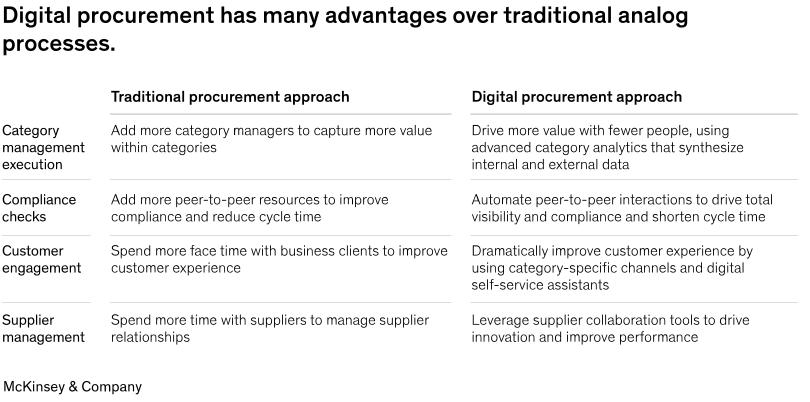
Compared with traditional procurement processes, digital and AI procurement strategies can increase efficiency, improve customer experience, and drive innovation with new technologies, including AI agents (Exhibit 1). As the digital ecosystem continues to evolve, digitalized procurement is expected to advance and further augment procurement teams. As a result, teams will be able to move beyond automating administrative tasks to complete more-strategic tasks, such as optimizing sourcing, enabling advanced analytics in procurement,5 and providing granular supplier visibility. Underpinning these changes are AI-first digital architectures that combine data integration layers with agent-based applications. This makes it possible for leaders to replace segmented legacy workflows with faster, data-driven, and platform-based solutions in which data, analytics, and execution are tightly integrated.
Best-in-class digitalized procurement systems include a suite of innovations—often driven by AI tools—that improve the procurement experience on multiple fronts:
- Data analytics. Data analytics can drive decision-making and improve procurement processes, including those that involve supplier selection, spend analysis, and performance management (for example, AI- or agent-led systems that organize and identify category-level opportunities, forecast demand, and detect anomalies).
- Contract management systems. These systems can automate the contract management process, including contract creation, approval, and execution (for example, AI agents can generate and redline key documents based on policy, historical outcomes, and market conditions).
- Supplier portals. These portals provide suppliers with access to procurement information (either self-serve or assisted by a gen AI chatbot), including bidding opportunities, procurement history, and performance metrics.
- E-signatures as the default. Implementing e-signature technologies can streamline the approval and signature process.
- Electronic bidding. Using electronic platforms for all procurement processes can streamline the bidding process and reduce manual effort (such as by enabling AI-assisted bid evaluation systems to help score suppliers and build fact bases for upcoming negotiations).
- Automated procurement workflows. Procurement software and specialized AI agents can automate entire procurement workflows (or time-consuming portions of them), such as sourcing, supplier selection, contract management, and payment processes.
However, simply investing in digital tools and redefining processes will not be enough to realize the full potential benefits of digitalized procurement. Uncoordinated, unplanned adoption of AI tools—without governance, integration into core workflows, and clear ties to business priorities—often fails to generate meaningful value and can even add complexity. To achieve positive outcomes, organizations generally need a DPO that acts as the execution engine for all digitalized procurement operations.
Where possible, the DPO will generally sit within the organization responsible for managing digital initiatives, programs, and projects related to procuring goods and services. This unit can champion the implementation of digital or AI procurement strategies, including identifying and implementing new digital tools and platforms, managing the transition from traditional procurement methods to digital ones, and staying abreast of the latest disruptions.
The impact of digitalized procurement
The benefits of digitalizing and integrating AI into procurement are substantial. In our experience, organizations with best-in-class capabilities that adopt these technologies in their procurement functions may be able to achieve some or all of the following concrete benefits (depending on the details of their organization):
- an increase in hands-free, frictionless sourcing and procurement transactions by up to 50 percent
- an increase in efficiency of up to 30 percent due to increased automation, which frees up personnel to focus on higher-value tasks
- up to 70 percent reductions in cycle times as a result of digital engineering and digital manufacturing
One organization with $4 billion in annual indirect spend implemented a data-driven procurement approach that involved the use of a suite of digital and analytics tools, including AI-assisted category analysis and geospatial analysis. The organization began with the goal of improving its historical annual savings rate of 1 percent by one or two percentage points. By the end of the effort, indirect spend was down by 11 percent, and the organization had saved more than $500 million on the cost of ownership.6
Current digitalized procurement practices
Although digitalized procurement has immense potential compared with traditional processes, comparatively few federal organizations are using these tools and strategies. In the private sector, those that have been slower to adapt are already being left behind by competitors. According to a recent survey, the share of chief procurement officers (CPOs) who prioritize the “need to accelerate digital enablement” saw a sharp increase of more than 20 percentage points between 2023 and 2024.7
This is primarily because it can be hard to build momentum behind digital transformations. In our experience, digital procurement transformations often run into difficulties when organizations lack either a structured, holistic approach to transformation or the organizational capacity and structure to execute on that approach.
In the current public sector landscape, we see five broad levels of maturity in the use of digital and AI procurement technologies and strategies (Exhibit 2).
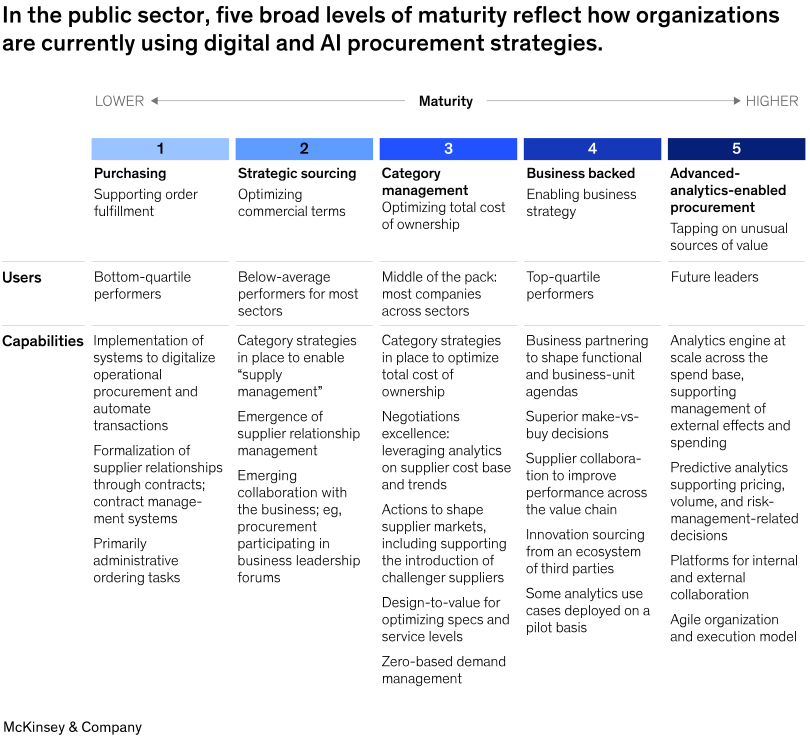
Organizations in the least-sophisticated quartile are not entirely digital-free; they typically use digitalization to support order fulfillment. However, the most successful organizations have made significant progress beyond this. They use digital tools for a wide range of needs (for example, complex customer requirements and expectations, real-time data transparency for planning processes, or increased auditability) to integrate new insights as quickly as possible. These emerging leaders are tapping into new sources of value using advanced-analytics-enabled procurement techniques, including volatility management and the enablement of sophisticated, cross-functional processes.
Six actions to start the procurement digitalization journey
Digitalizing procurement operations through AI-enabled procurement can feel overwhelming, sometimes to the point of decision paralysis. Organizations embarking on this journey can start by taking action across six areas.
1. Outline the aspiration
Procurement offices should identify their objectives in transitioning to digitalized procurement processes. These goals may include one or more of the following:
- Close capacity gaps. Amid federal talent shortages (including the separations of up to 21 percent of total agency personnel in the first six months of 20258), expectations for procurement are rising. Procurement offices may see digital and AI tools as a way to meet these expectations without having to add more resources.
- Increase efficiency. Digitalization and AI enablement could help organizations deliver specific program capabilities—for example, drafting requests for proposals (RFPs) or vendor prequalification and intake—faster or with reduced resourcing.
- Minimize risk or increase accuracy. Digital and AI tools could help minimize risk within a complex or highly integrated program.
Once the specific motivation for change has been identified, digital-procurement aspirations can be defined and codified. For example, procurement offices might set an aspiration to reduce cycle times by 50 percent through the use of AI agents across key workflows or to achieve 10 percent savings in spending across a prioritized category, such as IT. Concrete targets can guide the effort forward and inform a clear digital and AI procurement strategy.
2. Don’t go it alone—build broad and early support
Digitalizing the procurement function can be a significant endeavor. A senior “champion of the cause” in the organization may be invaluable in communicating the vision, modeling new ways of working, and sustaining momentum throughout the transformation.
The procurement office will also need to collaborate early with key stakeholders such as finance, legal, IT, and business units to ensure that procurement processes align with their needs and that procurement outcomes support overall organizational goals.
In addition, changes to how the organization executes its procurement function will require the professionals running and managing the procurement processes to learn new ways of working, interact with new systems, or both. The most effective (and sustainable) change efforts incorporate stakeholders’ ideas from the beginning and maintain a regular cadence with partners throughout implementation. For example, procurement professionals can help define the early, high-impact use cases of AI-driven tools or workflows and also serve as early adopters. Convening peers from across the organization at an off-site location can be a useful way to build alignment and momentum.
3. Establish a strong baseline
For most organizations, digitalizing the procurement office means a fundamental change in ways of working. An objective diagnostic can help establish a current-state baseline against which the organization can design and execute future changes and track progress. To develop this baseline, leaders should gain a detailed understanding of the entire ecosystem of people, tools, capabilities, and processes currently involved in procurement—including level of maturity and pain points. One of the key outputs of a diagnostic will generally be an assessment of which levers and changes are most likely to move the organization toward an improved customer experience. Together with the baseline, the resulting list of levers will be invaluable in guiding and prioritizing tech enablement efforts.
4. Create a digitalized procurement office road map
With the aspiration, appropriate support, and baseline in place, the next step is building a detailed road map to guide the creation of the digitalized procurement office and the transformation of the overall procurement function.
Achieving the target state is a multiphase journey. The process details of building the road map should be informed by a broad variety of factors, including budget allocation, organizational capacity, and internal capabilities. Concrete milestones should be created to guide the program and measure progress. Planning some early quick wins can be an effective way to build momentum with customers and employees. Organizations should therefore seek to identify a portfolio of initiatives that deliver both rapid improvements and better long-term solutions. For key initiatives, the pilot–redesign–rollout approach, which allows for rapid learning and refinement, can be an effective implementation strategy.
Once key milestones are in place, they can be integrated into RFPs and contracts to enable vendors and the procurement function to transform in tandem and develop necessary digital and AI enablers and capabilities along the way.
To build an appropriate road map, the organization will also need a clear vision of its target state AI-enabled tech stack. While IT solutions alone will not be enough to fully digitalize procurement, they are a crucial element of any successful transformation. The right set of procurement technology solutions will depend on the chosen procurement strategy. They might include procurement software, intake and orchestration tools, AI or generative AI-powered applications, and advanced analytics models. Once the target state tech stack is defined, the organization will need to make strategic decisions on what should be bought versus built.
5. Acquire or build the broad range of required skills and capabilities
Success relies, in part, on an organization’s ability to absorb and fully exploit advanced technologies. Procurement teams will therefore need a high degree of fluency with relevant digital technologies and platforms, as well as new skill sets to best engage with emerging AI tools.
But this digital and AI fluency will not be enough to deliver a best-in-class procurement function. Shared-services organizations will also likely have to build the internal capabilities that enable them to integrate new tools and technologies into their processes in a way that ensures efficient customer interactions and consistently high levels of customer service.
Achieving the required mix of skills and capabilities may mean acquiring new talent, or it may be possible through a detailed training program. Training materials—which may include presentations, user manuals, tutorials, and hands-on exercises—should be comprehensive, easy to understand, and engaging. Because people learn in different ways, the best results generally come from offering multiple training options, including in-person, online, and self-paced courses or modules.
6. Overinvest in change
Research shows that significant changes are hard for most organizations, and most transformations fail due to factors such as employee resistance, limited change management, and inadequate resourcing.9 According to a recent McKinsey survey, the difficulty of driving adoptions of new digital and AI tools at scale is one of the three primary obstacles to CPOs’ digital ambitions.10 Organizations should ensure that their planning and budgeting allow for significant investment in change management, including through role modeling, fostering conviction, reinforcing infrastructure, and building capabilities.
To understand the precise mix of change management initiatives needed, organizations should undertake a thorough assessment of their internal readiness for change, which will involve looking at factors such as leadership alignment, employee engagement, and culture and capabilities. Surveys or pulse checks should be conducted regularly through the course of the digital transformation to understand pain points and developing issues so that the change management strategy can be adjusted as needed.
Federal organizations that can integrate best-in-class digital and AI procurement technologies and processes have the opportunity to improve decision-making, increase efficiency and transparency, bolster supply chain resilience, and decrease outlay across a significant proportion of their cost base. At a time of uncertainty and tight budgets, realizing these benefits should be an organizational imperative across the public sector.