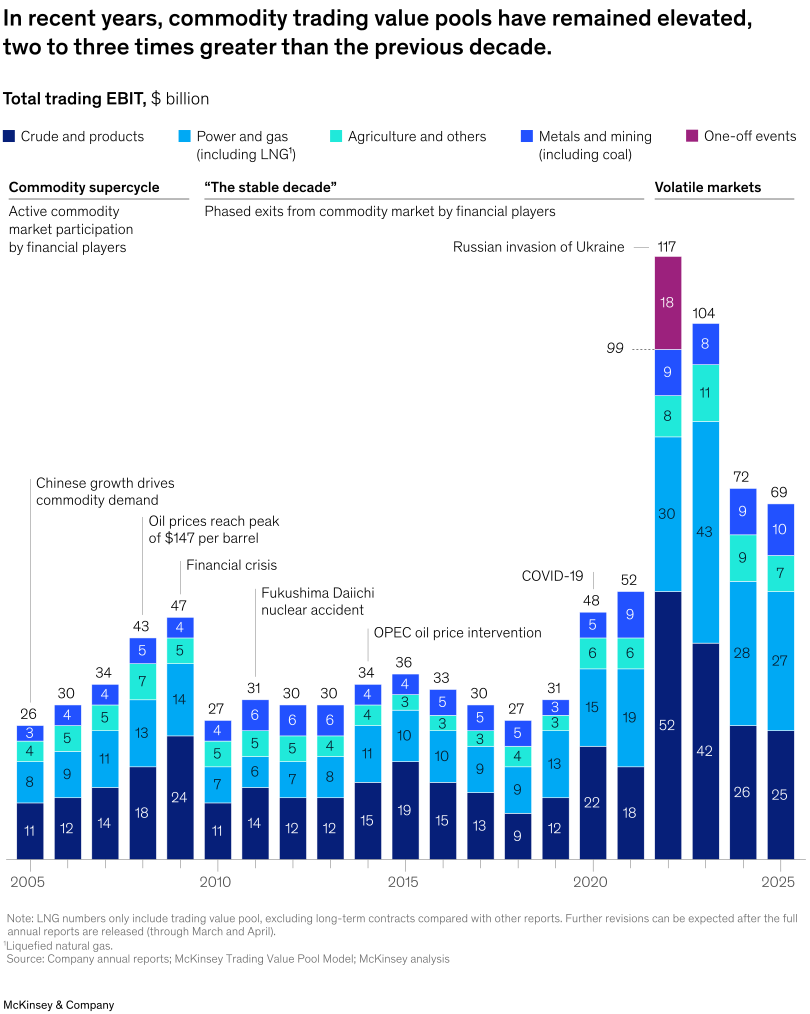
The energy landscape is experiencing a profound transformation. Geopolitical tensions, shifting trade policies, and changing energy transition priorities are reconfiguring trade flows and supply-and-demand dynamics. These forces have increased market volatility and amplified arbitrage opportunities, creating value pools in commodity trading that are two to three times larger than those in the previous decade (Exhibit 1).
Staying competitive in these new times requires different strategies.1 For fuel retail players in the United States, who collectively account for over 30 percent of total US motor gasoline consumption, this period of flux offers a rare and significant opportunity to build resilience and capture value by developing their trading capabilities.2 Many fuel retailers today still operate with basic supply-sourcing models, buying fuel largely to meet the captive demand of their own stations. Moving beyond this baseline opens a spectrum of trading roles. Asset optimizers use owned or contracted assets—distribution, storage, and channel flexibility—to lower costs and improve timing; asset-backed traders capture commercial margin by trading around that existing asset network, staying within signed offtake agreements rather than taking open (“naked”) positions; and full traders generate profit and loss (P&L) from a broader book, pursuing market opportunities largely independent of physical assets. We estimate that developing an asset-backed trading model could help to roughly quadruple margin per barrel (Exhibit 2).
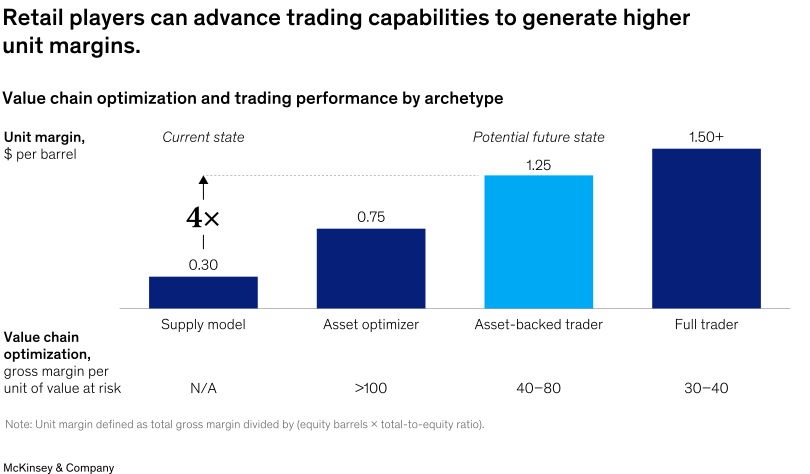
The strategic choice is not binary; rather, it represents a range of options along a continuum. Retailers can select different capability levels based on scale, risk appetite, and whether they decide to build, partner, or aggregate volumes.
The untapped potential of fuel retail shorts
In volatile markets, optionality becomes more valuable, as greater price movements confer a greater ability to optimize procurement and realization timing across the value chain or, put simply, to “buy low, sell high.” Fuel retailers hold substantial captive short positions in the US gasoline market—in essence, a large and predictable obligation to supply fuel through their own stores. However, by limiting their trading activity to basic supply procurement for retail stores, many are leaving substantial resilience and value unrealized.
The recent consolidation around 7-Eleven illustrates why large retail demand shorts matter. When Marathon Petroleum divested its Speedway convenience chain in 2020, the deal included long-term fuel supply agreements for approximately 7.7 billion gallons per year.3 Sunoco’s earlier divestiture to 7-Eleven included a 15-year take-or-pay fuel supply agreement starting with approximately 2.2 billion gallons annually.4 These agreements lock in 7-Eleven’s demand short—a guaranteed stream of fuel it must source—and provide the volume foundation on which a larger trading operation could be built.
Persistent customer demand ensures a continuous market for gasoline, and this, coupled with a strategic shift, is leading retailers who control aggregated demand pools to have more buying power over their suppliers. This empowers fuel retailers to exert greater influence on supply terms.
McKinsey analysis estimates that the US retail gasoline trading value pool could grow from its current value of between $150 million and $250 million to between $1 billion and $1.2 billion. This represents a significant margin uplift potential of approximately 3 cents per gallon (cpg) or more if retailers adopt asset-backed trading.5
Current market conditions make this opportunity more compelling. Particularly in the Atlantic basin, excess product supply means that traders and refiners increasingly value retail shorts, or a reliable outlet for their product. Trading houses, flush with profits from recent market cycles, are buying branded retail networks and similar assets.6 This reflects a broader trend in commodity trading where leading organizations are expanding their physical assets and securing access to the movement of fuel for better market intelligence and more flexibility in how they trade.
The landscape is further shifting as supply deals made by major oil companies when they sold large retail chains are now approaching the end of their contract durations.7 This means that large chunks of demand are becoming available to the broader market. This change provides the retail sector with greater supply flexibility by allowing retailers to choose more competitive suppliers. Increased competition is also arriving in the form of nontraditional traders, who are entering product trading at scale. New entrants, such as hedge funds and renewables players, are building trading capabilities and intensifying market competition across commodities.8
There are examples of fuel retailers already moving toward the asset-backed trading model. Consider RaceTrac, which is building trading capabilities off the back of scale and wholesale supply optionality. Its 2023 acquisition of Gulf Oil through its wholly owned wholesale subsidiary, Metroplex Energy, added approximately 1,100 Gulf-branded distributor and license agreements to its network. In announcing the deal, RaceTrac described Metroplex as a wholesale fuel supply and trading company that secures bulk fuel for rack sales and delivery of gasoline, diesel, and biofuel products by pipeline, rail, truck, barge, and vessel.9 Metroplex supplies both RaceTrac’s own stations and third-party wholesalers across 15 states in a model that combines asset ownership, logistics, and trading activity.
Love’s Travel Stops & Country Stores’s subsidiary, Musket, provides another example. Musket publicly describes itself as specializing in commodity supply, trading, and logistics in North America, providing both marketing and operational expertise. Its refined-products offering includes B2B supply, fixed forwards, transloading (moving fuel between transport modes to optimize cost and timing), and rack sales.10 This mix of managing supply contracts, offering hedging, and controlling logistics shows how a retailer-linked platform can build trading capabilities.
Fuel retailers who do not act decisively to develop these capabilities risk becoming undervalued acquisition targets for more agile trading houses and refiners.
From delivery obligation to trading portfolio: A mindset shift
To manage operational risk and increase their resilience, fuel retailers could shift their perspective. Instead of treating their asset footprint as merely a delivery obligation, they could view it as a valuable short to trade around or a source of trading flexibility. The transformation requires building storage, blending, and logistics infrastructure that turns a retailer’s footprint into a regional trading hub (Exhibit 3).
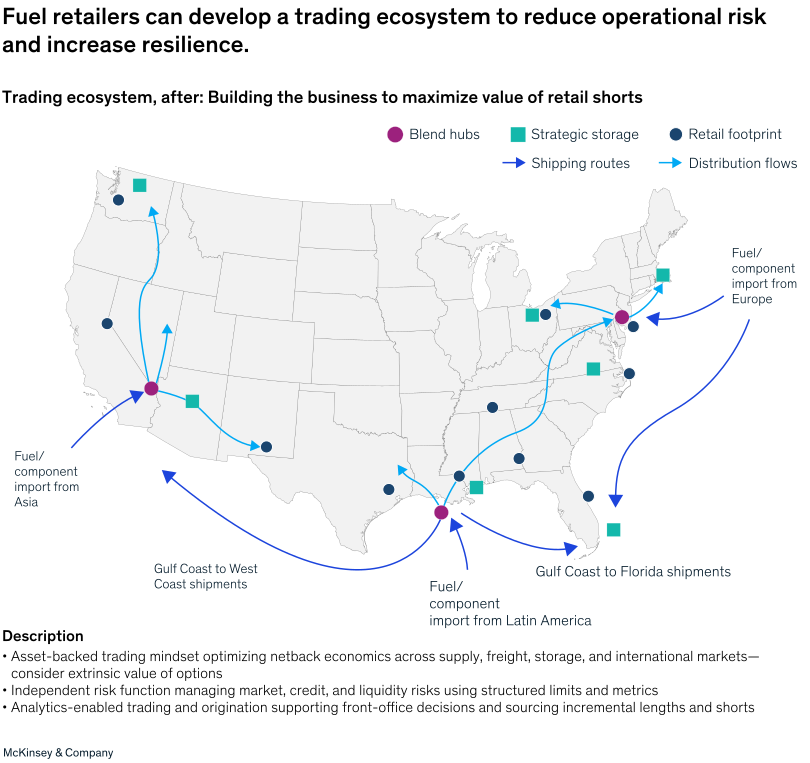
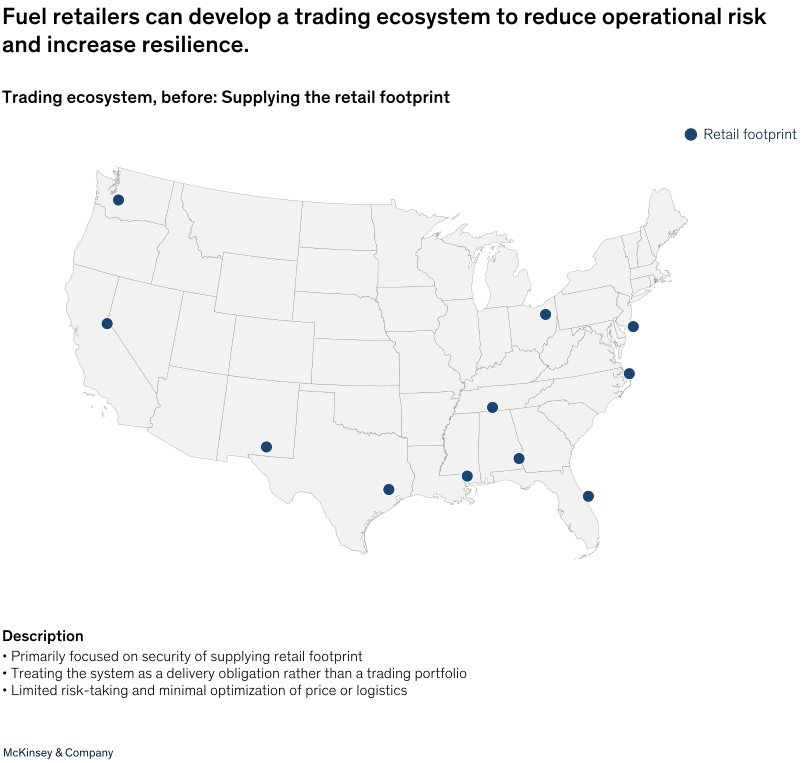
To achieve this in practice, fuel retailers could manage the full economics of every barrel across supply, freight, storage, and international markets. Pooling purchasing volumes across fuel retailers and marketers has the potential to achieve better terms and prices.
This aggregation could also significantly increase the tradable volume, which in turn could expand the scope for trading activities and corresponding profit generation.
Adopting this perspective and mode of operation means changing traditional ways of doing things. Being smart about where and when they buy, ship, store, and sell fuel could help fuel retailers build resilience in turbulent times. Looking across the fuels value chain suggests that retailers have a wide range of opportunities (Exhibit 4).
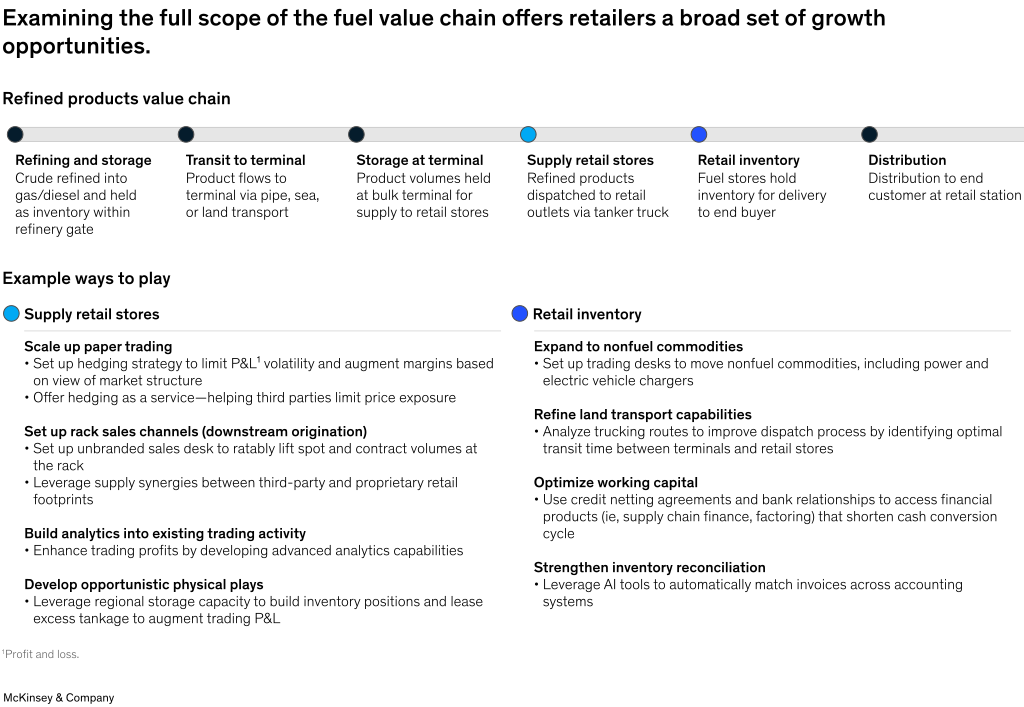
These opportunities can drive growth and resilience across the entire refined-products value chain, extending well beyond traditional fuel supply. Taken together, the levers below are less about any single trade than about assembling a larger, connected portfolio along the full value chain, from paper markets through rack sales, storage, logistics, and adjacent commodities. There are several measures fuel retailers can take to build this capability and eight stand out:
- Scale up paper trading. Fuel retailers can become more active in paper markets, developing market intelligence, setting up hedging strategies, and even offering hedging as a service to third parties.
- Set up rack sales channels. Setting up unbranded sales desks and coordinating supply with their own station networks can help retailers make more of the rack channel, where fuel is sold in bulk to other distributors.
- Build analytics into existing trading activity. Bringing advanced analytics, AI, and machine learning (ML) applications into existing trading activities can help improve trader decision-making, for example by running “what if” scenarios or finding the most profitable way to blend products. The industry widely expects AI to transform trading organizations.11 This technology could reduce middle- and back-office execution costs by 60 percent over the next five to ten years, while also making decisions faster and more accurate.12
- Develop opportunistic physical plays. Using regional storage, leasing out spare tank capacity, and building inventory ahead of seasonal fuel-specification changes (for example, the switch to winter-grade gasoline) can all create meaningful value. Physical holdings and infrastructure access give retailers flexibility, can help balance their portfolios, and can enable them to sell unused storage or capacity to others.
- Expand to nonfuel commodities. Trading desks can expand beyond fuel to manage exposure to nonfuel commodities. These could range from retail electricity demand (including electric-vehicle charging) to coffee and sugar prices from convenience store sales. This diversification across commodities is a strategy often used by trading houses to manage risk and build resilience.
- Refine land transport capabilities. Optimizing trucking routes and improving how trucks are loaded and scheduled at terminal bays can reduce freight costs, while offering trucking as a service can turn logistics into a source of revenue. Controlling the physical movement of fuel can also provide real-time market intelligence.
- Optimize working capital. Implementing tighter inventory management, establishing credit netting agreements, and utilizing financial products can free up working capital and speed up the cash conversion cycle. In volatile markets, access to capital and the discipline to deploy it effectively while managing working capital remain key differentiators.
- Strengthen inventory reconciliation. Finally, hiring dedicated reconciliation teams and using AI tools to automatically match invoices across accounting systems can help detect and prevent value leakage.
Across all of these, scale matters because the capabilities required to monetize a retail short—including trading talent, analytics, risk management, credit capacity, logistics access, and working capital—have a meaningful fixed-cost component. As these levers compound into a portfolio spanning the full value chain, that fixed-cost base is easier to justify at scale, which, for many retailers, is easier to reach through a partnership or joint venture to create ratable demand and regional optionality.
Larger retailers can aggregate demand across sites, terminals, suppliers, and geographies to improve sourcing leverage, optimize inventory and freight, and capture arbitrage opportunities. Smaller retailers can still capture value, but may need to do so through partnerships, joint ventures, or consolidation. In practice, the strategic choice is whether to build, partner, or aggregate scale depending on volume, capability maturity, and risk appetite, and, increasingly, whether building alone still makes sense at all, given how quickly the costs and complexities of a credible trading operation are rising.
What it takes to make the shift
It may take concerted effort across several critical dimensions for fuel retailers to move toward trading. For retailers considering this transition, the following capabilities could help them manage the transition:
- Talent and expertise. Trading requires highly specialized skills, so an expanded mandate into trading could mean attracting and retaining competitive talent across front-, middle-, and back-office functions, particularly in origination.
- Executive commitment. A fundamental mindset shift, driven by full commitment from the executive team, is paramount. The asset footprint can be viewed as a trading opportunity instead of simply a supply obligation.
- Integrated IT systems and analytics. Implementing a core trading tech stack—such as an energy trading and risk management (ETRM) system—and using advanced analytics platforms can support decision-making, scheduling, and blending. AI can help further, for example, by developing reusable agent architectures and systematically retraining the workforce to build and govern AI agents.
- Robust risk foundations. A comprehensive risk framework can help build resilience through clear definitions of risk appetite and robust processes to manage market, credit, and liquidity exposures. Successfully managing the trading risk triangle—market, credit, and liquidity—while steering working capital is a critical capability for traders in highly volatile markets.
- Logistics and infrastructure. Access to, and strategic investment in, logistics and blending infrastructure can help drive expanded trading initiatives, such as blending programs and marine freight capabilities. Control over key infrastructure and access to physical flows can help with balancing portfolios, managing event risk, and creating optionality, often leading to increased market concentration among retailers with such access. In this context, partnerships and joint ventures are increasingly relevant for asset-backed retailers to gain faster access to best-in-class systems and expertise without the long ramp-up and risks of organic builds.
A central question for any retailer is whether to build these capabilities alone. Trading talent, ETRM and analytics systems, risk infrastructure, and credit capacity are expensive and difficult to assemble from scratch, and the bar keeps rising as markets grow more sophisticated. For many retailers, a partnership or joint venture with an established trading platform can be a faster, lower-risk path to scale than an organic build—and, in some cases, the only one that is economic.
The coming years represent a pivotal moment for fuel retailers. By embracing a trading-centric mindset and proactively investing in specific capabilities, fuel retailers can build resilience and unlock value in a rapidly evolving energy market. Success in this new era of commodity trading will likely be determined by a combination of access to capital, high levels of trading sophistication (including AI adoption), and effective access to physical flows.