Over the past five years, distribution has been at the center of one of the most turbulent supply chain environments in recent memory. As the global pandemic spread across the world, distributors played a critical role in keeping products moving and the economy running. They became essential shock absorbers—managing inventory risk, securing constrained supply, and helping customers navigate disruption in real time.
Customer expectations evolved just as quickly. They pivoted to digital: Our recent survey found that 57 percent rank digital as their primary purchasing channel, almost double the level of three years earlier, and a majority of customers regard real-time visibility and a seamless omnichannel experience as a baseline expectation (see sidebar “About the research”).1 This was also true of buyers, who increasingly expected to transact with equal ease in person, online, through mobile apps, or on-site. With omnichannel presence assumed, the source of competitive differentiation shifted to trust and reliability, with loyalty earned through dependable and consistent execution and transparency.
In addition, broader market dynamics reshaped competition across the sector, favoring scale and lifting profitability. Larger distributors leveraged deeper supplier relationships, preferential product access, broader assortments, and structural cost advantages to widen the gap over smaller competitors. More broadly, inflation supported margin expansion and drove profitability to historic highs across much of the sector.2
While distribution leaders responded to these industry changes, the sheer pace, scale, and nature of the evolution in the past two years have altered the basis of competition. Digital transformation is assumed, and AI has evolved from a side dish to the main course, with 60 percent of publicly traded distributors referencing the technology and 25 percent identifying AI investment as an explicit strategic priority in recent earnings calls or investor presentations, according to McKinsey analysis. Yet while 90 percent report active AI initiatives, only a small minority have scaled them fully into production.3
The implication is clear: AI is shifting from experimentation to expectation. It is beginning to reshape pricing, procurement, inventory management, and commercial execution, narrowing historical information advantages and resetting customer expectations.
As these shifts raise the bar on execution, they change how distributors create and defend value. M&A is evolving beyond transactions relying primarily on multiple arbitrage. McKinsey analysis shows that average deal values have risen sharply as transaction volumes decline, underscoring that value creation is highly dependent on the ability to derisk integration and capture operational and commercial synergies. At the same time, e-commerce has evolved from extending omnichannel offerings into a broader digital operating capability, reshaping how distributors price, sell, and service across the customer journey. In parallel, suppliers are accelerating direct-to-consumer (D2C) strategies, with 86 percent expecting to expand D2C investments, and more than half of distributors are anticipating that a portion of current sales will bypass traditional channels in the next year. Distributors are being forced to reconsider their role as M&A activity becomes more deliberate, digital infrastructure becomes a strategic advantage, and suppliers build direct relationships.
Overlaying all of this is the new reality that volatility is no longer episodic but structural. Persistent swings in pricing, supply availability, labor constraints, geopolitical conflicts, and trade policy (particularly tariffs) are forcing real-time adjustments to sourcing, pricing, and inventory decisions. Resilience and adaptability are no longer defensive capabilities; they are core sources of competitive advantage. In this environment, outperformance comes from treating these pressures not in isolation but as a single, integrated mandate—one that builds trust through better decisions, stronger execution, and greater resilience.
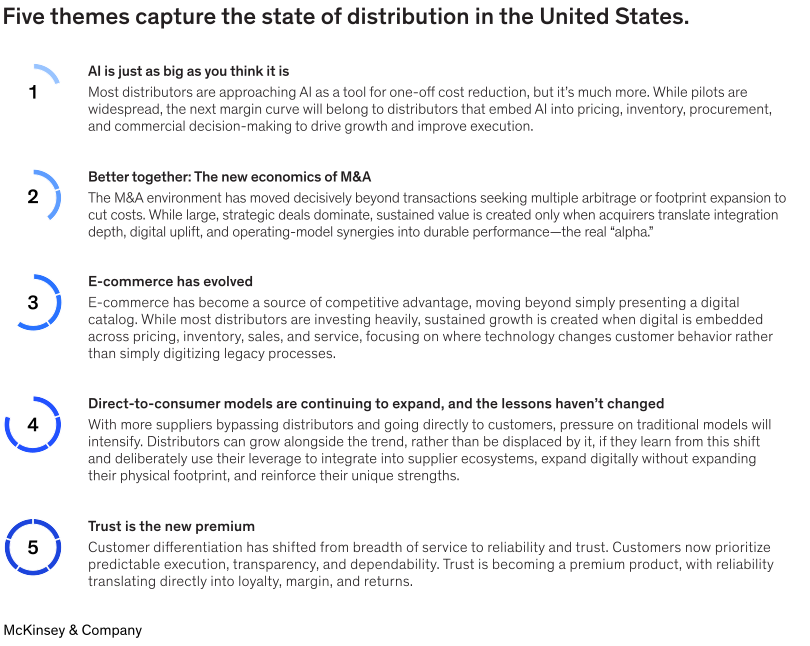
This article examines the state of distribution in the United States through five themes (Exhibit 1), highlighting examples and the critical questions CEOs should ask to assess their position. The forces reshaping the industry are demanding, but they also present a narrow window of opportunity. The next era of distribution is unlikely to be defined by the largest players but by those with the discipline to execute across AI, M&A, e-commerce, and D2C while building trust and reliability in the face of permanent volatility.
Theme 1: AI is just as big as you think it is
AI is no longer an experimental capability but a decisive factor through which distributors may capture the next margin curve. CEOs from nearly all publicly traded US distributors have mentioned AI and acknowledged the need to evaluate or prepare for AI-driven transformation: 60 percent have referenced AI in recent statements, presentations, or earnings calls, and 25 percent have identified AI investment as an explicit strategic priority (Exhibit 2).4
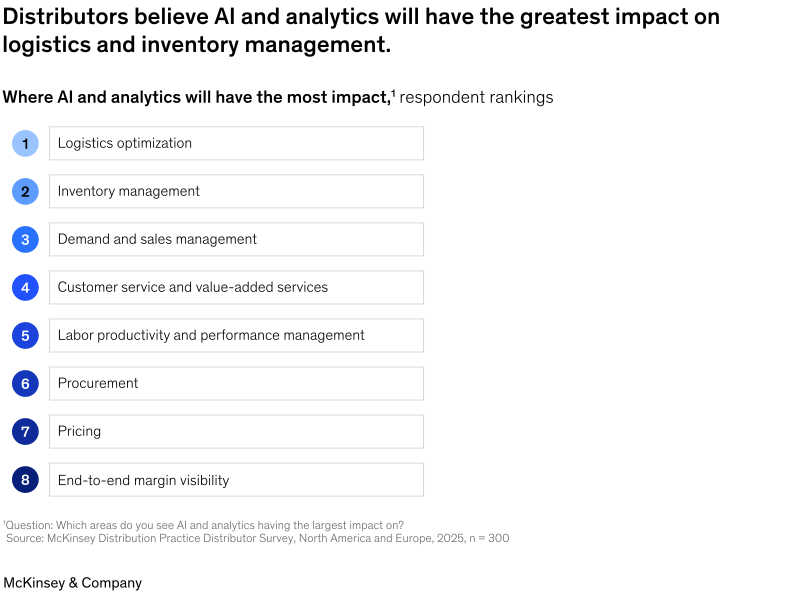
Its potential seems clear to distribution leadership teams. Our survey emphasized that digital and AI are now growth accelerants, particularly in specialty distribution, although the gap between ambition and impact remains wide. While 90 percent of distributors have AI initiatives, only 11 percent have fully adopted the technology, and among those adopting it, just 25 percent realize expected cost savings and 31 percent realize expected revenue gains.5 The constraint appears to be execution, not ambition. One CEO told us the industry has a blind spot on what AI will replace and how it may affect how distributors go to market, with little clarity on speed of execution.
Incremental automation will not close this gap. Distributors generating real impact are embedding AI directly into the physical and decision workflows that define the cost structure and commercial performance—pricing, procurement, inventory management, and customer engagement. In our experience with procurement, for example, companies integrating AI across strategy, sourcing, negotiation, purchasing, and value preservation typically achieve savings of 15 to 35 percent, as well as 90 percent greater efficiency. This helps establish a new, more defensible margin edge.
Commercial performance is diverging for similar reasons. A large building-equipment distributor implemented an AI‑enabled sales‑coaching tool compressing hundreds of hours of memo preparation into minutes, freeing managers to focus on frontline performance while improving coaching quality. A leading construction-materials distributor equipped more than 2,000 sellers with a gen AI–powered analytics platform that integrated internal and third‑party data, surfaced cross‑sell and whitespace opportunities, and generated tailored outreach at scale, unlocking thousands of missed opportunities and increasing value capture from existing accounts. Another North American building‑materials distributor with more than 400 branches unified fragmented data sources into a single commercial platform, automated lead identification and prioritization, and uncovered more than $4 billion in opportunity value within weeks. Managers reclaimed two to five hours per week, and outreach expanded more than 25‑fold. As one regional leader put it, the new transparency and discipline were a “game changer” that enabled managers to hold teams accountable with real data.
These examples point to a structural shift in how distribution businesses create value. AI is not simply automating tasks but reshaping the operating model and redefining workforce productivity. Distributors combining these enablers with a value-driven approach may be able to not only protect today’s margins but also decide who captures the next margin curve.
Theme 2: Better together: The new economics of M&A
M&A in distribution has entered a fundamentally different phase, reflected in both the scale and composition of recent transactions. Increased deal value made 2025 a blockbuster year for distribution M&A (Exhibit 3), with average deal value rising about 260 percent from $85 million in 2024 to $310 million as of October 2025 as the number of deals fell from 276 to 153 in the same period. This increase was not driven by a resurgence of traditional roll-ups but by a series of industry-shaping acquisitions led by deep-pocketed retailers and investors making strategic bets on the construction professional market. Transactions such as Home Depot’s acquisitions of SRS and GMS, Lowe’s purchase of FBM, and QXO’s acquisition of Beacon and Kodiak represent large-scale platform moves rather than the aggregation of small local and regional distributors.
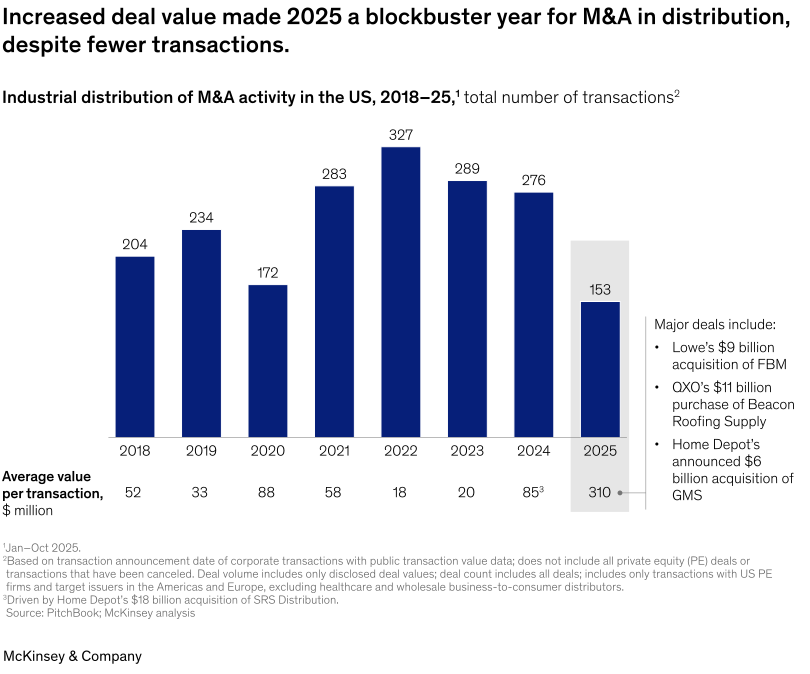
Together, these transactions signal a shift from gradual, long-term consolidation to rapid disruption. The slowdown in deal count reflects the impact of higher interest rates and market volatility on traditional roll-up strategies. At the same time, well-capitalized strategic players see distribution, particularly in building products, as an attractive structural growth market. Their entry is accelerating valuation multiples, intensifying competition for scaled assets, and reshaping expectations of what transactions must deliver.
For more than a decade, distributors could create value through geographic expansion, branch density, and multiple arbitrage. Scale itself generated returns. Today, higher entry multiples, increased competition for quality assets, and more-sophisticated sellers have eliminated easy financial upside. Buyers can no longer rely on valuation spreads or density alone to justify transactions. Sellers increasingly expect to participate in synergy value, and capital markets scrutinize integration outcomes more closely than ever. The margin for error has narrowed.
Value creation now depends on integration depth. Acquisitions must deliver commercial alignment, unified pricing engines, shared data infrastructure, supply chain coordination, and operating model redesign. Wesco International’s 2020 merger with Anixter illustrates this shift. The transaction was designed not merely to increase scale but to combine complementary portfolios, deepen customer relationships, and build a stronger go-to-market platform. By integrating sales teams, harmonizing data, and emphasizing cross-selling rather than relying solely on cost synergies, Wesco reshaped its commercial engine. Pro forma sales increased by approximately $5 billion from premerger levels, EBITDA more than doubled, margins expanded by roughly 210 basis points, and TSR exceeded 300 percent through the end of 2023.6
The M&A environment has decisively moved from “bigger is better” to “better together.” Distributors that treat M&A as a catalyst for capability building and disciplined integration will continue to compete in an increasingly demanding M&A landscape. Those relying on legacy consolidation strategies may find that scale without integration is no longer a sustainable advantage.
Theme 3: E-commerce has evolved
Digital has crossed a structural threshold, with 93 percent of major public distributors reporting significant digital investments and 57 percent of buyers now ranking digital as their primary purchasing channel, up from 33 percent in 2022.7 It is no longer a channel layered onto distribution but is becoming the channel of choice around which go to market should be designed.
Expectations are rising just as quickly. Real-time inventory visibility, transparent pricing, seamless omnichannel execution, and self-service tools are no longer differentiators but baseline requirements. Leading distributors are not building better digital catalogs but connected systems that integrate online, mobile, counter, field sales, pricing engines, and supply chain into a unified, data-enabled architecture. Digital is becoming the backbone of commercial execution (see sidebar “One e-commerce size does not fit all”).
Yet despite the surge in investment, performance outcomes remain uneven. Few distributors see digital as a growth engine rather than a cost center (Exhibit 4), and digital initiatives often operate alongside the commercial organization rather than within it. Legacy systems constrain execution. Pricing, assortment, inventory, and sales activation remain disconnected from the digital layer. The result is a widening gap between spending and impact.
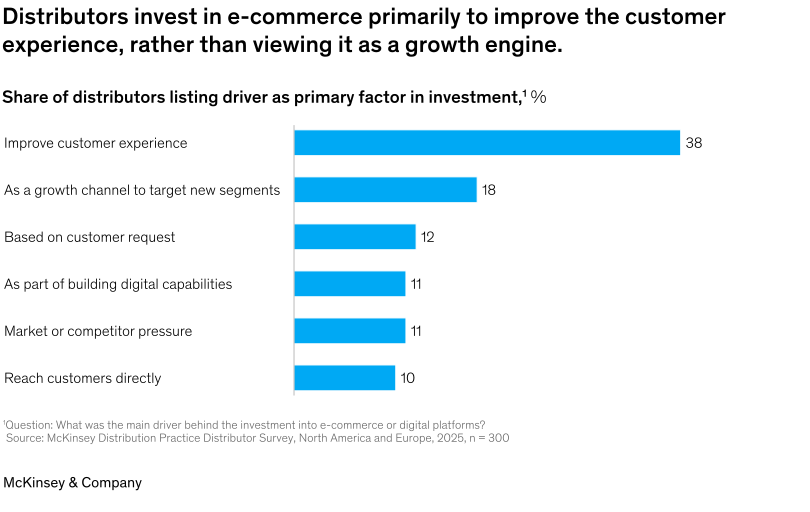
The challenge appears to be insufficient integration rather than insufficient investment. Distributors may digitalize the interface but not the economics, launching platforms without embedding digital into pricing discipline, inventory optimization, demand forecasting, and sales workflows. Smaller players face additional constraints—limited capital, lower digital fluency, and customer segments that may not require full-scale e-commerce transformation—but scale alone does not determine success. What differentiates leaders is how deeply digital is embedded into the operating model.
A small group of outperformers illustrates what integrated digital looks like in practice.
For example, a leading MRO (maintenance, repair, operations) distributor has built an integrated ecosystem, linking pricing, product data, and supply chain systems into a unified architecture. Intelligent search, automation, and self-service tools have turned digital into both a profit engine and a loyalty platform. By early 2025, digital accounted for roughly 30 percent of total sales, supporting revenue growth of approximately 4 percent from 2023 to 2024 and roughly 5 percent in the trailing 12 months of 2025.
Another industrial distributor rebuilt its e-commerce and mobile platforms between 2021 and 2024, streamlined reordering across 19 million SKUs, and integrated AI-driven personalization tools. Digital was elevated to a strategic priority with dedicated executive ownership. While broader industrial softness weighed on demand, omnichannel capabilities appeared to be stabilizing performance with double-digit growth over the past few years, despite the slowdown.
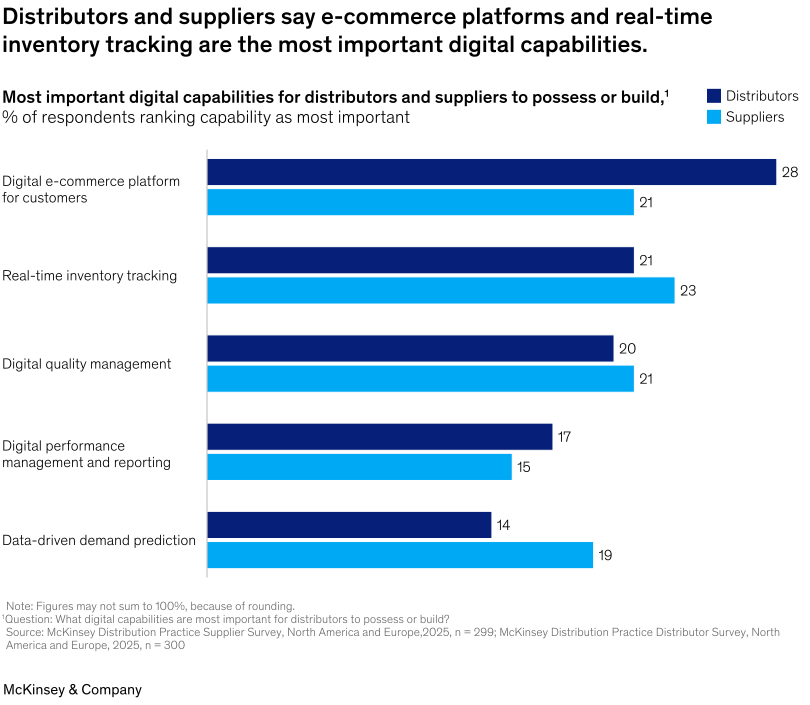
The divergence is clear. Digital is no longer a channel layered onto distribution—it is the business model itself. Customers expect real-time visibility, integrated service, and consistent execution. Suppliers prioritize partners that can connect data, pricing, inventory, and service into a single ecosystem (Exhibit 5). Distributors that redesign their operating models around digital integration are likely to define the next phase of competition, with those treating digital as a storefront rather than a system potentially at risk of becoming intermediaries in ecosystems they do not control.
Theme 4: Direct-to-consumer models are continuing to expand, and the lessons haven’t changed
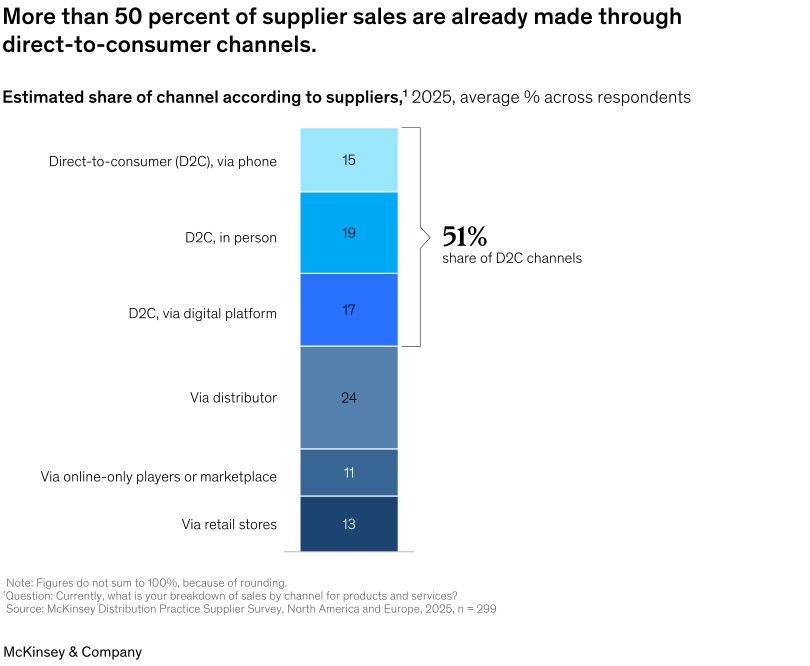
Suppliers have long experimented with bypassing distributors to sell D2C, especially during market slowdowns. However, we have recently seen investments and resources being deployed to expand D2C, with the objective of achieving higher margins, getting closer to customers, and having stronger brand control (Exhibit 6). In 2025, 86 percent of suppliers expected to expand D2C investments, and 72 percent expect D2C sales to grow by more than 25 percent during the next two years, which undermines the role of distributors.8 AI makes this more feasible for both suppliers and customers because it creates a near instantaneous ability to aggregate product information, availability, pricing, and quality insights without a distributor in the middle. Distributors are aware of this trend: Some 65 percent are bracing for at least 10 percent of current sales to bypass them within the next 12 months, according to McKinsey analysis.
Distributors staying ahead of the competition aren’t seeking to challenge the rise of D2C but to redefine their role within it. Leading distributors are doubling down on what makes them unique by expanding their assortment, building their technical expertise, expanding their logistics infrastructure, and deepening their customer relationships with digital touchpoints (such as the ease of doing business, responsiveness, and trust). Many are using their own AI and data capabilities to more effectively address customer friction, given that strengthening their value proposition is a strong moat against the rise of D2C and a platform to expand beyond core offerings.
As an example, one distributor noticing a supplier was moving core products D2C sought to underline its importance to that supplier by highlighting customer dependence on more than $50 million in accessory inventory held locally. That availability was essential to keeping projects on schedule, prompting the supplier to reconsider further disintermediation. In this way, the distributor made it clear it retained its leverage by asserting it deliberately.
Theme 5: Trust is the new premium
The basis of competition in distribution is shifting from service breadth to reliability.
For years, distributors expanded assortments, channels, and value-added services to meet rising expectations. That model appears to be losing its effectiveness. In an environment defined by supply volatility, labor constraints, and pricing pressure, customers seem to no longer reward optionality but instead prioritize certainty, reliability, and consistency. Trust, anchored in reliable execution, seems to drive customer loyalty.
Customers expect distributors to deliver what they promise: product availability, accurate delivery, and transparent pricing (not the lowest prices). When those expectations are met consistently, trust compounds. As digital tools and AI increase visibility into performance, failures that were once tolerated are now exposed in real time. Many distributors are yet to adjust. Execution remains a challenge, with customers increasingly expecting consumer-grade performance with real-time inventory, accurate ETAs, breadth and depth of products, technical expertise, ease of doing business, and transparent pricing.
The bar is also getting higher and moving beyond merely having the product be enough. According to McKinsey analysis, 49 percent of customers now rank value-added services among their top three buying criteria—a 1.7-times increase from five years ago—and what they value within those services has also evolved. Reliability, transparency, and responsiveness now define service quality.
Leading distributors are responding by embedding reliability into their operating metrics—investing in real-time inventory accuracy, predictive fulfillment, dynamic pricing, and proactive communication. These capabilities turn trust into a scalable performance engine that drives retention, share of wallet, and pricing power. The implication is clear: Trust is earned through delivery, and distributors able to institutionalize reliability have the opportunity to secure customer relationships that may be difficult to displace.
Putting it all together
The next era of distribution is likely to be defined not by scale alone but also by the ability to execute an integrated agenda across interdependent forces. Digital is the operating model and AI the margin engine. M&A is the capability accelerator and D2C a channel to integrate, not resist. Trust and reliability earn customer loyalty. Competitive advantage is likely to be determined by how these elements reinforce one another.
Yet this shift requires fundamental choices about where to play, where to double down, which capabilities to build versus buy, and how to redesign the operating model to support a different way of competing. Incremental change is unlikely to be enough, and the window to act may narrow. We already see a widening performance gap between leading distributors and their competitors that may accelerate during the next two years. The implication is clear: Distributors may need to redefine their role in the value chain sooner rather than later to remain central as the industry evolves.