Increasingly powerful AI models are enabling new applications and creating more economic value, which, in turn, accelerates adoption and drives demand for ever greater computing power. This conforms with the economic principle known as the Jevons paradox, in which tech advances that allow more efficient use of a resource lead to rising consumption of that resource. As computing intensity rises, so do the energy requirements of AI data centers. Overall, their electricity demand is expected to grow considerably through 2030, with AI workloads accounting for about 70 percent of the increase.
In the most modern data centers, which are often run by hyperscalers, software and processing developers, and AI-native companies, the racks that hold computing components have electricity requirements that traditional, low-voltage delivery systems were not designed to match. At these higher rack densities, use of conventional power architectures can create undesirable knock-on effects, including electricity conversion losses, increased heat emissions, and overly complex power distribution.
To address these problems, data centers could shift toward newer power architectures. In place of 480- or 415-volt alternating current (480/415 VAC), which are now commonly used to deliver 48-volt direct current (DC) to racks, data centers could use higher-voltage DC. One such approach, which may gain ground as leading companies and industry consortiums set standards, involves using 800-volt DC (800 VDC) systems,1 which have lower current requirements. These systems can move power distribution closer to racks, which reduces distribution losses, improves scalability and fault isolation, and better supports the high power densities and thermal demands of modern AI data centers. At the gigawatt scale of modern data centers, even marginal efficiency gains can add significant operational and economic value.
An increase in 800 VDC systems could shift profit pools from metal-intensive, low-voltage switchgear and legacy alternating current (AC) systems used in most data centers. Instead, newer, high-voltage-friendly DC platforms and components would be in greatest demand. This development could open the ecosystem to new entrants, as well as companies in adjacent industries.
To help both new and incumbent suppliers of electricity and components capture opportunities, this article explores the forces prompting the move to 800 VDC systems, potential shifts in equipment demand, the evolving competitive landscape, and the strategic considerations for companies navigating the transition.
The need for better power systems at data centers
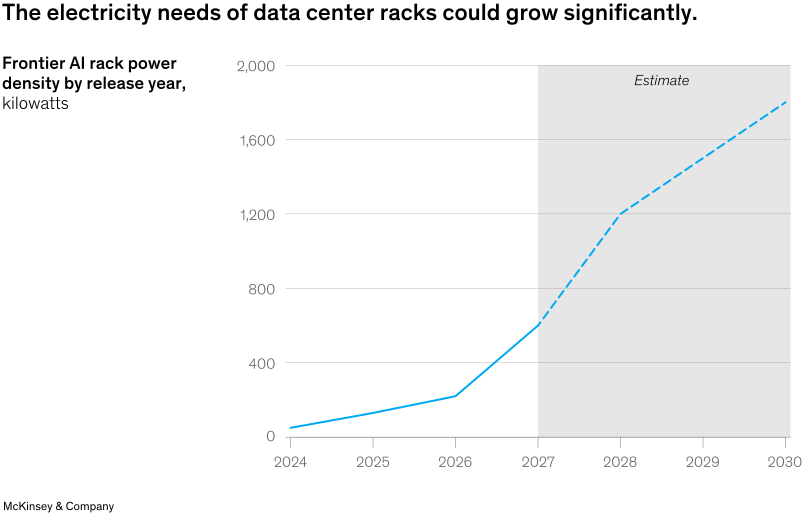
Today’s AI-focused data centers are packing computing power more densely into each rack than ever before, increasing energy consumption. Previous electricity needs of less than 50 kilowatts per rack are now climbing to 200 to 600 kilowatts per rack (Exhibit 1). If the current trajectory continues, energy requirements could reach about one megawatt per rack later this decade.
At higher rack densities, traditional 480/415 VAC power systems must carry extremely large currents—more than 700 amps per phase for a rack drawing 500 kilowatts or more. Accommodating these currents requires larger cables, connectors, and breakers, increasing the infrastructure footprint and making heat management more difficult.
The inefficiencies of low-voltage systems extend beyond current carrying capacity. Because power enters the facility as medium-voltage AC but chips and servers ultimately operate on low-voltage DC, conventional architectures require multiple conversion stages throughout the power chain. Each conversion introduces efficiency losses (typically 1 to 3 percent per stage), generates additional heat, and requires equipment that consumes valuable white space and electrical infrastructure.
Systems with 800 VDC address many of these limitations. They deliver the same power as 480/415 VAC while carrying roughly half the current, reducing conductor size, copper requirements, and the footprint of electrical infrastructure. Because high-voltage DC can be distributed directly throughout the data center, fewer power-conversion stages are needed as electricity moves from the grid to computing equipment. This simplifies the electrical architecture, reduces conversion losses, and gives operators greater flexibility to optimize power distribution and use space more efficiently.
Higher-voltage DC also reduces I²R losses—the energy dissipated as heat—improving overall electrical efficiency. At gigawatt scale, even modest reductions in electrical losses can meaningfully improve power usage effectiveness (PUE), reduce total grid demand, ease power constraints that can delay deployment, and lower long-term operating costs.
Together, these technical improvements can translate into meaningful economic value. By reducing electrical losses, shrinking the electrical footprint, and freeing space for higher-density computing, 800 VDC architectures can lower infrastructure costs while increasing revenue-generating capacity. Early industry estimates suggest that native 800 VDC systems could reduce capital expenditures on non-IT infrastructure by approximately 15 to 18 percent and power-related operating expenditures by about 8 to 10 percent, although realized savings will depend on deployment architecture and the extent of retrofit requirements.
Potential shifts in equipment demand
Amid the shift toward next-generation power architectures, major changes in data center electrical infrastructure could emerge: Overall, the equipment mix across the data center could shift away from copper- and iron-intensive electrical infrastructure and toward semiconductors, power electronics, control software, and DC-native protection technologies that can handle fault isolation, circuit interruption, and surge management.
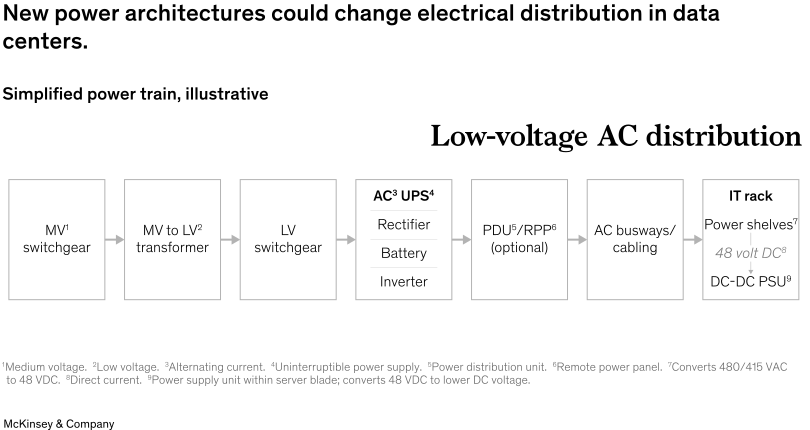
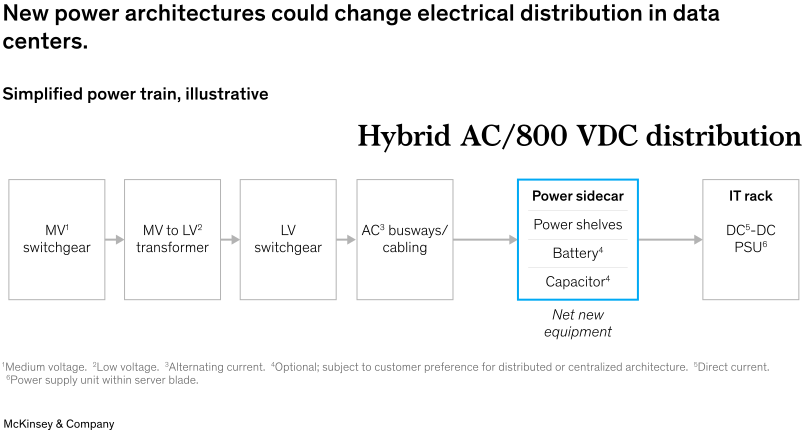
Some equipment categories—such as low-voltage switchgear rooms, uninterruptible power supply (UPS), floor power distribution units, per-server power supply units, and AC-rated rack power distribution units and busways—could see reduced or reconfigured demand. By contrast, DC-rated busways and DC-native backup power systems could expand or be newly emergent. Likewise, DC-rated breakers, connectors, and insulation systems could become critical gating components.
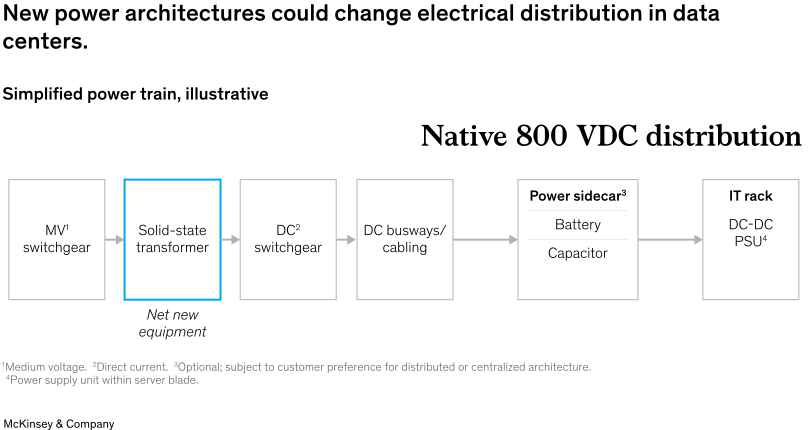
Some of the most significant changes may involve two pieces of equipment (Exhibit 2):
- solid-state transformers (SSTs), which use power electronics and semiconductor switches—instead of relying primarily on large copper windings and an iron core—to convert and control electricity
- power sidecars, which are external power units installed next to server racks
These devices could alter equipment requirements, shift value pools across suppliers, and influence the pace at which data centers move from incremental upgrades toward fully DC-native architectures. If SSTs enable fully DC-native architectures, they could simplify or eliminate portions of the traditional low-voltage electrical stack altogether.
Power sidecars
Power sidecars allow today’s AC‑dependent facilities to deploy high-voltage DC by rectifying current (converting it from AC to DC) close to the rack, cutting both distribution losses and copper usage. While some experts view power sidecars as a transition bridge toward fully DC-native architectures, others see them as a durable long-term approach.
Centralizing power conversion and protection in a dedicated sidecar rather than within every rack simplifies the electrical architecture and frees rack space for IT equipment. It also creates a standardized high-voltage DC interface, making it easier to scale to higher rack power levels and adopt future power technologies. As a result, power sidecars offer a practical pathway to facility-level DC distribution without requiring changes to rack architecture.
A power sidecar can integrate several functions in a single module, including:
- AC input handling and electrical protection
- high-efficiency conversion to high-voltage DC
- battery and capacitor backup for power continuity
- high-voltage DC distribution to one or more racks
- monitoring, fault management, and telemetry for facility power management
SSTs at the facility boundary
Solid-state transformers (SSTs) can accelerate the transition to 800 VDC by converting medium-voltage AC directly into high-voltage DC at the facility boundary, rather than near individual racks. By consolidating multiple power-conversion stages into a single, high-efficiency bidirectional system, SSTs can reduce electrical losses, lower copper requirements, and shrink the infrastructure footprint across the data center.
By delivering a native high-voltage DC backbone into the data hall—the main room housing server racks and other computing equipment—SSTs eliminate the need for rack-adjacent rectification and simplify power distribution to standardized DC racks. This enables fully DC-native architectures in which multiple functions share a common DC bus, supporting higher rack densities and tighter integration than sidecar-based retrofits.
Unlike conventional transformers, which rely on large iron cores and copper windings, SSTs use power electronics based on wide-bandgap semiconductors such as silicon carbide (SiC) and gallium nitride (GaN), together with high-frequency magnetics. If commercialized at scale, they could enable more compact power conversion, greater digital control, and faster deployment.
McKinsey analysis suggests that SST-based 800 VDC architectures could reduce non-IT capital expenditures by 15 to 18 percent, lower annual energy-related operating costs by 8 to 10 percent, and reduce copper usage by 40 to 50 percent relative to comparable AC systems. Long lead times for conventional transformers—which can stretch to several years in constrained markets—may further strengthen the case for adoption.
Industry analyses suggest that SST-based 800 VDC architectures could reduce capital expenditures by $4 million to $8 million per 10 megawatts of capacity, lower annual energy-related operating costs by 8 to 10 percent, and reduce copper usage by 40 to 50 percent relative to comparable AC systems. Long lead times for conventional transformers—which can stretch to several years in constrained markets—may further strengthen the case for adoption.
Several hurdles remain before SSTs can be deployed at scale. Because they would serve as mission-critical infrastructure expected to operate reliably for decades, operators will need greater confidence in their long-term performance. Costs for power electronics must continue to decline to make the economics work, and standards, service models, and operating practices remain less mature than those supporting conventional transformer-based systems.
Until SSTs become commercially viable at scale, transformer-plus-rectifier architectures are likely to serve as an intermediate step, enabling facility-level 800 VDC distribution using proven technologies. As technical and commercial barriers are addressed, SSTs could accelerate the shift to fully DC-native data centers, particularly in greenfield AI campuses designed around a high-voltage DC backbone from the outset.
New entrants, converging industries, and established incumbents could reshape the competitive landscape
If 800 VDC becomes the standard for high-density AI data centers, the addressable market for compatible equipment, semiconductors, and rack-level power systems could expand rapidly over the next five to ten years. The competitive landscape could evolve in tandem, as the transition attracts a broader set of players. New entrants from adjacent sectors could play important roles. System-level engineering capabilities, software and controls expertise, ecosystem partnerships, manufacturing scale, and direct hyperscaler relationships could emerge as key sources of competitive advantage and potentially sustainable moats.
This evolution is reshaping traditional industry boundaries. Competitive differentiation may shift from individual components toward integrated systems as providers of white-space infrastructure—equipment deployed inside the data hall—expand into gray-space electrical systems outside the data hall, while gray-space suppliers move closer to the rack through integrated power modules and software-defined controls. Higher rack densities are also driving tighter integration between power and cooling systems, encouraging collaboration across OEM categories that have historically operated independently. Hyperscalers, meanwhile, may deepen vertical integration in rack-level power modules to improve performance, reliability, and supply-chain resilience.
A broader range of companies could also compete for these emerging opportunities. Power-conversion specialists in renewables, electric-vehicle (EV) charging, and industrial drives (high-power AC-to-DC-to-AC converters) already possess capabilities in high-power conversion that could be applied to rectification, SSTs, and other processes and components. The automotive industry has already industrialized 800-volt EV platforms, creating expertise in high-voltage inverters and power modules, insulation systems, fast DC switching and protection, and thermal management. Several automotive suppliers have recently signaled plans to expand into adjacent electrification markets.
Established electrical-equipment companies bring important advantages, including installed customer bases and long-standing relationships with hyperscalers. However, companies with significant exposure to traditional AC-centric electrical infrastructure could face disruption as higher-voltage DC architectures gain traction. The transition is also attracting a growing number of venture-backed start-ups focused on SSTs, rack-level power systems, DC protection, and integrated power and cooling architectures, with several companies collectively raising hundreds of millions of dollars in capital in recent years.
The most significant opportunities may emerge during the transition window, while architectural standards, supplier ecosystems, and customer relationships are still taking shape. As rack power densities continue to rise, deeper integration of power and cooling systems, together with advances in power semiconductors, could accelerate the evolution beyond today’s 800 VDC architectures toward fully DC-native data centers. Companies that establish capabilities and partnerships during this transition may be best positioned to shape—and benefit from—the next generation of AI infrastructure.
Navigating the transition to 800 VDC
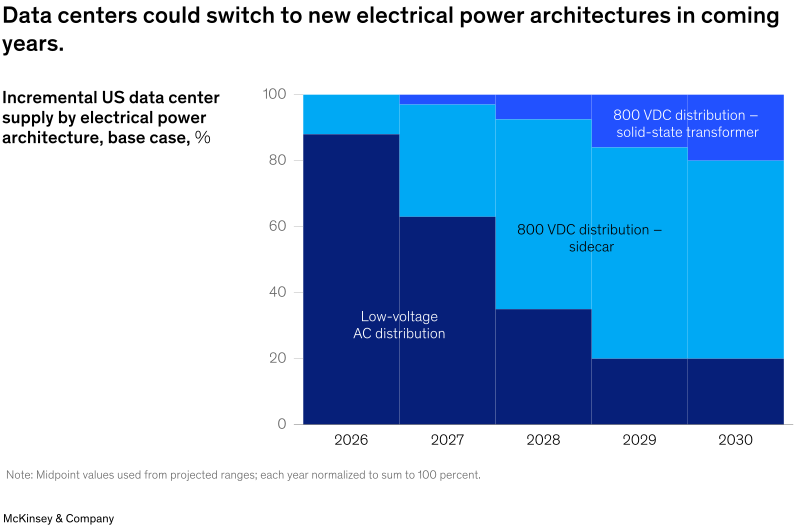
McKinsey research suggests many data centers could be switching to new power technology in the coming years (Exhibit 3). In the near term, operators are likely to adopt a hybrid approach, layering high-voltage DC distribution onto largely AC-based facilities through power sidecars or deploying DC architectures within dedicated AI pods. The pace of rack power density increases will likely be a primary trigger for large-scale architectural shifts.
Broader adoption will depend on continued technical, operational, and ecosystem development. The pace of the transition will likely be shaped by several factors:
- Safety. This issue remains a primary barrier because 800 VDC introduces materially different shock, fault, and arc flash risks than today’s 48-volt rack power, requiring new protection strategies and operating procedures. Operators cannot simply copy existing AC practices.
- Industry standards. Testing methods, equipment requirements, and installation guidelines for 800 VDC data centers remain less mature than those for legacy AC systems, requiring continued collaboration among vendors, operators, and standards bodies.
- Workforce readiness. Electricians, operators, and IT personnel will require new training, personal protective equipment, access controls, and maintenance procedures to work safely around higher-voltage DC systems.
- System integration. Coordinating grounding, insulation, energy storage, and controls across the power chain requires an end-to-end system architecture rather than point solutions, although integration capabilities are improving.
The economic case for 800 VDC will also vary by deployment model. Greenfield AI-dedicated campuses are likely to capture greater structural benefits than retrofit-intensive enterprise or colocation environments.
Industry leaders can consider strategic implications
Differences in economics, technology readiness, and competitive positioning have important implications across the data center value chain. The following stakeholder groups may wish to consider how evolving power architectures could reshape their competitive positions:
- Power OEMs can identify which parts of the traditional electrical stack remain advantaged as architectures shift toward higher-voltage DC distribution. Exposure to legacy switchgear, transformers, and power distribution units (PDUs) may create margin pressure, while opportunities could emerge in DC busways, protection systems, power shelves, power sidecars, and SSTs.
- Cooling OEMs can evaluate how higher rack densities could accelerate demand for liquid cooling, coolant distribution unit (CDU) platforms, and rack-integrated thermal management. Competitive advantage may increasingly depend on delivering integrated cooling and power solutions rather than standalone equipment.
- Server and rack OEMs can prepare for changes in power conversion and rack architecture that could reshape system integration requirements. Capabilities in rack-scale integration, power orchestration, and codesign with hyperscalers and silicon providers may become increasingly important.
- Component suppliers can identify where demand could increase for enabling technologies such as power semiconductors, connectors, busbars, insulation materials, and DC protection devices. Suppliers tied primarily to legacy AC components may face slower growth as DC-native architectures scale.
- Semiconductor providers can position for growing demand for wide-bandgap semiconductors, power management integrated circuits (ICs), and monitoring and control solutions that support greater efficiency and higher rack densities.
- Capital allocators can identify where profit pools could expand—particularly in power semiconductors, modular conversion platforms, DC protection, and integrated rack systems. Long-lead investments in large, low-voltage electrical infrastructure may face higher obsolescence risk as demand shifts toward high-density AI deployments.
- Operators can determine the rack power density thresholds at which conventional AC distribution becomes operationally inefficient or physically impractical. Developing DC-ready data center designs, safety protocols, supplier partnerships, and in-house high-voltage DC expertise early could position organizations ahead of broader industry adoption.
The move to 800 VDC represents a structural shift in how power is delivered inside AI data centers. It could alter the physical design of facilities, redistribute value across the supply chain, and create a transitional window for new strategic approaches. Leaders who anticipate interface control points, secure ecosystem partnerships, and align capital allocation with newly emerging architectures could be positioned to capture significant returns as the AI infrastructure buildout accelerates.