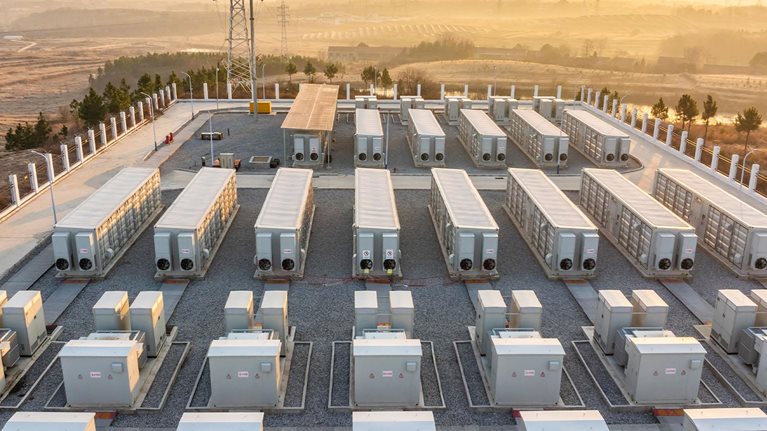
The global energy landscape is undergoing a profound transformation, including the increased deployment of renewable power. Solving grid challenges will require major adjustments, and many countries are already making improvements. As one example, annual grid investment in the European Union and United Kingdom is expected to reach $120 billion by 20301. Some countries are upgrading transmission networks or adopting digital grids that provide real-time data and automate management tasks, while others are using new mechanisms to influence demand, such as spot tariffs for end users. Another popular solution involves deploying new assets that provide greater flexibility when managing supply and demand. While operators can choose from several assets to gain flexibility, many are finding value in battery energy storage systems (BESS). These systems have existed for years, but their deployment accelerated significantly in the early 2020s.
By storing excess energy and discharging it when supply is tight, BESS can reduce system stress and help manage net supply and demand spikes. Recent technology innovations also allow BESS to provide crucial services, including voltage and frequency regulation and even synthetic inertia to stabilize grids. The global BESS market is now growing rapidly and is expected to reach a value of $120 billion to $150 billion by 2030. Each market has distinct characteristics, including country-specific regulatory guidelines and differing opportunities for value creation, that require a unique strategy. To succeed in this diverse space, developers must identify market-specific challenges and opportunities, generate the highest revenue possible through stacking and other mechanisms, and improve procurement and cost management capabilities. In addition to attracting capital, these efforts will help developers create long-term value.
Batteries are leading the way in energy storage solutions
The need for better battery energy storage systems is intense. Worldwide energy demand is expected to increase 130 percent between 2023 and 2050, going from 31,000 terawatt-hours to 66,000 terawatt-hours.2 Meanwhile, renewable power is presenting more challenges. In 2024, for instance, German operators were forced to curtail around 9.4 terawatt-hours of renewable power production because of transmission system bottlenecks and distribution capacity issues.3 Other countries with high renewables use, including Chile, China, Great Britain, and Ireland, are experiencing similar issues.
While legacy energy storage technologies, such as hydropower or flywheels, depend on extensive mechanical infrastructure and require significant engineering and construction work, BESS4 are easier to deploy, require less space, and have modular components that contribute to faster installation times. BESS are also less expensive than legacy systems, largely because of rapidly declining battery prices and increasing product densities, and have improved technology. For instance, if a grid operator signals that voltage is fluctuating outside of system limits, BESS can respond more quickly than many legacy systems.
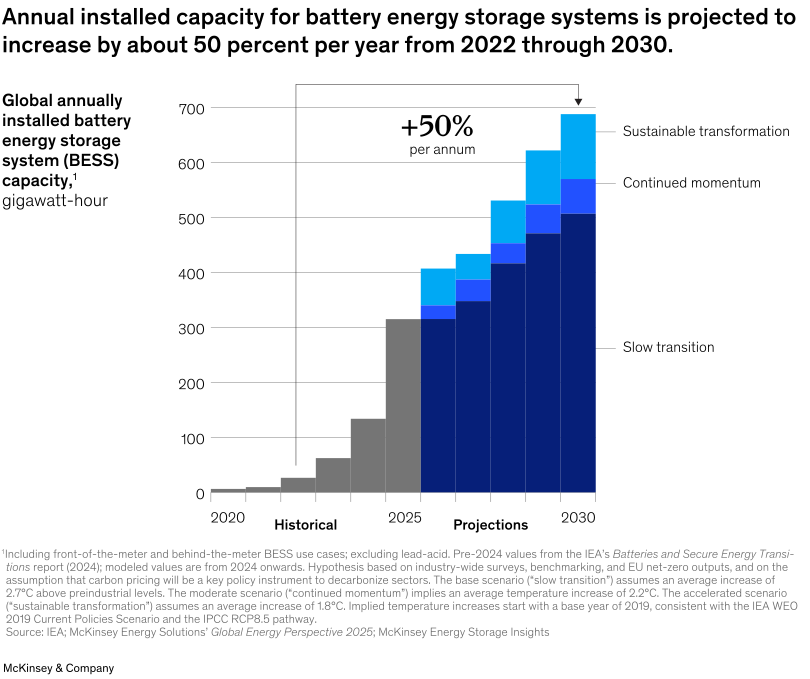
Operators can deploy BESS in combination with more traditional, large-scale grid improvement efforts, such as the installation of new powerlines, that are designed to expand and modernize aging grids. While the traditional grid improvement projects enhance long-term resilience, they often involve lengthy development timelines and high costs, making BESS a valuable interim solution. Partly because of these advantages, new BESS installations are surging across the globe. A McKinsey analysis of three different future scenarios concluded that installed capacity for BESS could grow by about 50 percent annually in each one from 2022 to 2030 (Exhibit 1).5
Strategies for success: Three imperatives
For BESS developers, opportunities and obstacles may vary by location. What’s needed to thrive is a deep understanding of three areas:
- market features, including the regulations, revenue potential, and incentives that may affect value
- solid revenue generation strategies, including the need for revenue stacking
- strategies for improving procurement and cost-management capabilities, including those related to negotiating with vendors and minimizing operating expenses
Identifying market-specific challenges and opportunities
To identify the most lucrative and viable project pipelines, developers must thoroughly understand diverse market structures, grid regulations, and bottlenecks across geographies. As they investigate opportunities, they may benefit from building constructive relationships with stakeholders, including transmission system operators (TSOs)/distribution system operators (DSOs), regulators, local community leaders, and industry bodies. Developers that improve their grid modeling capabilities and digital tools may gain the best understanding of local investment priorities and the most attractive development sites.
Regardless of the location under investigation, developers should understand three factors in each market that may have the most significant impact on BESS value:
Regulations. In many markets, BESS developers face lengthy permitting processes, requiring negotiations with various stakeholders, including local authorities, TSOs/DSOs, and regulators. Lithium-ion based BESS are subject to particularly close regulatory oversight because of potential risks, including fire. In Europe, developing and connecting BESS typically takes between three and seven years, and rapidly lengthening grid queues may further extend the timelines. If a BESS project requires land rezoning or major grid infrastructure upgrades, it could be delayed for months or even years.
BESS regulations are much more stringent in some regions than in others. In the United States, developers are encountering permitting delays following recent incidents, such as fires in several facilities, that have prompted stricter fire and safety codes. In the United Kingdom, stringent codes have contributed to a backlog in approvals, but regulators and the national system operator have recently approved reforms to prioritize and fast-track mature energy projects, including BESS. Because the reforms allow developers of near-term viable projects to avoid lengthy, multiyear grid connection queues, many early-stage projects were removed or lost their place in the queue.
For developers, it is crucial to be aware of potential changes in regulations in each of their target markets and how these will affect the overall opportunity. In addition, with changing regulations, developers need to remain agile in the deployment of their assets, as revenue pools will likely shift.
Revenue potential. At a macro level, markets that have a higher share of renewables could offer higher margins for BESS providers, since their services will be in greater demand. A recent McKinsey analysis found that renewable energy accounted for 55 percent of Spain’s electricity in 2025; by 2030, BESS owners could see gross margins of about €40,000 per megawatt per annum from energy arbitrage (assuming two-hour discharge).6 In other European markets, however, gross margins could exceed €100,000 per megawatt per annum for a two-hour BESS in some years, when additional revenues generated by balancing supply and demand are included.
The location of BESS within a particular country can also affect overall return on investment. In rural areas, for instance, BESS providers typically benefit from lower land costs but often encounter grid connection challenges. Areas with rapid demand growth and constrained grid buildout may also offer greater returns for BESS projects because of operational dispatch advantages and greater support for grid infrastructure support.
Incentives. Developers must also determine if any countries offer particular advantages that may compensate for certain regulatory constraints. Some, for instance, may offer incentives for renewable-energy innovators to support BESS development.7 For instance, the UK Battery Strategy, a government-backed program, provides more than £2 billion in capital to build competitive supply chains.8 Similarly, Germany holds EEG9 innovation auctions as which companies bid for the right to a market-based subsidy. The winners receive a premium of €70 to €85 per megawatt-hour. To date, BESS developers have won premiums for 820 megawatts of capacity; premiums for an additional 1.5 gigawatts will be applied to BESS installed before August 2029. Italy has also recently completed its first landmark MACSE10 capacity auction and procured ten gigawatt-hours of targeted capacity at highly competitive prices, putting pressure on the developers to achieve their profitability targets.
Generating the highest revenue possible through stacking and other mechanisms
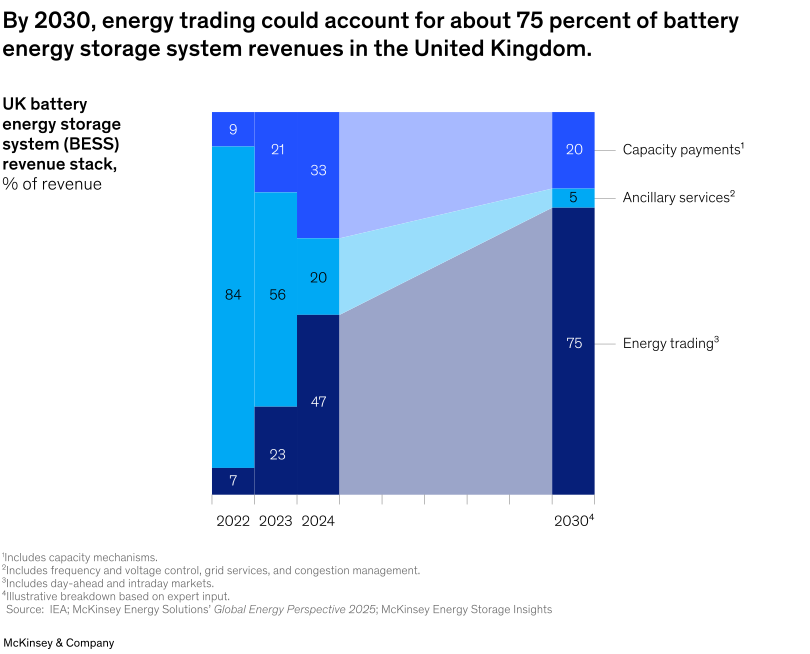
As more BESS come online, the intensifying competition will limit revenue potential as the industry undergoes a form of cannibalization: As more batteries are installed, fewer gaps will exist between energy supply and demand—and that will reduce the need for ancillary grid support services from developers, such as short-term grid balancing. A McKinsey analysis of BESS revenues in Great Britain, home to many large-scale BESS deployments, shows that ancillary services represented only 20 percent of the total in 2024, down from 75 percent in 2022. In the United States, the Electric Reliability Council of Texas saw revenues from ancillary services decline from $21 per megawatt-hour in 2023 to $3 per megawatt-hour today as more than ten gigawatts of additional BESS were deployed over that period.
This decline in ancillary-service revenues has led BESS developers to shift their assets to energy trading for both day-ahead and intraday markets, in an effort to tap into deep value pools and spreads that increase with price volatility. In Great Britain, the share of total BESS revenues generated by energy trading increased from under 10 percent in 2022 to approximately 50 percent in 2024. By 2030, energy trading could account for 75 percent of total BESS revenues in Great Britain, which would be equivalent to the value generated from ancillary services in 2022 (Exhibit 2).
Three strategies are critical as developers address challenges to revenue generation:
- Optimizing route-to-market strategy. Developers should tailor their revenue-generation approach for individual markets to obtain full value from their assets and ensure sustainable growth in diverse regulatory and market environments. They should evaluate options for managing risk and increasing revenues, such as implementing tolls, revenue-sharing arrangements with guaranteed minimum payments, or merchant models, either with or without external partners. Experience suggests that developers who optimize their commercial strategy by improving market exposure and contracted revenues can, in turn, optimize their debt financing and increase their equity internal rate of return by approximately three to four percentage points.
- Following dynamic, data-driven trading strategies. BESS developers could benefit from investing in analytics, market intelligence tools, and algorithmic-trading tools that allow them to respond rapidly to price fluctuations. They could also use AI-enabled energy management to optimize dispatch schedules.11 For example, McKinsey analysis found that a BESS asset in the California Independent System Operator market could boost real-time trading revenues by 35 percent through programs that allowed reinforcement learning based on experience, compared with traditional linear programming approaches.12 Developers can also benefit from in-house efforts to optimize trading. For instance, they could first engage in shadow trading—that is, simply practice trades that do not actually involve the exchange of money—before expanding their real trading efforts. Leading BESS developers can also use data to improve fleet optimization strategies and risk-aware trading functions.
- Using BESS flexibility to enhance asset-backed structured products trading. Beyond short-term algorithmic optimization, BESS developers are now using their flexible energy storage systems to underpin structured, multiyear product bundles that include green and baseload power purchase agreements. This strategy, which requires strong pricing discipline and origination capabilities, can lead to more predictable revenues and reduce risk exposure.
Improving procurement and cost-management capabilities
Manufacturing capacity for many essential hardware elements, such as battery cells, power electronic systems, inverters, and transformers, is concentrated in a few countries. In addition, raw materials such as lithium and graphite may be subject to export limits, tariffs, and supply disruptions. In early 2025, for instance, the United States cumulative tariff rate was 64.9 percent for Chinese lithium-ion batteries for energy-storage systems. These pressures elevate costs across the clean-energy ecosystem and heighten uncertainty for developers and manufacturers.
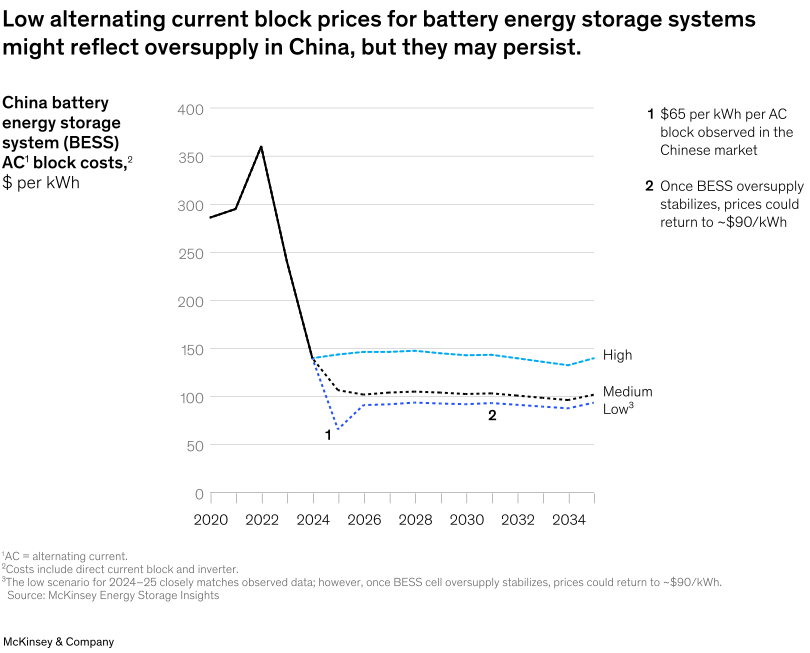
Simultaneously, however, product costs for BESS have fallen dramatically, with total costs decreasing by about 55 percent since 2019, and the price of BESS hardware, including alternating current (AC) blocks, dropping below $100 per kilowatt-hour in early 2026 (Exhibit 3). This decline primarily results from a significant increase in manufacturing capacity combined with stabilizing prices of critical raw materials used in batteries. The increase in manufacturing capacity is particularly high in China, where full system quotes for BESS have occasionally been as low as $65 per kilowatt-hour. Some analysts attribute these low prices to temporary market oversupply, but they could persist if baseline product costs remain low. The three scenarios in Exhibit 3, which are based on the cost of input components and manufacturing capacity, show how BESS costs could evolve.
The fluctuations in raw material costs, import regulations, and manufacturing capacity contribute to volatility in BESS pricing, making procurement negotiations and timing a critical factor in determining a project’s overall financial performance. Procurement outcomes vary widely for BESS developers. The leaders often have capital expenditures that are 40 percent better than those of average developers for comparable BESS projects. Project scale explains some of the difference, but contracting methodologies, and engineering, procurement, and construction excellence play a larger role.
Beyond supply chain and procurement challenges, developers may have difficulty finding sufficient BESS technical talent to cover the sourcing, design, and construction of their assets, potentially delaying deployment. Staff in short supply include engineers, specialized trade workers, and experienced construction managers. For instance, the German Economic Institute found that over 18,300 vacancies remained unfilled in energy-transition-related sectors in 2024, up 2.9 percent from 2023.13 To address the talent issue, larger developers and utilities can upskill their existing workforce to support BESS deployment. Smaller developers, by contrast, must lock in capacity well in advance of BESS deployment to ensure timely commissioning.
For operators, cost issues loom large. After final delivery of the BESS, they may find systems operation and maintenance challenging, particularly if they lack prior experience in managing such assets. Any downtime could hit their bottom line, especially if it occurs during a period of high demand. Operators may struggle to optimize operations and maintenance costs, however, because of differences in system design, variations in service agreements offered by BESS suppliers, as well as the geographic spread of the assets.
BESS developers can improve procurement negotiations and help operators manage cost challenges through the following measures:
- Optimizing system design. The use of modular, repeatable system configurations allows developers to reduce engineering and construction costs. Standard designs also streamline procurement (for battery modules, inverters, and other components), reduce supply chain risks, and simplify maintenance. When designing BESS, developers should think about future operational needs and technology advances to help them optimize costs related to augmenting and maintaining systems. Further, novel approaches to system delivery, including generative scheduling, may shorten the interval between the final investment decision and commercial operation date by six to 12 months. This acceleration can have a substantial impact, especially in countries with decreasing revenues from merchant BESS activities.
- Enhancing BESS sourcing. To improve procurement, developers should enhance their negotiation capabilities with suppliers and consider volume bundling strategies (for instance, better deals if multiple plants are coming on line simultaneously). Developers can also improve their bottom line and create better deals for operators by simplifying and streamlining specifications, monitoring changes in system costs, and derisking their supply chains. Negotiating appropriate service-level agreements and warranties with BESS suppliers can lower risk and improve value for both developers and operators.
- Using advanced monitoring and degradation management tools. By integrating real-time monitoring tools into their offerings, developers can track critical parameters, such as voltage, temperature, and state of charge, and immediately detect anomalies that could indicate possible failure or inefficiencies. Such tools can also help anticipate component degradation and allow operators to schedule maintenance proactively, reducing unplanned outages and extending BESS lifespan to well beyond 15 years.
- Keeping an eye on new technologies. While some new technologies, such as sodium-ion batteries and supercapacitors, have not yet reached large scale, they might offer significant cost or performance advantages in the future. Developers that conduct early pilots of these technologies can build experience and outpace the competition in selecting the most promising technologies for future deployments.
BESS is becoming an integral part of modern power infrastructure, enabling grids to become more adaptable and resilient as renewable-energy production accelerates. With global governments promoting battery storage through supportive policies and private investment reaching historic levels, BESS developers have significant opportunities to create value, help grid operators stabilize their systems, and provide a reserve of swiftly deployable electricity. While challenges lie ahead, including the rapid decline in ancillary-service revenues and intensifying competition, developers can sustain value creation by building detailed market insights, adopting dynamic and data-driven trading strategies, and strengthening internal capabilities.