Asia’s wealth industry is entering a once-in-a-generation reset. The assets of Asia’s high-net-worth individuals (HNWIs) are growing fast, especially in wealth hubs such as the Hong Kong SAR and Singapore markets. At the same time, the requirements and expectations of HNWI clients in Asia are evolving. They are seeking liquidity when it matters (family support and business continuity), protection across uncertainty (longevity risk and health), and control of wealth transfer to the next generation. The multi-jurisdictional family structures, cross-border wealth, and increased expectations of control are challenging traditional wealth solutions in the Asian HNWI market.
The evolution of this market offers a big opportunity and challenge for insurers in Asia. We estimate annual HNWI new-business premiums in Asia to reach $100 billion to $140 billion by 2030.1 As part of a holistic wealth strategy, insurance can offer guaranteed liquidity, payout certainty, and risk protection in a single integrated solution. At the same time, it can complement trust structures, which provide governance and control over asset distribution. Well-structured insurance solutions also offer accessible cash value and flexibility in allocating assets across beneficiaries as well as support efficient wealth transfer and estate planning.
Despite rapid wealth creation across Asia, the HNWI insurance market remains structurally underpenetrated, creating a window of opportunity for insurers. Only 15 to 20 percent of HNWIs in the region have integrated life insurance into their wealth planning, according to industry estimates and our interviews with insurance CEOs and other experts.
Some insurers are pursuing this market with their existing retail playbook: more advisors and more life insurance policies wrapped around an investment portfolio. We believe that approach is ill-adapted to the HNWI segment. Insurance in Asia is less about selling individual products than developing new capabilities that enable underwriting authority, cross-border operating muscle, and a service model that signals status and certainty. To that end, this market requires a dedicated business with its own operating model within the insurer.
In addition, in HNWI insurance, brokers remain the gatekeeper, often controlling access to clients and influencing product selection and pricing conversations. At the same time, a parallel opportunity is emerging for insurers to partner with fast-growing midtier private banks, financial advisors, and external asset managers who are looking to strengthen their wealth offerings and are increasingly open to embedding insurance into holistic client solutions. To succeed, insurers can position themselves as the default risk-and-legacy partner for multi-jurisdiction families.
This article shares our perspective on how insurers can build an industry-leading HNWI business. As part of this research, we interviewed several insurance leaders across Asia to understand capabilities, operating models, and partnerships that differentiate successful HNWI franchises. The article explores the structural shifts reshaping HNWI insurance in Asia, the reasons traditional retail insurance playbooks fall short, and the six building blocks of a competitive HNWI business.
Three structural shifts are reshaping the Asian wealth landscape
Three structural shifts help explain why many insurers’ current business model is no longer suited to the HNWI market: HNWI segments are growing fast, while client needs are changing; insurance is evolving from being just a product to an engagement with clients across life stages, from wealth accumulation to intergenerational asset transfer; and the marketplace is splitting into two groups, retail-first insurers moving upmarket and specialists designed for the increasing complexity of the HNWI market.
HNWI segments are growing fast, while client needs are evolving
HNWI segments in Asia are projected to be among the fastest-growing client tiers as measured by personal financial assets (Exhibit 1). By 2030, the Asia–Pacific region is expected to reach about $120 trillion in personal financial assets, accounting for about 40 percent of the global total and rising at a 6.4 percent CAGR. Within this asset growth, HNWI segments are expanding even faster, at more than 8.0 percent CAGR. As noted, we estimate annual HNWI new business premiums at $100 billion to $140 billion by 2030.
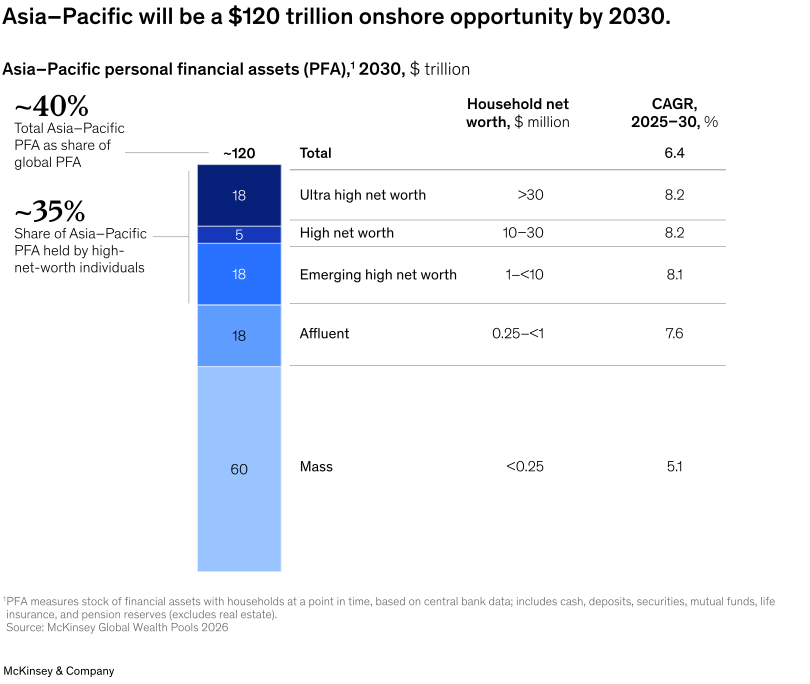
The Asia–Pacific region is also approaching a historic wave of intergenerational asset transition: $5.8 trillion in assets is expected to transfer by 2030, with ultra HNWIs (UHNWIs) representing the majority of the transfers.2
Meanwhile, client needs are changing in four ways:
Focus is shifting from protection to life stage architecture. As wealth accumulates, the focus is shifting from selling individual products to liquidity planning, legacy transfer, business succession, health optimization, and the drawing down of assets to fund retirement. These are areas in which most insurers are actively building capabilities. This shift is already visible across the wealth ecosystem, where leading private banks are expanding beyond product distribution into integrated advisory through dedicated family office and wealth planning offerings.
While insurance and investments are often kept separate early in a client’s financial life, more integrated approaches and solutions (for example, indexed universal life and variable universal life) tend to gain relevance as wealth increases and structuring needs become more complex. In markets such as Singapore, indexed universal life solutions and participating savings plans made up an estimated 80 to 85 percent of sales among HNWI-focused brokers as of year-end 2025, reflecting their appeal as integrated solutions that combine growth, protection, and structuring flexibility.
Participating savings plans, on the other hand, can provide stability and capital preservation, with smoother, bonus-driven returns that align with long-term legacy and estate planning objectives. However, these products have become increasingly commoditized, with most insurers offering broadly similar propositions, benefit structures, and investment features.
HNWI decision-making is increasingly ecosystem-led. HNWI decisions sit within a circle: private bank, broker, financial advisors, family office, and sometimes a patriarch or matriarch. In the current industry setup, the insurer is rarely chosen directly; it is often recommended. Private banks and family offices typically anchor client relationships and originate demand. Brokers play a central role in coordinating across stakeholders and partnering with insurers to structure cross-border insurance solutions.
Financial advisors and external asset managers operate across the segments, with access to HNWI and UHNWI clients built on personal relationships. Increasingly these advisors are engaging insurers directly (non-broker-led).
AI is raising the competitive bar. AI is changing what clients expect from insurers, for example, faster responses, more personalized advice, real-time policy information at an aggregated level, and intelligent digital conversational experiences.
At the same time, AI is lowering the barriers for entrants. Wealthtechs and other technology companies are using AI to make insurance options easier to compare, recommend, and manage as part of a holistic wealth solutions and advisory approach. The AI and technology bar is rising across the business, from AI-assisted underwriting to distributor enablement to the end client experience. Insurers that consider AI as an IT upgrade rather than a competitive capability risk falling behind.
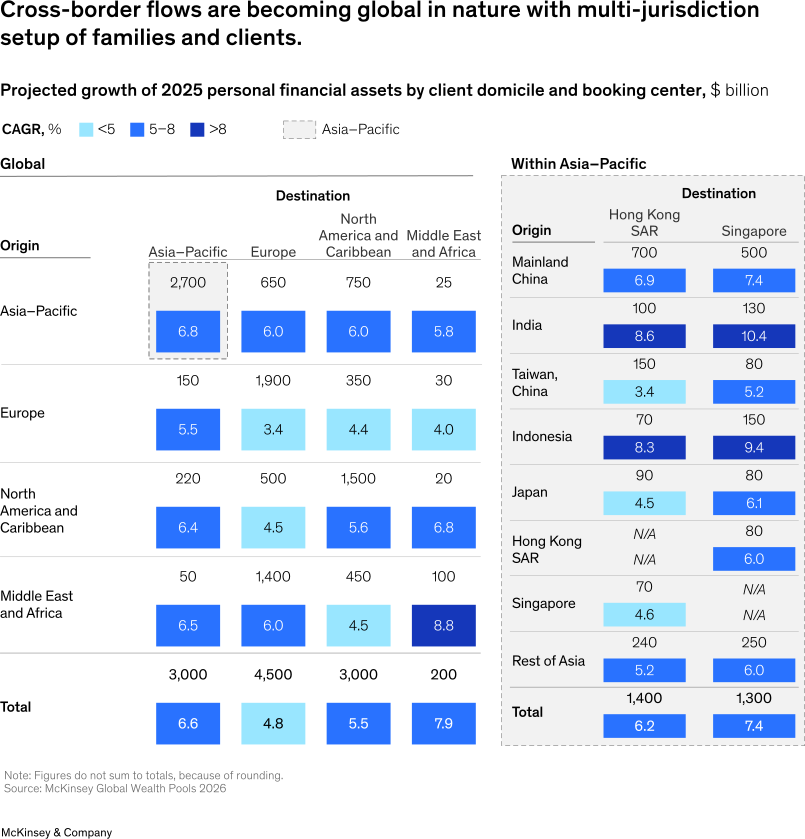
Multi-jurisdiction is becoming the default. Families, assets, and structures now span jurisdictions (Exhibit 2). Wealth flows are more dynamic and less bound to a single home market, increasing wealth-management complexity. Asia plays a central role as both a source and destination within these global networks.
Insurance is evolving from just a product to an engagement with HNWI families across life stages
Insurance is becoming more central to the wealth ecosystem because it serves multiple strategic roles simultaneously:
- a legacy and estate solution across generations
- a liquidity provisioning instrument (death, disability, succession, tax, and strategies for financing premiums)
- a wealth structuring vehicle (cross-border portability)
- an integrated risk platform with protection, health, and service integration
That shift raises the bar for market participants. Clients and intermediaries are no longer purchasing just a policy. They are also buying confidence in an insurer’s ability to manage complexity and to operate across long time horizons and multiple jurisdictions.
The Asian marketplace is splitting into two groups
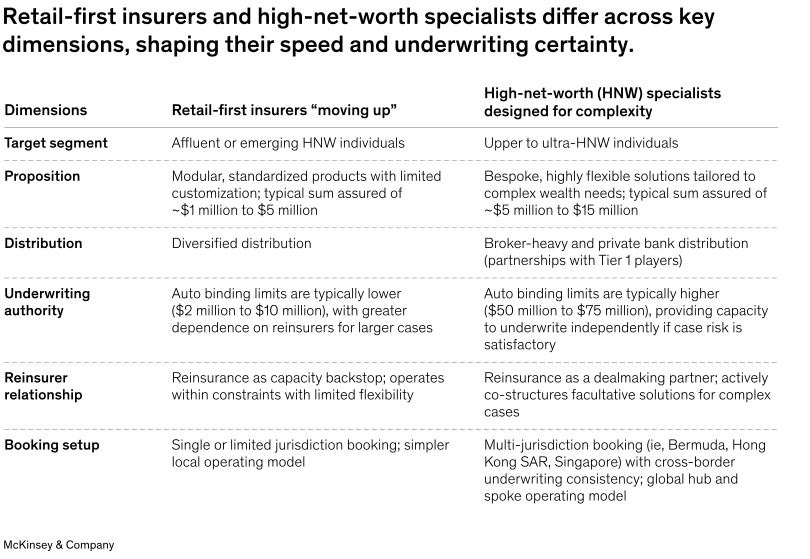
Retail-first insurers and HNWI specialists designed for complexity now define the HNWI competitive landscape.
Retail-first insurers moving upmarket. This group is extending the proven affluent market client model into the HNWI segment. These insurers’ approach is based on scale with broader distribution access (financial advisors, insurance agents, bancassurance, and brokers), targeting entry-level HNWI and younger emerging wealthy segments, relatively smaller case sizes, a domestic market focus, and a higher degree of reinsurance cession to manage risk.
This model can potentially be effective in capturing growth at the lower end of the HNWI spectrum and building early relationships with future HNWI clients. Some insurers are adding pockets of underwriting expertise or selective offshore access to push further upmarket.
HNWI specialists designed for complexity. These insurers (existing players and new units of incumbents) are designed from the ground up to serve HNWI and UHNWI clients across jurisdictions. Their models typically combine multibooking centers (for example, Bermuda, Hong Kong SAR, and Singapore). The distribution is more curated, often broker-led or employing banking partnerships. These insurers have greater risk-retention tolerance with higher-sum assured underwriting supported by strong reinsurer access, and they are competing on capability depth. Beyond bringing innovative products to market quickly, their proposition features rapid execution.
Retail-first insurers can continue to scale in the emerging HNWI segment. But as client needs get more complex and case sizes increase, the bar shifts from distribution reach to underwriting depth, from product innovation to execution reliability, and from onshore engagement to offshore orchestration (Exhibit 3). One example is the variation in auto binding limits (the maximum sum assured an insurer can issue under its delegated underwriting and reinsurance authority without requiring facultative approval). These limits can vary significantly across insurers. Specialist HNWI carriers may operate with auto binding limits of $50 million to $75 million or more, while retail-first insurers often have limits closer to $2 million to $10 million. This difference can materially affect speed, certainty, and the ability to compete for large and complex cases.
This raises an important question for retail insurers in Asia: How far can their current model stretch, and what will it take to build an HNWI franchise?
The six building blocks of a competitive HNWI insurance business
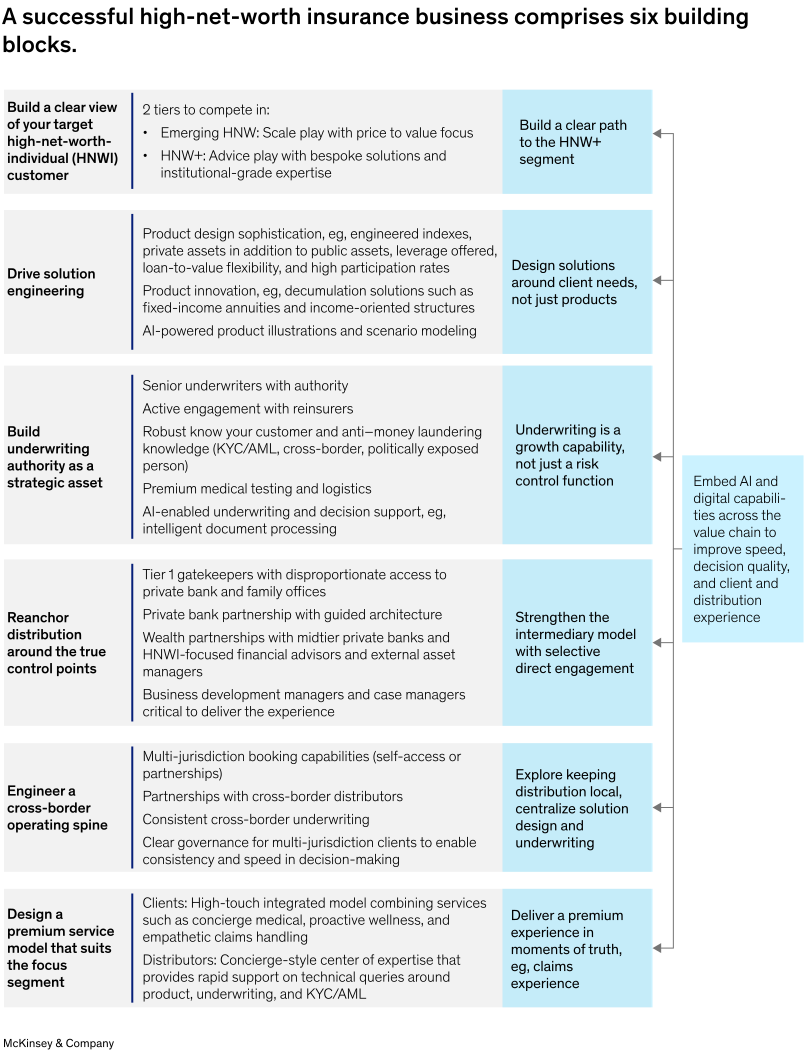
Some retail insurers might treat the HNWI opportunity as a segment expansion needing limited investment. In our view, success in this segment requires building a dedicated unit with its own capabilities, operating model, and talent and leveraging any synergies with the wider group. This means underwriting authority for complex risks, cross-border reach, a service model built around the client’s life cycle stages, and specialist talent that can engage directly with the HNWI client and across the HNWI ecosystem of brokers, private banks, and family offices.
The following offers a path forward for building a winning position in the Asian HNWI market. The six capabilities are not a checklist to complete before the HNWI business launch. The objective is to establish the right to compete quickly, deliver early commercial results, and strengthen the capabilities as the business scales (Exhibit 4).
Building block one: Build a clear view of your target HNWI customer
Insurers must choose where to compete and develop a clear expansion road map targeting higher HNW tiers:
- Emerging HNWI ($1 million to $5 million in assets): This is a scale play focused on standardized, high-value solutions. Clients are generally price-conscious and unlikely to pay a premium for bespoke solutions.
- HNWI-plus (more than $5 million in assets): This is an advice play with bespoke solutions and institutional-grade expertise. Clients value customization and trusted advisory relationships over price alone.
Trying to target both tiers with one model leads to dilution. Insurers may fail to deliver what each tier values most, resulting in lost relevance and weaker economics across both.
“HNWI insurance must evolve beyond product-led propositions toward holistic solutions focused on liquidity, tax planning, wealth protection, and legacy structuring,” said Mohit Bahoria, regional chief strategy, distribution, and customer officer at Allianz Asia Pacific. “True disruption will come from improving access to these capabilities for underserved families while scaling seamlessly through stronger collaboration with banking and distribution partners.”
Building block two: Drive solution engineering
In the HNWI market, differentiation will be based more on difficult-to-replicate, sophisticated product engineering than product breadth. For example, such offerings might include access to specially designed indexes (versus plain-vanilla benchmarks), access to private assets in addition to public assets, premium leverage offered, and loan-to-value flexibility.
In addition, innovation is increasingly important. For example, decumulation remains underdeveloped in Asia, creating white space for solutions such as fixed-income annuities and income-oriented structures tailored to HNW liquidity and legacy needs.
Building block three: Build underwriting authority as a strategic asset
In the HNWI market, unlike the mass and affluent markets, underwriting is more than a risk control function. It is also a major differentiator. The ability to assess, negotiate, and decide on complex cases quickly and confidently often determines whether a client case is won or lost.
Insurance executives could consider these questions: What is your risk appetite? How much risk will you retain versus cede to reinsurers? What is your target decision velocity on large cases, and how consistently can you deliver it end to end (initial assessment, medical underwriting, reinsurance capacity, and final pricing)?
Both medical and financial underwriting come with complexity. The spectrum of medical rating from extra mortality (the highest risk rating) to super preferred, coupled with the financial underwriting complexity of fragmented cross-border sources of wealth and tax considerations, could limit an insurer’s underwriting capacity and slow decision-making.
AI can help underwriters work faster. It can summarize medical documents and source of wealth documents, extract key information, and identify cases that need close review. This helps to reduce manual work and speeds up decisions, allowing underwriters to focus on more complex cases where their experience and judgment matter the most.
This complexity intensifies with case size, especially for large cases (more than $20 million). Each large case outside standard decision rules becomes bespoke, with heterogeneous profiles and limited standardized data at the top end. As a result, experienced HNWI underwriters are essential to interpret ambiguity, navigate complexity, and structure bespoke solutions while coordinating inputs across medical, financial, and reinsurance stakeholders to avoid bottlenecks. Their credibility and judgment also strengthen reinsurer confidence, increasing willingness to support and co-execute on solutions. As such, underwriting cannot be designed purely to minimize losses because excessive conservatism will constrain growth. Competing effectively requires underwriting that enables decision-making at speed and scale, such as in the following examples:
- senior underwriters with the authority to make decisions on large cases (for example, exceeding $20 million to $30 million assured limits)
- active engagement with reinsurers while codesigning risk-sharing arrangements, retention levels, and pricing terms rather than submitting cases and waiting for capacity decisions and quotations
- robust know-your-customer and anti-money laundering knowledge, particularly to assess complex cross-border sources of wealth and funds and politically-exposed-person status, while maintaining strong alignment with distributors’ risk appetite
- access to premium medical testing and logistics for underwriting, delivered through concierge-style coordination
Building block four: Reanchor distribution around the true control points
HNWI insurance flows are disproportionately influenced by a small set of large brokers, according to more than a dozen interviews with Asia-based industry experts, CEOs, and brokers. The brokers act as gatekeepers to leading private banks and family offices. At the same time, regional midtier private banks, independent financial advisors, and external asset managers are attractive and underpenetrated access points that offer opportunities for more exclusive partnerships for insurers as they build and scale their wealth propositions.
Having said that, the client journey today is fragmented, with multiple intermediaries involved across origination, advice, underwriting, and servicing. This often leads to inefficiencies, inconsistent client experience, and limited visibility for insurers.
Insurers already have access to enough distribution channels. The question is whether they have the capabilities to succeed in the channels that matter most for the HNWI market. Should they prioritize depth by becoming a top-quartile, preferred carrier for a focused set of Tier-1 gatekeepers or pursue breadth by investing in coverage to scale across mid-tier private banks?
A more radical, less-tested option is selective disintermediation of brokers. That means engaging clients more directly to reduce broker commissions and gain greater control over the end-to-end experience. However, given clients’ reliance on intermediaries and the challenge of replicating cross-border reach and relationships, this is unlikely to replace the existing model. Instead, this option could be pursued selectively as a complement to a broader multi-channel distribution strategy.
Irrespective of the channel strategy, insurers will need to simplify and orchestrate the end-to-end client journey while improving coordination across stakeholders, enhancing transparency, and delivering a more seamless experience. Dedicated business development and case managers are critical to deliver the experience. Business development managers build trusted relationships with brokers and banks while case managers coordinate underwriting, operations, and reinsurance to keep complex cases moving and provide a single point of contact for distributors.
Giving brokers, banks, and other distributors a real-time view on where a case stands reduces follow-up churn and keeps clients informed. AI-powered digital tools that generate policy illustrations and model different client scenarios help distributors respond more quickly and have better conversations with clients. Insurers that embrace the AI capabilities and make it easier for distributors to do business with them will be better positioned to win business.
“Customers perceive the current engagement journey as quite complex, requiring interaction with multiple parties including private banks, lawyers, tax structuring experts, brokers, and insurers,” said Harpreet Bindra, CEO of HSBC Life Singapore. “Navigating this ecosystem involves numerous handoffs, making this experience fragmented and difficult to manage. There is a clear need to simplify the end-to-end customer journey, creating a more seamless and integrated experience with a strong focus on advisory, both pre- and postpurchase.”
Building block five: Engineer a cross-border operating spine
Cross-border distributors such as brokers and private banks prioritize ease of execution, clarity, and consistency across jurisdictions. A well-coordinated insurer operating model can reduce friction and improve access to distributor flows. Leading insurers distinguish themselves through the following:
Multi-jurisdiction booking capabilities through proprietary booking centers or strategic partnerships. This enables insurers to issue policies from the most appropriate jurisdiction based on client domicile, tax considerations, solution availability and regulatory requirements (Exhibit 5).
- Bermuda is often used by individuals in Asia and elsewhere for bespoke HNWI and UHNWI insurance solutions because of its mature and flexible insurance regulatory framework, tax-neutral environment (while clients remain subject to the tax laws of their country of residence), and ability to support highly customized policy structures.
- Hong Kong SAR remains an important regional hub for participating life insurance products supported by a mature insurance market and a well-established distribution ecosystem.
- Singapore is a leading wealth management hub for sophisticated life insurance solutions, supported by its strong private banking ecosystem, growing family office sector, and focus on wealth transfer and legacy planning for HNWI clients.
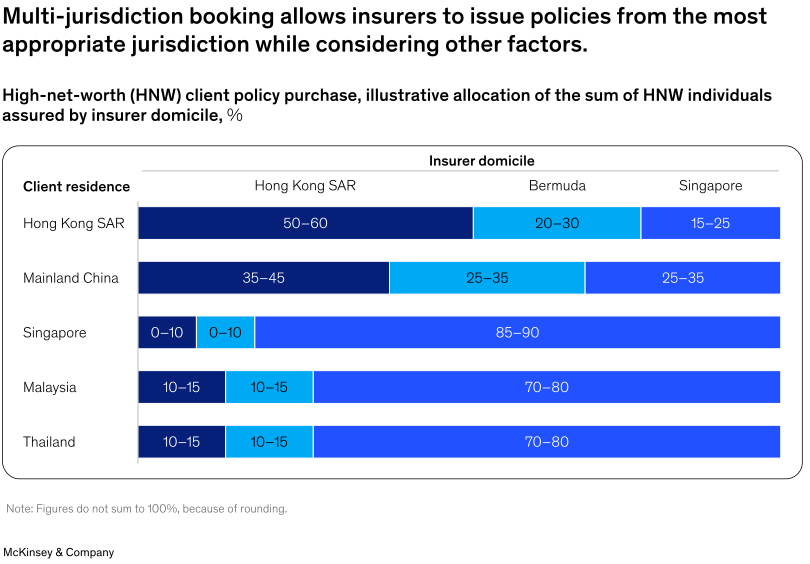
The optimal booking location is not the same for every insurer. Rather, it depends on the insurer’s target client segment, product mix, and strategic intent, with leading players increasingly adopting a multicenter model to capture the advantages of each jurisdiction.
These points raise a common organizational question for companies operating in multiple geographies: how to strike a balance between country-led structures and a more centralized global business line with profit and loss ownership. Some insurers are employing hybrid structures in which they keep distribution local while centralizing product design and underwriting.
“HNWI insurance must move beyond a stand-alone insurance purchase toward an integrated, multi-jurisdictional advisory model spanning legal, tax, health, longevity, education, trusts, and philanthropy,” said Abby Leung, group head of HNW at Great Eastern. “To scale this effectively, advisors must be equipped through continuous training and professional development to become trusted, world-class client partners.”
Building block six: Design a premium service model that suits the focus segment
In the HNWI market, service is a core driver of trust, conversion, and retention. For the emerging HNWI market, insurers can meet client expectations through gestures such as birthday flowers or tickets to exclusive events and facilitating access to high-quality healthcare. As wealth and complexity increase, client expectations shift toward a higher-touch integrated model combining offerings such as concierge medical and logistics services, proactive wellness, and alignment with legacy, estate, and tax planning. These capabilities matter most in critical moments, such as during underwriting, when sensitive medical issues arise, or when clients file claims.
In addition, insurers frequently underestimate the importance of seamless technology integration with distributors. In a premium service model, real-time access to product information and dynamic scenario modeling are critical enablers of distributor and client experience. Legacy or paper-based processes with turnaround times of even one to two weeks can exclude an insurer from consideration by distributors because they prioritize partners who can support immediate client engagement and decision-making. AI is raising expectations for speed and ease of service. Insurers that do not invest in these capabilities risk becoming less attractive distribution partners.
“HNWI insurance remains complex and opaque, creating an opportunity to simplify the experience through clear communication, education, and transparent guidance across the customer journey,” said Pearlyn Phau, executive director and group CEO of Singlife. “Trusted advisory, concierge-style support, and specialist access will become increasingly important differentiators. A seamless, pain-free claims experience during moments of truth can further set us apart. Equipping distributors with better tools, insights, and real-time information will also be critical to improving outcomes for customers and partners.”
Based on our analysis, a three-phase approach to build an HNWI business emerges, but insurers can develop some capabilities in parallel depending on their existing strengths and ecosystem assets:
- Establish: Align on the HNWI segment(s) to serve and launch one or two flagship HNWI solutions. In parallel, augment or build your underwriting capability and reinsurer support to win business, and work with a focused number of strategic distribution partners. The goal is to win the first meaningful cases and establish market credibility.
- Differentiate: Expand the HNWI solutions set to address more client needs and build the cross-border capabilities required to support increasingly complex cases. The goal is to win larger, higher-value business.
- Scale: Strengthen premium service and cross-border operations as the business grows to improve retention and support long-term growth.
AI and digital capabilities are ideally built in parallel across all three phases as a way to speed underwriting, support distributors with faster illustrations and case tracking, and enhance client service. Every phase should deliver measurable business results, not just new capabilities.
As capital moves across borders and generations, HNWIs are an opportunity for insurers. Succeeding in this market has two main elements. First, the complexity of the market means insurers should consider building a new business to serve HNWIs rather than just extending a retail offering. Second, insurers should refine their understanding of the broker-led ecosystems while actively building partnerships across the broader wealth landscape. If you are not structurally designed to serve HNWIs, you may be already behind.