The recent unveiling of an AI-enabled tax-planning workflow in Altruist’s Hazel advisor workspace platform did not introduce AI to wealth management. However, it did provide public markets with a provocative and sudden narrative to model: If the time and cost to produce complex tax and planning outputs collapse, what happens to fees, operating leverage, and the long-run growth of the entire industry?
The market reaction was immediate and telling. In the trading session following the announcement, publicly listed wealth managers saw broad-based sell-offs in the mid-to-high single digits, erasing more than $20 billion in market value in short order. This was not a one-day headline reaction; three weeks later, drawdowns in major markets had reached more than $100 billion, suggesting that investors are re-underwriting the fundamental durability of the wealth management business model.
This article distills the signal from that disruption. While Hazel was the anecdotal spark, the implications are systemic. Our preliminary conclusions—presented with humility given the pace of change—are threefold:
- AI will quickly replace tasks such as preparation, extraction, drafting, and scenario planning, especially in document-heavy planning and service work.
- Replacing tasks is not the same as replacing the advisor’s role as the human accountable for judgment, trust, and behavioral coaching.
- The playing field will tilt from those who can produce outputs to those who own the control points that make automation trusted, compliant, and executable.
The industry backdrop
The wealth management sector is far from being priced for distress. Our research shows that it encountered this event from a position of strength,1 with demand for advice growing as households become wealthier and their needs more complex. However, the industry’s most underappreciated constraint is supply: A projected shortfall of 90,000 to 110,000 advisors by 2034 makes AI-enabled productivity a necessary capacity lever rather than a nice-to-have.2
When strong industries face disruption, markets worry less about near-term earnings and more about terminal assumptions. For years, the wealth management story has relied on three beliefs: that advice is constrained by the number of licensed professionals, that planning is labor-intensive, and that trust and compliance create barriers to automation. AI challenges the first assumption indirectly and the second immediately. The third, that regulation provides a defensive moat, is also being tested. As we discuss in the section on control points below, AI does not just automate advice; it industrializes the oversight and auditability that once required manual intervention. If the marginal cost of generating tax analysis, scenario modeling, portfolio commentary, and meeting documentation collapses, then operating leverage, advisor capacity, and fee durability require rigorous reexamination.
The Altruist moment is part of a broader revaluation of software as a service (SaaS). The “SaaSpocalypse” was triggered by investors no longer valuing SaaS companies on pure growth but instead on the long-term durability of their cash flows in an AI-driven world. Multiples compressed not because customers left overnight but because the market began discounting future cash flows, questioning whether a business model can maintain its margins and moats when its core technical outputs become easy to replicate.
Six market concerns: Noise versus signals
Wealth management is now experiencing its version of SaaSpocalypse. Industry leaders are worried whether the rapid commoditization of technical expertise will erode the barriers to entry that have historically protected high-margin advisory fees. Investors have moved from viewing AI as a productivity enhancer to a structural threat to traditional business models. In our conversations with leaders, six questions have come up repeatedly. To answer them requires us to distinguish between the noise of temporary market volatility and the signals of permanent shifts in value creation.
Will AI replace the financial advisor?
There is no doubt that AI will aggressively assume specific tasks, because it is exceptionally good at compressing the invisible labor of the industry—preparation, data extraction, and document drafting. However, to say that AI will make the leap from automating tasks to replacing the job itself is a significant overstatement. Especially in the high-net-worth and ultra-high-net-worth segments, the true product is not the spreadsheet but accountable judgment and behavioral coaching: Our research shows that interest in holistic advice rose from 29 percent in 2018 to 52 percent in 2023.3 In our view, the replacement thesis is mostly false for core advice segments, where nearly 80 percent of affluent households still prefer a human relationship,4 though an AI takeover might indeed be possible for standardized, lower-touch service models and for younger clients, who are increasingly comfortable with AI-only interfaces.
Can advisory fees survive the collapse of planning costs?
While we anticipate a repricing of those services where clients perceive no differentiation, such as basic tax projections, the fear of an immediate, industry-wide fee freefall is likely overstated. In most models, planning is embedded in a broader advisory fee, and the primary impact of AI-driven efficiency is cost relief and capacity expansion for the provider rather than an automatic discount for the client. Historically, fee rates for relationships of more than $1 million have remained remarkably steady at about 104 basis points since 2019,5 even as digital tools have proliferated. We believe fee pressure will be uneven, manifesting as demands for transparency and unbundled pricing rather than a blanket reduction in basis points.
Is the workflow layer at risk of being unbundled?
Wealth management’s true vulnerability lies not in the regulated core areas of custody and compliance but in the interface where the client relationship is managed. If an AI-driven operating system becomes the advisor’s primary interface, it creates a new point of entry that bypasses traditional systems. The danger here is systemic: As the interface shifts, the stickiness of the traditional back-office and workflow layer begins to erode. We have already seen digital-first innovators close the gap in account opening and funding speeds, proving that the primary theater of competition has moved from the ledger to the experience. While incumbents can defend their turf through partnerships or acquisitions, the signal they should monitor is the emergence of a dominant, independent interface that successfully relegates the legacy business system to a background utility.
How quickly will baseline capabilities inflate?
As AI raises the floor for technical planning across the industry, feature gaps between firms will narrow at an unprecedented rate. This baseline inflation means that yesterday’s differentiators, such as sophisticated tax modeling, are rapidly becoming table stakes. The market signal here is not a collapse in demand, which remains high due to the advisor shortage, but a shift in value creation. Differentiation will move downstream to implementation and upstream to trust-based distribution. Long-term winners will be those that use AI to solve the delivery bottleneck, not those that are merely seeking internal cost savings.
What is the duration risk of the AI narrative?
Public markets are currently repricing narrative credibility, punishing any wealth manager that lacks a coherent AI strategy. While these sell-offs may well represent an overreaction to early catalysts, they reflect deep investor concerns about the long-term terminal value of the traditional business model. We expect a cycle of repeat catalysts to further divide the industry into perceived winners and losers. For leadership teams, the objective is to move beyond the technical demo and show how they are reengineering their entire operating system to keep human trust at the center of an automated workflow.
Where will competitive advantage sit in the control points?
In an agentic-AI world, the most durable value pools will migrate toward specific control points: permissioned data, compliance-grade auditability, and execution rails. The Hazel episode is significant because it highlights how tax planning sits at the nexus of messy documentation and executable advice. While new toll collectors may emerge, seeking to capture these points, incumbents with vast distribution and proprietary data have a clear path to winning if they internalize the AI layer. The ultimate measure of durability will be who controls data permissions and the primary interface through which permission to act is granted.
Control points: The new battleground for value
In our view, the least useful question to ask is the first, whether AI replaces advisors. The most important is question six: Which parts of the value chain become features, and which will become control points?
Hazel matters because it targets a historically high-touch, expensive service area—tax-driven planning—and makes it fast and repeatable. That accelerates output commoditization and pushes value toward systems that can safely turn insight into action. The table below illustrates the migration of value. As AI automates technical production, differentiation shifts from generating insights to taking accountability for and executing them.
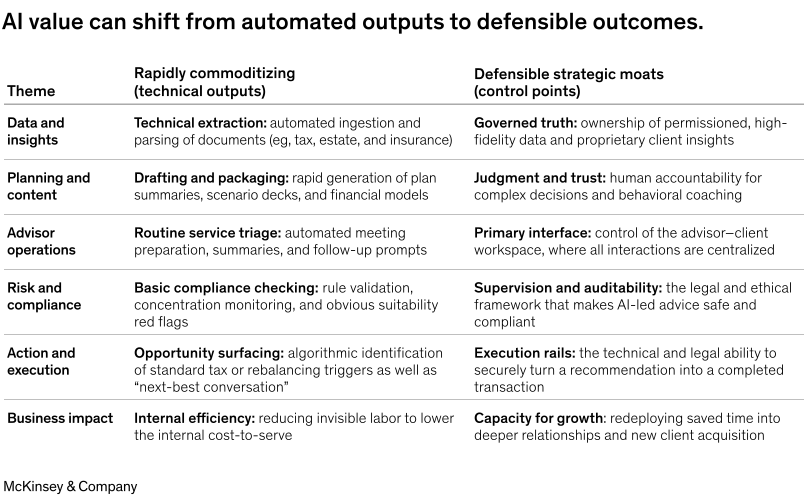
Image description:
A table lists how different themes can rapidly commoditize and become technical outputs or turn into defensible strategic moats and become control points. For the data and insights theme, the technical output is technical extraction, which is automated ingestion and parsing of documents (e.g., tax, estate, and insurance). The control point is governed truth, which is the ownership of permissioned, high-fidelity data and proprietary client insights. For planning and content, the technical output is drafting and packaging, which is rapid generation of plan summaries, scenario decks, and financial models. The control point is judgment and trust, which is human accountability for complex decisions and behavioral coaching. For advisor operations, the technical output is routine service triage, which is automated meeting preparation, summaries, and follow-up prompts. The control point is primary interface, which is control of the advisor–client workspace, where all interactions are centralized. For risk and compliance, the technical output is basic compliance checking, which is rule validation, concentration monitoring, and obvious suitability red flags. The control point is supervision and auditability, which is the legal and ethical framework that makes AI-led advice safe and compliant. For action and execution, the technical output is opportunity surfacing, which is algorithmic identification of standard tax or rebalancing triggers as well as “next-best conversation.” The control point is execution rails, which is the technical and legal ability to securely turn a recommendation into a completed transaction. For business impact, the technical output is internal efficiency, which is reducing invisible labor to lower the internal cost-to-serve. The control point is capacity for growth, which is redeploying saved time into deeper relationships and new client acquisition.
End of image description.
The punchline is simple: Planning is getting cheaper than supervision. Durable economics will likely accrue to those that industrialize trust—permissioned data, compliant controls, and execution—not those that generate the prettiest output.
Beyond the demo: Outcomes over outputs
The Hazel episode wasn’t a verdict on whether human advisors will still matter. It was a reminder that when AI makes once-invisible work fast and cheap, markets immediately question what clients pay for and who captures the released economics. This moment is less about a single tool and more about a repricing of durability. With workflow compression making outputs easier to replicate, the advantage shifts toward firms that can prove and monetize outcomes.
The essential question for wealth managers is whether their value is anchored in outputs that are being commoditized or outcomes that require trust, governance, and execution. Management teams can test their positioning with the following questions:
- What drives our clients’ willingness to pay for advice as technical planning becomes cheaper? What are the implications for value proposition positioning, sales and service, and advisor training and development?
- Which control points do we own versus rent, specifically regarding permissioned data, workflow surface, supervision, implementation, and distribution?
- If an agent is the primary interface, how do we avoid being relegated to a back-end utility, and what do we need to control to prevent it?
- Do we have auditability-by-design for AI-assisted recommendations, including evidence trails, supervision workflows, and explainability?
- How will we redeploy productivity gains, such as supporting more households per advisor, increasing service intensity, or lowering the cost to serve, and what operating-model changes are required?
- What signposts—sustained unbundling, switching-cost erosion at the workflow layer, or third parties capturing the interface—will tell us whether the bear case is materializing?
In our recent article “US wealth management in 2035,” we wrote, “Wealth management CEOs will need to lead organizations that are AI-fluent, human-centered, and relentlessly adaptive.”6 Recent industry events have radically accelerated that mandate. The winners in wealth management are already being defined not as those that create the flashiest planning demo but as those that can integrate AI into the operating system of advice, securely and compliantly, in a way that keeps the human relationship at the front end of trust.