Artificial intelligence (AI) has emerged as the centerpiece of investment for customer operations in the banking industry. Banking leaders often prioritize the contact center as an initial domain for AI investment because of its high-density data environment, which makes the work highly automatable. Few other areas offer the same volume of recorded transcripts, structured contact logs, and real-time customer feedback. Consequently, millions are being poured into voice bots, agent copilots, and real-time sentiment analysis that promise 30 to 45 percent cost reductions and significant improvements in customer experience.
Yet in boardrooms across the industry, a fundamental reckoning is looming as the anticipated gains fail to materialize.
As early adopters move toward broader AI implementation, the gap between leaders and laggards is no longer defined by the tools they buy, but by the operating models they build. Most banks are not failing because their technology is weak; they are failing because they are layering AI onto legacy operating models, addressing symptoms rather than structural issues, and automating broken processes rather than redesigning them.
Why value stalls: The “rewired” gap
The elusiveness of AI value in banking is rarely a failure of the technology itself. Instead, it is a failure of integration. Drawing on McKinsey’s Rewired research, we find that institutions run into trouble when they deploy powerful tools to support disconnected workflows and legacy incentives. Failures are caused by one or more of three gaps:
1. The process gap: Automating inefficiency
Most banks begin by identifying primary drivers of contact to automate, such as disputes or card declines, treating them as monolithic categories. This approach overlooks the reality that a single category often contains root-cause complexity.
For example, high-level speech analytics might classify a large volume of calls as being about a customer’s balance. However, customers rarely call just to check a number; the balance is usually only the starting point of a more nuanced conversation. As the discussion progresses, the issue often reveals itself as: “My balance is not correct,” “There are transactions I don’t recognize,” or “A recent deposit isn’t reflected properly.”
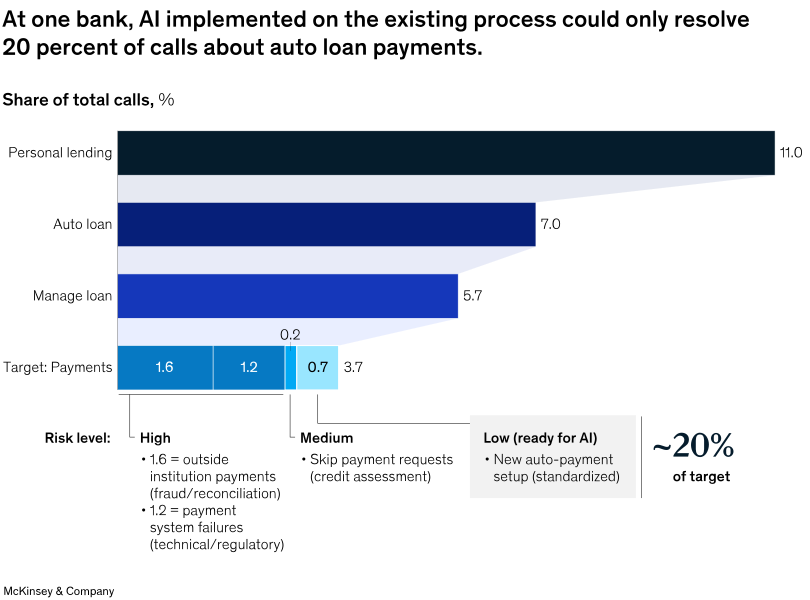
If banks don’t capture these root causes, AI simply amplifies existing inefficiencies. A US credit union we worked with discovered that while login issues seemed ripe for automation, many calls were about multifactor authentication failures that required high-touch support (see sidebar, “Accelerating AI-driven value in a busy banking call center”). Similarly, a banking client anticipated it could easily automate calls about auto loan payments, which were about 3.7 percent of all the calls it receives. However, deeper analysis revealed that only 20 percent of those calls could be handled by AI without significant risk. The remaining 80 percent involved complexities that required “rewiring”—reconfiguring cross-functional processes and underlying data—before the calls could be safely and effectively automated (Exhibit 1).
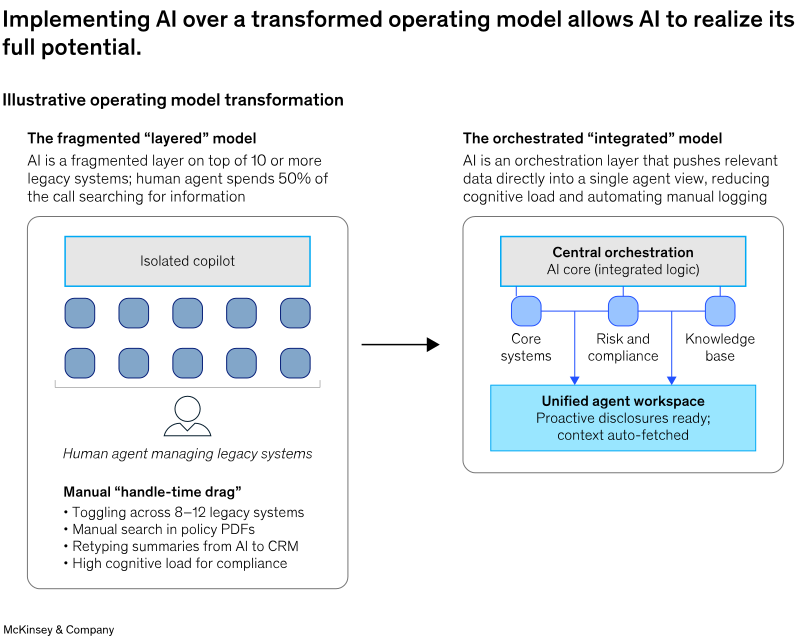
Adding an AI copilot to a broken workflow provides little relief for an agent who still spends 70 percent of their time toggling between ten legacy systems.
2. The operating model gap: Misaligned incentives
A significant disconnect often exists between the innovation lab and the C-suite. Pilots focus on technical metrics, such as contact identification accuracy and containment rates, while boardrooms care about financial metrics, including cost per contact and customer satisfaction scores.
A bot might achieve a 90 percent containment rate for disputes, but if those customers call back three days later because the root cause wasn’t addressed, the total cost per contact can actually increase. Furthermore, prioritizing aggressive replacement of agents over augmentation of their jobs can lead to a surge-and-retreat pattern, in which rapid AI-driven layoffs result in service-quality collapses, forcing a return to human-led support.
3. The governance gap: Risk as a bottleneck
In banking, AI operates under unique risk constraints, including fair lending, explainability, and data residency. Too often, AI projects are developed in isolation and presented to risk and legal teams only at the point of scaling up. This approach turns potential breakthroughs into permanent pilots as concerns around hallucination and regulatory exposure stall deployment. True value is unlocked only when risk and compliance are treated as integrated design constraints rather than a final gate to be cleared.
How banks unlock full value
To transition from tactical automation to strategic impact, leading banks are doing five things:
- Leveraging AI for demand intelligence. Instead of asking what can be automated, winning banks ask why customers are calling. One global fintech used AI to analyze dispute transcripts and found that 50 percent of calls were driven by a single root cause: filing a new dispute for an unauthorized transaction. Similarly, a credit union found that a significant portion of calls seeking digital support were simple multifactor authentication failures during login. By fixing these common root causes, the organization eliminated demand before it reached the contact center.
- Optimizing performance before replacement. Rather than jumping directly to agent replacement, leading banks use AI to close the performance gap first. A financial services organization with 20,000 agents and $1 billion in annual call-center spend used an AI engine to optimize workforce management. By identifying intraday staffing gaps and automating schedule adjustments, it freed up 5 to 10 percent of capacity and achieved a 10 to 15 percent reduction in costs.
- Tuning models to the nuances of banking. Generic AI does not understand the complexity of banking. High-performing models are fine-tuned on the bank’s own transcripts, taxonomies, and policies. This requires mastering the nuances of chargeback life cycles, ACH return codes, regulatory disclosures, and fair-lending considerations. If the AI is not tuned to the bank, accuracy will be low and agent trust will evaporate.
- Prioritizing workflow redesign over adding new interfaces. The most effective use cases integrate AI at key decision points to ease mental effort. For one retail bank, this involved shifting AI from a research tool to actively supporting agents in real time by navigating knowledge bases, signaling fraud risk thresholds, and drafting compliant disclosures (Exhibit 2).
- Establishing structural AI ownership. Winning banks often adopt a lab-and-factory setup: The lab identifies and builds reusable AI components (like standard authentication modules), while the factory scales specific use cases. This modular approach can reduce investment by more than 50 percent and accelerate delivery times by up to 70 percent.
What full value looks like
When AI is effectively embedded into banking operations, it substantially elevates operational performance. Based on initiatives we have observed, properly aligned AI can deliver:
- 25 to 40 percent reduction in calls through root-cause analysis and digital journey fixes
- 10 to 20 percent reduction in average handling time by removing the burden of system-toggling and manual information retrieval
- 15 to 25 percent improvement in first-call resolution through real-time agent support and live compliance flagging
- 10 to 15 point increase in customer satisfaction (CSAT) as friction is removed from the most common customer journeys
- 20 to 30 percent reduction in quality assurance costs as manual reviews are replaced by automated 100 percent transcript monitoring
The strategic shift for banks
AI implementation is not a chatbot initiative, a vendor deployment, or an innovation-lab experiment. It is a fundamental operating model transformation.
Banks that treat AI as a tactical automation tool will likely continue to see incremental gains and stalled pilots. However, institutions that approach AI as a demand intelligence engine, a decision-support layer, and a catalyst for process redesign—the heart of being rewired—can capture its full economic and customer experience value. Success depends on aligning incentives and objectives early in the process, but the long-term prize is a permanent step change in productivity.
As the gap between rewired leaders and legacy-bound laggards widens, the boardroom reckoning will shift from a question of technology to a question of competitive survival. Success will not be defined by which banks have the most advanced AI, but by which have the courage to dismantle the legacy structures that prevent AI from delivering strategic value.
Related Articles