





Commercial and specialty underwriting is at an inflection point. Advances in AI have materially expanded what is possible across complex underwriting workflows. Yet much of today’s underwriting process still looks much like it did a decade ago: queues of broker submissions, and underwriters reading emails, extracting facts from documents, chasing missing information, and manually moving cases between various stages over days, sometimes weeks.
Underwriting teams face increasing pressure to scale without adding cost and amid a talent shortage, yet they remain constrained by fragmented workflows and legacy technology. Advancements in agentic AI now provide the opportunity to fundamentally rewire that workflow. We call this new AI-enabled operating model the underwriting operating system (UWOS)—a machine-first, human-governed model where AI can manage routine tasks end to end, from intake, triage, and risk selection to pricing and issuance, while underwriters focus on portfolio management and complex decisions.
The term “operating system” matters: This is not another tool, interface, or ad hoc process redesign layered onto today’s workflow. It is a fundamentally new chassis that changes how work is distributed between machines and humans. The underwriting environment would be governed by an intelligence layer, or a “nerve center,” that connects all workflows, as opposed to a collection of disconnected interfaces. Capabilities that were not available even a few months ago are now within reach, as agentic AI can perform multistep processes, such as reading submissions, reconciling evidence, retrieving precedents, and preparing recommendations. AI-enabled software development cycles are also compressing, which changes the build-versus-buy equation: For selected lines and domains, insurance carriers can build targeted UWOS capabilities in-house quickly, capture early wins, and set the stage to reach scale.
In this system, work is dynamically routed based on complexity, confidence, and required underwriting authority level: some cases flow through automatically, some are prepared for rapid review, and others are escalated for expert judgement. Critically, the role of humans does not disappear; it shifts from manual case processing to oversight, judgment, and portfolio steering. Portfolio underwriters and underwriting managers move into oversight roles, shaping the portfolio and ensuring underwriting quality. Expert underwriters become exception handlers for the complex, nuanced, and bespoke cases that genuinely require judgment, negotiation, and experience. The machine handles the bulk of processing.
A UWOS delivers three benefits. First, the process is sped up, as decisions occur more quickly, especially for simple and repeatable risks. Second, the quality of decisions improves due to more consistent, evidence-based underwriting informed by past cases, claims data, broker context, and portfolio performance. Third, efficiency is enhanced, given a reduced need for manual and redundant data entry, repetitive validations, and multiple handoffs.
The future operating system across the value chain
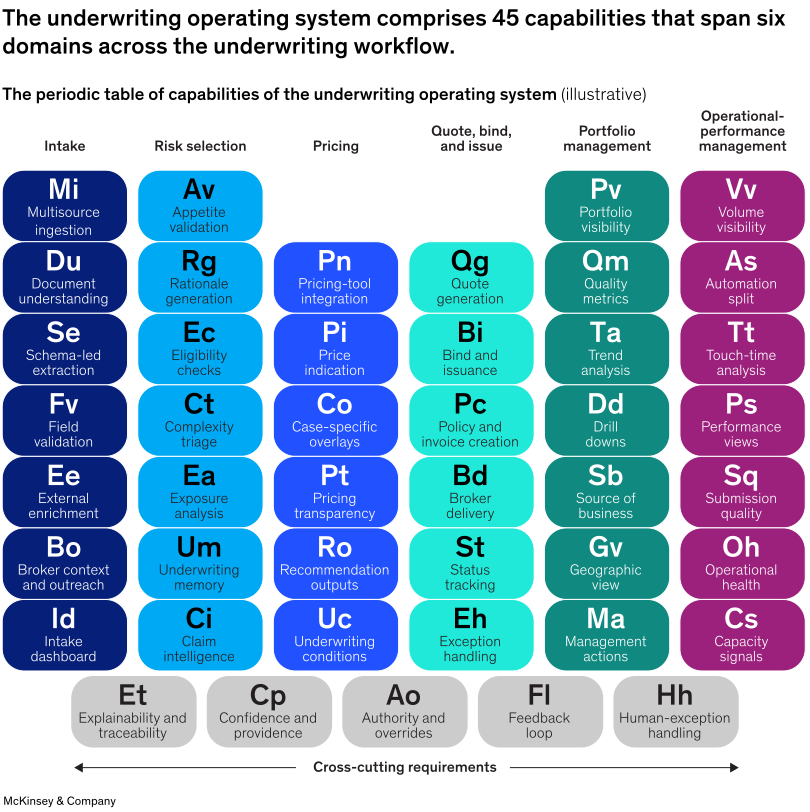
So what does the UWOS actually do? It turns underwriting from a sequential, fragmented, manual process into a dynamic, coordinated, machine-driven workflow. That flow spans six domains: intake, risk selection, pricing, quote–bind–issue, portfolio management, and operational performance management (exhibit).
Submission intake—from inbox to decision-ready case
The multisource ingestion agent takes in broker submissions from email, portals, and document uploads. Then, other agents extract data using document-parsing models, map the data into a standard underwriting schema, check for internal consistency and completeness, and enrich with third-party data. Finally, the UWOS triggers automated broker queries for missing fields. The result is a structured, validated, and decision-ready case that enters the process complete and ready for downstream decision-making. Humans intervene only where ambiguity remains or broker interaction requires expert judgment.
Risk selection—system led, human owned where it matters
Once a structured case is available, the agentic system evaluates whether and how the risk should be written, combining automated assessment with human judgment where required. It applies underwriting rules and risk appetite guidelines, analyzes exposure to claims or losses based on structured fields and extracted documents, retrieves comparable historical underwriting decisions and claims data, classifies complexity based on risk signals and data completeness, and generates a recommendation with traceable rationale. Humans confirm or challenge borderline cases and own decisions for complex or ambiguous risks.
Pricing—transparent and flexible for the best outcomes
The agentic flow for pricing combines model-driven outputs with human commercial judgment to determine the final underwriting position. The system uses pricing models specific to the line of business to calculate a technical baseline premium and then adjusts pricing by assessing risks and customer characteristics, as well as broker performance, portfolio signals, and market context. This analysis produces a transparent range of prices and the UWOS can generate a recommended price with suggested conditions. Humans review and adjust pricing where needed and retain ownership for complex or strategic risks.
Quote, bind, and issue—streamlined execution and automated fulfillment
Once a decision is reached, the system can fulfill it with minimal manual intervention. It generates quote and policy documents from templates and then starts the processes required to formally activate insurance coverage after the customer accepts the quote. Finally, it can issue policies and invoices, as well as send outputs to brokers via digital channels. Through it all, the UWOS maintains status tracking with a full audit trail while flagging exceptions that require human intervention.
Portfolio management—from periodic review to dynamic decision-making
All case activity feeds into a live portfolio view, enabling active and continuous management of the book. An AI agent aggregates cases, pricing, and outcome data into a central data layer; tracks metrics such as rate changes, price adequacy, and win rates across the portfolio; and identifies trends across brokers, segments, and geographies. Another agent drills down into drivers of performance and surfaces recommended management actions. Underwriting leaders use these insights to adjust appetite, pricing, and broker strategy for future policies.
Operational performance—continuous improvement by design
Agents in this domain provide transparency on how effectively the underwriting operation is running and where it can improve. The system captures workflow activity data across all cases, including volumes, automation rates, and cycle times; measures underwriter and broker performance; and identifies bottlenecks and rework drivers. Based on this analysis, the UWOS can recommend improvements to rules, thresholds, and process design so that leaders can optimize the workflow and capacity.
The three lanes of underwriting
The level of automation that the UWOS can enable across the six domains will not be the same for every case, product line, or customer segment. The approach will vary by risk appetite and complexity, data quality, confidence level, and level of underwriting authority required. That is why the future model is best realized across three lanes—not a single path to full automation:
- Straight-through lane. Simple, repeatable cases flow through with little or no human intervention. The system completes intake, assessment, pricing, quote, bind, and issue within defined risk appetite, authority, and confidence thresholds.
- Assisted-decision lane. Medium-complexity cases are prepared by the system and reviewed by an underwriter. The UWOS structures the facts, highlights uncertainties, retrieves precedents, uses pricing tools, and produces a recommendation that can be quickly approved, amended, or declined.
- Expert-judgment lane. Complex, high-value, ambiguous, or strategic risks remain underwriter led. But the nature of the work changes. The system packages the case, surfaces evidence, identifies trade-offs, and prepares options so expert underwriters spend more time on judgment, negotiation, and portfolio impact—and less time on administration.
Across all three lanes, the UWOS learns continuously through ongoing input and refinement by underwriters and portfolio managers. Outcomes from underwriting decisions, claims experience, broker behavior, pricing adequacy, and operational performance feed back into the system to refine rules, thresholds, recommendations, and routing over time.
The path from vision to implementation
For commercial and specialty insurers, the journey starts with four concrete moves:
- Pick a lighthouse case. Choose a high-volume product line, customer segment, or renewal book where submissions are frequent, data is available, and cycle time or consistency matters.
- Build the minimum data foundations. Focus on the documents, fields, rules, pricing tools, and decision history needed to support the first workflows, instead of trying to perfect the entire enterprise data model.
- Define the controls. Set confidence thresholds, authority rules, override processes, and human-in-the-loop roles. For example, different roles can be defined for consulting on analyses, prioritizing decisions and workflows, and being accountable for decisions.
- Launch targeted workflows. Start with one or two high-impact domains to agentify, such as submission intake, risk selection, or pricing; prioritize based on business value, data readiness, and feasibility.
The insurance carriers that move first will set the pace on speed, service, and underwriting discipline for the next decade.
Antonio Grimaldi is a partner in McKinsey’s London office, where Chien-Teng Chia and James Polyblank are also partners and Georgie Solymar-Withers is a consultant; Cameron Talischi is a partner in the Chicago office; and Shannon Varney is a partner in the Boston office.
This article was edited by Querida Anderson, a senior editor in the New York office.
For a PDF version of this article, click here