A shorter version of this article was originally published in the August 18–25 edition of ChemWeek.
Growth is more important than ever in chemicals as it continues to be the key driver of valuation multiples. Significant headwinds and capacity imbalance in 2023 and 2024, economic uncertainty in 2025, and ongoing geopolitical instability have all challenged the industry. In this environment, specialty and commodity players alike have had difficulty driving growth. Legacy ways of working have left sales professionals unable to keep up with customer demand for rapidly developed, customized solutions. In short, the status quo is no longer enough.
To keep pace, leading chemical companies are “rewiring” their commercial functions with AI and gen AI. By leveraging these tools, sales teams are able to simultaneously identify and convert the best opportunities and enhance the customer experience. What takes these companies to the next level is their approach to transformation: Growth champions rethink their commercial organizations, capabilities, and processes while they integrate new technology.1
In this article, we dive into “rewiring for growth,” outlining why and how it can accelerate growth for chemical companies, with a focus on executive leadership teams and sales leaders. When successful, the impact is considerable, with rewired companies delivering revenue growth at the same time as expanding their margins. In fact, according to McKinsey analysis, rewired chemical companies achieve 10 to 20 percent above market growth within 12 to 24 months of launching, see 250 to 400 basis points in EBITDA margin expansion, and accelerate their sales cycle by 1.5 to 2.0 times. This results in two to three turns in valuation multiple expansion.
Strong headwinds in the chemical sector
In the past three years, TSR in the chemical sector has dipped below the global average, reversing a decades-long trend of outperformance (Exhibit 1). High interest rates and volatile financial markets have affected merger activity across the industry, and achieving organic growth has been difficult. This trend can be attributed to a range of structural factors,2 from short-term dynamics such as supply chain disruptions and destocking to longer-term structural forces driving a persistent supply–demand imbalance.
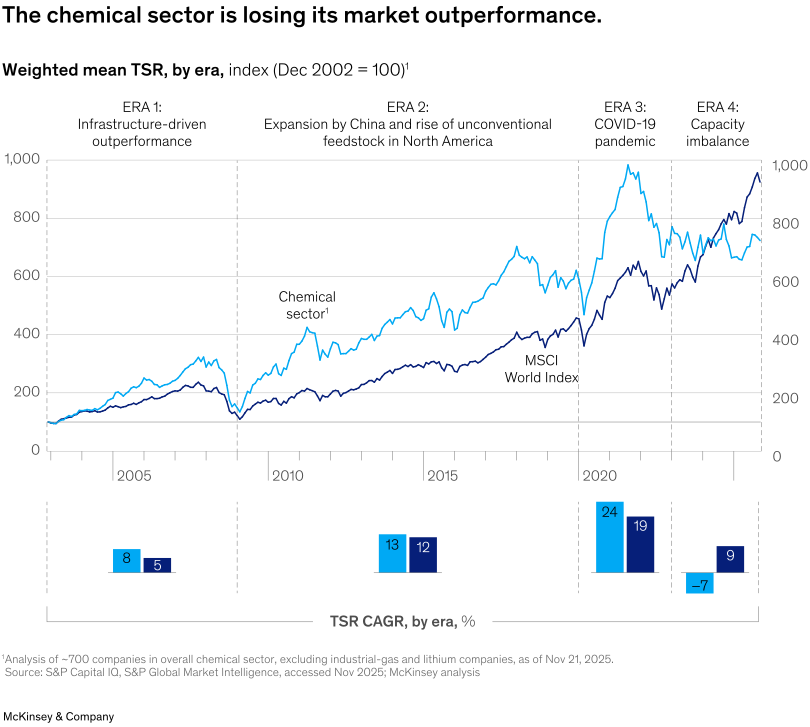
Recent market headwinds have affected commodity and specialty chemical companies differently. Commodity chemical companies have experienced a significant downturn and are struggling to optimize pricing, manage margins, and drive sales-force effectiveness given volatile macroeconomic dynamics.3 Persistent global overcapacity, in part due to increased production in Asia,4 has challenged operating rates and led to underutilized production capacity for some commodity chemical companies. Trade uncertainty, tariffs, and market unpredictability have disrupted global supply chains, and rising input costs such as higher energy prices have eroded competitiveness for commodity players.
Meanwhile, specialty chemical companies are typically focused on a smaller set of end markets (for example, paints, personal care, and automotive) that experienced elevated COVID-19-era demand that did not sustain itself.5 To keep up with demand, sales representatives became order takers, and companies underinvested in sales capabilities and the customer experience. The sudden shift from strong demand during the COVID-19 pandemic to post-COVID-19 destocking and weaker industrial demand created a need for differentiation and tailored solutions that commercial teams struggled to keep up with. As a result of slower demand since 2023, specialty chemical companies are now feeling the pinch. According to McKinsey analysis, valuations came down by as much as 50 percent in 2025, with a few exceptions among players associated with market segments showing continued growth, before beginning to recover in the latter part of the year and in early 2026.
The evolving chemicals customer
As these broad industry headwinds challenge chemical companies, chemical customers are also evolving to demand elevated offerings and a seamless customer experience, according to McKinsey research (Exhibit 2). A marketwide focus on agility means customers increasingly expect responsiveness and flexibility from chemical companies. In addition, decision-making in chemical procurement is becoming more sophisticated and involves many more cross-functional stakeholders with varying needs and preferences related to supplier engagement.
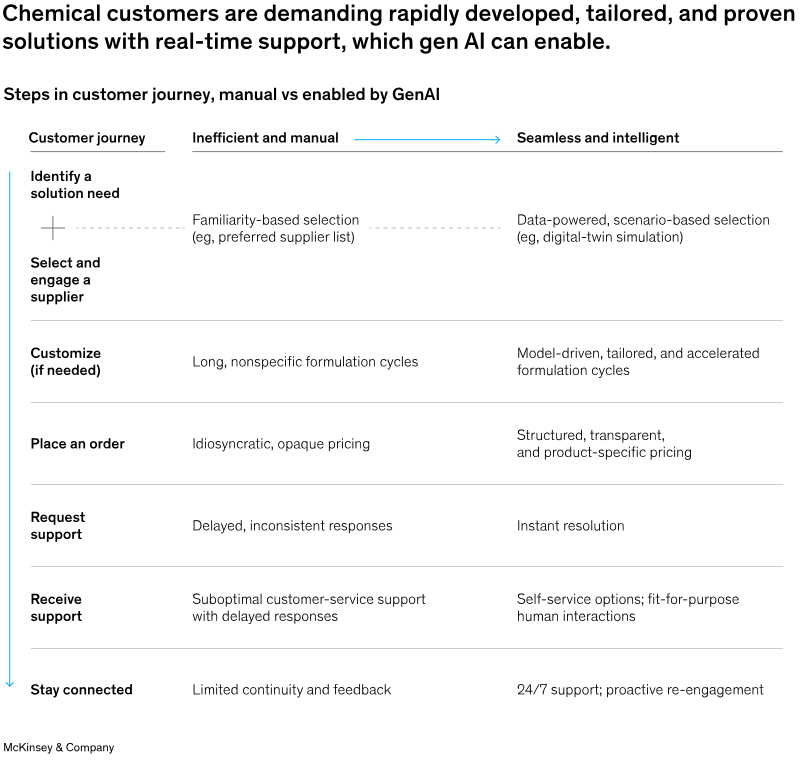
Customer expectations are changing across the buying journey. According to McKinsey research, customers are expressing growing preferences for insights-driven outreach from suppliers, tailored offerings and value propositions including differentiated pricing strategies, and seamless postsale service and support enabled by automation and gen AI. As a result, we expect chemical companies to be increasingly evaluated primarily on their ease of doing business, faster innovation cycles, and greater pricing transparency—with exceptional customer support and sustainable offerings as table stakes.
To meet these changing customer demands, chemical companies’ commercial organizations must evolve to deliver a seamless end-to-end sales process. This requires a fundamental shift from operating in a sometimes siloed, uncoordinated manner to integrating activities across all commercial functions through holistic, tech-enabled “rewiring.”
Debottlenecking sales to meet customer demand
In our experience, many chemical industry executives start in operations. This means most chemical companies are well-versed at “debottlenecking” their manufacturing processes—that is, removing operational constraints to enable production capacity increases without the significant capital expenditures associated with expansions.
However, in recent years, the sales function has become a major bottleneck to profitable growth, rather than manufacturing. Applying the same methodical debottlenecking approach used in manufacturing requires identifying the key factors that have hindered sales teams from meeting customer demand. These typically include the following:
- Inefficient pipeline management. Teams may lack clarity on which opportunities to focus on, spending excessive time sorting through low-quality leads and conflicting “lead lists.”
- Limited customer engagement. Interactions between sales representatives and customers may be limited to phone calls and in-person visits, restricting reach to digital-first customers and reducing customer insights due to a limited ability to systematically track browsing behaviors and purchasing habits.
- Inability to address customer needs. Teams are unable to tailor offerings and craft compelling value propositions due to gaps in their understanding of evolving customer needs, mounting administrative burdens, and limited cross-functional collaboration.
- Slow speed to quote. Price quoting and approval process are highly manual and time-consuming, and they are often driven by intuition rather than data and fact-based insights.
- Insufficient commercial enablement. Teams may have suboptimal sales execution rigor caused by limited visibility into and alignment concerning performance and customer growth potential, worsened by a lack of consistent sales capability building, suboptimal customer relationship management (CRM) usage, and poor pipeline health that prevents effective sales interventions.
Leading companies are leveraging technology to address these factors, including experimenting with AI and AI pilots. However, most of these pilots struggle to scale, usually due to overly narrow scopes and misaligned deployments of technology and commercial operating models.
For these pilots to achieve their full impact, simply building analytical tools is not enough. Instead, growth champions—chemical companies that deliver top-quartile growth in their areas of participation—rewire for growth by embedding technology into their organizations by boldly rethinking their end-to-end commercial strategy, processes, organizational structure, and capabilities.
For example, a large industrial-materials provider was looking to grow within existing mature product lines, but their sales team was very lean, with limited “hunting” capabilities to find new customers. Unlocking growth meant using AI solutions to develop a prioritized market map of customer and product opportunities, leveraging web mining to understand customer needs and tailor value propositions, and using CRM-based technical sales assistants to accelerate customer outreach.
While helpful, these new insights alone did not unlock sales growth. To create impact, the materials company had to revamp its pipeline management process to systematically review, qualify, and track new opportunities brought by the AI solutions alongside other opportunities. It also had to redefine sales work, shifting its inside sales team role from one of sales support and order management to one of business translation of AI insights, keeping more experienced sales reps focused on human-to-human customer interactions. Combined, these efforts nearly doubled revenues for targeted products and led to about 10 percent incremental growth within two years (due to a long sales cycle of 12 to 24 months).
Fundamentals of rewiring for growth
When fully rewired for growth, chemical companies integrate technology into everything they do to identify and convert new opportunities and to meet existing customer demands faster and better. And they do it in a systematic way, every single time (Exhibit 3).

Successfully rewiring the commercial function relies on a few core principles:
- Focus on value. Build a commercial road map grounded in business impact. Growth champions often drive value creation over multiple horizons, including share of wallet growth and pricing for near-term impact, churn prevention in the medium term, and new customer growth in longer term.
- Design for scale. Take a holistic approach to rewiring for growth, building a customer-backed commercial strategy and sales-team-forward operating model. Leverage well-scoped pilots to test and refine strategies and deliver quick wins to create momentum for scale.
- Improve data quality as you go, not up front. Low-quality data is no longer a barrier to growth. Gen AI can help accelerate digitalization and data-structuring efforts, enabling actionable insights sooner. Creating value for end users could also organically improve data quality over time; for example, sales reps could become more inclined to enter data into CRM if it helps drive better pipeline management.
- Partner across IT and business. Reimagine how (gen) AI can power critical commercial use cases aligned with business growth priorities, and deploy tools that are easy to use and enable sales teams to move faster
- Build capabilities as a priority, not an option. Leverage technology to reduce the administrative burden for sales teams, and empower talent to succeed with multimodal learning journeys and upskilling.
- Resource appropriately. Make the rewiring effort a priority for cross-functional teams, both at the leadership level and for frontline sales reps pursuing growth opportunities.
Rewiring for growth also requires a different operating model for IT. When rewired, the IT function has a business-backed digital foundation where even imperfect data can unlock fast, insight-driven decisions. A rewired IT team is integrated across functions, product-driven, focused on customer needs, and measured by business outcomes. In such a system, tech-enabled talent, including machine learning engineers, product owners, and prompt engineers, can effectively collaborate across functions.
A journey, not a race
Rewiring does not happen all at once—it is a journey (Exhibit 4). With a carefully planned “crawl, walk, run” approach, companies can progressively deploy technology and build capabilities, deliver early successes to build momentum, and enable the change management required to scale more broadly. The competitive advantages offered through this approach could allow players (especially those in low-growth segments) to begin outperforming quickly. Given this, companies should strongly consider acting now to position themselves to accelerate growth.
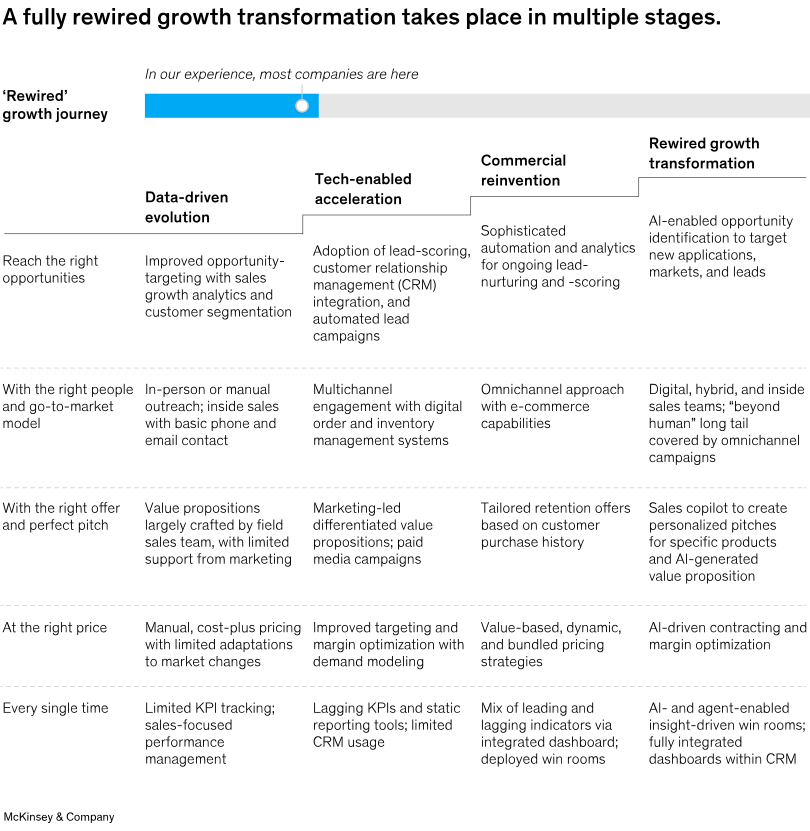
Companies embarking on a rewiring journey typically start by developing a comprehensive fact base on growth potential, what it would take win, and how rewiring along the end-to-end sales process could help unlock growth. What these companies typically address include specifics on priority initiatives, the business case for change, and an execution road map to set clear direction. To launch execution, companies can implement early quick wins to create momentum, then build and execute scale-up plans for these and other initiatives. As they roll out changes, companies can also implement performance management and impact-tracking systems.
It is important to note that rewiring does not have to be a linear journey. Instead, it can be modular—in other words, chemical companies can focus on rewiring specific elements of the sales journey (lead generation, pricing, go-to-market strategy, and so on), rather than the entire end-to-end journey.
Compare two specialty chemical companies: One opted for a full end-to-end rewire, whereas another chose to make targeted rewiring interventions.
The first, an industry leader with more than $15 billion in revenue, faced stagnating growth due to underpenetrated share of wallet. The company believed it had an untapped growth opportunity in holistic solution selling and cross-selling across two specific business units. Because it wanted to build a new, holistic growth model to replace its established, legacy commercial practices, it chose to lead an end-to-end rewired growth transformation implemented in three distinct phases: a regional pilot, a scale-up across North America, and finally, a full global implementation. The effort included an organizational integration of two business units in North America and a complete overhaul of the commercial operating model. With this new structure, the company was able to rewire to identify the right growth opportunities to pursue, design streamlined sales motions powered by technology across the entire customer journey, craft integrated value propositions, and launch rigorous change management and capability building to reignite growth. The full transformation drove over $250 million in value capture.
In contrast, a midsize global specialty chemical company pinpointed specific challenges with its pricing journey, which was highly manual and fragmented. To solve this, the company deployed AI featuring microsegmented discount guidance and improved cost accuracy using forecast bills of materials, resale prices, and costs for specific chemicals to increase overall margin performance. The company also deployed a tech-enabled suite of pricing tools embedded within their enterprise-resource-planning system to increase speed to quote. This targeted rewiring effort increased return on sales by 3 to 5 percent and created capacity for the product and sales teams to shift from tactical price setting to strategic price execution with teamwide adherence to best practices.
As companies explore ways they can rewire their operations, it’s important to remember that rewiring for growth is complex; as in any transformation, it is normal to encounter some organizational resistance to change. Change management is critical to sustain growth and allow new commercial capabilities to take hold. Active role modeling by leadership, thoughtful two-way communication to ensure organizational alignment, structured capability building, and formal reinforcement mechanisms—including incentives—are crucial for driving real change.
Today, the chemical industry’s bottlenecks lie not in manufacturing, but in sales. By rewiring for growth, chemical companies can rethink sales functions and enter a new era of commercial success built on better access to high-quality, high-potential opportunities and the right tech-enabled infrastructure to pursue them. First movers will have the advantage in this new opportunity landscape—and as the industry evolves, the distance between rewiring adopters and laggards is only expected to grow.