Pressure is mounting for the automotive industry globally to adapt to changing consumer preferences, growing competition, and the volatile macroeconomic and geopolitical environment. The North American automotive industry, historically a leader in this space, must act strategically to maintain its foothold.
McKinsey’s article “A new ‘ERA’: An action plan for the European automotive industry” describes how European automotive companies can accelerate their transition toward a resilient and sustainable future.1 This article examines the North American automotive sector with a similar objective. By considering the region’s distinct economics, consumer preferences, and regulatory environment, the report outlines ways for North American OEMs to remain adaptable, resilient, and competitive—forming the acronym “ARC”—in the face of today’s challenges. It also offers tangible guidance based on our firsthand insight and our work across the sector.
In our piece “The North American automotive industry’s road to resilience,” we outline the challenges facing the North American automotive industry specifically and offer guidance on how stakeholders can respond, taking measures to build cross-industry alliances and strengthening their ecosystem.2 This piece offers a complementary, inward-facing view to evolve OEMs’ organizational and functional capabilities.
An action plan for North American automotive OEMs
To address the challenges North American OEMs are facing and the forces that are transforming the industry globally, the automotive industry must act on three dimensions: adaptability, resilience, and competitive economics. Together, these dimensions will build a strong foundation for the industry’s future:
- Adaptability. North American auto OEMs can maintain optionality as the pace of powertrain transition remains uncertain and consumer preferences diverge across regions and consumer segments.
- Resilience. North American auto OEMs can build secure and diverse supply chains for critical components to mitigate geopolitical risks.
- Competitive economics. North American auto OEMs can deliver sustainable cost improvements and expand consumer lifetime value to maintain competitiveness in the face of increasing global disruption.
For North American OEMs to successfully improve upon each of these dimensions, they will not only need to compete as an ecosystem and manage volatility alongside strategic partners; automotive companies will also need to revamp their internal operations to be more productive, competitive, and distinct (Exhibit 1).
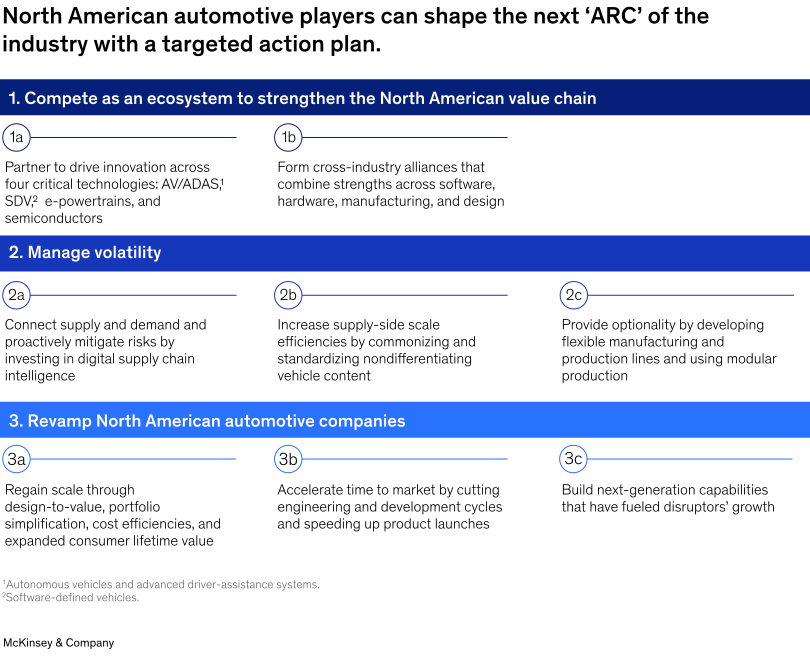
Revamp North American automotive companies
North American OEMs are reaching an inflection point as mounting pressures shape the future of domestic automotive manufacturing. The stakes are high, but there is an opportunity for OEMs to regain scale, accelerate their time to market, and build next-generation capabilities.
Regain economies of scale
Since China’s entry into the World Trade Organization at the turn of the century, North American OEMs have steadily lost scale as global sales volumes declined. Production costs for vehicles in North America have risen to meet diverse customer demands, with fixed resources spread across a range of models, trims, and powertrains. In the past two decades, the compound annual increase in R&D costs per vehicle for North American OEMs has risen by about 4.8 percent.3
As such, pressure on investment productivity has increased, and consumers are becoming more price sensitive. McKinsey’s 2025 Mobility Consumer Pulse Survey found that price ranked as the top purchase criterion for internal combustion engine (ICE) buyers and as the second-most-important criterion for EV buyers.4 One in four consumers now plan to buy lower-cost models, while four in ten have delayed purchases altogether in response to record-high prices.5 At the same time, Chinese OEMs are building vehicles at cost levels that rival US offerings, even with a 100 percent tariff.6 To restore capital efficiency, recapture market share, and lower operating costs, OEMs can regain scale by taking the following four steps:
Relentlessly pursue design-to-value optimization. OEMs can seek to optimize product design, cost, and value by ensuring every feature increases consumers’ perceived value of the vehicle. For example, as demand for electric off-road SUVs grew, one OEM in the United States invested in launching a plug-in variant of an existing model. That bet paid off: The OEM now holds 41 percent of the US plug-in hybrid EV market.7 Reorienting product development to better align with evolving consumer preferences and to eliminate under-appreciated elements can allow OEMs to lower costs while increasing appeal.
Simplify portfolio offerings. OEMs can eliminate low-value complexity that inflates cost and slows execution by designing more focused product portfolios. For example, in 2020, a North American OEM announced plans to cut 50 percent of drivetrain variants over the next five years to reduce manufacturing complexity, lower per-unit costs, and accelerate time to market for new models.8
Among SUVs, which make up more than 50 percent of US sales,9 incumbent OEMs offer an average of eight or more different trim or powertrain combinations for their best-selling mass-market model; one OEM even offers up to 26 variants for a single model. Disruptors, including Tesla, offer only three. Simplifying product offerings means carefully balancing optionality and decision fatigue. By mastering this, North American OEMs can create portfolios that streamline production and simplify consumer choice without sacrificing perceived variety.
Use AI to improve cost efficiencies. Rising overhead costs erode margins and limit competitiveness, and performance improvements are often incremental in support functions. OEMs can reverse this trend by digitally enabling their corporate functions and deploying AI-enabled automation. By embedding gen AI across support functions, North American OEMs can streamline fixed costs, improve operational efficiency, and restore margin competitiveness.
For example, after implementing conversational AI into their recruiting process, a North American OEM cut the time it took to schedule interviews with candidates from five days to 29 minutes, saving $2 million annually. In addition, in sales and marketing, virtual agents can deliver personalized, proactive service to customers while reducing department costs by up to 50 percent.10
Expand consumer lifetime value. In North America, new vehicle sales are expected to plateau in the coming years, decreasing from a 2.4 percent CAGR from 2010 to 2023 to an expected 0.7 percent CAGR from 2023 to 2030.11 To mitigate market share losses and margin pressures, OEMs can expand beyond the point of sale and capture greater value over the lifetime of the vehicle. The McKinsey Center for Future Mobility estimates that in 2030, more than 70 percent of the automotive revenue pool will be generated postpurchase.
Leading OEMs are already expanding into life cycle services such as finance and insurance (supported by a shift from ownership to usership), used cars, aftersales (driven by aging ICE vehicles that require maintenance and spare parts), fuel and charging, mobility services (such as connected vehicles, robotaxis, and further development in shared mobility and micromobility), and circularity (with battery recycling gaining relevance as older BEV models reach end of life).12 For example, one truck OEM developed an EV strategy that identified an additional $1,500 revenue per vehicle in aftermarket potential.13
Accelerate time to market
International disruptors have proven they can meet seemingly impossible product development timelines. Chinese OEMs, for example, have compressed the typical timeline of 40 to 50 months that incumbent OEMs require to as few as 24 months.14 Accelerating development cycles is an opportunity to capture efficiencies from late-stage technology, including AI and automation, and boost competitiveness in an increasingly disrupted market.
By maintaining long development cycles, North American OEMs are committing to using earlier generations of hardware, consequently forfeiting successive waves of cost and performance improvements and effectively paying more for technology that is already outdated. In contrast, OEMs with faster development cycles can integrate newer, cheaper, and higher-performing components closer to launch.15
For example, to target a 2030 launch, a North American OEM would pay between $3,300 and $3,700 per vehicle for level three highway pilot content, while a Chinese OEM—which doesn’t need to lock in its technology until two years later, after costs have decreased—would pay about 12 percent less, translating to savings of $400 per vehicle (Exhibit 2). Even as costs plateau, as they have for lithium-ion EV batteries, for instance, performance improvements remain a competitive advantage, underscoring the imperative for faster, more flexible development models.16
North American OEMs can accelerate innovation and go-to-market cycles by taking the following three steps:
Digitalize and virtualize product development. China’s leading OEMs conduct 65 percent of their testing through simulation and virtual prototypes, and 75 percent of those tests are automated.17 Conversely, North American OEMs have digitalized 40 to 50 percent of their testing. Implementing virtual testing, digital simulation, and AI-enabled engineering can reduce the need for physical prototypes and cut engineering time in half.
Decouple software and hardware. For many legacy OEMs globally, software complexity can delay launches. For example, one European OEM’s EV project was delayed by six months because software from more than ten suppliers required intensive integration before launch.18 Decoupling software from hardware and using over-the-air updates to refine products postlaunch enables continuous improvements, allowing OEMs to adapt quickly to consumer feedback. By adopting a parallel development approach, North American automotive companies can launch faster and update more frequently while staying in line with consumer expectations.
Collaborate with agility and speed. Disruptors institutionalize speed by flattening their organizations and empowering teams to make decisions. Radical information transparency, in which design data, test results, and strategy updates are accessible across teams, can reduce the need for alignment meetings by more than 50 percent.19 This degree of collaboration is not limited to internal working teams: In China, executive teams of leading automotive OEMs, battery producers, and other technology companies in the value chain share problems and solutions openly on messaging platforms. This rapid information sharing allows them to quickly find solutions to common challenges and accelerate development timelines. For these executives, speed of execution offers more of a competitive advantage than intellectual property (IP) protection.20
Build next-generation capabilities
North American automotive OEMs have come a long way in recent decades. They’ve adopted digital retail channels and direct-to-consumer models. Leadership has become more diverse, with women now representing about 20 percent of executive teams. And they’ve expanded their global footprint to include operations and sales in more than 100 countries.
The industry’s current landscape requires OEMs to navigate a new set of global headwinds and international disruptors. To build next-generation capabilities, they can assess their capacities in two differentiating areas—vehicle performance and consumer experience—and determine where to build versus where to partner for critical capabilities. Three areas are emerging as advantageous focal points for automotive companies to drive scale and value:
Software-native product development. Leading disruptors see vehicles as platforms for software innovation, not just hardware. For incumbent OEMs, developing next-generation capabilities involves more than just expanding or upgrading software talent: Development models can evolve toward hardware–software codesign, clear ownership of end-to-end software architecture, faster and more iterative development cycles, and performance metrics aligned with software outcomes. In the era of AI, the working relationship between software and hardware teams will also change. Different internal infrastructure is needed to foster collaboration among hybrid teams of human engineers and AI agents. To compete as software-led companies, North American OEMs can build in-house expertise in software architecture, system integration, and data governance. OEMs can either build sufficient technical know-how independently or partner with industry experts to design, develop, and deploy software and hardware independently yet cohesively.
Consumer centricity and profiling. Today, the automotive industry ranks 37th out of 50 industries globally for consumer experience.21 As expectations rise, offering an exceptional customer experience is increasingly becoming a differentiator—and a value driver. OEMs leading in this domain, including Tesla, are setting the bar high, enabling end-to-end digital purchases in as few as ten clicks.22
To excel in consumer experience, OEMs’ marketing, sales, and data teams can work cross-functionally to integrate consumer, vehicle, and market data and build a holistic view of each consumer. These views allow for better demand forecasting; more personalized interactions, which can increase consumer lifetime value by 10 to 15 percent23; and products, services, and experiences that anticipate consumer needs and elevate the entire ownership journey, expanded to include, for example, the accessories and aftersales spaces. The retail industry provides a blueprint: Nike’s personalized and data-driven direct-to-consumer strategy more than doubled the channel’s revenue, redefining industry standards.24 For North American automotive OEMs, next-generation consumer-centricity means owning the consumer relationship, transforming data into actionable insights, and delivering seamless, personalized experiences in person as well as on digital channels, where 29 percent of consumers say they would like to buy their next vehicle.25
Strategic vertical collaboration. Early supplier collaboration can reduce OEMs’ requests for adjustments or corrections and accelerate launch timelines by as much as four months.26 In North America, relationships between OEMs and suppliers often follow traditional handoff models between the supplier and the manufacturer. In contrast, Korean OEMs frequently work alongside suppliers and peer OEMs to codevelop platforms and standardize their materials. This approach enables economies of scale and improved product offerings without a proportional R&D investment.27 To realize similar benefits, North American OEMs can develop internal capabilities that enable deeper technical collaboration. For example, they can build engineering teams to codesign on site with suppliers, establish shared environments during development for simulation and testing, and create joint road maps with clear governance mechanisms for cross-functional decision-making across suppliers. With these capabilities, suppliers become integrated partners, allowing for faster launches, lower costs, and higher-quality products.
The North American automotive industry has an opportunity to set itself on a more adaptive, resilient, and competitive track. The strategies outlined in this article and the complementing article, “The North American automotive industry’s road to resilience,” chart a clear path forward, suggesting actions that make the most of external partnerships while overhauling operational capabilities.28 Automotive companies can compete as an ecosystem to combine strengths across sectors and reduce redundant R&D. They can manage volatility by investing in digital supply chain intelligence, standardizing nondifferentiating vehicle content, and creating flexible manufacturing. And they can revamp internally so they can regain economies of scale, accelerate product launches, and build next-generation capabilities. Together, these moves don’t just stabilize the industry—they create the foundation for a stronger North American mobility landscape. The question is no longer whether transformation is necessary but how leaders will seize this moment to shape the next ARC of the industry.