Global demand for lithium-ion (Li-ion) batteries is surging. As illustrated in a recent McKinsey article, demand is expected to increase from approximately 1.0 terawatt-hours (TWh) in 2024 to 4.2 TWh in 2030 and to 6.8 TWh by 2035.1 That said, 75 percent of global supply remains concentrated in China.2 Building competitive global supply chains and unlocking the value of emerging technologies in Western countries requires creating the right incentives.
Doing so won’t be easy. Our research finds that approximately $1 billion is required for every ten gigawatt-hours, and construction lead times of four to five years can make investment risky and slow to mature. Commodity price volatility undermines predictable returns and investor confidence. For example, lithium and nickel prices fluctuated three to six times in recent years.3 Furthermore, uncertain policy and permitting mean a lack of consistent mechanisms for long-term price or return stability (see sidebar, “MineSpans market intelligence services”).
Despite recent government incentives, such as the Inflation Reduction Act’s 45X tax credits,4 many investors, producers, OEMs, and policymakers still view Western battery production as uncertain. This article aims to show how a set of incentive pricing mechanisms, based on other industries or early scaling successes, can help make Western battery projects competitive with alternative investments.
The techno-economics of battery materials
The battery value chain in China has a number of structural scale and cost advantages, which ultimately enable producers to account for more than 90 percent of anode and lithium-iron-phosphate (LFP) cathode production.5 Access to low-cost energy, labor, and financing has enabled exceptionally high levels of mining, refining, and cell manufacturing capacity, creating economies of scale that further entrench these advantages.
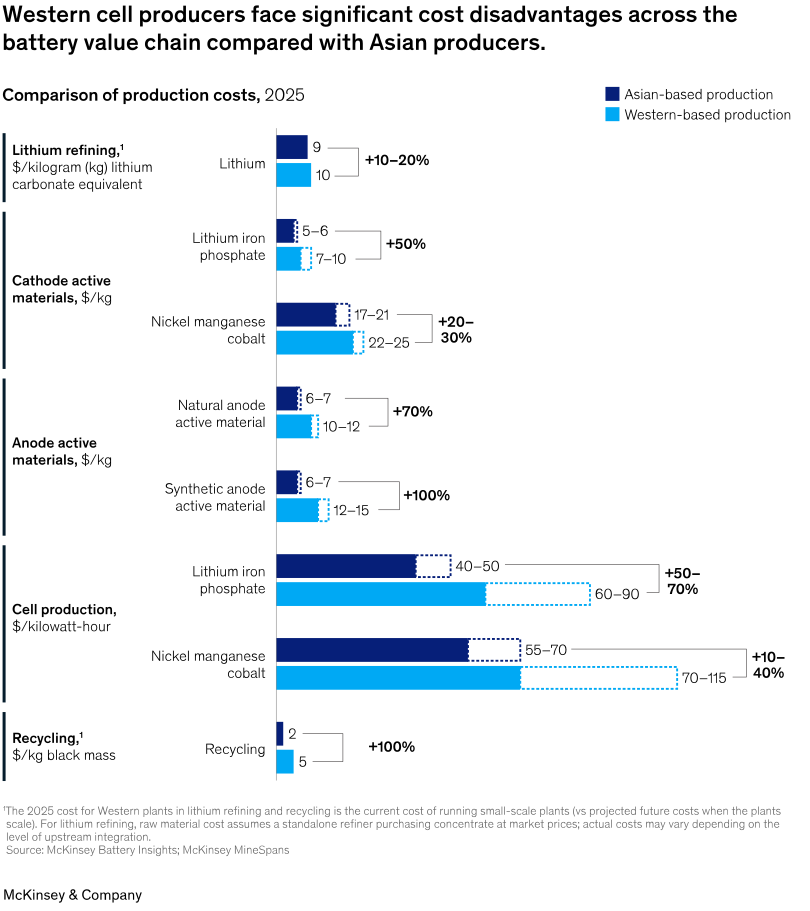
In contrast, Western producers face structural disadvantages (Exhibit 1). Although these disadvantages look different at each step of the value chain, from upstream minerals to midstream materials to cells, they share common elements of higher capital intensity, greater exposure to commodity and energy costs, and limited process know-how (relative to China).
Lithium refining
According to MineSpans estimates, refining capacity is heavily concentrated in China, which accounts for more than 70 percent of both lithium carbonate and lithium hydroxide. Western markets suffer from structurally higher costs because of limited feedstock access and energy prices driving up operational expenses, as well as higher labor costs and potentially stricter regulation driving up capital expenses. In addition, high price volatility (for example, lithium carbonate prices fluctuated from $8,000 to $83,000 per metric ton over the past five years) makes it difficult to finance new capacity. Although contractual agreements partially insulate refiners from fluctuating spot prices, most value is accrued by miners upstream, which ultimately constrains profitability.
Cathode active materials
When it comes to LFP batteries, Western markets largely depend on cathode production and know-how in China. As a result, the energy and labor costs as well as the capital expenditures are structurally higher. Process maturity for nickel manganese cobalt (NMC) batteries exists in Japanese and Korean manufacturing, but Chinese companies dominate in terms of both cost and speed of innovation.
Anode active materials
Anode active materials (AAM) have high capital and operational expenditures that are sensitive to electricity prices, which makes Western production uncompetitive. Graphite oversupply in China further discourages new investments.
Cell production
Despite strong subsidy support in the United States, and protection from tariffs, demand for electric vehicles (EVs) has decreased and sales have slowed,6 delaying many cell projects. Europe continues to see solid growth rates in EV sales, pushing the need for domestic battery production. But many key projects are and have been struggling both financially and terms of production ramp-up.
Recycling
Many commercial-scale recycling plants are concentrated in Asia (with the majority in China), while Western facilities are either in early stages or subscale. As a result, economies of scale are limited in the West and unit costs remain elevated. Although trade limitations in Europe lessen exports of recycling feedstock to China, access to scrap remains uncertain, being driven mainly by exports to South Korea, which limits incentives for large-scale production.
What is incentive pricing? And how can it be positioned?
Governments and markets have historically used the following mechanisms to promote local production and investment along the battery value chain:
- ecosystem support, enabling infrastructure, permitting reforms (such as accelerated or simplified permitting), or industrial-zone incentives to lower nonfinancial barriers to investment
- strategic reserves, which are rules-based public procurement and release mechanisms designed to secure crisis supply and stabilize prices (such as the US Strategic Petroleum Reserve7 and the recently announced Project Vault8)
- loan guarantees, reducing financing costs and risk exposure by backstopping private lending
- tariffs or trade barriers (including content requirements), enforcing import costs to establish a domestic price floor for local production, often in combination with domestic sourcing requirements (such as the EU-UK Trade and Cooperation Agreement9 and the United States-Mexico-Canada Agreement10)
- long-term offtake contracts or contracts for difference, guaranteeing a minimum price paid or indexed for future output
- direct tax credits or subsidies (including local content requirements), providing fixed per-unit incentives or credits to directly improve project economics, with access to subsidies often conditioned on domestic production or sourcing requirements
Although each of these mechanisms addresses specific barriers in the battery value chain and helps improve project economics, they differ substantially in how they influence technology choices, provide return visibility, and mobilize capital (Exhibit 2). When applied in isolation, each mechanism tends to alleviate individual cost or risk components. They do not, however, provide the reliable, end-to-end return visibility required to overcome high capital intensity, volatile input costs, and nonfirm demand, particularly for upstream materials and early-stage cell projects.
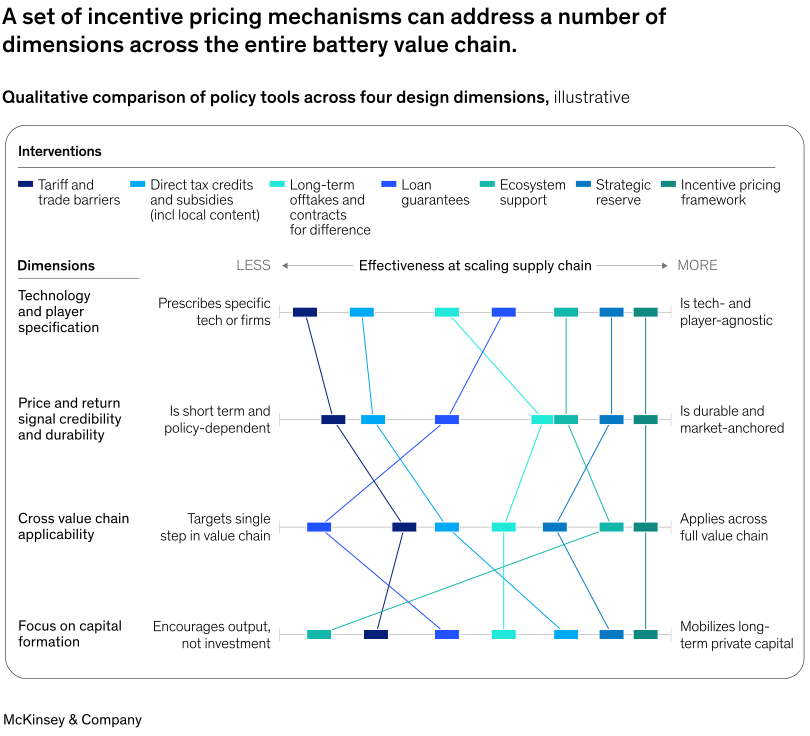
Incentive pricing mechanisms can help address this gap by establishing transparent, long-term return thresholds to guide capital toward competitive investments without prescribing specific technologies or companies. These mechanisms are not intended to be policy tools, nor are they intended to create a centrally mandated price. Rather, they can help align complementary interventions that together create credible, long-term pricing and return signals sufficient to mobilize private capital.
The following four principles illustrate how incentive pricing mechanisms could play out in practice:
- Technology and player agnosticism. Not rewarding specific technologies or companies can help set return thresholds that allow the most competitive solutions to emerge.
- Credible visibility into future pricing or returns. Anchoring in transparent market signals can increase investor confidence.
- Application across the full value chain. Balancing up- and downstream incentives can prevent oversupply and help ensure that investment flows align with end-market volumes.
- Focus on capital formation. Structure capital to make long-term, capital-intensive investment the rational choice compared with the next-best alternative.
The specific instruments through which incentive pricing is realized can vary by value chain segment and investor type and may include combinations of long-term offtake structures, strategic procurement, policy-backed floors, milestone-based support, or demand-side commitments.
Investor archetypes: How incentive pricing mechanisms can help mobilize capital
Designing effective incentive pricing mechanisms requires understanding the motivations, return expectations, and constraints of different investors participating in the battery value chain. Each investor archetype faces distinct market failures, including uncertain long-term returns, limited offtake visibility, and volatile input costs, among others that prevent capital from flowing at the required scale. Some start-ups and new entrants (such as direct-lithium-extraction innovators and cathode or anode producers) aim to raise capital to commercialize and scale new technologies, but most struggle to attract financing without early offtake anchors.
Although incentive pricing mechanisms are technology- and player-agnostic, the specific return thresholds and design parameters should be calibrated to each investor archetype. This in mind, key investor profiles include strategic industrials, private capital, and strategic customers.
Strategic industrials: Large chemical or oil and gas conglomerates
Strategic industrials—such as oil and gas conglomerates, petrochemical and specialty materials companies, and major mining companies—can invest to leverage existing capabilities and maintain competitiveness amid shifts in the energy transition. However, many lack the consistent demand and pricing signals needed to justify large-scale capital commitments.
Large oil and gas and chemical companies are increasingly evaluating investments in upstream battery components, including AAM, cathode precursors, electrolyte solvents, and engineered carbon materials—all areas in which their process engineering and global feedstock positions provide an advantage.
Several incumbents have begun moving into this space, illustrating how projects can become strategically and financially attractive when structured correctly. For example, ExxonMobil committed capital to scale synthetic graphite anode materials in North America through its acquisition of Superior Graphite assets and is currently testing its next-generation anode with US and European automakers.11 The company is leveraging deep carbon-materials expertise and advantaged refinery feedstocks to position itself as a US-based at-scale AAM supplier.
As another example, BASF is building a cathode active materials (CAM) platform centered on high-nickel NMC chemistries (such as NMC 622 and NMC 811), with major investments in China, Finland, and Germany,12 supported by €3.5 billion to €4.5 billion committed globally. Its Battery Materials division has secured long-term contracts with cell makers and automakers. The company has also announced investments in the European battery recycling market.
Despite these early-mover investments, activity remains limited and has not scaled broadly. Several additional conditions backed by strategic industrials can help scale AAM and CAM investment in the West:
- accelerated qualifications for OEMs or cell suppliers, with support tied to early milestone achievements, which can shorten the path to commercial acceptance and make returns more predictable for new industrial entrants in Western markets
- resilient, long-horizon policy support (anywhere from ten to 15 years) to match the asset life of materials plants
- regional alignment with automaker localization strategies as OEMs seek US and EU materials content to comply with Inflation Reduction Act and EU battery regulations
Private capital: Infrastructure investors
Private capital players, such as infrastructure funds, private equity, private credit, and hybrid funds, seek stable, contracted returns comparable to other infrastructure assets, but they often face limited visibility on long-term offtake and cash flows.
Infrastructure investors have so far focused on battery segments with predictable, contracted revenues such as utility-scale battery energy storage systems (BESS) and operating portfolios for which infrastructure funds enter post–commercial operations date (COD) with capacity payments or power purchase agreements anchoring revenue. However, other parts of the value chain, such as component manufacturing, could be investable but have not yet attracted long-term capital. Potential reasons for this include insufficient firm offtake (for instance, cell production plants are sometimes delayed due to OEM EV scale-backs), highly complex operations creating execution and ramp-up risks that infrastructure investors are not used to underwriting, and the difficulty in relying on potentially short-lived policy incentives.
However, recent market examples demonstrate how component manufacturing can be investable. A global infrastructure investor recently announced a majority stake investment in a battery separator producer, which was supported by a loan from the US Department of Energy (DOE). Three major characteristics help explain how this deal became more investable: first, a balanced portfolio with lead acid and Li-ion battery exposure, demonstrating existing stable base cash flow; second, lower cost of capital, enabled by DOE support; and third, reduced commodity exposure as separator margins depend on engineered performance rather than volatile lithium or graphite spot prices.
Given the successful investment cases in BESS or component manufacturing, the following incentive criteria appear critical for making this segment investable:
- tying long-term incentives and market access to domestic production, using enforceable local-content rules to reward localized capacity—because when designed with sufficient duration and clarity, such mechanisms can underpin demand certainty and support capital formation, as seen in the emergence of CAM capacity in Europe under EU and UK rules-of-origin requirements
- strengthening and standardizing offtake structures (such as “take or pay”) so component producers have confidence in more predictable baseline revenue, even when OEM demand fluctuates
- using milestone-based incentives to derisk early scale-up, mirroring how DOE support reduced financing risk in battery separator production and made the equity case more investable
Strategic customers: Auto OEMs
Strategic customers, such as utilities procuring BESS and auto OEMs purchasing batteries, need predictable input costs and localized, secure supply. However, they often face volatility in upstream materials and uncertain end-market demand, which discourages long-term contracting.
OEMs are investing upstream, generally through three pathways—supply contracts, joint ventures (JVs) with cell producers, and vertical integration—with each facing structural challenges that limit broader supply chain scaling.
- Supply contracts with cell or upstream producers. Some OEMs have signed multiyear deals to secure critical inputs and meet localization rules. When lithium prices fell sharply in 2023 to 2024, some suppliers sought to defer deliveries or renegotiate terms to preserve margins, while OEMs slowed or reduced offtake in response to weaker EV demand. These changes revealed a market failure in which battery materials remained traded through bilateral pricing with no transparent index, leaving counterparties without a mechanism to manage risk.
- JVs with cell producers. OEMs have increasingly formed joint ventures to secure technology access and localized capacity. On this point, several projects have been delayed or scaled back as EV sales growth slowed and OEMs recalibrated demand forecasts. These JVs thus leave cell producers fully exposed to utilization risk because OEMs cannot commit to fixed volumes during weak demand.
- Direct vertical integration. Some OEMs have integrated directly into cell production and even upstream materials refining to secure supply and reduce costs. The model can deliver strong margins and technology control for scaled players but carries significant risks for most automakers due to high capital expenditure burden, commodity exposure, and limited transferable know-how.
OEMs remain pivotal to scaling supply chains. Incentive pricing can help channel or scale their capital more effectively by reducing volatility and enable better risk sharing. Example incentive pricing mechanisms include the following:
- Share ramp-up and fixed-cost risk by using milestone-based policy loans to fund early losses in new facilities.
- Enable flexible utilization through public backstops (during demand slowdowns, channel excess capacity into grid storage or other strategic reserves that could steady utilization).
- Support upstream investment through price stabilization tools, such as reasonable price floors in return for price ceilings, which are better suited to upstream materials where local-content enforcement is less effective and investment depends more directly on managing price volatility.
Analogous industries and potential solutions
Analogous industries offer some examples of how similar investment barriers have been overcome. For instance, reshoring in semiconductors and steel shows that large-scale industrial investment succeeds when three conditions are present: credible demand, durable policy support, and transparent pricing signals.
In semiconductors, credible demand has been anchored by hyperscalers, manufacturing, and the defense sector, where long-term procurement needs provide visibility into future volumes. These demand signals are reinforced by durable policy support under the European Chips Act, enabling investors to underwrite capital-intensive manufacturing projects.
In steel, pricing transparency and stability played a central role. The United States has planned, begun, or completed 21 million metric tons (Mt) of production capacity for 2025 or beyond,13 in addition to a total production base of about 90 Mt.14 Section 232 tariffs created stable domestic price floors,15 helping producers meet US capacity with confidence that demand from construction, automotive, and infrastructure would absorb new supply, given the well-established supply chain.
Further upstream, in uranium supply, the US government addressed both demand certainty and pricing transparency through strategic stockpiling. The establishment of a federal strategic uranium reserve and its expansion via long-term purchase contracts (of up to ten years) with domestic producers aim to create predictable demand anchors and reduce price uncertainty, thereby catalyzing investment in domestic mining and processing capacity.16
Battery materials differ in two fundamental ways: thinner margins and less firm demand. AAM and CAM producers face higher commodity exposure, while OEM demand remains uncertain and can easily be scaled down. In addition, not all upstream battery materials can be stockpiled or easily held in strategic reserves, limiting the effectiveness of buffer mechanisms effective in other commodity supply chains. Without anchored offtake or pricing visibility, localized upstream capacity risks being underutilized or stranded.
As an industry, battery production comprises a wide range of players—from investors to producers, OEMs, and policymakers—all of whom have questions about where to start. Although many uncertainties are shared from one player to the next, each needs to understand the unique challenges to scaling a Western battery value chain.
This in mind, investors can prioritize platforms with downside protection, contracted offtake, and clear timelines for how long permitting and incentives will last. They can also investigate transparent return thresholds for projects rather than betting on a single technology. Producers can move to secure anchor customers, standardizing qualification and ramp-up milestones while structuring commodity exposure to underwrite cash flows. OEMs and other strategic buyers can commit to staged offtake with established ranges of tolerance, sharing risk, and aligning specifications to accelerate qualification. Finally, policymakers can create a supportive climate by pairing durable, tech-neutral incentives with faster permitting and demand-side commitments.