The factors influencing agricultural commodity markets are changing more quickly and interacting in ways that are more complex than ever before. In 2025, the increased frequency and intensity of weather outliers, vacillating trade policies, new biofuel regulations, price volatility, and logistical bottlenecks made it increasingly challenging for leading commodity merchants to anticipate shifts in supply, demand, and trade flows. As a result, the profit pool of agricultural commodity trading declined 15 percent year over year, a four-year low since 2022, according to McKinsey estimates.1
The heightened frequency of unpredictable events is likely to continue. On the ground level, variations in agricultural yields are expected to increase due to changes in typical temperature and precipitation ranges, more favorable conditions for pest and disease outbreaks, and changes to soil health (such as accelerated nutrient cycling), among other factors.2 Markets are also becoming a growing source of disruption due to shifts in global trade and geopolitical tensions, with trade flow disruption in the Strait of Hormuz in early 2026 as an example of this risk.
In this article, we outline trends that could affect agricultural trading and the capabilities leading traders will likely need to navigate commodity market volatility. For merchants and processors, improving the agility of their trading teams and the analytics they use to inform their decisions could be critical for success. Players that do not invest in these capabilities risk being structurally disadvantaged as new digitally sophisticated market entrants pay to close information asymmetries. A step change in agility is also anticipated as leading players redesign their commercial, hedging, logistics, and risk workflows for agentic AI. Improving these capabilities could allow global and regional players to increase the resilience of their asset footprints and more quickly adjust their positions following unpredictable events.
Today’s environment: Split markets and squeezed growers
Supplies for different commodities are diverging, putting pressure on growers, traders, and processors alike. Between 2024 and 2025, agricultural futures markets split sharply as long‑cycle commodities such as cocoa and coffee moved into supply‑driven rallies, while row crops such as corn and soybeans sank under the weight of multiple bumper harvests (Exhibit 1).
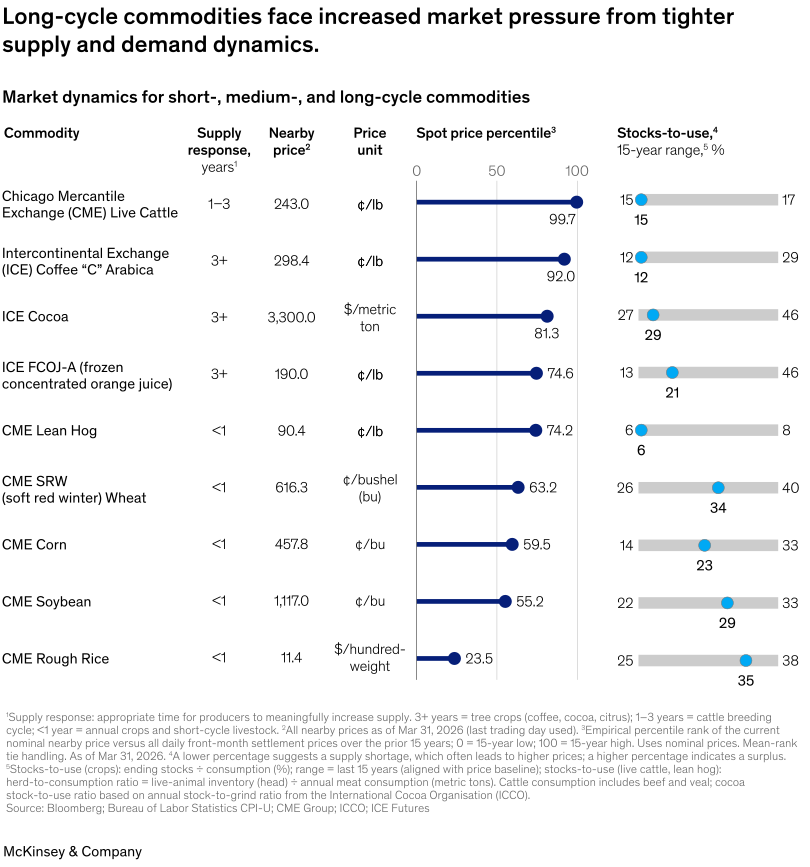
On the one hand, oranges, cocoa, coffee, and beef experienced tightened supplies due to a combination of adverse weather, disease, pests, and breeding herd contractions, leading to notable price increases.3 These higher prices are allowing some cocoa and coffee growers and cattle ranchers to make targeted investments such as herd rebuilding, seedling planting, and irrigation, but these efforts will likely take two to four years to translate into greater output. In the near term, decisions such as replanting and heifer retention4 could further constrain supply.
On the other hand, record global production of corn, soybeans, and wheat (on the back of strong yields and increased harvested acreage) has driven futures prices to multiyear lows.5 Grain and oilseed growers now face a profitability squeeze as fertilizer, seed, fuel, and financing costs remain elevated against historically weak commodity prices.6 Since early 2026, increases in futures prices of input-intensive crops such as corn and wheat have not offset dramatic input-price increases, according to McKinsey analysis as of April 2026. As a result, average net returns per acre of row crops have entered negative territory for many growers before government payments.
These supply imbalances have rippled through the value chain, with ag traders and processors struggling to maintain profitability. Like growers, traders and processors have had to grapple with an abundant supply of grains and oilseeds, as well as a surplus of processing capacity in key origins such as North America, a higher cost of capital, and difficult-to-predict trade agreements and tariffs that have affected price discovery.7 Logistics headwinds have added further margin pressure and operational complexity.
Developments in the oilseeds market over the past few years illustrate how pricing regimes have shifted. From 2018 to 2024, renewable-diesel policies in the United States and Indonesia spurred investment in capacity additions.8 In 2022, for example, growing demand for renewable-fuel feedstocks in North America elevated soybean oil futures prices to their highest levels since 2008 and raised oilseed crush margins to multiyear peaks.9 This high-margin environment spurred large‑scale investments in US crushing capacity. As new facilities came online, the market saw two major effects: First, crush volumes for US soybeans continued to hit record highs for four consecutive years, ending in 2024.10 Second, soybean crush margins decreased by up to 80 percent year over year from 2023 to 2024.11 These historical links between government policy, energy prices, and agricultural commodity prices continue today; for instance, increases in fuel prices typically increase demand for biofuels and their agricultural feedstocks, often increasing margins for biofuel producers.
Similar fluctuations have been seen across commodity crops around the world, challenging trading houses to keep up. Companies with limited flexibility have struggled to adapt to shifts, while companies with asset footprints that are geographically diverse, access to different transportation modes, and presence in multiple destination markets have benefited from improved margin resilience. Companies are also shifting exposure toward structurally wider margins and sources of demand that are more stable and away from historically volatile grain origination, processing, and trading businesses. For example, many agricultural processors have invested in specialty and downstream product markets such as specialty oils, alternative-protein processing, and functional health markets to reduce earnings volatility.12
Today’s heightened uncertainty related to inflation and the physical availability of fertilizer and fuel has introduced new challenges for growers, trading houses, and processors. The combination of increases to market volatility and ongoing changes in interest rates has amplified pressure from additional working‑capital requirements. Market players face elevated capital costs for carrying inventories and increased collateral required to meet margin obligations at major commodities exchanges such as the Chicago Mercantile Exchange (CME) and Intercontinental Exchange (ICE).
Three trends reshaping agricultural markets
Today’s uncertain environment means that tomorrow could look very different—but how? A few key factors could profoundly affect the future of ag trading.
Supply variability is expected to increase
Production variability and supply chain disruptions may increase in the future for multiple reasons.
Tariffs and geopolitical uncertainty have affected trading strategies for several years. As these trends continue, the frequency of events that cause short- to medium-term trade flow dislocation is expected to increase, affecting agricultural value chains from growers to end markets (see sidebar, “Supply disruptions in the Middle East”). Regional shortages, changing trade routes, and frequent changes to trade barriers are becoming the rule rather than the exception.
At the ground level, global supplies of different crops are expected to be affected by adverse weather events, biodiversity changes, and shifts in soil health and availability moving forward, leading to increased yield fluctuations and crop failures. For example, in tropical regions, maize yields could decline by up to 30 percent by 2050 under high-emissions scenarios.13 Moreover, a third of the world’s topsoil is already degraded, and up to 90 percent is forecast to be at risk by 2050.14
Shifts in cyclical weather patterns are set to have wide-ranging effects across regions as well. Notably, El Niño Southern Oscillation (ENSO) events have gradually increased over time.15 The effects of ENSO events are also expected to become more extreme due to climate change,16 making the impact on crops in different regions harder to predict. In recent years, for example, Brazil’s 2023 drought severely affected soybean production in key regions such as Mato Grosso, while Australia’s 2022–23 La Niña rains led to downgraded wheat quality, favoring traders with diversified sourcing.17
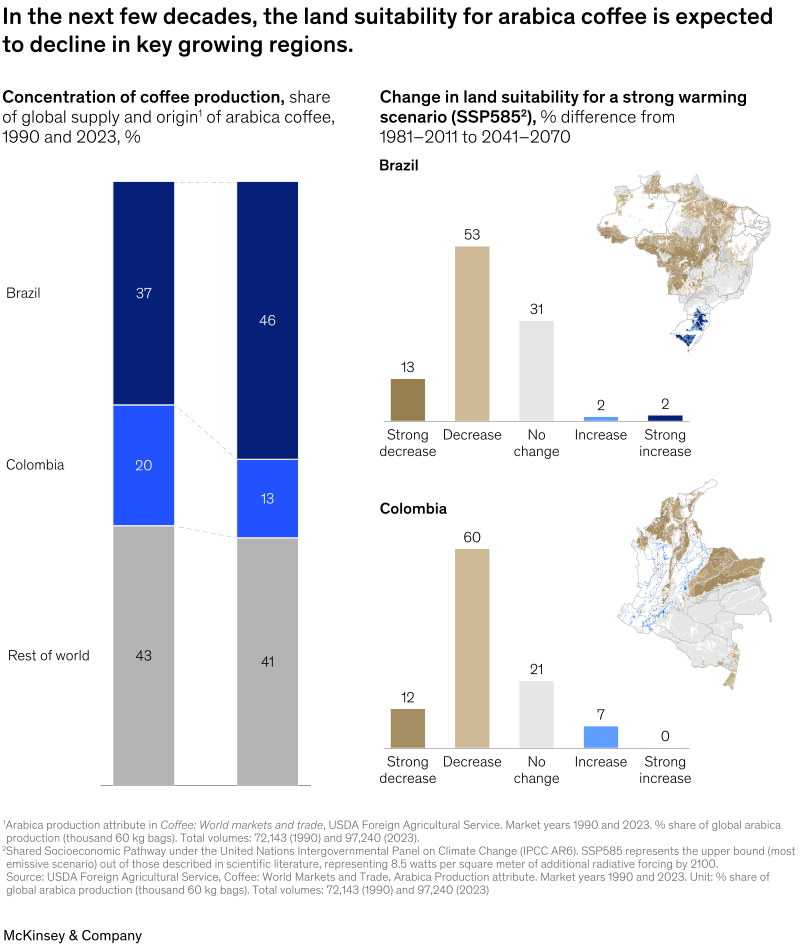
Market reliance on fewer key regions has also amplified sensitivity to supply chain disruptions and resulted in higher volatility. For some soft commodities such as coffee and cocoa, declining land suitability in concentrated regional pockets of production (for example, Brazil, Colombia, and Indonesia for coffee and Ghana and Côte d’Ivoire for cocoa18) may heighten supply chain risks for commodity buyers (Exhibit 2).
New entrants will provide more complex liquidity
Today’s momentum and volatility are attracting new market entrants, such as hedge funds, oil and gas incumbents, and new types of commodity buyers:
- Hedge funds. Dramatic price increases driven by supply shortages can be highly attractive to hedge funds. These funds use “quantamental” strategies that blend fundamental supply and demand insights with quantitative tools such as momentum indicators to identify strong and persistent price trends. However, elevated volatility can sharply increase the cash needed to meet initial and maintenance margin requirements.19 What’s more, as liquidity thins, speculators reducing their positions can further amplify market swings.
- Oil and gas incumbents. Energy majors are ramping up strategic investments in agricultural commodity trading. There have been a few hot spots for these investments, including renewable-fuels desks that trade feedstocks and byproducts (for example, soybean meal), as well as the physical infrastructure used to produce renewable diesel and sustainable aviation fuel.20 Following North American expansion of oilseed crushing and renewable-fuels refining capacity in recent years, these trading desks have been successful at using analytics to form market views of how correlations of food and energy products will evolve, such as soybean oil to diesel price spreads.
- Commodity buyers. Fast-moving consumer goods (FMCG) and food service companies are increasingly entering the ag trading space. These companies dynamically hedge for value, rather than certainty. Accordingly, many are investing in increasing the sophistication of their hedging strategies and mechanisms (for example, options). Some buyers also outsource their price risk to third parties that trade on their behalf.
As these new entrants make their way into the ag trading space, new sources of liquidity could create opportunities for incumbent players. However, a more crowded trading space can lead to trading profitability headwinds if more-sophisticated market participants account for a greater share of open interest and trading volume.
Price discovery will occur more quickly with algorithms
A more unpredictable world has pushed traders to upgrade their predictive systems. As new, algorithm-powered buyers enter the market, a greater proportion of traded volumes and open interest are placed by algorithms and quantamental signals. Price discovery is also shifting from interpretation by humans to interpretation by machines. In tandem, markets are speeding up.
More-frequent trades mean fundamental supply and demand signals are being priced into markets much more quickly, compressing the time traders have to act. Where traders once could make basis predictions by analyzing stock imbalances that build up over months, today’s markets require faster analytics-driven interventions. Leading traders are now leveraging satellite imagery, weather data, and machine learning models to predict such supply shocks and more quickly optimize logistics in near real time. Based on work with clients, we have observed that existing market participants are increasingly investing in these third-party data analytics providers that benefit from economies of scale as well as in quantamental research. Large language model (LLM) advancements are also enabling commodity brokers to more rapidly synthesize in-the-moment news, which is eroding information asymmetry that historically benefited the largest, most diversified commodity traders. These dynamics are expanding who competes with whom: Agriculture buyers are increasingly using algorithms to make inroads into areas where low-latency market makers have typically had an advantage.
There has also been a rising demand for data to feed the models that identify trading signals. Accordingly, industry players across the value chain have monetized their internal data, such as physical basis prices and market signals, by providing it to third-party players such as hedge funds. This monetization creates a trade‑off: It can generate revenue, but it could also erode proprietary advantages developed over decades.
This pace of change is likely to quicken further, driven by AI-powered digital agents capable of shaping decisions and carrying them out autonomously. Pre‑trade research agents that blend technical, macro, fundamental, and sentiment signals from both internal and external sources could help traders form convictions and act on them far faster. In addition, risk‑focused agents that track value at risk, credit exposure, and liquidity in nearly real time and recommend interventions when limits are hit could meaningfully reinforce risk management. At the same time, if designed or calibrated poorly, they could also trigger stop cascades in which large players’ automated stop‑loss orders fire in sequence, amplifying market stress.
Exacerbated supply chain challenges, new entrants, and algorithmic price discovery are increasing the speed and degree of change. Agriculture traders and processors should take these factors into account as they build strategies for the road ahead.
Imperatives for traders and processors
Traders and processors best positioned to succeed in this environment have calibrated their operating models and invested in capabilities to be more agile across geographically diverse asset footprints. Redesigning organizational structures, prioritizing a collaborative work culture, and creating well-structured incentives to optimize enterprise-wide profits could help improve traders’ ability to proactively reroute flows in response to volatile prices and regional shifts in processing margins.
To become more nimble and ready for the future, processors and traders can consider a few avenues of transformation: shifting from regional to global value chain optimization, designing an agile operating model to move quickly, empowering efficient collaboration by improving data quality and transparency, and building nimble analytics that scale by interconnecting across a common domain.
Shifting from regional to global value chain optimization
Today, most agricultural players optimize decisions at the level of the individual business unit or regional operating company. The trouble is that these groups may hold conflicting views of what is best for the broader enterprise since global and regional leaders lack unified, standardized, and transparent decision-making processes. To enable decision-making to be more efficient, companies can pursue operational transformations to reduce friction, especially those designed to make handoffs clearer.
Such transformations should have the aim to establish clear accountability through redesigned incentive structures and better delegation protocols. Companies can establish incentives and responsibilities linked to performance targets that are shared across multiple decision-making nodes in an organization (for example, origination, rail and barge logistics, ocean freight, and primary processing). Another key element of a successful transformation is to extend any change efforts throughout the different levels of a company’s hierarchy. The larger and more integrated a commodity company is, the more likely that managers across the value chain (that is, business units, regions, and operating companies) will have differences of opinion.
As more activities are managed by agentic AI, it will also become increasingly important to reassess interfacing processes and agent-to-agent protocols. For organizations that incorporate agentic AI, accountability should extend to agent‑to‑human and agent‑to‑agent handoffs.21 One solution is to establish an “agent change‑control board” to review releases, access to prompts and tools, and rollback plans. These boards can be analogous to model risk management systems but tuned for agents’ planning and memory behaviors. If done correctly, operational transformations can empower teams to move faster and support rapid, cross-functional decision-making.
To make it easier to resolve differences, ag traders can find inspiration from companies in other sectors. For example, in one case study, a major energy company that had divided its generation, trading, and customer businesses established a portfolio optimization team dedicated to balancing conflicts and optimizing operations. This central team ensured that there was global alignment among traders across the value chain, allowing employees to overcome internal dynamics and do what was best for the business as a whole. Indeed, most leading integrated oil and gas companies use similar value chain optimization teams to interface between traders and refinery managers. In this way, they can help ensure that crude-oil sourcing and the marketing of refined products (for example, gasoline or diesel) maximize profit for the company overall, rather than for one individual refinery or trading desk.
Designing an agile operating model to move quickly
Traders, especially global players, can find it challenging to move and adapt quickly. An agile operating model can help differentiate companies by introducing shorter, more frequent planning cycles to enhance responsiveness to market shifts.
Companies can also adopt scenario-based planning to model multiple geopolitical, economic, and policy outcomes. Ideally, these models should also explicitly incorporate physical and commercial optionality across a company’s value chains. This way, companies can have at-the-ready plans for when difficult-to-predict events occur. With scenario-based planning, companies can better optimize their risk exposure through stress tests that model abrupt, nonlinear tail events that often follow news of geopolitical and supply shocks. This ensures that modeled risk matches the risk appetite defined by leadership.
In addition, companies can use regular backcasting to learn from missed opportunities and apply insights to forward-looking decisions. This necessitates closer collaboration between traders and analytics teams to ensure that data and insights are rapidly shared and aligned. With alignment, teams can more efficiently act on trading opportunities and manage market risks. This is also true in agentic AI–enabled organizations, where McKinsey has found that workflow redesign is the attribute most correlated with EBIT impact.22 Successful approaches have included agents that sit at the center of scenario planning and rolling “plan‑operate‑learn” sprints so squads can iterate guardrails and limits as models and markets evolve.
In one case, a global commodity trading house implemented an agile risk-management framework that allowed for real-time adjustments to hedging strategies. It also adopted rolling risk assessments, rather than relying on static risk models, and used scenario analysis to prepare for potential disruptions related to sanctions or supply chain bottlenecks. Ultimately, this enhanced the company’s ability to mitigate risks and capitalize on broader arbitrage opportunities while improving internal alignment between trading decisions and broader corporate goals.
Empowering efficient collaboration by improving data quality and transparency
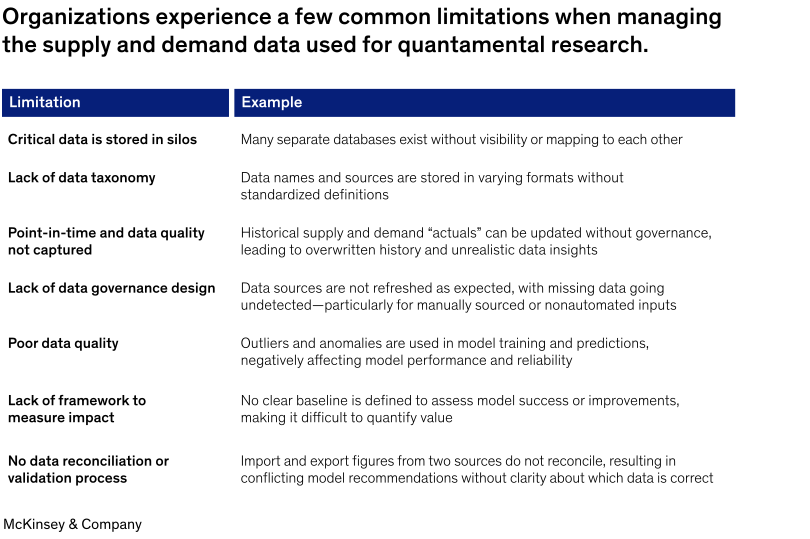
Trading organizations of all sizes are often hindered by poor data quality that slows decision-making and increases the cost of collaboration (Exhibit 3). Although investments to overhaul data quality can take years to complete, they may only take months to drive value.
In addition to working to improve data quality, enabling end-to-end profit and loss (P&L) visibility for all traders across a value chain can mitigate conflict and allow traders to prioritize trades that optimize P&L for the entire enterprise, rather than a desk or business unit. This can be accomplished through a few steps:
- Establish a single source of truth of market, operations, and KPI calculation methodology data to ensure consistency across the organization.
- Document optionality of assets and contracts (for example, flex provisions and embedded rights) to allow adjacent teams to understand the solution space.
- Share interoperable model outputs that help analysts in one value chain node understand the implications on the P&L of other nodes upstream, downstream, or both across the value chain.
Once a common lens and methodology for interpreting P&L movements is in place, traders can begin acting on that shared understanding in real time.
In one case study, a global ag trader embarked on a two-year journey to transform its digital and business model. By focusing first on just one commodity value chain, the trading house was able to implement custom-built analytics infrastructure that better deployed repositories of SAP data and to build a “business book” simulator to model inventory valuation, contract balances, processing margins, and hedges to interactively simulate market exposure and EBIT impact. Not only did this help the trading house to identify more than $150 million in EBITDA improvements, but it also created a pipeline of more than 70 additional AI use cases to further optimize their business model.
Building nimble analytics that scale by interconnecting across a common domain
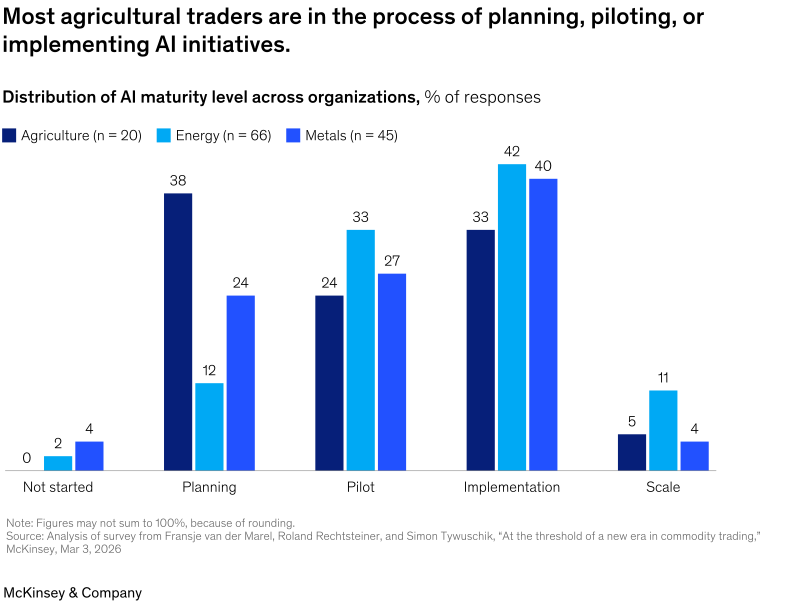
Investing in AI has become table stakes, with more than 60 percent of ag traders and processors planning or piloting large‑scale AI initiatives (Exhibit 4). At the same time, executives in agriculture remain more pessimistic about AI’s potential than their peers in the energy and metals sectors.23 Although around one in three ag traders is deploying AI, most struggle to realize material returns. The issue is structural: Easy‑to‑implement use cases generate modest returns, while the highest‑ROI opportunities come with greater investment requirements and execution risk. Those that navigate this trade‑off successfully have realized outsize impact, with one in ten reporting EBIT uplift of 10 percent or more.24
For traders, choosing wisely between feasibility and upside can make the difference between exceeding or underperforming earnings guidance. This is particularly important when it comes to choosing which analytics systems to invest in and how to manage investments throughout the analytics development cycle (exploratory data analysis, proof-of-concept or minimum-viable-product [MVP] development, and machine learning productionization).
For this reason, ag traders can best be served by investing in a diversified portfolio of interoperable, nimble analytics that can evolve and progress over time once they’ve demonstrated their value. Ideally, this journey begins with setting realistic near-term expectations designed with current data quality and technology limitations while also planning for tomorrow’s possibilities with aspirational long-term goals.
As companies build nimble analytics portfolios, a few guidelines should influence their road maps:
- Be aware of timelines. Quick wins are rare in commodity trading analytics, and most quantamental research and pretrade analytics are risky investments with lumpy payoffs that can vary dramatically over time. Some companies have been able to drastically reduce working capital with improved inventory management or broker prioritization within a few months. However, most bespoke analytics use cases require at least two months to develop a working MVP before starting productionization.
- Start small, and expand from there. Commodity traders that build analytics with a narrow scope are more likely to capture value sooner. Planning an analytics road map that maps interconnecting use cases across commodity value chains and functions can help investments scale across a common domain to enable value chain optimization and prepare for agentic AI.25
- Leverage existing strengths. Tactically, companies can leverage existing strengths, tools, and successful approaches when creating new analytic functions. When deciding where to invest in data, tools, and time, consider the potential impact on profits and returns, feasibility, and replicability of use cases.
- Radically rethink workflows. While gen AI– and LLM-enabled agents will not fully replace middle- or back-office teams, workflows are expected to be dramatically transformed in the coming years with agentic AI. A recent McKinsey survey of agricultural commodity trading executives suggests that more than half of executives expect AI to deliver more than a 5 percent EBIT uplift over the next decade.26 Now is the time for early movers and fast followers to explore how traditional workflows might change as AI evolves at a rapid pace.
Although there is no crystal ball that can accurately predict the future, and global optimization of all decisions is not possible, the benefits of implementing nimble analytics portfolios are noticeable. Leading commodity traders that have invested in predictive analytics and value chain optimization have uplifted their profitability by 200 to 500 basis points, and deploying agentic AI in post-trade operations (for example, trade booking, reconciliation, and settlement) is expected to improve productivity by 30 to 60 percent over the next two to four years, according to McKinsey analysis.
The pace of change in agricultural markets is accelerating, and the gap between leaders and laggards is widening. The next edge won’t come from more dashboards—it will come from reimagined workflows, powered by AI agents that interface with predictive and optimization models that use well-established machine learning methods. Agents could compress decision cycles from days to hours while important guardrails of human oversight and governance preserve safety, trust, and internal controls.27 Building a strong backbone based on agility could allow companies to keep transforming in the future as new technology and further changes continue to shape global agriculture. While uncertainty remains regarding how capabilities of frontier AI models will evolve, traders and processors that invest now in robust data quality, interoperable analytics models, and agile operating models could be better positioned to improve trading results with AI.